How does Backpropagation work?
F(X) = Y describes what a model does once it’s trained. But how does F gets to that state in the first place?

Practical writing on AI and machine learning for people building with it.
Subscribe:.rss.atom.json.md.m3u.pls
Live Last read · last published · next check
F(X) = Y describes what a model does once it’s trained. But how does F gets to that state in the first place?
Machine learning reduces to one expression: F(X) = Y. A model F takes input data X and produces output Y. From these combinations, we can learn all the main strategies to solve data problems with ML.
Notebooks are a great way to communicate narrative and encourage engagement in data projects.
Output length bias in the training process impacts the cost of model inference.
Most organisations have a formal model of their customer relationships and a real one that differs from it. Embeddings and community detection surface the real structure.
Capability is arriving faster than teams can absorb it. The engineering task becomes protocols and interfaces in place of bespoke services.
Recommendation systems deliberately surface under-explored content to find new audience clusters. Understanding why this happens changes how you think about content distribution.
The four horsemen of the techpocalyse!
Some tasks are so well understood there are specific classes of models just for that task. Identify named entities and redacting private information are two of those specific tasks.
How do you know if you are saving money when things get cheaper?
Fully Homomorphic Encryption will bring massive change to the inference landscape, but it is not yet possible.
Multi-tenancy is a spectrum from shared tables to fully separate infrastructure, and the right point on that spectrum depends on your risks.
The format you use to pass data to a language model affects reliability and cost more than most expect...
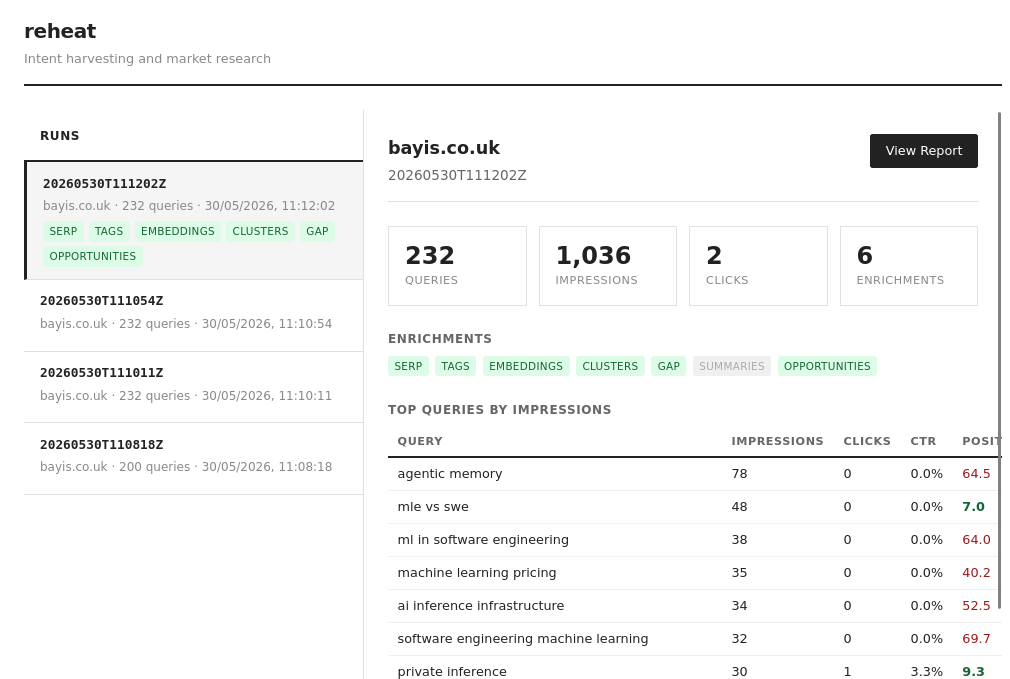
Our new open source tool pulls your Search Console queries, embeds them as vectors, clusters by semantic intent, and surfaces ranked content gaps and opportunities as a report.
UK focus with approximate pricing.
The medallion architecture maps cleanly onto PostgreSQL. Each layer has a single concern, with transitions being where the interesting engineering lives
A practical framework for defining, building, and maintaining an ML system -- including a free checklist!!
Postgres LISTEN/NOTIFY mechanism can trigger embedding generation on INSERT, without polling, without a separate scheduler, and without coupling services.
If an organisation can define "what correct looks like" ML projects will likely succeed; it also answers the gnarly "Are you automating my job?" question
Two Jobs, One Title; which one do you love most?
Often framed as an ideological discussion, open weight models actually solve the business problem which ruins closed model providers over the long run.