
Greetings, science fans!
It is Fogust in San Francisco, and I have not seen the sun in what feels like several geological epochs. Karl has taken up permanent residence. Gray has been replaced by different shades of gray.
This weekend, I took a walk out by Ocean Beach, squinting through the mist, knowing that somewhere out there, the Farallon Islands are doing extraordinary things without me.
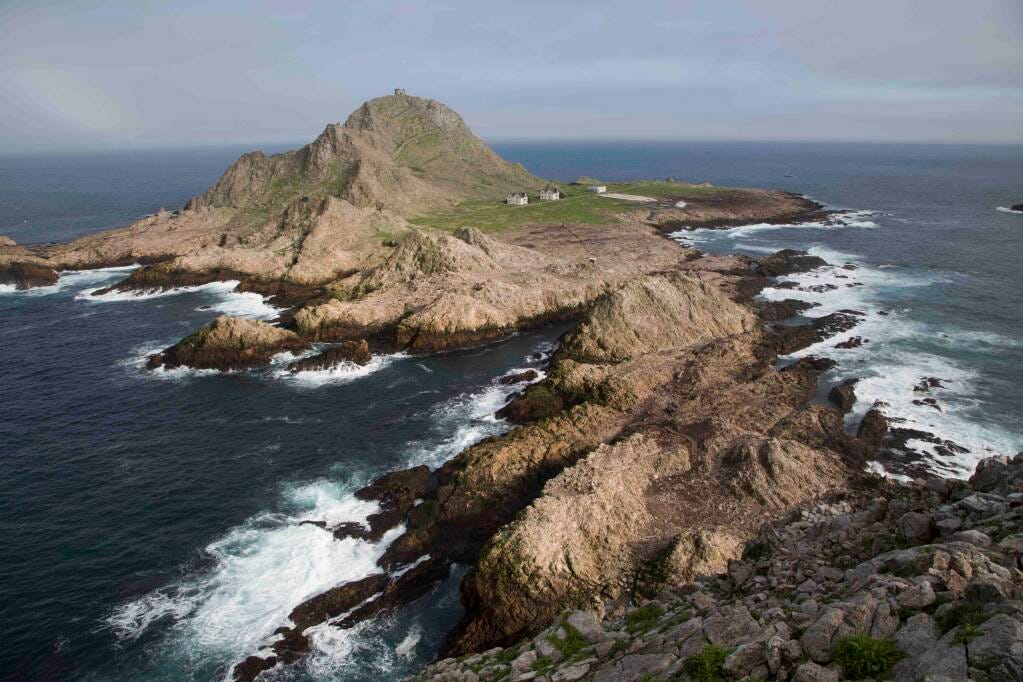
I have never been. Most people haven’t. The islands are closed to the public and accessible only to the small crew of researchers from Point Blue Conservation Science who have maintained a continuous presence on Southeast Farallon Island since 1968.
But I have spent an unreasonable amount of time reading and watching accounts from the lucky few who have made the boat trip out. Their stories tend to include the same things: the 2.5-hour crossing through notoriously rough seas, the moment the islands suddenly appear out of the fog, and, before anything else, the smell.
Elephant seals. Hundreds of thousands of seabirds. Decades of accumulated biological activity on a small rocky island with nowhere for any of it to go. People describe the smell with a kind of reverent horror. One journalist wrote that she smelled the seals before she saw them.
Then there are the sounds.
Western gulls shrieking from their nests. Hundreds of thousands of common murres making a strange, kazoo-like call that carries across the water. Sea lions grunting from the rocks in such numbers that the sound reverberates off the surrounding islands.
And then there is the sheer scale of the place. The Farallones are home to the largest seabird nesting colony in the contiguous United States, with roughly half a million birds representing 13 species. At the peak of spring breeding season, more than 300,000 common murres nest there alone.
The science coming out of this improbable place is pretty extraordinary, too. Because Point Blue has had researchers there continuously since 1968, the Farallones have produced one of the longest-running wildlife datasets in the American West, tracking population numbers, diet, and reproductive success across seabirds, seals, sea lions, and white sharks.
Each fall, somewhere between 15 and 50 great white sharks arrive after their annual migration across the Pacific. And they are there for a very specific reason: young northern elephant seals, arriving at the islands for the first time after their first summer at sea, fattened up and blissfully unaware of what is waiting below. Point Blue researchers typically see the first predation event in late August, with numbers increasing through September and peaking in October.
In 2023, global sea surface temperatures reached record highs, while a prolonged El Niño pushed temperatures around the Farallones a couple of degrees above the long-term average. Some seabirds responded by delaying breeding, laying fewer eggs, or abandoning nests altogether, essentially deciding to keep the resources for themselves rather than spend them raising chicks. As we brace for one of the strongest El Niño events ever seen, I wonder what that means for the future of the tiny islands.
On Wednesday evening at the San Mateo Public Library, Gerry McChesney, Refuge Manager with the U.S. Fish and Wildlife Service, will talk about the islands’ history, wildlife, and management. For most of us, it is about as close as we’re going to get to one of the most extraordinary wild places on Earth, sitting just over the horizon from our own backyard.
If you want to get a little closer, the Oceanic Society has been running full-day whale-watching trips to the Farallon Islands since 1972. They leave from San Francisco on weekends from April through December aboard their 60-foot vessel, the Salty Lady. Shark Stewards and Marin Audubon also run trips in the fall, timed to the return of the great whites.
You can’t set foot on the islands, but you can get close enough to see the murres, elephant seals, and, if you’re lucky, the sharks. And yes, you can smell it.
-Kishore
My picks for the week:
Popping the Science Bubble: Tracking viruses in wastewater (Tuesday, August 18, Berkeley Public Library)
The Ethics of Making Babies: Genetic Selection and Gene Editing (Wednesday, August 19, Manny’s, San Francisco)
The Mystical & Bountiful Farallon Islands (Wednesday, August 19, San Mateo Public Library)
Upcoming Events:
Click to see the next two weeks of events in your browser.
Tuesday, 08/18/2026
Protecting the unseen; conservation technology solutions to preserve secluded ecosystems - 08/18/2026 11:00 AM
Monterey Bay Aquarium Research Institute Moss Landing
Emperor penguins breed through the dark Antarctic winter on sea ice, in one of Earth’s most extreme environments, making them difficult to monitor yet invaluable as indicators of Southern Ocean health. Our program follows penguins across their lives and vast ocean areas by combining long-term field observations with electronic tagging, animal-borne sensors, robotics, and satellite data, linking what happens to individual animals with large-scale ecosystem change. We extend the same approach to whales through Whalespotter, using stabilized thermal cameras, AI, and expert verification to detect whales up to seven kilometers away - day or night - and cut the risk of deadly ship strikes by over ninety percent. Like penguins, whales are sentinels of ocean health. Together, these efforts show how one integrated toolkit can turn iconic species into partners in observation, providing crucial knowledge to monitor and protect Antarctica and the wider ocean in a rapidly changing world.
Speaker: Daniel Zitterbart, Woods Hole Oceanographic Institution
Attend in person or register at weblink to attend online
Giving Scientists Superpowers: How an AI-Powered “Thinking Microscope” Is Fast-Tracking Medical Breakthroughs - 08/18/2026 05:30 PM
Commonwealth Club San Francisco
Gladstone’s Steven Finkbeiner shares how Gladstone’s AI-powered microscope is racing to cure neurodegenerative disease.
Imagine a scientist that never sleeps, runs thousands of experiments at once, and learns from every success and failure in real-time. It’s not a person - it’s a microscope. Scientist Steven Finkbeiner, M.D., Ph.D., of San Francisco’s Gladstone Institutes, introduces us to a mind-boggling new reality: a “thinking microscope” powered by autonomous AI. By looking beyond the limits of human imagination, this machine is mapping out how diseases such as Alzheimer’s and ALS unfold, and discovering how to reverse them.
Join us in person to learn how this revolutionary leap in technology is radically accelerating the timeline for curing the world’s most devastating diseases. Come witness how going beyond human imagination might be the key to unlocking the world’s most anticipated medical breakthroughs.
Speaker: Steven Finkbeiner, Gladstone Institutes; Robert Lee Kilpatrick, Commonwealth Club, Moderator
Attend in person or online
Popping the Science Bubble: Wastewater viruses & plant sunscreen - 08/18/2026 05:30 PM
Berkeley Public Library Berkeley
This month’s presentations will be:
Tracking viruses in wastewater: Some are more vulnerable to soaps and detergents than others - Allie Nguyen, Environmental Engineering, UC Berkeley
My research lies at the intersection of environmental water microbiology and public health. I am currently involved in multiple projects. One project focuses on wastewater-based epidemiology, specifically investigating the persistence of viral nucleic acid signals in wastewater and how surfactants may affect their stability. Another project explores how sub-sewershed-level sampling can enhance efforts to improve health equity in wastewater-based surveillance. In an upcoming project, I will study the impact of blending purified direct potable reuse water with conventional drinking water directly within distribution systems, with a focus on implications for drinking water quality and safety.
Plant sunscreen: Zooming in on how plants avoid the light - Jeff Chen, Plant and Microbial Biology, UC Berkeley
Plants need sunscreen to protect themselves, just like people. However, this creates an interesting dilemma because, unlike people, they also need light to grow. In my talk, I will describe some of the things that we know about plant sunscreen, and why it is an interesting topic to study. Then I will talk about my own research, which uses advanced microscopes to look at what is actually happening inside the plant when sunscreen is applied.
Room: 2nd Floor Mystery Room. Attend in person, or register here to watch via Zoom
Birds of Costa Rica and the Ecology of the Tropics - Livestream - 08/18/2026 06:00 PM
San Francisco Bay Bird Observatory
Naturalist Steven Stolper will speak about tropical ecology and share personal experiences with birds and animals that he encountered on a recent exciting adventure to Costa Rica. He will also talk about the tree research that brought him to the tropics for this particular trip, and how this important scientific and environmental work will help return agricultural land to the rainforest. Steven’s talk will conclude with advice on how you too can participate in similar research and advocacy.
Register at weblink
Wonderfest: Modern Alchemy: Building New Elements - 08/18/2026 07:00 PM
Hopmonk Tavern Novato
Like thoroughly scientific alchemists, nuclear chemists work to create elements that don’t exist naturally on Earth. These new super-heavy atoms could be long-lived, residing on proton-packed islands of stability off the far end of the periodic table. What new elements have most recently been added to the periodic table? How do scientists construct these fundamental novelties? How do investigators deduce the physical and chemical properties of the new elements from just a few ephemeral atoms?
Our Wonderfest speaker is Dr. Jacklyn Gates, leader of the Heavy Element Group in the Nuclear Science Division at Lawrence Berkeley National Laboratory.
Editor’s Note: This event was originally scheduled for July 21, 2026
Nerd Nite SF #163: Caving 101, Gin & Tonics & Terawatt Wire Explosions - 08/18/2026 07:00 PM
Rickshaw Stop San Francisco
Hey. What are YOU up to this summer? Taken any trips lately? You’ve come to the right place for some travel advice. If you’re feeling the heat, why not enjoy the cool cozy confines of a cave? If you’re ready to see the world, why not follow in the surprisingly medicinal steps of one of the all time drinks, the Gin and Tonic? If all this travel has you feeling revved up, what better way to party down than by blowing up some wires with absurd amounts of electricity? Alternatively, you can save yourself the hassle and join us and let our speakers show you the woooooooorld!
Caving 101: An Insider’s Guide to Exploring the Underground
Vivek Zilpelwar, hardware reliability engineer
While most of the Earth’s surface has been mapped and explored, a vast frontier still exists completely out of sight right beneath us. This talk provides an exclusive insider’s look into caving - a niche technical sport which requires constant problem-solving, physical/mental endurance, and serious teamwork. Discover what it truly feels like to step into the unknown, navigate challenging environments, and stand in places where very few people have been before.
Around the World with the Gin & Tonic
By: Camper English, journalist
The history of the G&T includes the history of malaria (prevented and cured by quinine in tonic), the Black Death (repelled by juniper), Jesuit missionaries in Peru, the swamps of Rome, the Belgian Congo, horse races in India, Greek medicinal wines, the World Health Organization, the Dutch in Indonesia, Australians in Bolivia, French scientists in the lab, and if there’s time we’ll include cats dropped out of airplanes, the invention of the color mauve, Little House on the Prairie, the birth of chemotherapy, the Official Preppy Handbook, and how the wrong ice machine inspired the creation of the Spanish-style Gin and Tonic.
EX-pinch: Surprising Physics from Terawatt Wire Explosions
Glenn Carroll, physicist
The field of exploding wires is littered with discredited theories, not-quite-accurate models, and fraught speculations. The X-pinch variant of exploding wires is quite simple: two (or more) wires are twisted together to form an X and then electrically detonated. Unexpectedly, X-pinch has novel, spectacular, and highly useful behavior, proving that explosions can be not only fun, but also practical and handy tools for science!
Tickets at weblink
Fighting for Reproductive Freedom: The Science, Law, and Politics of Abortion - 08/18/2026 07:00 PM
Guildhouse San Jose
Abortion is a critical health care issue that demands informed discourse and action, yet the conversation is often reduced to slogans rather than substance. This talk explores the complexities of abortion through a social science lens, giving listeners the tools to understand the lived realities of people accessing abortion services.
Dr. Tanya Saroj Bakhru, Professor of Women, Gender, and Sexuality Studies at San Jose State University, draws on her research in reproductive justice and transnational feminism to trace the shifts that have shaped perceptions of abortion over time. Joining her is Dr. Grace E. Howard, Associate Professor of Justice Studies at San José State University and author of The Pregnancy Police, whose work focuses on reproductive law and policy, the criminalization of pregnancy, and the legal dimensions of abortion, contraception, miscarriage, and reproductive rights.
Together, they look beyond the United States to global perspectives on abortion practices in countries like India, Ireland, and South Korea, equipping the audience for informed discussions about reproductive rights worldwide. Tanya also shares case studies of successful advocacy, showing how human rights frameworks can drive policy change.
Come ready for a grounded, global conversation about one of the most contested issues of our time.
Wednesday, 08/19/2026
Oceanographic drivers of deep ocean predator-prey dynamics - 08/19/2026 11:00 AM
Monterey Bay Aquarium Research Institute Moss Landing
Deep-ocean predators depend on patchy prey resources embedded within a poorly understood physical environment, making it difficult to determine how oceanographic variability structures prey fields and shapes predator behavior at bathypelagic depths. Using goose-beaked whales in the Southern California Bight as a case study, I will synthesize recent work combining a variety of autonomous observations, including hydrography, active acoustics, eDNA, long-term passive acoustics and 3D acoustic tracking, to examine how basin structure, water-mass variability, internal waves, flushing events, and mesoscale flow shape prey fields and predator habitat use. I will highlight evidence that fine-scale oceanographic processes influence bathypelagic prey availability, whale presence, and coordinated foraging behavior. I will also present new results and ongoing work from deep-sea camera deployments to further active acoustic target classification, and emerging near real-time passive acoustic monitoring approaches. These efforts show how integrated observing systems can reveal predator-prey dynamics in the deep ocean and improve our understanding of vulnerable ecosystems facing environmental change and human disturbance.
Speaker: Simone Baumann-Pickering, Marine Physical Laboratory
Attend in person, or see link in the weblink to register
You Win Some, You Lose Some: How Phenotypic Plasticity Shapes Resilience to Climate Change - Livestream - 08/19/2026 03:00 PM
UC Davis Bodega Marine Laboratory
Speaker: Yaamini Ventkatarama, Assistant Professor, Santa Clara University
Register for Zoom at weblink
The Ethics of Making Babies: Genetic Selection and Gene Editing - 08/19/2026 06:00 PM
Manny’s San Francisco
It may sound like science fiction, but reproduction has entered a complex new reality. It is now possible to select IVF embryos based on genetic predictions for diseases and other traits. And the same gene-editing technology that allows scientists to treat patients with sickle cell disease could one day make it possible to change the genes of future children and generations.
The question is no longer what can we do...it’s what should we do?
Join us for a fascinating discussion with three experts as they discuss the latest in gene-editing capabilities.
We’ll learn about the difference between somatic vs. germline editing, meaning treating a living patient where changes don’t pass onto future generations, or editing an embryo so changes do pass on to all future generations. And in each category, there is still more complexity about what is considered “ethical.”
What diseases should we treat for living patients?
What are the long-term potential impacts on global health?
How should we make decisions about selecting against or “editing out” diseases at the embryo stage?
How will this affect the diversity of communities in this world? (e.g., disabilities, LGBTQ)
This technology is here and holds a lot of potential. Let’s find out where to draw that line together.
The Mystical & Bountiful Farallon Islands - 08/19/2026 06:00 PM
San Mateo Public Library San Mateo
The archipelago of small islands known as the Farallon Islands (or, Farallones) sit about 30 miles west of San Francisco. Rugged and remote despite their proximity to The City, the islands have a storied history dating to the early 19th century and beyond that included seal hunters, commercial egg collectors, lightkeepers, and a naval station. These uses gave way to the islands’ protection as the Farallon Islands National Wildlife Refuge, managed by the U.S. Fish & Wildlife Service. The islands now host the largest seabird nesting colony in the lower 48 United States, with nearly 500,000 breeding birds, plus thousands of seals and sea lions, and other unique species found nowhere else. A natural biological laboratory, biologists from partner Point Blue Conservation Science have been studying the islands’ ecosystem since the late 1960s. Hear about the islands’ history, wildlife and management from Gerry McChesney, Refuge Manager with the U.S. Fish and Wildlife Service.
Please register at weblink
Modern Test Automation & Quality Engineering in Agile Systems - 08/19/2026 07:00 PM
Valley Research Park Mountain View
As software delivery accelerates, traditional testing approaches struggle to keep pace with Agile and DevOps environments. Modern systems demand more than automated test cases - they require a shift toward quality engineering practices that embed reliability, scalability, and continuous feedback into every stage of development.
This talk explores how test automation has evolved from a validation activity into a core engineering discipline. We will examine how to design resilient automation frameworks, integrate testing seamlessly into CI/CD pipelines, and build quality signals that provide real-time insight into system health. Through practical examples, the session will highlight strategies for moving beyond UI-driven automation toward API, integration, and workflow-level validation. It will also cover key aspects such as test data management, environment stability, performance considerations, and accessibility as part of continuous quality.
Attendees will gain a clear understanding of how to align automation with Agile delivery, reduce flaky tests, and create scalable, maintainable solutions that support rapid releases without compromising quality. This session is designed for engineers and quality professionals who want to modernize their automation approach and build systems that are reliable by design, not just tested after the fact.
Speaker: Shri Lakshmi Rajagopal, Deloitte
Astronomy on Tap San Francisco - 08/19/2026 07:00 PM
Standard Deviant Brewing San Francisco
Local astronomers talking about stars, planets, and the universe at your neighborhood bar. No PhD required.
Tickets here.
Speakers: Jean Somalwar (Stanford/UC Berkeley) - If You Give a Black Hole a Cookie
and
Steve Croft (SETI) - Can Artificial Intelligence Discover Extraterrestrial Intelligence?
Somalwar is a joint MultiRAPTOR Postdoctoral Fellow at UC Berkeley and Kavli Fellow at Stanford. Croft is an Adjunct Senior Astronomer at the SETI Institute and Project Scientist for the Breakthrough Listen project.
One drink minimum
Thursday, 08/20/2026
Baylands Explorations - 08/20/2026 09:30 AM
Palo Alto Baylands Nature Preserve Palo Alto
Join expert EV docents for an exploration of the science and nature of the Palo Alto Baylands. What makes this habitat so special? How do the plants and animals survive the salty conditions? Why is it so different at different times of day or times of the year? How can we protect it?
Low-impact hike for ages 6 and up (no children under age 6, please). Children under 14 must be accompanied by a parent or guardian.
Space is limited. Advance registration through our EventBrite link is strongly encouraged.
SETI Live: Why Do Some Solar Eruptions Fail? - 08/20/2026 02:30 PM
SETI Live
Why do some eruptions from the Sun blast into space while others never make it?
Join us for SETI Live when SETI Institute heliophysicist Dr. Becca Robinson talks with Dr. Kathy Reeves of the Center for Astrophysics | Harvard & Smithsonian about new research revealing what can stop a solar eruption in its tracks.
Using observations of a failed solar eruption in March 2024, Reeves and her colleagues examined how the Sun’s complex magnetic fields can both drive an eruption upward and ultimately prevent it from escaping. Their research shows how magnetic reconnection above an eruption can weaken it, while strong overlying magnetic fields act as a kind of cage, trapping the material before it can develop into a coronal mass ejection.
Understanding why some solar eruptions succeed while others fail could improve our understanding of space weather - and may even help explain why astronomers see powerful flares on other stars but relatively few stellar coronal mass ejections.
What determines whether an eruption escapes? What can this event teach us about the Sun’s magnetic environment? And what could it tell us about space weather around other stars and planets?
Join us live to find out - and bring your questions!
Watch on Facebook Watch on YouTube
After Dark: Extraterrestrial - 08/20/2026 06:00 PM
ExplOratorium San Francisco
Is anyone out there? Decode cosmic signals, imagine alien life, and dive into other possibilities offworld.
Ages 18+
NightLife - 08/20/2026 06:00 PM
California Academy of Sciences San Francisco
Thursdays hit different at NightLife. The museum comes alive after hours-wilder, more curious, and full of exciting creatures. Grab your friends, grab a handcrafted drink, and let yourself wander into whatever weird or wonderful corner calls you.
Plus, you can:
Step inside our four-storyOsher Rainforest, where you can explore the Amazon’s treetops surrounded by free-flying birds and butterflies.Wander our newest exhibit,Vivid: Immerse Your Senses, for an unforgettable, embodied experience that awakens the senses and unlocks hidden worlds and unexpected perspectives.Venture into our aquarium exhibitVenom, to encounter live venomous animals and learn the power of venom to both harm and heal.Bask in the glow of one of the largest living indoor coral reef displays in the world: our 212,000-gallonPhilippine Coral Reefhabitat.
Precision Metrology for Space Science: LISA, Atom Interferometry, and Optical Clocks - 08/20/2026 06:30 PM
Hacker Dojo Mountain View
The hardest space-science missions are, at their core, measurement problems. ESA’s LISA gravitational-wave observatory was formally adopted in January 2024, with industrial construction under prime contractor OHB System AG underway since mid-2025, and launch targeted for the mid-to-late 2030s on the Ariane 6 launcher. LISA must resolve picometer-scale changes in distance across 2.5-million-kilometer arms: a fractional measurement of order one part in 10^21. At that level, the spacecraft and instrument form a single coupled measurement system, and the limiting noise sources are precisely the types an analog and measurement engineer worries about on the bench, scaled to extremes. In this talk, we will walk through the LISA metrology chain end-to-end, mapping each link to the noise term it contributes. We will also examine how this metrology cross-pollinates. GRACE Follow-On’s laser ranging interferometer (LRI) demonstrated nanometer precision over 220km and the GRACE-FO mission now maps changes in Earth’s gravity associated with groundwater, ice, oceans, and other redistributed mass. Meanwhile, atom interferometers and portable optical clocks are moving fundamental-physics techniques toward field-deployable inertial sensing, gravity measurement, and relativistic geodesy.
Speaker: Walter Victor Unglaub, CSU Dominguez Hills
Register at weblink
Open Question: Extraterrestrial - Is there Life in Outer Space? - 08/20/2026 07:00 PM
ExplOratorium San Francisco
As we learn more about exoplanets and other worlds, experts expect that we will soon discover life beyond Earth, an exciting (and perhaps concerning) prospect. But how do we define intelligent life? And how does our imagination prepare us for the potential discovery - and its impact on the world as we know it?
Explore the outer limits of this question and more at our thought-provoking panel, featuring exciting speakers with diverse expertise and perspectives.
Part of After Dark
Raptors in the Concrete Jungle - 08/20/2026 07:00 PM
David Brower Center Berkeley
You’ve heard the gossip; you’ve seen the headlines. In recent years, Bay Area Bald Eagles built nests in a school yard in Milpitas, in Mountain View Cemetery in Oakland, and on an Alameda golf course. Peregrine Falcons have called UC Berkeley’s Campanile Tower home along with other buildings and bridges from San Jose to Mill Valley. Osprey nests line the East Bay shoreline from Hayward to Vallejo, and as many as eight other raptor species breed annually in our municipal midst! Isn’t this wonderful?
Well - yes and no. City living isn’t always a bed of roses for a bird of prey. The list of hawk headaches is long. Think about wires, windows, poisons, cars, electrocution, entanglement, and disease. In his August 20th talk, ecologist Allen Fish will give accounts of the real lives of Bay Area raptors, both their feats and their fiascos. But he also raises a key question: now that raptors are in our cities, how might we all do a better job - from city-planning to gardening - to benefit birds of prey?
Attend in person or see weblink to watch online.
Feathers of the Forests - Livestream - 08/20/2026 07:00 PM
Peninsula Open Space Trust
Tune into the soundscape of Bay Area forests and discover the birds that bring coastal redwoods and oak woodlands to life.
These landscapes are alive with birds, even when they’re out of sight. From towering redwood forests to rolling oak woodlands, native and resident birds help shape healthy ecosystems, and their songs offer clues about who’s in the forest and what’s happening around them. We’ll help you tune in to the flow of the forests around you and reveal the hidden world that shapes some of our most distinctive landscapes.
Join POST and Carolyn Knight, Education & Outreach Manager at Santa Clara Valley Bird Alliance, for a live online event exploring the fascinating roles birds play in our local forests. You’ll discover how to listen beyond what you can see, meet some of the Bay Area’s year-round feathered residents, and learn why these birds are essential to thriving forest ecosystems.
Here’s what we’ll be chirping about:
Discover the many ways birds help forests thrive, from controlling insects and dispersing seeds to supporting healthy ecosystems year-round.Explore the incredible diversity of birds that call Bay Area redwood forests and oak woodlands home, and learn simple tips for spotting and identifying them.Learn how bird songs and calls reveal who’s in the forest and what they’re up to because birding is just as much about listening as it is looking.Peck away at your bird questions during a live Q&A with Carolyn.
You’ll come away with:
A new appreciation for the feathered neighbors that help keep Bay Area forests healthy.A better understanding of how birds support local ecosystems.Insight into how organizations like POST and Santa Clara Valley Bird Alliance are working to conserve Bay Area forests and the birds that depend on them.
Register at weblink
The History of Gender: How Culture has Shaped the Way We Think About Identity - 08/20/2026 07:00 PM
Donkey & Goat Winery Berkeley
Across cultures and eras, human societies have organized gender in wildly different ways. Some recognized three, four, or even more genders long before Western medicine ever entered the conversation. In this lecture, Alex Lindsay, a doctoral candidate in Clinical Psychology at the University of San Francisco, traces how colonization flattened these plural traditions into rigid binaries, and how psychiatry later turned gender diversity into a diagnosis.
Drawing on trans history, anthropology, clinical psychology, and critical theory, Alex examines who gets to decide which identities are considered real, legitimate, or worthy of care. Their work as a clinician specializing in queer-affirming therapy, combined with dissertation research on the pathologization of trans identities, gives them a front row seat to how these questions play out in real people’s lives.
This talk asks us to reconsider gender not as something fixed inside us, but as something built, contested, and constantly redefined by the institutions around us.
Friday, 08/21/2026
Become an AI Builder: Create Your First Project in One Night - 08/21/2026 06:00 PM
Bright Data San Francisco
No coding. Just come with an idea. Leave with a real project you can use and share in three hours.
This is a free event. Seats are limited, and registration is required. Click here to save your spot.
Join Builder Pub for a focused, friendly night of creating with AI. Builder Pub is a Bay Area community that runs beginner-friendly, hands-on AI workshops for anyone who wants to turn an idea into something real.
Most of the evening is yours to create. Bring a specific idea if you have one. If not, curiosity is enough. Your project could be a personal website, portfolio, product launch page, web app, useful tool, game, or something entirely your own.
You do not need to write the code yourself. An AI coding agent handles that part while you make decisions and guide the project as it takes shape.
We will wrap up with a community project showcase. Everyone who presents will receive thoughtful, practical feedback. Please bring a fully charged laptop.
Lick Observatory After Hours - SOLD OUT - 08/21/2026 06:30 PM
Lick Observatory Mt. Hamilton
Take a walk through the Eastside of the Lick Observatory, culminating in a visit to the iconic Shane Telescope. After a journey through time with a history lecture, we’ll transition to a night of star gazing. Experience the cosmos firsthand through our expert-led portable telescope stations.
Our behind-the-scenes After Hours Tour showcases the Shane instruments, technology, and the scientific discoveries we have been making for almost 150 years - including an up-close look at the 3-meter Shane Telescope, the largest telescope on the mountain. During twilight, staff will give a history lecture about the founding and construction of the observatory. Once the sky is dark (and weather permitting), guests will view celestial objects through our portable telescopes. This event will be approximately 4 to 6 hours long. Visitors should be prepared to walk about one mile during the evening, including taking stairs.
Saturday, 08/22/2026
Wildlife tracking hike in the Sonoma Valley - 08/22/2026 10:00 AM
Bouverie Preserve Glen Ellen
Join us for an engaging, curiosity-led morning of wildlife tracking at Bouverie Preserve with trail camera project manager, Kate Remsen. This hike and workshop is designed to welcome nature enthusiasts of all experience levels - no prior tracking knowledge needed. Whether you’re fascinated by wildlife, curious about trail cameras, or eager to learn how scientists study wildlife in their habitats, you’ll feel right at home.
Together, we’ll explore the preserve at an easy pace while learning to notice the subtle signs wildlife leave behind - tracks, scat, scrapes, markings, and movement through the landscape. Along the way, Kate will introduce participants to the fascinating world of trail cameras, sharing how they are used to monitor wildlife behavior, uncover hidden animal activity, and deepen our understanding of our wild neighbors.
Through stories, observation, and hands-on learning, we’ll discuss wildlife ecology, habitat use, and the important role predators, like mountain lions, play in maintaining healthy ecosystems. Participants will also gain insight into how tracking and camera data help researchers and land stewards better protect wildlife and preserve biodiversity.
Bring friends, family, and your questions. This is a supportive, no-pressure space to slow down, sharpen your awareness, and experience the landscape.
Register at weblink
Foothills Family Nature Walk - 08/22/2026 11:00 AM
Foothills Nature Preserve Los Altos
Join us at Foothills Nature Preserve for a family-friendly nature walk, guided by EV docents. Good for ages 6 and up; all children must be accompanied by an adult.
Register at weblink
Family Bird Walk - 08/22/2026 12:00 PM
Don Edwards Refuge Headquarters & Visitors Center Fremont
Join us on a fun, family, feathered Family Bird Walk! This program is especially recommended for families with children ages 5-10.
Let family walks become a shared time of nature learning! We’ll begin by helping kids create their personal bird watching field guides, and then head out onto the trails to find those birds.
A limited number of binoculars are available to borrow. Recommended for families with children ages 5-10, but all are welcome! This program is led by Ken Roux.
Registration is required so we know how many people to expect and so we can contact you in case of any changes! If the event is full, add yourself to the waitlist!
Sunday, 08/23/2026
Marine Mammals of SF Bay - 08/23/2026 10:30 AM
Marine Mammal Center Sausalito
Join us as we explore the marine mammals just under our Golden Gate bridge. We will learn about California sea lions at PIER 39, harbor seals, dolphins and even whales that come into the bay.
30 minute presentations at 10:30 am, 12:00 pm, and 2:00 pm
Lick Observatory After Hours - SOLD OUT - 08/23/2026 06:30 PM
Lick Observatory Mt. Hamilton
Take a walk through the Eastside of the Lick Observatory, culminating in a visit to the iconic Shane Telescope. After a journey through time with a history lecture, we’ll transition to a night of star gazing. Experience the cosmos firsthand through our expert-led portable telescope stations.
Our behind-the-scenes After Hours Tour showcases the Shane instruments, technology, and the scientific discoveries we have been making for almost 150 years - including an up-close look at the 3-meter Shane Telescope, the largest telescope on the mountain. During twilight, staff will give a history lecture about the founding and construction of the observatory. Once the sky is dark (and weather permitting), guests will view celestial objects through our portable telescopes. This event will be approximately 4 to 6 hours long. Visitors should be prepared to walk about one mile during the evening, including taking stairs.
Monday, 08/24/2026
How the Strait of Hormuz Crisis Threatens Famine in the Sahel in 2027 - Livestream - 08/24/2026 12:00 PM
Stanford University
Join us for this international panel of multidisciplinary experts to examine the escalating risk of food insecurity and famine in the Sahel and to identify concrete policy pathways for response.
Register at weblink
System Engineering: The Role of AI and Software in Emissions Reduction - 08/24/2026 07:00 PM
Valley Research Park Mountain View
Tackling climate change isn’t just a moral imperative - it’s an optimization problem. Life Cycle Assessment (LCA), the gold standard for measuring environmental impact, has historically been slow, expensive, and data-starved. But AI can change that. By automating data collection, predicting missing inputs, and scaling complex calculations, “life cycle LLMs” can make LCA fast, accurate, and actionable. With better system-level visibility, organizations can identify emission hotspots, avoid false trade-offs, and make decisions that genuinely move the needle on net-zero goals. Software itself is part of the problem, but also a powerful lever. As computing’s carbon footprint grows, developers can embed sustainability into their work through efficient algorithms, leaner data flows, and low-carbon infrastructure choices - what some call “green coding.” More importantly, software can multiply impact: powering smart grids, optimizing logistics, or modeling entire supply chains. This talk makes the case that the biggest climate wins won’t come from treating sustainability as charity - they’ll come from treating it like the ultimate systems engineering challenge.
Speaker: Johanna Behm, Envire.AI
Attend in person or online (see weblink)
Tuesday, 08/25/2026
Drones: Taking Cetacean Research to New Heights - Livestream - 08/25/2026 07:00 PM
American Cetacean Society
Please join us as we hear from marine biologist, Dr. Gina Lonati of The Marine Mammal Center’s Cetacean Conservation Biology department. Gina will discuss the myriad ways drones are being used to study cetacean behavior, ecology, health, and physiology. Including results from her PhD research on North Atlantic right whales, she will review new insights ??” such as how researchers can measure the body volume or internal temperatures of free-swimming whales with drones. Additionally, Gina will describe her current role leading drone operations with The Marine Mammal Center in San Francisco Bay and how this technology is contributing to the local conservation of gray whales - notably of heightened concern to all of us.
Registration required. See weblink
Speaker: Gina Lonati, Marine Mammal Center
Flint’s Water Crisis and Beyond: An Introduction to Environmental Justice - 08/25/2026 07:00 PM
Gold Palm Oakland
Environmental justice is the principle that all people, regardless of race, income, or background, deserve equal protection from environmental hazards and equal access to healthy environments. In practice, those protections are distributed anything but equally.
Mona Shomali, an Iranian American author, visual artist, and former adjunct faculty professor, has spent years working at the intersection of environmental justice and human rights, including with Communities for a Better Environment and Pesticide Action Network.
In this lecture, Mona introduces the history and importance of environmental justice by examining how environmental burdens fall disproportionately on marginalized communities. She walks through three case studies. The Flint water crisis, Latino farmworkers in California’s San Joaquin Valley, and the Sarayaku Indigenous tribe’s landmark case against Ecuador in the Inter-American Court of Human Rights.
Together these stories reveal both the scale of the problem and the power of communities fighting back.
Wonderfest: The Secret ‘Life’ of Viruses - 08/25/2026 07:00 PM
Hopmonk Tavern Novato
Viruses are infectious agents that exist in the twilight zone between the living and the non-living. Despite their tiny genomes and diminutive nature, viruses hold the power of life and death. They also contain remarkable molecular tools, some of which researchers have learned to harness to understand and control the fundamental powers of biology. Stanford’s Bob Siegel will shine light on the basic structure and function of viruses. He’ll also explore those features that distinguish viruses from the living organisms they commandeer.
Speaker: Robert Siegel, Stanford University
Wednesday, 08/26/2026
Dolphin communication: past, present and future research directions - RESCHEDULED - 08/26/2026 11:00 AM
Monterey Bay Aquarium Research Institute Moss Landing
Walk with a Naturalist - 08/26/2026 12:30 PM
San José Museum of Art San Jose
How Can Fishing Communities Respond to the Most Extreme Climate Shocks? - Livestream - 08/26/2026 03:00 PM
UC Davis Bodega Marine Laboratory
Repurposing CRISPR to turn genes on and off - 08/26/2026 03:00 PM
Genetics and Plant Biology Building Berkeley
Reporting on AI: Ethics, Accountability and Human Impact - 08/26/2026 03:30 PM
North Gate Hall Berkeley
Let’s talk about AI: A conversation with W. Kamau Bell - 08/26/2026 05:00 PM
North Gate Hall Berkeley
Virtual Skeptics on the Pub - 08/26/2026 07:00 PM
Bay Area Skeptics
High Before Hello: Cannabis and the Developing Brain - 08/26/2026 07:00 PM
Planted SF San Francisco
Thursday, 08/27/2026
North Ridge Trail Hike at Purisima Creek Redwoods - 08/27/2026 10:00 AM
Purisima Creek North Ridge Trailhead Woodside
Science on Tap: Creatures of the Land & Sea - 08/27/2026 05:30 PM
Pacific Grove Museum of Natural History Pacific Grove
After Dark: Deep Observations - 08/27/2026 06:00 PM
ExplOratorium San Francisco
Partial Lunar Eclipse Watch Party - 08/27/2026 07:00 PM
Chabot Space and Science Center Oakland
The Silicon Gold Rush - How AI is Driving the Development of New Chips - 08/27/2026 07:00 PM
Computer History Museum Mountain View
Friday, 08/28/2026
Redox-Responsive Molecules and Nanomaterials: From Energy Storage to Switchable Sensors - 08/28/2026 04:00 PM
Latimer Hall Berkeley
Lick Observatory After Hours - SOLD OUT - 08/28/2026 06:30 PM
Lick Observatory Mt. Hamilton
Full Moon Bair Island Sunset Walk - 08/28/2026 07:00 PM
Bair Island Wildlife Refuge & Trail Redwood City
Saturday, 08/29/2026
Bird Walk at Point Pinos - 08/29/2026 09:00 AM
Near Point Pinos (details send after registration)
Science Saturday: Unique Habitats - 08/29/2026 10:00 AM
Pacific Grove Museum of Natural History Pacific Grove
LASERS! Galactic Odyssey at The Tech Interactive - 08/29/2026 04:45 PM
The Tech Interactive San Jose
Sunset Naturalist Walk at Bair Island - 08/29/2026 05:30 PM
Bair Island Wildlife Refuge & Trail Redwood City
Lick Observatory After Hours - SOLD OUT - 08/29/2026 06:30 PM
Lick Observatory Mt. Hamilton
Monday, 08/31/2026
Higher Frequency of Homologous Chromosome Pairing in Human Adult Aortic Endothelial Cells - 08/31/2026 12:00 PM
Darwin Hall Rohnert Park
Detection of anyon scaling dimension and braiding properties in the fractional Quantum Hall Effect - 08/31/2026 02:30 PM
McCone Hall Berkeley
UC Berkeley Physics Colloquium - CANCELED - 08/31/2026 04:15 PM
Physics North Berkeley
Comments
Nothing yet. Say the first thing.
Sign in to join the conversation.