
Greetings, fellow carbon-based computing units!
“The human foot is a masterpiece of engineering and a work of art.”
— Leonardo da Vinci
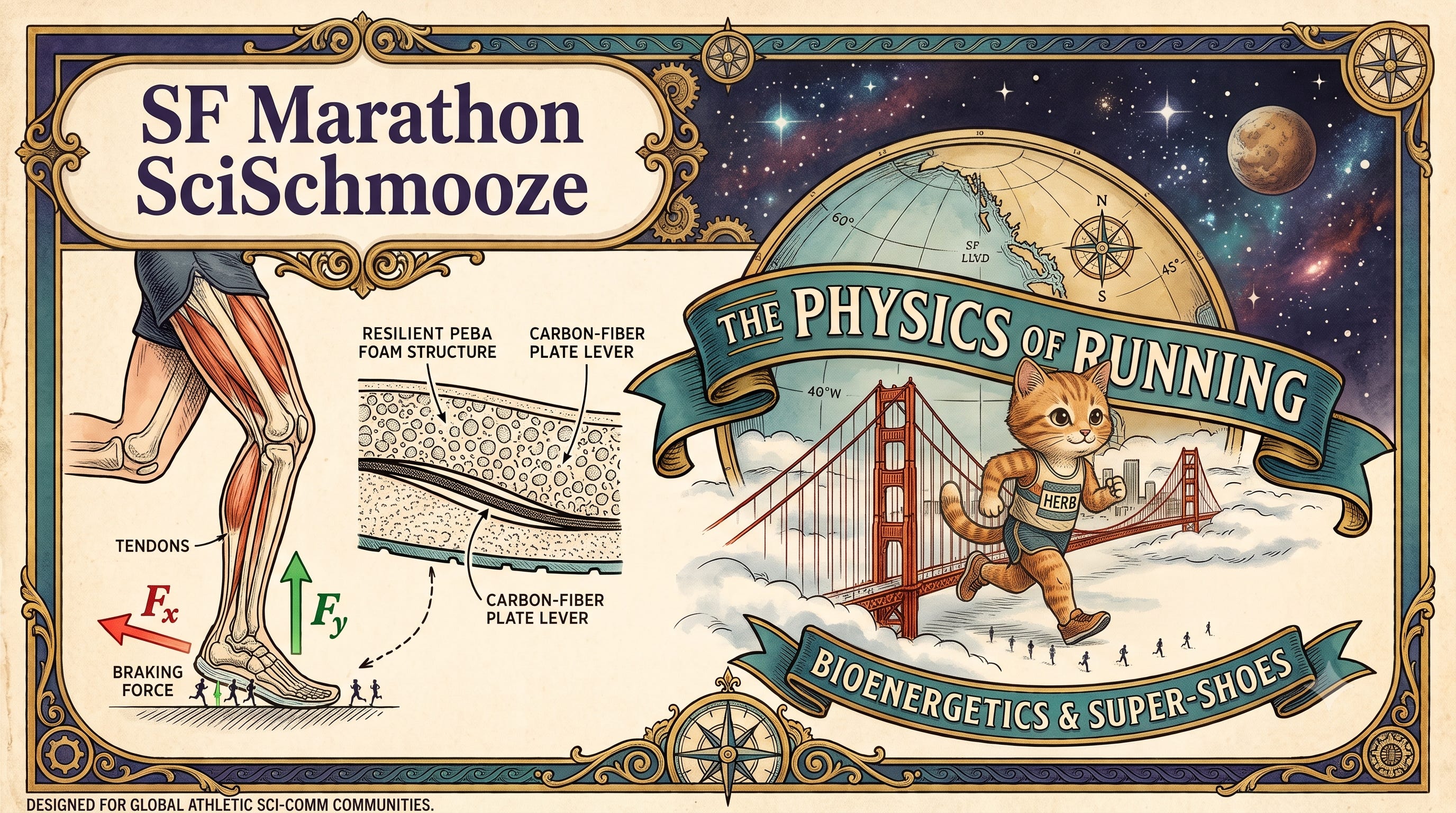
With another San Francisco Marathon officially in the books, thousands of runners are currently nursing sore calves, proudly displaying their finisher medals, and slowly regaining normal metabolic baseline. Winding through 26.2 miles of foggy coastlines, steep city gradients, and an iconic sunrise crossing over the Golden Gate Bridge, the SF Marathon is widely considered one of the most scenic—and biomechanically demanding—urban races in North America.
First run in 1977 with a humble field of fewer than 1,000 entrants, the event has expanded into a global spectacle drawing over 30,000 runners. And as we look ahead to next year’s historic 50th anniversary in 2027, it’s worth stepping back to examine the sheer physical reality of what happens when human physiology collides with classical mechanics on the streets of San Francisco.
Grab a high-electrolyte drink—it’s time to break down the science of the stride.
1. Bioenergetics & Thermodynamics: The Human Radiator
Every marathoner fears “The Wall” at Mile 20—a psychological and physical abyss where the legs feel filled with wet cement. But “The Wall” isn’t a mysterious mental barrier; it is a hard bioenergetic boundary.
Your body stores approximately 2,000 kcal of easily accessible glycogen in the liver and skeletal muscles. At a typical marathon pace, you burn roughly 100 kcal per mile. By Mile 20, your primary carbohydrate fuel tank is bone dry, forcing your metabolism to switch to fat oxidation. Because fat requires significantly more oxygen to break down, your energy output drops off a cliff.
However, fueling is only half the thermodynamic equation. The real boss fight of marathon running is heat dissipation.
Biophysically speaking, humans are magnificent radiators but terrible engines. Human skeletal muscle operates at only 20% to 25% mechanical efficiency when converting chemical energy into forward motion (Gaesser & Brooks, Journal of Applied Physiology). The remaining 75% to 80% is converted directly into pure waste heat. If your body’s physics can’t shed that thermal burden fast enough, your central nervous system triggers protective fatigue to prevent hyperthermia, forcing you to slow down or stop regardless of how much fuel remains in your tank (Nielsen et al., Pflügers Archi).
This physical reality aligns directly with evolutionary biomechanics (Bramble & Lieberman, Nature). As Harvard human evolutionary biologist Dr. Daniel Lieberman puts it:
“We are terrible sprinters compared to other mammals, but we are magnificent long-distance runners... Humans can dump heat faster than almost any other animal because of our hairless skin and millions of sweat glands. A human running in the heat is basically a specialized cooling tower on legs.”
This is where San Francisco’s famous microclimate gives runners a distinct physical advantage. The cold marine layer rolling in off the Pacific Ocean provides an optimal external heat sink. Through convective and evaporative cooling, the low ambient temperature allows the body to reject waste heat far more effectively than in warm-weather marathons, keeping the central nervous system from pulling the emergency thermal brake on performance.
2. The Physics of Motion: Vectors, Overstriding, and Super-Shoes
If thermodynamics governs your internal engine, classical mechanics dictates how efficiently that engine moves across space.
The Vector Penalty of Overstriding
When fatigue sets in around Golden Gate Park, many runners naturally lengthen their stride in an attempt to maintain speed. From a physics perspective, this is a major tactical error.
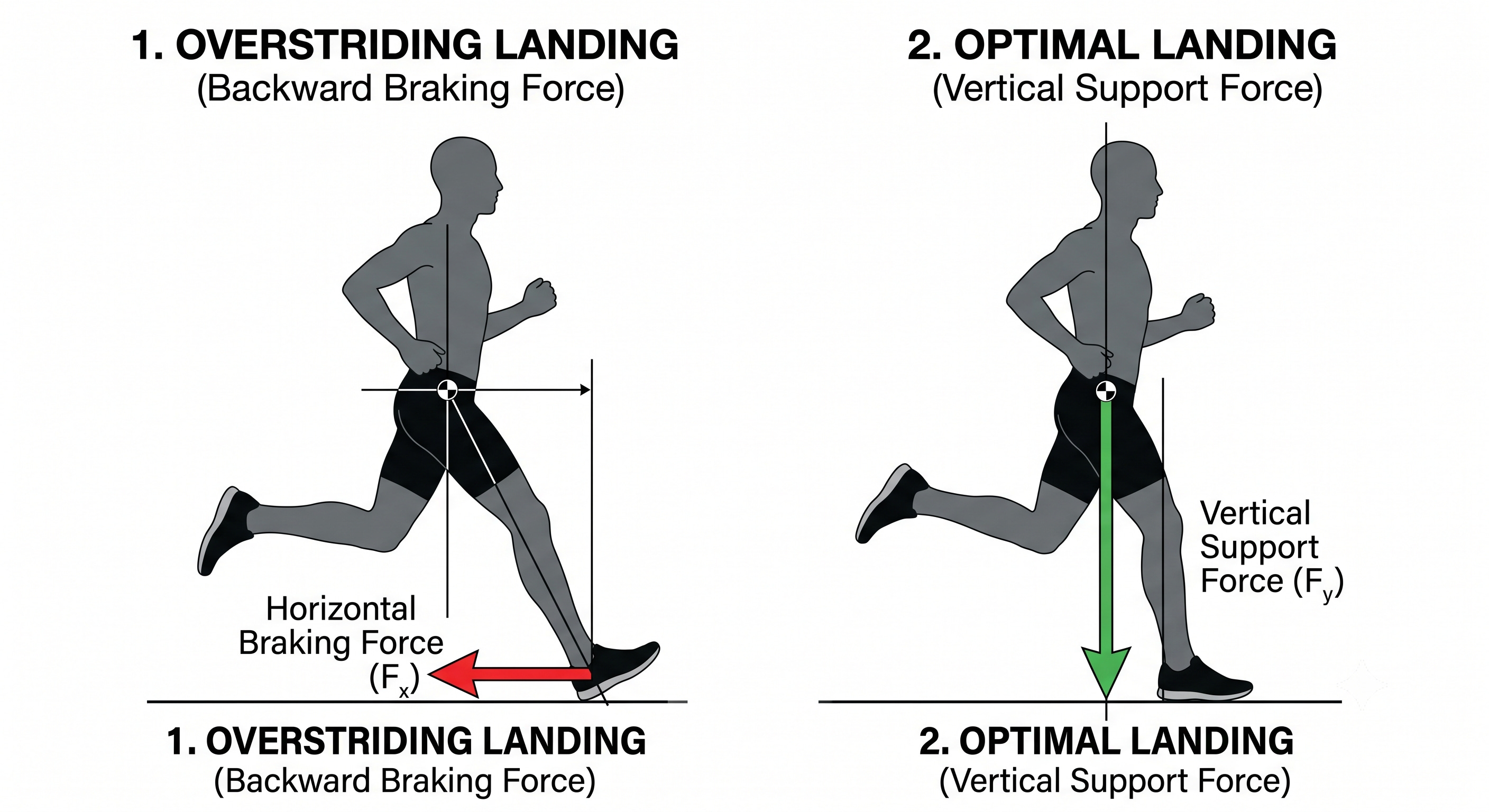
Every footstrike generates a Ground Reaction Force (GRF) vector. If your foot lands directly beneath your hips (your center of mass), that force vector is almost purely vertical, supporting your body weight against gravity. But when you overstride—landing with your heel far in front of your body—you create a horizontal braking force vector (F_x) pointing backward.
In essence, overstriding means tapping your biological brakes with every single step, expending precious metabolic energy just to re-accelerate your mass back up to speed (Heiderscheit et al., Medicine & Science in Sports & Exercise).
Materials Science in the Midsole
To combat impact stress and mechanical energy loss, modern runners have turned to high-performance polymer engineering: the “super shoe.”
Traditional running shoes used standard Ethylene-Vinyl Acetate (EVA) foam, which absorbs impact but only returns about 60% of stored mechanical energy. Today’s elite marathon shoes utilize Polyether Block Amide (PEBA) foam—a lightweight, highly resilient thermoplastic elastomer that yields an extraordinary energy return of 85% to 87% (Hoogkamer et al., Sports Medicine).
When paired with a curved, rigid carbon-fiber plate, these shoes don’t act like springboards pushing you forward. Instead, the rigid plate acts as a mechanical lever at the ball of the foot (the metatarsophalangeal joint), preventing excessive toe bending and allowing the calf-Achilles complex to work at a far more biomechanically efficient angle.
3. Data-Augmented Running & California’s Endurance Heritage
We are living in the era of the quantified runner. Beyond simple GPS watches tracking split times and elevation profiles, today’s athletes rely on real-time physiological telemetry:
Continuous Glucose Monitors (CGMs): Providing live estimates of blood glucose trends to optimize carbohydrate gel timing before hitting the bioenergetic wall.
Microfluidic Sweat Patches: Analyzing electrolyte concentrations (specifically sodium and potassium loss) to prevent cramping and hyponatremia.
Integrated Accelerometers: Measuring ground contact time, vertical oscillation, and stride symmetry to alert runners when their form begins to degrade into braking vectors.
Yet, long before wearable sensors and PEBA foam existed, California was the birthplace of raw ultra-endurance running.
Consider Ann Trason, a legendary Bay Area local, former science instructor, and widely regarded as one of the greatest trail runners in human history. Trason famously won the grueling Western States 100-Mile Endurance Run an astounding 14 times. Long before algorithms optimized race execution, Trason applied a rigorous, almost scientific mind to ultra-endurance—treating pacing, metabolic intake, and terrain strategy like a precise laboratory experiment while outrunning both women and men across the Sierra Nevada mountains.
“Running an ultra is really just a 100-mile science project. You are the test subject, and your job is to constantly solve the physiological puzzle as the variables change around you.”
— Ann Trason, 14-Time Western States 100 Champion
The SciSchmooze Skeptical Twist
As microfluidic sweat patches and real-time CGMs turn runners into walking telemetry stations, we have to ask a foundational question: is data-augmented running sharpening our physical insight, or blunting it?
Evolution spent millions of years fine-tuning human interoception—the complex network of neurochemical feedback loops that tell us when our core temperature is spiking or our glycogen is depleted. When we outsource that self-awareness to an algorithm on a wrist display, do we risk losing touch with the raw biological signals that athletes like Ann Trason used to conquer 100-mile wildernesses? Real-time data can inform the strategy, but it can never replace the art of listening to the machine from the inside.
May your friction coefficients remain high, your ground reaction forces stay vertical, and your thermodynamic systems find steady-state equilibrium.
Structurally yours,
Lili
Upcoming Events:
Click to see the next two weeks of events in your browser.
Monday, 08/10/2026
How to Invent: A 37-Year Journey with OLEDs - 08/10/2026 02:00 PM
Paul G Allen Building Stanford
Inspired by the first report of a two-layer heterojunction OLED by Tang and VanSlyke in 1987, our group began OLED research at Yamagata University in 1989. Our first OLED device was a terbium-complex-based green emitter that exhibited triplet-state emission. We then shifted our focus to polymer OLEDs, leading to the development of the world’s first white OLEDs. Subsequently, we developed vacuum-deposited white OLEDs, marking the beginning of our research on OLED lighting.
OLED performance has advanced steadily over the past three decades. In 2003, our group first reported tandem OLEDs at SID, demonstrating a device architecture capable of achieving both high brightness and long operational lifetime. In 2011, Lumiotec commercialized the world’s first OLED lighting panels. Subsequently, LG adopted tandem white OLEDs with color filters for the mass production of large-size OLED display panels. Today, OLED displays are widely used in consumer electronics and are predominantly manufactured by vacuum deposition.
In this talk, I will describe how these innovations were conceived and developed over the past 37 years, highlighting the key ideas behind each breakthrough and discussing future directions for OLED technology.
Speaker: Junji Kido, Distinguished Research Professor, Frontier Center for Organic Materials, Yamagata University
Attend in person or watch online (see weblink)
Room: Allen Annex Room 101X auditorium
Tuesday, 08/11/2026
The Science of L.A.’s Wild Parrots - 08/11/2026 06:00 PM
Hopkins Marine Station Pacific Grove
Wild parrots have become one of Los Angeles’ most surprising icons. But how did they get here, and how are they thriving? In this talk, evolutionary biologist and museum curator John McCormack separates urban legend from science, using genetics, field research, and thousands of public photos to uncover their origins, survival strategies, and even their love lives. We’ll explore what their future holds, and what L.A.’s parrots can teach us about cities, belonging, and conservation.
Speaker: John McCormack, Occidental College
Seaside Heermann’s Gull Colony Update - 08/11/2026 06:00 PM
Hopkins Marine Station Pacific Grove
Did you know Seaside is home to the only nesting colony of Heermann’s Gulls outside of Baja California? With approximately 1% of their population nesting on rooftops in downtown Seaside, you can imagine the challenges they face, as well as the struggles we have keeping them protected.
This year, Monterey Audubon Society launched an official monitoring and outreach program designed to engage locals in our conservation efforts. Join us Tuesday to learn more about their natural history from Amanda, creating and managing an outreach program from Deb, things we learned with interns monitoring the colony weekly from Shannon and Amanda, and what our plans are for the future from Shannon.
Attend in person or watch on YouTube
Wonderfest: Genetics of Extinction (& Survival) + Next-Gen Meds with Light & Electricity - 08/11/2026 07:00 PM
Hopmonk Tavern Novato
It’s a science double feature! Wonderfest presents two half-hour talks - each followed by Q&A (of course) - by outstanding UC Berkeley researchers:
Biologist Dr. Stephen Gaughran on The Genetics of Extinction (and Survival) - Species are now disappearing faster than at any point in the last several million years. Decades of conservation and management has made real progress in protecting endangered species, yet we still struggle to understand why some recover while others go extinct. By combining new genomic technologies with evolutionary theory, we are entering a new era of species conservation - one where we can use a species’ evolutionary past to plan for its future survival.Chemist Dr. Colin Gould on Building Next-Generation Medicines with Light & Electricity - Modern medicines have revolutionized treatments for cancer, heart disease, chronic illness, and more. These therapeutics often consist of carefully engineered organic molecules, which are designed in an iterative process of chemical synthesis and biological testing. Alternative energy sources, such as light and electricity, can help to speed up drug discovery, while also making manufacturing more environmentally friendly.
Skeptics in a Real Pub - 08/11/2026 07:00 PM
Fiddler’s Green Millbrae
Enjoy an evening of socializing and feasting with fellow Bay Area science-forward folk in an Irish Pub on the Peninsula with great food. < Menu >
Join us! This is a free event brought to you by Bay Area Skeptics. All are welcome.
Astronomy on Tap East Bay - 08/11/2026 07:30 PM
Two Pitchers Oakland Oakland
This month, we have two excellent talks lined up: First, Dan Werthimer (UC Berkeley, SETI) will give us an update on the past, present, and future of the Search for Extraterrestrial Intelligence. Then we’ll hear from Eamonn Needham (UC Davis) about lunar geology and the case for going back to the moon!
Two Pitchers is all ages and pet friendly, and just a few minutes’ walk from the 19th St BART station. Our space is “outdoor” but covered from inclement weather and heated.
Wednesday, 08/12/2026
Total Solar Eclipse Live Stream Watch Party - 08/12/2026 10:00 AM
Chabot Space and Science Center Oakland
Join us for a live broadcast of the 2026 Total Solar Eclipse on the giant screens in Chabot’s Theater, streamed live from NASA TV.
We are hosting a live viewing of the 2026 Total Solar Eclipse as it unfolds across Europe. NASA live coverage begins at 10 am. The Eclipse will reach its totality in Iceland at 10:45am and in Spain at 11:30am. This experience is included in general admission. Come watch on the big screen!
Theater Opens for Live Viewing 10:00 AMIceland’s totality around 10:45 AMSpain’s totality around 11:30 AM11:34 AM - Last location exits totality12:58 PM - Eclipse ends worldwide
Plus, enjoy hands-on solar and eclipse-themed activities with Chabot’s Science Associates and volunteers throughout the day.
Total Solar Eclipse Watch Party - 08/12/2026 10:30 AM
ExplOratorium San Francisco
Join us at Pier 15 for a live broadcast of the total solar eclipse!
Since 1998, the Exploratorium and NASA have worked together to broadcast stunning images of solar eclipses from around the world. This summer, our team of scientists and educators is ready to bring you the latest visuals from Spain.
Look up (safely), dive into the science behind the eclipse, and enjoy special programs for all ages. Don’t miss this celebration of the cosmic wonders all around us.
Effects of Local and Global Environmental Change on Seagrass Traits and Ecosystem Functioning - Livestream - 08/12/2026 03:00 PM
UC Davis Bodega Marine Laboratory
Speaker: Aly Hall, Postdoc, UC Davis
Register for Zoom at weblink
Matrescence: How Motherhood Rewires the Brain - 08/12/2026 07:00 PM
tiat San Francisco
The journey into motherhood involves far more than physical changes. Researchers now recognize matrescence as a major developmental stage, marked by significant shifts in the brain, body, identity, relationships, and emotional life. Yet despite affecting millions of women, the concept remains largely unknown outside of maternal health circles.
In this lecture, Kelsey Green, registered nurse, educator, and matrescence researcher, explores what neuroscience and psychology reveal about this often-overlooked stage of life. Drawing from both research and her work training healthcare professionals, she explains how motherhood reshapes the way women think, feel, and experience the world around them.
Whether you’re a parent, planning to become one, or simply want to better understand the mothers in your life, this talk offers a new framework for understanding one of the most significant transformations a person can experience.
Peninsula Open Space Trust - Livestream - 08/12/2026 07:00 PM
Silicon Valley Bird Alliance
Wildlife cannot exist without habitat. Protecting the land where our beloved birds live is essential for their survival, and in the San Francisco Bay Area, we’re lucky enough to have organizations whose primary focus is the protection of such lands. Whether your favorite birding spot is up in the hills, under the redwoods, or out on the shore, odds are good that you’ll be hiking through lands that have been protected by the Peninsula Open Space
Trust.
For nearly 50 years, Peninsula Open Space Trust has helped shape the network of protected lands that makes the Peninsula and South Bay such an extraordinary place for people and wildlife. Mark Medeiros will share the story of POST’s founding, explain how a nonprofit land trust works with landowners and public partners to acquire and permanently protect land, and highlight major conservation accomplishments throughout the region. The presentation will include examples from Santa Clara County - including Coyote Valley - and explore how protecting and connecting habitats supports wildlife, agriculture, public access and the long-term resilience of our communities.
Speaker: Mark Medeiros, Peninsula Open Space Trust (POST)
Register at weblink
Thursday, 08/13/2026
Slow Morning Walk at Lower La Honda Creek - 08/13/2026 10:00 AM
La Honda Creek Open Space Preserve La Honda
Are you looking for a fun, educational activity for the whole family this summer? Do you want a leisurely-paced hike with other community members?
Join Peninsula Open Space Trust for a beautiful hike at Lower La Honda Creek Open Space Preserve where you’ll experience the area’s sweeping views and gorgeous rolling grasslands! The preserve is over 6,100 acres, of which POST has contributed 5,200 acres. You will be guided by POST ambassadors on the meandering trails of Lower La Honda Creek, featuring a still-active cattle operation and views of the surrounding ridgelines!
We will be slow walking the 1.3-mile Grasshopper loop. This hike will be aimed towards families and slow walkers who enjoy lots of stops, engaging interpretation, and sweeping vistas!
Register at weblink. Note that the address we are listing may not be correct. Instructions will be included when you register.
After Dark: Unplug and Play - 08/13/2026 06:00 PM
ExplOratorium San Francisco
Your monthly invitation to hang out and try something new - play science trivia, find your community, and connect deeply.
Ages 18+
UFOs and Life Out There: Some Skepticism, Some Optimism - Livestream - 08/13/2026 07:30 PM
Bay Area Skeptics
With the release of the Spielberg blockbuster “Disclosure Day,” there has been great public interest in UFO claims and cases. In this illustrated, non-technical talk, astronomer Andrew Fraknoi will discuss the scientific, skeptical understanding of UFO (or UAP) claims. He will show what really happened in several famous cases, including the events in Roswell, New Mexico, which now drive the town’s tourist industry. Then he will explain our modern scientific understanding of the possibilities of intelligent life among the stars, and the serious and extensive experiments now under way to detect “techno-signatures” - remote evidence of advanced technological lifeforms.
Speaker: Andrew Fraknoi, Foothill College (emeritus)
Friday, 08/14/2026
Light Up the Night - 08/14/2026 06:00 PM
San José Museum of Art San Jose
Celebrate downtown San José’s newest public art installations created for SJ2026 with an illuminating evening featuring artists Brooke Einbender and Esteban Garcia Bravo. Presented in partnership with the Office of Economic Development and Cultural Affairs, the event highlights the power of light, color, and creativity to transform public spaces and inspire new experiences throughout downtown San José.
Explore demonstrations and workshops by Einbender and Garcia Bravo, along with live music by Nandi of Los Ritmos Calientes, a digital projection showcase by San José State University students Noe Naranjo Arias and Phin Nguyen of n@p_t1m:3, and free hands-on activities.
Workshop #1: Kaleidoscope Lab: Light, Color & ReflectionTo coincide with the public installation of Gaiascope at Circle of Palms, artist Brooke Einbender will lead a hands-on workshop where participants build and personalize their own handheld kaleidoscopes inspired by the installation.
Workshop #2: LED Animation and Video Mapping for Public ArtIn this welcoming, hands-on demo, participants will get a behind-the-scenes look at the creative and technical process behind a series of public light sculptures created for SJ26 by SJSU Professor Esteban Garcia Bravo in collaboration with his art students. This demonstration explores LED color mixing and video mapping through live demonstrations and interactive activities. Participants will experiment with projecting light and imagery, and learn the fundamentals of video mapping.
The demo will also include a presentation by Nandi Marocco of DJ Ritmos Calientes, featuring LED animated lights synchronized with music.
Get tickets at weblink
Saturday, 08/15/2026
Salt Marsh Walk - 08/15/2026 11:00 AM
Don Edwards Refuge Headquarters & Visitors Center Fremont
Join us for a leisurely walk along the La Riviere Trail of the Don Edwards San Francisco Bay National Wildlife Refuge in Fremont. You’ll learn about the ways that salt marshes benefit wetland ecosystems and us!
Meet at the Visitor Center. Bring warm layers, sun protection, sturdy walking shoes, and binoculars if you have them! We will have a limited number of binoculars available to borrow if needed.
This program is led by USFWS volunteer Kamalini Ranasinghe.
Register at weblink
Lick Observatory After Hours - SOLD OUT - 08/15/2026 06:00 PM
Lick Observatory Mt. Hamilton
Twilight Marsh Walk - 08/15/2026 06:45 PM
Don Edwards Refuge Headquarters & Visitors Center Fremont
Experience the salt marsh at twilight on an easy stroll along refuge trails (about 0.6 miles). You will learn about the habitats at the refuge, the wildlife it protects, why the refuge was established and why it is just as important for us. This program is led by USFWS volunteer Mary Bobik. Meet outside the Visitor Center.
Register at weblink
Sunday, 08/16/2026
Junior Rangers at the Refuge: Wonders of a Watershed - 08/16/2026 10:30 AM
Don Edwards Refuge Environmental Education Center Alviso
Love learning about new habitats? Curious about wildlife? Our Junior Rangers at the Refuge program is perfect for your family! Join us each month as we explore the Don Edwards SF Bay National Wildlife Refuge through fun, educational activities.
This month, we’ll explore how we’re connected to the Refuge through our watersheds. We’ll participate in a water cycle relay, play with our interactive watershed model, and learn about how to keep our watersheds clean.
Our Junior Ranger program is perfect for families with elementary-aged children.
Register at weblink
Lick Observatory After Hours - SOLD OUT - 08/16/2026 06:30 PM
Lick Observatory Mt. Hamilton
Tuesday, 08/18/2026
Protecting the unseen; conservation technology solutions to preserve secluded ecosystems - 08/18/2026 11:00 AM
Monterey Bay Aquarium Research Institute Moss Landing
Giving Scientists Superpowers: How an AI-Powered “Thinking Microscope” Is Fast-Tracking Medical Breakthroughs - 08/18/2026 05:30 PM
Commonwealth Club San Francisco
Wonderfest: Modern Alchemy: Building New Elements - 08/18/2026 07:00 PM
Hopmonk Tavern Novato
Nerd Nite SF #163: Caving 101, Gin & Tonics & Photographing the Whole Internet - 08/18/2026 07:00 PM
Rickshaw Stop San Francisco
Fighting for Reproductive Freedom: The Science, Law, and Politics of Abortion - 08/18/2026 07:00 PM
Guildhouse San Jose
Wednesday, 08/19/2026
Oceanographic drivers of deep ocean predator-prey dynamics - 08/19/2026 11:00 AM
Monterey Bay Aquarium Research Institute Moss Landing
UC Davis Bodega Marine Laboratory Seminar Series - Livestream - 08/19/2026 03:00 PM
UC Davis Bodega Marine Laboratory
The Ethics of Making Babies: Genetic Selection and Gene Editing - 08/19/2026 06:00 PM
Manny’s San Francisco
The Mystical & Bountiful Farallon Islands - 08/19/2026 06:00 PM
San Mateo Public Library San Mateo
Modern Test Automation & Quality Engineering in Agile Systems - 08/19/2026 07:00 PM
Valley Research Park Mountain View
Astronomy on Tap San Francisco - 08/19/2026 07:00 PM
Standard Deviant Brewing San Francisco
Thursday, 08/20/2026
Baylands Explorations - 08/20/2026 09:30 AM
Palo Alto Baylands Nature Preserve Palo Alto
After Dark: Extraterrestrial - 08/20/2026 06:00 PM
ExplOratorium San Francisco
NightLife - 08/20/2026 06:00 PM
California Academy of Sciences San Francisco
Precision Metrology for Space Science: LISA, Atom Interferometry, and Optical Clocks - 08/20/2026 06:30 PM
Hacker Dojo Mountain View
Open Question: Extraterrestrial - Is there Live in Outer Space? - 08/20/2026 07:00 PM
ExplOratorium San Francisco
Raptors in the Concrete Jungle - 08/20/2026 07:00 PM
David Brower Center Berkeley
Feathers of the Forests - Livestream - 08/20/2026 07:00 PM
Peninsula Open Space Trust
The History of Gender: How Culture has Shaped the Way We Think About Identity - 08/20/2026 07:00 PM
Donkey & Goat Winery Berkeley
Friday, 08/21/2026
Become an AI Builder: Create Your First Project in One Night - 08/21/2026 06:00 PM
Bright Data San Francisco
Lick Observatory After Hours - SOLD OUT - 08/21/2026 06:30 PM
Lick Observatory Mt. Hamilton
Saturday, 08/22/2026
Wildlife tracking hike in the Sonoma Valley - 08/22/2026 10:00 AM
Bouverie Preserve Glen Ellen
Foothills Family Nature Walk - 08/22/2026 11:00 AM
Foothills Nature Preserve Los Altos
Family Bird Walk - 08/22/2026 12:00 PM
Don Edwards Refuge Headquarters & Visitors Center Fremont
Sunday, 08/23/2026
Marine Mammals of SF Bay - 08/23/2026 10:30 AM
Marine Mammal Center Sausalito
Lick Observatory After Hours - SOLD OUT - 08/23/2026 06:30 PM
Lick Observatory Mt. Hamilton
Monday, 08/24/2026
How the Strait of Hormuz Crisis Threatens Famine in the Sahel in 2027 - Livestream - 08/24/2026 12:00 PM
Stanford University
System Engineering: The Role of AI and Software in Emissions Reduction - 08/24/2026 07:00 PM
Valley Research Park Mountain View
Comments
Nothing yet. Say the first thing.
Sign in to join the conversation.