
Greetings, fellow carbon-based computing units!
This week, we are pulling our heads out of the abstract digital clouds and smashing them squarely into a massive pile of wet rocks—exploring how an ancient Roman architectural masterpiece is helping Silicon Valley solve its most pressing modern environmental crisis.
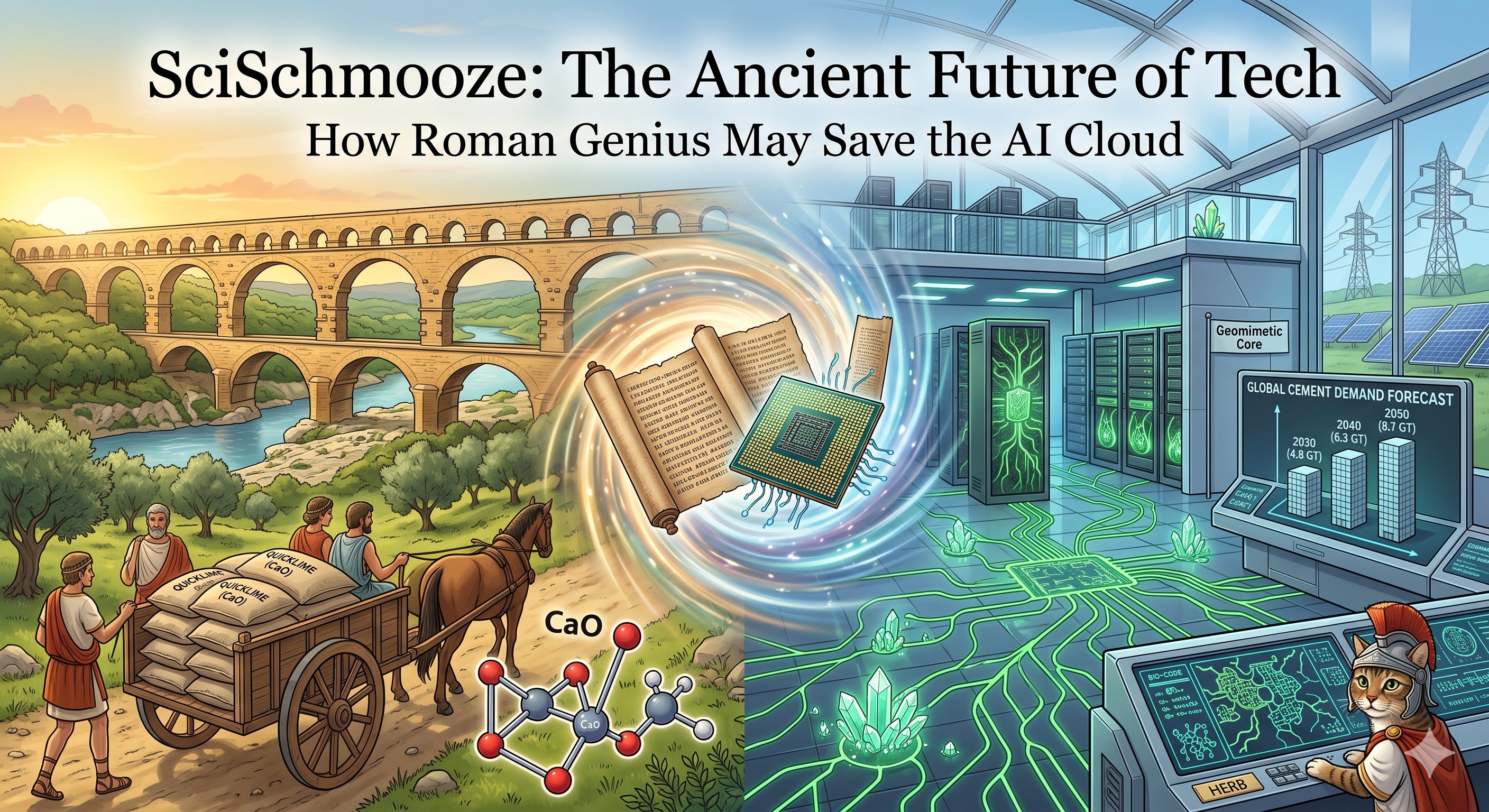
When we think about the current artificial intelligence revolution, we tend to picture lines of code, complex neural networks, and racks of high-powered graphics cards. We rarely think about concrete.
Yet, the literal foundation of the digital cloud is incredibly physical. To power the massive compute clusters required for modern AI models, tech giants are building gargantuan data centers at an unprecedented pace, making the tech sector one of the largest consumers of construction materials on Earth. But this physical expansion presents a massive climate dilemma: how do you build out the heavy infrastructure of the future without blowing past corporate net-zero targets?
To solve this cutting-edge Silicon Valley problem, structural engineers and materials scientists are looking nearly 2,000 years into the past, drawing direct inspiration from the ancient stones of the south of France.
If you stand before the historic Pont du Gard—the legendary Roman aqueduct bridge built nearly 2,000 years ago (around 40–60 AD)—you are looking at the gold standard of durable infrastructure. It successfully carried over 40 million gallons of water a day to the city of Nîmes, and the mathematical precision underlying its construction is absolutely staggering.
To bypass a rugged mountain range, Roman surveyors designed a winding 50-kilometer aqueduct detour to connect the freshwater spring to the colony. Because the total elevation drop over that entire 50 km journey was only 17 meters, they had to maintain an average slope of roughly 1 in 3,000—a drop of a mere 34 centimeters per kilometer. In some downstream stretches, the gradient was flattened to a microscopic 7 millimeters per 100 meters. At the Pont du Gard bridge itself, the water channel drops an astonishingly precise 2.5 centimeters over the entire 275-meter span.
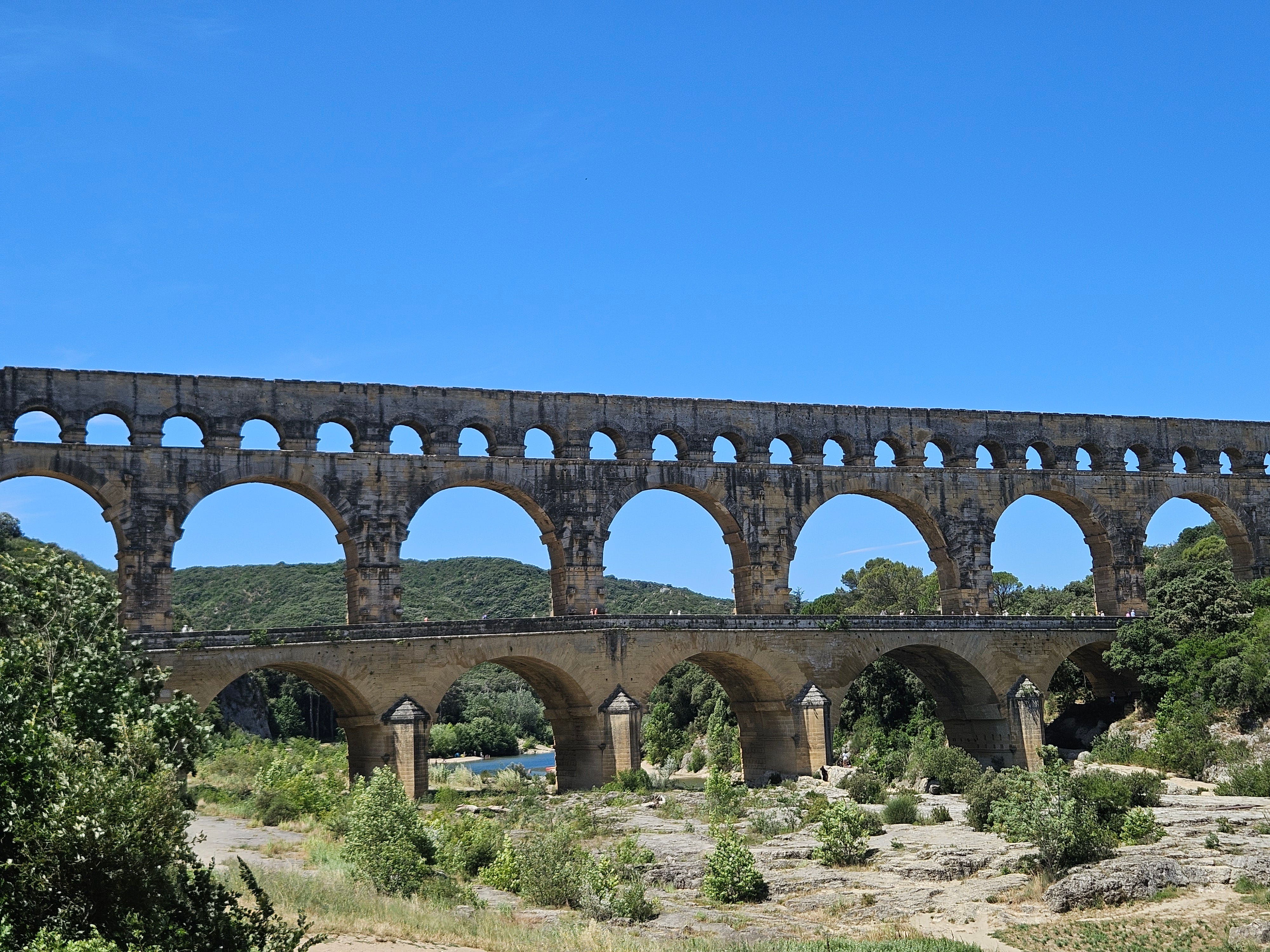
Photo: Pont Du Gard (Gard, France) taken by yours truly in early June, 2026.
The physical execution perfectly matches the geometry. The bottom tiers consist of roughly 50,400 tons of massive limestone blocks cut so perfectly flush that they are held together entirely without mortar, relying on pure gravity and internal friction. The joints are so tight you cannot slip a knife blade between them.
Yet, while the bridge frame relies on flexible dry-stacking to absorb seismic shifts, the water conduit along the very top required tight chemical isolation: opus signinum—a highly specialized hydraulic mortar. By mixing traditional lime and sand with crushed terra-cotta tiles, they triggered a chemical reaction that created a dense, completely waterproof plaster barrier that kept the city’s water from leaking through the porous stone.
This brilliant blueprint didn’t just preserve ancient Rome’s water; it became the direct inspiration for early American municipal infrastructure. Centuries later, when New York City built the Croton Aqueduct system in the 1840s to supply fresh water to a booming Manhattan, chief engineer John B. Jervis mirrored this exact multi-tiered Roman rhythm to create the iconic High Bridge across the Harlem River. Distributed by contemporary critics as the “American Pont du Gard,” it swapped massive dry-stacked stones for smaller quarried blocks bound with hydraulic cement mortars, proving that ancient water-carrying engineering remained the ultimate solution for industrial-era cities.
To visualize how the ancient structural mechanics and specialized water channels mentioned in the article were put together, you can watch this stunning 3D construction breakdown on Roman Aqueduct Engineering at the Pont du Gard.
To understand why tech giants want to ditch modern concrete for Roman-style formulations, we have to look at a fundamental chemical clash. Both eras rely on a critical structural enabler: lime.
In construction, “lime” refers to calcium oxide (CaO). It is indispensable because it provides the active calcium ions required to create the microscopic chemical “glue” holding concrete together. Without it, sand and gravel would remain a loose pile of rocks. Traditionally, it is produced by baking sedimentary limestone (CaCO₃) in an industrial kiln at roughly 900°C. The heat forces a chemical separation:
CaCO₃ + Heat ➔ CaO + CO₂
This single reaction is the root cause of the cement industry’s carbon footprint (accounting for roughly 8% of global emissions). Crucially, 60% of concrete’s emissions come not from the energy used to burn the kilns, but from this exact chemical process, which vents CO₂ gas straight into the atmosphere.
Once mixed with water and silica (SiO₂), this generated lime reacts to form Calcium-Silicate-Hydrate (C-S-H gel). This gel acts as the ultimate microscopic glue, growing into a dense, interlocking web of crystalline fibers that wraps around loose sand and heavy gravel, locking them forever into a solid artificial stone:
CaO + SiO₂ + H₂O ➔ C-S-H Gel
To make modern Portland cement, factories must heat limestone and clay to a blistering 1450°C. This extreme heat is required to chemically fuse the ingredients into a synthetic, glass-like material called “clinker.” The process demands a staggering amount of fossil fuel energy. The Romans bypassed this step entirely. They only needed to crack the limestone open to yield raw quicklime, which happens at a much lower 900°C.
Instead of manufacturing a complex chemical binder from scratch in a high-temperature kiln, the Romans let geology do the heavy thermodynamic lifting. They mixed their low-temperature lime with raw, unbaked volcanic ash (pozzolana). Because volcanic eruptions instantly freeze molten rock, the resulting ash is packed with unstable, highly reactive silica. When mixed with lime at room temperature, it naturally locks into a solid crystalline matrix—drastically reducing the total amount of energy and baked limestone required.
Modern concrete is rigid and brittle. Over 50 to 100 years, moisture seeps in, corroding internal steel reinforcement and causing the structure to crumble. We are forced into a relentless, high-carbon cycle of demolition, manufacturing, and rebuilding.
Roman concrete, by contrast, gets greener with age because it is alive. When water infiltrates it, it dissolves internal lime inclusions and reacts with the volcanic ash to grow new minerals like Al-tobermorite. These crystals actively map to the stress lines, plugging the cracks and reinforcing the structure. Because the Pont du Gard has stood for nearly two millennia without needing to be remanufactured, its carbon footprint over time is practically zero.
The sheer volume of concrete required for this AI expansion has triggered an unprecedented industrial supercycle. In real estate tracking, data center development is grouped under office-related construction spending. A decade ago, data centers accounted for a mere 4% of that slice; today, they consume over a quarter of it, and market projections indicate they will swallow nearly 40% of all office-related construction spending by 2027.
The physical requirements of AI are drastically different from the traditional cloud. Modern AI chips run incredibly hot, requiring heavy liquid-cooling manifolds, massive backup generators, and dense server clusters. This hardware is phenomenally heavy and generates intense structural vibrations.
As a result, an AI data center cannot rely on standard commercial foundations. They require massive, ultra-thick, vibration-dampening concrete slabs. According to projections from the American Cement Association, the U.S. will require roughly 1 million metric tons of cement over the next three years alone just to lay the physical foundations for this incoming wave of AI infrastructure. With global data center capacity on track to double to 200 gigawatts by 2030, the tech sector is facing a literal bottleneck made of stone.
With strict corporate net-zero targets and new “Buy Clean” legislative mandates in states like California and New York, AI data center engineers are using modern materials characterization to scale up these ancient tricks.
At the Stanford Doerr School of Sustainability, a multidisciplinary team led by Professor Tiziana Vanorio (Earth & Planetary Sciences), alongside Alberto Salleo (Materials Science) and Matteo Cargnello (Chemical Engineering), has engineered a low-carbon cement alternative called Phlego.
Instead of destroying sedimentary limestone, the Phlego process utilizes a blend of carbon-free, locally sourced igneous rocks. Because these volcanic rocks naturally contain calcium bound up within silicates rather than carbonates, processing them in a kiln releases zero chemical CO2—slashing manufacturing carbon emissions by up to 75%.
As outlined in the portfolio overview by the Stanford Office of Technology Licensing, the team didn’t just solve the carbon problem; they used geomimetics—mimicking how nature naturally cements rocks together in high-stress volcanic calderas—to completely change the material’s microstructure.
Phlego is chemically engineered to grow an intertwined meshwork of mineral nanofibers (C-A-S-H) directly inside the curing matrix. These microscopic fibers act like natural, nanoscale rebar. When a micro-crack begins to form, the fibers bridge the gap, giving the material massive fracture toughness and seismic resilience—perfect for anchoring the heavy, vibrating server infrastructure of tomorrow’s AI hubs.
As these regional projects transition from laboratory validation to commercial pilot scales, modern engineering is coming full circle. To build the futuristic, data-driven cloud of tomorrow, we are quite literally learning how to think like volcanic systems and Roman masons once did.
What do you think of this ancient approach to modern tech problems?
May your personal infrastructure remain as enduring as volcanic ash, and your micro-cracks effortlessly self-heal whenever life applies the pressure,
Lili
Before you crawl back inside your local space-time coordinates, here are three brilliant ways to tickle your prefrontal cortex in the neighborhood this week:
A Giant Leap: How AI Is Transforming Healthcare (SF Bay Area | Tuesday, June 30, 7:00 PM): Keep the AI infrastructure conversation rolling with this evening panel mapping out how machine learning models are stepping directly into medical diagnostics, data pipelines, and drug discovery workflows.
After Dark: Starstruck (Exploratorium, SF | Thursday, July 2, 6:00 PM – 10:00 PM): An adults-only evening event exploring the ancient light of the Big Bang and cosmic recycling. You can look through high-powered telescopes, catch experimental short films of the night sky, and listen to planetary scientists chart how we evolved out of old “star stuff.”
Ask a Scientist: Meteorites (Exploratorium, SF | Friday, July 3, 12:00 PM – 2:00 PM): Spend your lunch hour learning about celestial geology from Osher Fellow Br. Guy Consolmagno, a planetary scientist and the Director Emeritus of the Vatican Observatory, who will be breaking down the literal chemical compositions of rocks falling to Earth from deep space.
Upcoming Events:
Click to see the next two weeks of events in your browser.Tuesday, 06/30/2026
A Giant Leap: How AI Is Transforming Healthcare - 06/30/2026 07:00 PM
Computer History Museum Mountain ViewDespite decades of investment, healthcare has been slow to embrace a digital transformation. Inefficiencies and problems with electronic health records persist. With the rise of AI, is healthcare finally at a turning point?
Join us for a CHM Live book talk with Robert Wachter, MD, chair of the Department of Medicine at UCSF and one of the nation’s leading voices on healthcare innovation. In his new book, A Giant Leap: How AI Is Transforming Healthcare and What That Means for Our Future, Wachter explores how artificial intelligence is beginning to reshape medicine - from reducing administrative burden and clinician burnout to improving diagnosis, communication, and patient care.
But AI’s power to read and synthesize vast amounts of medical data comes with risk. Wachter and journalist Katie Hafner will discuss both the promise and the peril of AI in healthcare.
What You’ll Experience:
A clear look at how AI is already changing healthcare - and where it’s headed next.
Insight into opportunities and risks of AI in high-stakes, real-world settings.
A thoughtful discussion of trust, human judgment, and the future of the doctor - patient relationship.
5 Things Everyone Can Learn From Kink - SOLD OUT - 06/30/2026 07:00 PM
The Faight Collective San FranciscoYou are what you eat, and for killer whales, it’s not always good news - Livestream - 06/30/2026 07:00 PM
American Cetacean SocietyWhat can a tiny sample of killer whale skin or blubber reveal? Surprisingly, a lot! From their diet to the pollutants they carry and the effects on their health, a single biopsy opens a window into the wider ocean ecosystem. In this talk, Dr. Anaïs Remili will cover how lipid and chemical analyses help scientists track what killer whales eat, how contaminants move up the food chain, and why some populations do better than others. Please join us to explore the detective work behind marine mammal ecotoxicology and discover how these insights can guide real-world actions to protect whales and their habitats.
Register at weblink
Wednesday, 07/01/2026
Birdy Hour: The Many Hats of Honey Bees - Livestream - 07/01/2026 06:00 PM
San Francisco Bay Bird ObservatoryIn their hives, out in the fields, and all around the world, honey bees, Apis mellifera, play a multitude of roles: honey maker, nurse, guard, forager, navigator, dancer, communicator, pollinator and ambassador. In this talk, you will learn more about these roles and some of the remarkable abilities honey bees possess that enable this work. As globally important pollinators, the recent decline in honey bee populations in the U.S. raises concerns; I will also discuss the threats to honey bees and other pollinators, the need for pollinator conservation, and what you can do to help.
Speakers: Cynthia Wei, Walsh School of Foreign Service’s Program in Science, Technology, and International Affairs
Register at weblink
Thursday, 07/02/2026
After Dark: Starstruck - 07/02/2026 06:00 PM
ExplOratorium San FranciscoFrom stardust to supernovae, the universe holds the secrets to our origins and possible futures.Tonight, explore the wonders of the cosmos through science, belief, and art. Find out what ancient star light can teach us about the Big Bang. Dig deep into how uncertainty informs both astronomy and religion, and uncover the importance of stellar explosions.
Ages 18+
Friday, 07/03/2026
Ask a Scientist: Meteorites - 07/03/2026 12:00 PM
ExplOratorium San FranciscoJoin us to learn about meteorites from an expert and also see some samples!
Current Osher Fellow Br. Guy Consolmagno is a Jesuit brother, a planetary scientist, and the Director Emeritus of the Vatican Observatory. He splits his time between the meteorite collection in Rome and the Vatican telescope in Arizona. His Vatican work has also sent him to every continent in the world, including a meteorite hunting expedition to Antarctica.
First Friday: The Mother of All Demos - 07/03/2026 06:00 PM
San José Museum of Art San JoseA Special Performance by Sarah Buckius
Step into a zany and participatory, multimedia performance by artist Sarah Buckius. Adopting the role of a tech CEO, Buckius will explore the roles of women in past and future technologies, from textile patents to robot design and artificial intelligence training.
Buckius is an exhibiting artist of the exhibition Motherboards, which explores the foundational contributions of women’s work to the technology industry.
Saturday, 07/04/2026
First Saturday Tour at the Santa Cruz Arboretum - 07/04/2026 11:00 AM
UC Santa Cruz Arboretum Santa CruzFirst Saturday Tours are a wonderful way to introduce yourself to the Arboretum or to deepen your knowledge of the Arboretum’s plant collections. Each tour is a little different depending on the time of year, the interests of the tour guide, and the people who join in. For example, you might learn about the birds and mammals that make this land their home or about the amazing physical adaptations that plants have evolved to better deal with our extreme weather and climate conditions.
Monday, 07/06/2026
Harsh Medicine: Gender Bias in Science & Health Care - 07/06/2026 06:00 PM
Commonwealth Club San FranciscoDespite decades of progress, women continue to face systemic barriers to success in medicine and science. This is the considered view of Dr. Jennifer Grandis, Distinguished Professor at UC San Francisco. In her new book, Harsh Medicine: Why Women Can’t Get Ahead in Science and Health Care, Dr. Grandis draws on case studies, rigorous analysis, and decades of experience to reveal how gender bias is embedded in the structures of academic medicine and scientific research. How do science policies, funding systems, promotion practices, and cultural norms disadvantage women throughout their careers in science and medicine?
Attend in person or online. Use promo code WONDERNAUTS for a $10 discount, making the online ticket free.
Speaker: Jennifer Grandis, UC San Francisco; Katie Hafner, Lost Women of Science podcast, moderator
Wednesday, 07/08/2026
Expanding accessibility in the geosciences through Group Level Assessment (GLA) - 07/08/2026 11:00 AM
Monterey Bay Aquarium Research Institute Moss LandingThursday, 07/09/2026
NightLife - 07/09/2026 06:00 PM
California Academy of Sciences San FranciscoAfter Dark: Science of Sports - 07/09/2026 06:00 PM
ExplOratorium San FranciscoThe Numerology of Toxicology: How Bad Science Travels into the Regulatory Domain - 07/09/2026 07:30 PM
Bay Area SkepticsFriday, 07/10/2026
Lick Observatory After Hours - SOLD OUT - 07/10/2026 06:30 PM
Lick Observatory Mt. HamiltonSaturday, 07/11/2026
History of Drawbridge - 07/11/2026 09:30 AM
Don Edwards Refuge Environmental Education Center AlvisoFamily Nature Adventures: Redwoods - 07/11/2026 10:30 AM
Chabot Space and Science Center OaklandThe Tech Interactive’s Molecular Meals: Summer BBQ Workshop - 07/11/2026 02:00 PM
The Tech Interactive San JoseLick Observatory After Hours - SOLD OUT - 07/11/2026 06:30 PM
Lick Observatory Mt. HamiltonTwilight Marsh Walk - 07/11/2026 06:45 PM
Don Edwards Refuge Headquarters & Visitors Center FremontSunday, 07/12/2026
History of Drawbridge - 07/12/2026 10:00 AM
Don Edwards Refuge Headquarters & Visitors Center FremontTop Predators - 07/12/2026 10:30 AM
Marine Mammal Center SausalitoThe Tech Interactive’s Molecular Meals: Summer BBQ Workshop - 07/12/2026 02:00 PM
The Tech Interactive San JoseMonday, 07/13/2026
Evolution through gene duplications - 07/13/2026 06:00 PM
Crepe Place Santa Cruz
Comments
Nothing yet. Say the first thing.
Sign in to join the conversation.