
Imagine you open your computer and it’s frozen, with a few white words across a blue screen telling you it’s been infected. There’s a number to call for help from Microsoft and a warning not to shut the device or risk losing everything. A loud voice keeps coming on to repeat the threats.
It’s suspicious and scary so you ignore the number, but leave the computer on just in case. You use your cellphone to search the internet for a legitimate number, with the keywords “Microsoft.org” and “support.” You call one that comes up, and tell the man who answers what happened. He tells you your computer’s been hacked, and to share your phone screen with him on Facetime.
So begins a cautionary tale. You don’t know where the scam began, but over three hours, the person you reached out to to disrupt it will dupe and try to rob you, accompanying you virtually as you drive to places he tells you to go.
This happened recently to a friend of mine, an Iowa retiree. She’s still picking up the pieces but wants her story shared (without her name) to warn others.
It’s a subject I knew little about (I even had to look up “Malware” and “Phishing, and assumed the latter was misspelled). But as I’ve learned, my friend’s story is ubiquitous. The FBI’s 2023 Internet Crime Report estimates cyber scam losses at $924 million. And Malwarebytes, a cybersecurity website, calls fake tech-support scams the most common type.
They often start with a “bogus” warning about a computer problem, a Federal Trade Commission website says, that “could be a fake pop-up-warning that looks like it’s from a well-known company and urges you to call a phone number to get help.”
Using her Facetime, the man directed my friend to open apps like Apple and Uber, claiming that was to see if unauthorized charges had been made. It also enabled him to photograph her credit cards, front and back, and run up expenses for four $100 Apple gift cards and $499.99 Uber charges.
When they got into her credit union account, “David,” as he called himself, informed her she had an $18,400 charge pending and the money had to be withdrawn by the end of the workday or it would be gone. He brought into the call a woman claiming to be from the credit union. They told my friend to go to straight there, withdraw the cash and put it in a Bitcoin machine.
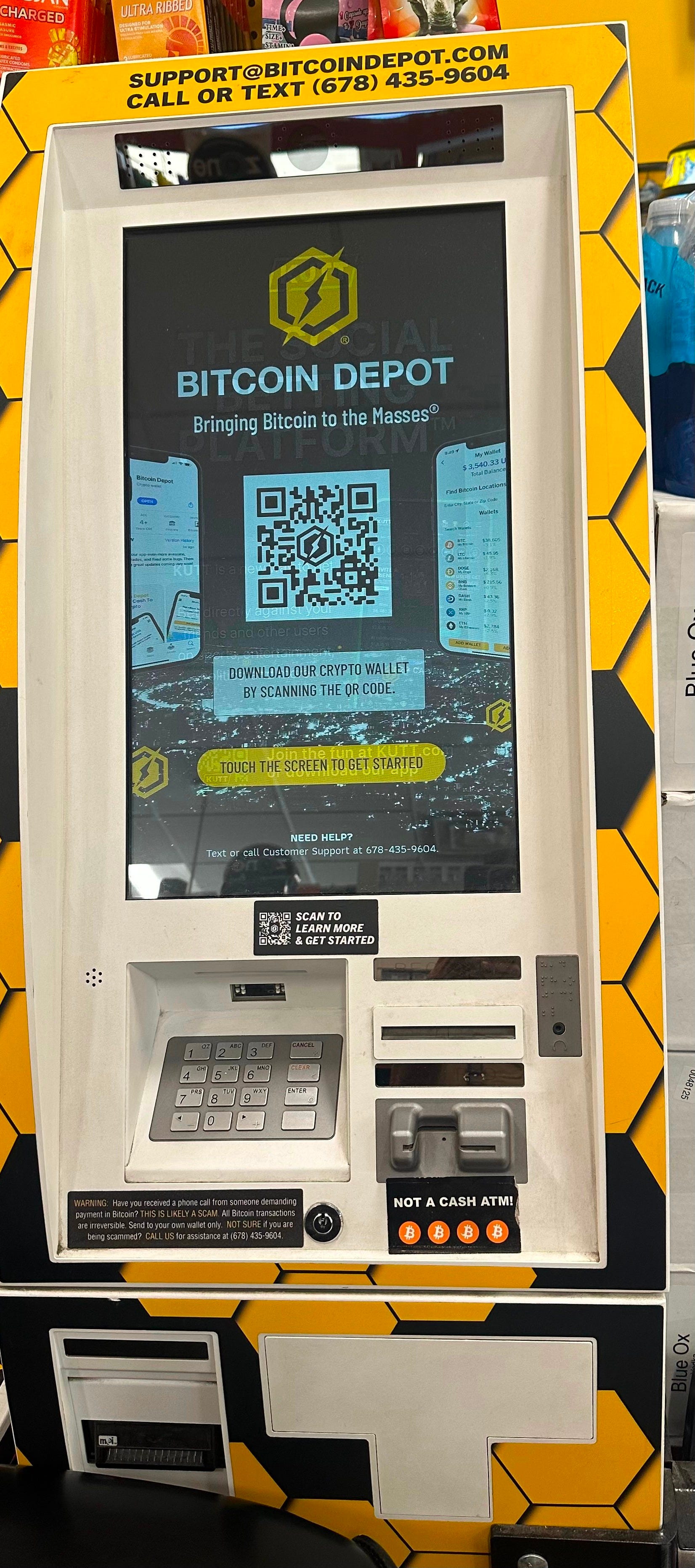
Bitcoin machine at a Des Moines convenience store
“I’ve read about scams but I didn’t realize how they suck you in,” she explained of why she went along. “I’m not clearly in my head then.” It’s not an uncommon response.
The first credit union branch would only release $5,000. A second said they’d give her the $13,400 balance she sought in a cashier’s check. And they said there was no $18,400 charge pending. Asked by the teller what she wanted the money for, my friend first answered as David had prompted: To pay a contractor. The teller pointed out that contractors don’t need cash. And sensing something amiss, she asked who my friend was talking to, as David was texting her to get the money and leave.
Thanks to the teller’s questions, my friend learned she was being scammed, and that by trading the money for Bitcoin, she’d never see it again. So, instead, she returned all the money to the teller, hung up and went home, “shaken and wanting to cry.”
She had even visited the Bitcoin location in preparation.
She cancelled three credit cards and a debit card, froze her credit and disputed the charges the scammer had put on her account. Her computer has been turned off since, and the hard drive is being reformatted. She went with a relative to the Apple store, where staff helped reset her phone, change her Apple password and enable 2-factor authentication.
She has been advised not to respond to any messages, emails or texts from people she doesn’t know.
This subject has so many aspects that only a few can be covered here. But the bottom line is, online scamming is a real and growing problem that spans much of the globe. Many people don’t recognize it or realize how easily you can be dragged down a rabbit hole. Microsoft says it blocks around 4.5 million new Malware attempts a day – the malicious software cyber criminals develop to steal data and damage or destroy computer systems. Still, it says, thanks to “advances in automation tools” and AI, hackers can still encrypt and demand ransom payments to undo it.
My friend doesn’t know why the problem began with her computer. But what ensued was from clicking on a scam site posing as a technical assistance one. Those are online ads for which Google is paid, which can make their way to the top of its list when someone searches for tech help. As Malwarebytes puts it, “scammers are leveraging Google ads to lure victims in, getting them on the phone and finally fleecing them.”
But because Section 230 of the Communications Decency Act generally protects internet platforms from liability for ads placed by third parties, it’s hard to make Google get rid of them.
I learned that though middle-aged people are the most frequent scam victims, seniors typically lose three times as much money from them as middle-aged people do. For those over 80, that’s $1,400 on average, according to Marti DeLidema, a gerontologist at the University of Minnesota social work school. Older adults are most affected by tech support scams. And, she said on the Freakonomics podcast, scammed seniors are more susceptible to suicide because of the trauma, sense of betrayal and hopelessness.
Does hearing that enrage you as much as it does me? To target people often in the most vulnerable stages of their lives, and exploit their trust and bankrupt them for sheer greed isn’t just cruel and inhumane. It’s unfathomable
And then there are the victims on the other side of it. The scammers behind the scenes may themselves have been trafficked. It reportedly began during the COVID pandemic, when traffickers, mostly in Southeast Asia, began recruiting adults and children from dozens of countries to run internet scams targeting people abroad.
These workers are subject to multiple abuses, imcluding sometimes sex trafficking. If they don’t meet their quotas, they can be beaten or electrically shocked. Food, water and medicine can be withheld and their movements are restricted. There are a reported 10,000 victims still entrapped in Cambodia’s compounds.
The kingpins of these enterprizes can be billionaires, like 38-year-old businessman Chen Zhi who was arrested in Cambodia and extradited to China in January. He allegedly ran a massive online scamming and money laundering enterprise called Prince Group, which operated over 100 business entities in more than 30 countries, using forced labour. It reportedly generated $19 billion dollars a year- $10 billion of that from the U.S. in 2024.
India, my birthplace, also has scamming victims. Three were featured in a March 31 Wall Street Journal article. It was about police impersonators, who “arrested” the victims on WhatApp, alleging money-laundering. One was a 77-year-old woman, a retired doctor, scammed out of $1.6 million. An 83-year-old retired Army colonel, targeted the same way, transferred $60,000 to a bank, believing it was for an audit. (He recovered around a tenth of that.) A 45-year-old accountant lost $38,000, telling a reporter he felt “something was off,” but the scammers’ self-confidence and quick responses convinced him otherwise.
My friend said she heard children’s voices in the background on David’s phone and it “should have been my clue, but I just sank in deeper.”
Technology and AI can bridge distances increase our efficiency and entertain us. They can also put us out of work, harm children and replace our unique voices with fake ones. Until we find the proper balance as a society, consider this a wake-up call and please protect yourself and the kids around you.
Ultimately we need to forge a global agreement to put these shameless predators out of business.
Some advice my friend has gotten:
Disable the remote control on FaceTime that enables scammer to see and control your mobile phone: go to your settings, click on Apps, FaceTime and SharePlay and swipe left to turn that off.
Turn on Call Filtering to block both unknown Callers and FaceTime spam.
If you’ve been scammed, you’re encuraged to file a complaint with the FTC and the FBI’s Internet Crime Complaint Center. You can also get guidance there on protecting your security, including in making mobile payments
Let someone know if you’re tempted to share sensitive information over the Internet with anyone, and why. A small step could cost more than you can imagine.
I’m a proud member of the Iowa Writer’s Collaborative. Click below for the full roster.
No posts
Comments
Nothing yet. Say the first thing.
Sign in to join the conversation.