
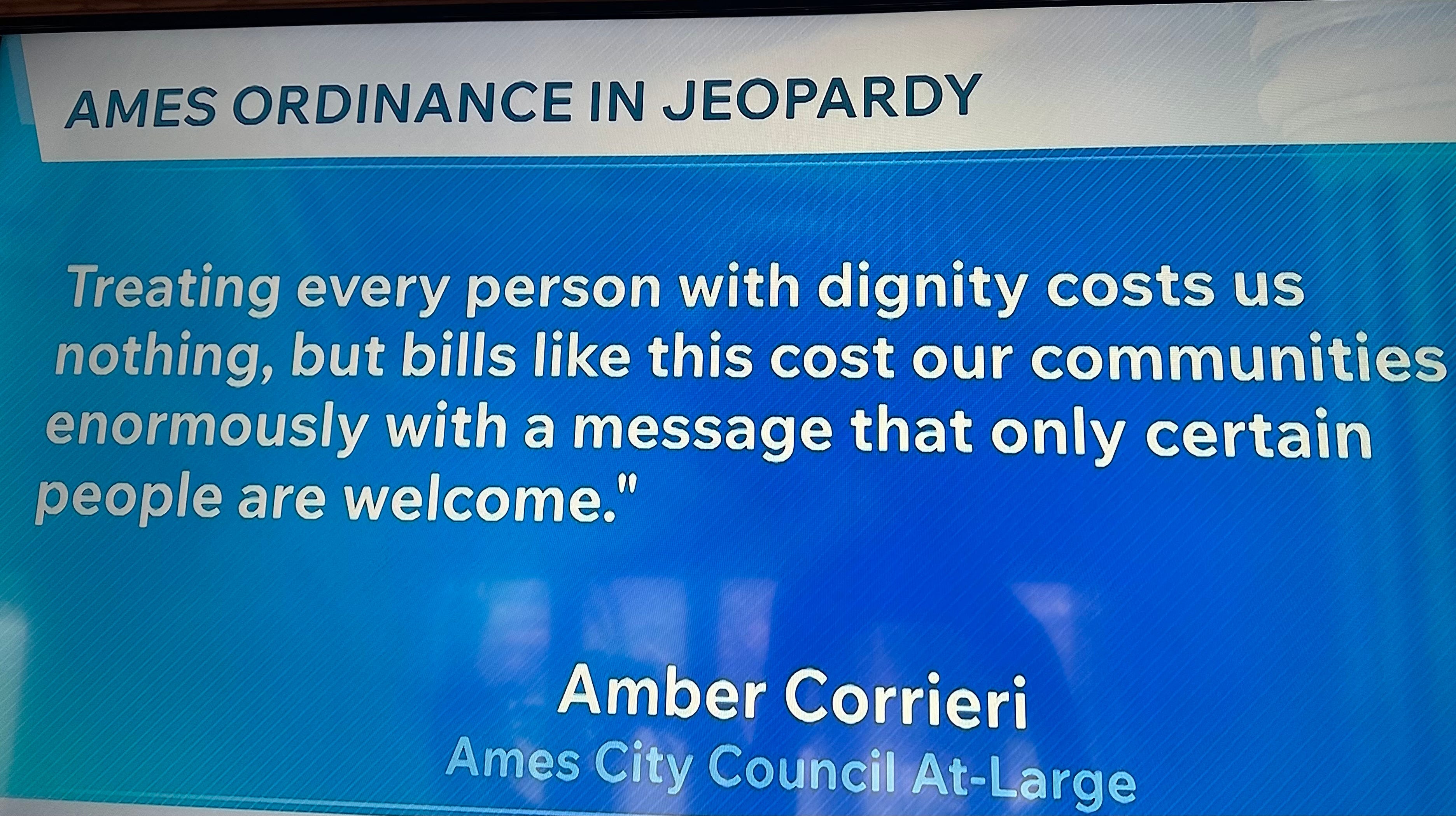
An Ames City Council member’s response to a bill that would forbid Iowa cities and counties from having civil rights protections based on gender identity.
What’s a conscience, and what benefits should we get for following ours on a path we believe is right?
None, actually, other than the rewards we get from within, or recognition from a place of worship. In civil society, where moral principles and how we choose to abide by them vary from person to person, we need to follow laws. We get paid for following workplace policies. If we go above and beyond expectations, there may be a bonus (or are those a thing of the past?).
Civic organizations might honor us for extraordinary generosity to a cause or for putting ourselves at risk to save a life. But expecting employers, especially in health professions, to bend their standards of care to our individual beliefs, is going too far. Your moral code can dictate your calling, but it can’t absolve you of responsibility for filling your obligations to others.
That’s why the Iowa Senate’s passage this week of House File 571, a so-called “medical conscience” bill is so disturbing. If signed into law, it will let medical providers, pharmacists and hospitals opt out of providing non-emergency patient care or medication they say violates their personal ethics. Some would call those prejudices. Those patients will suffer.
Lawmakers should heed the warnings from states that already passed such laws. Under Florida’s, health care providers and insurance companies can refuse to perform or pay for anything “that violates ethical beliefs.” Montana won’t even allow health care providers to refer patients elsewhere for abortions without those facilities’ permission – much less perform them themselves. But Montana protects providers who won’t prescribe medical marijuana or take part in gender-affirming care, or other procedures that don’t fit their ethical, moral, or religious beliefs.
In Nashville, Tennessee last month, a patient had been in a hospital for three hours hooked up to an IV, awaiting a sterilization procedure. Then she was told it wasn’t going to happen - not because of any medical complications, but because, as the woman was told, the Catholic hospital’s Catholic Ethics Oversight Committee said it had a “duty to protect her sacred fertility.”
And a single mother in a “medical conscience” state was turned away from getting prenatal care because it violated the doctor’s moral code. She had to go to another state to get it.
Since there are no rules that require patients be told in advance which providers won’t do which procedures, many would be denied services they came in for. One example was a doctor refusing a mother’s request to be sterilized while getting a C-Section.
Simply put, those providers could retain their licenses and jobs despite refusing to carry out the services their patients came for. Think gene therapy that could treat sickle cell disease or hemophilia. Think a liver transplant for someone with a history of alcoholism. Think abortion or gender-affirming surgery. Those were examples offered by Democratic lawmakers in testimonies before Iowa’s House and Senate. Or think about the growing divides over vaccines, and the prospect of doctors or pharmacists refusing to give them. State licensing boards wouldn’t be allowed to discipline the professionals or institutions and patients couldn’t sue.
As Democratic Sen. Sarah Trone Garriott of Dallas County pointed out, many Iowa communities already lack health care providers and depend on pharmacies within driving distance. She worried about pharmacists refusing to dispense weight-loss drugs, also used for diabetes, because they think losing weight is just about will power. She also wondered about doctors refusing to prescribe, or drugstores to fill, prescriptions for anti-depressants, drugs to treat ADHD in children, medicines for HIV or Herpes or erectile dysfunction.
That latter example was the only one bill proponent Jeff Taylor, a Sioux County Republican senator, specifically scoffed at on the Senate floor. He said, “I’ve never heard it’s immoral to prescribe Viagra.” Right, because who would dare question a man’s right to sexual gratification? But a woman’s right to reproductive choice? That’s another story.
Accomodations to our respective belief systems can be negotiated if they don’t interfere with our responsibilities at work. But in a field as crucial as medicine, they would interfere, to clients’ detriment. And there may be no recourse.
Of the lobbyists weighing in on last week’s bill, 18 were in favor and 70 opposed. One opponent was Wendy Abrahamson, a lobbyist for the Iowa Episcopal Diocese. I asked her why a religious institution would disapprove of this legislation. She answered with reference to the right to bodily autonomy, including abortion, gender-affirming care and mental health care. “It will mean even stronger restrictions in a state where they’re already pretty tight,” she said, adding such a law could discourage more people from practicing medicine in Iowa, which already has a shortage. But Abrahamson was careful not to “judge the impulse” of those proposing it.
The Senate vote on the bill was 30 yes, 16 no, with all Democrats opposed. The House passed an earlier version of the bill last March 64 to 32. But that one also protected insurance companies from liability for refusing to cover services based on their ethical beliefs, as Florida’s does. An Iowa Senate amendment removed that part.
But the bill still restricts the state’s licensure boards from disciplining practitioners for statements or associations. It allows providers to sue anyone believed to have violated those provisions.
You can’t look at this bill without considering all the other pieces of legislation, either proposed or passed, seeking to force religion into secular law. They crop up as “Don’t Say Gay” measures and book bans, parental protections for parents who seek “conversion” therapy to force their gay children to be straight. One strips the civil rights of transgender people from counties and cities that still recognize them. A new House bill proposes making it a felony to obstruct a religious service - no other kind of proceeding. Not that any such obstruction has taken place here that we know of.
And that’s not to mention the massive transfer of public taxpayer money taking place from public schools to religious ones via vouchers. Are the lawmakers behind these oblivious to the constitutional separation of church and state?
This bill is a grave disservice to anyone seeking care who isn’t warned in advance that it might not be provided.
An Iowa poll taken in February, 2024 found that 73% of Iowa Democrats opposed allowing health practitioners to opt out of services based on their beliefs, compared to 32% of Republicans. Among independents, it was 55% opposed and 43% in favor.
As for religious groups: 60% of evangelicals and 53 % of Protestants support opt-outs
But 57 % of Catholics oppose them. So do 74% of those who don’t identify with a religious belief.
A conscience is a beautiful thing and everyone needs one. Maybe you don’t eat meat to protect animals. Maybe I’d be a conscientious objector because I couldn’t support a war. But I’d be willing to face the consequences.
In a secular society governed by laws, our personal dictates might conflict with other people’s rights. We can’t and shouldn’t try to foist our values on those we’re meant to serve. If you’re a doctor or nurse who can’t bring yourself to follow medical expertise or protocols, you should either limit your practice or consider another line of work.
Next week is the Iowa Legislature’s second funnel week, when some bills will advance and others will die. Those based on religious prejudices or giving special advantage to religion should not move forward. They’ll not only violate the constitution, they’ll foster even more discrimination.
I’m a proud member of the Iowa Writer’s Collaborative. Click below for the full roster.
No posts
Comments
Nothing yet. Say the first thing.
Sign in to join the conversation.