
Cartoons are magic. They just are. You can argue that they’re just pixels on a screen, or ideas from someone’s head made into a 2D program for television, or even brain rot if you really feel that way. But before they’re any of those things, they’re magic.
A guy named Burt Gillett knew this was true long before we ever wrote it down. Burt came in guns a-blazing to the empire that was (and still is) Disney back in 1929, having some years as a newspaper cartoonist and creator of his very own studio under his belt. He also had quite the reputation at this point, well known for his erratic outbursts and touch of, well, let’s just call it “arrogance.” This story isn’t really about Burt at all, though. Burt, as it happens, would build a career at Disney, which would culminate into one pivotal moment for himself, and ultimately, for animation as we know it: Flowers and Trees.
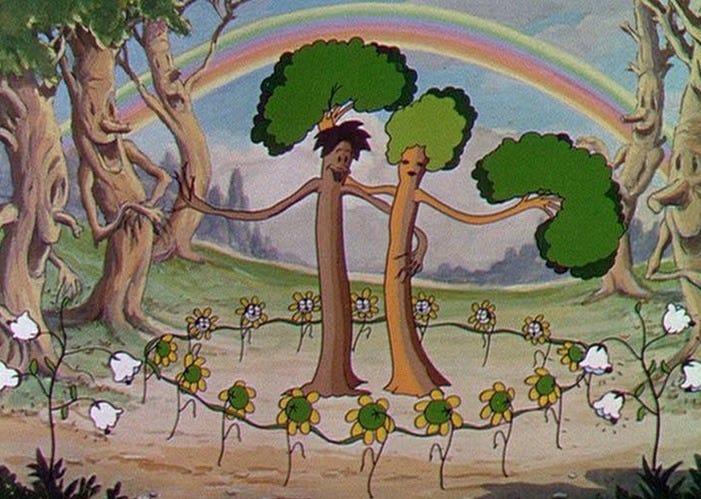
If you haven’t seen the masterpiece, we order you to stop reading this immediately and look it up on the good ‘ol Tube of You. Or you can just click here. It’s easy to get caught up in the thinking that humans are as creative or as funny as we’ve ever been in this day and age. Flowers and Trees knocks that notion high into the sky and into oblivion. First and foremost, it’s a love story between two trees. And whoever you are — boy, girl, cynic, robot, or alien from outer space — everyone likes a good love story.
The opening credits are shakily filmed, a bit like a home movie, which naturally adds to the nostalgia of it all. The action begins with a meadow waking — trees yawning dramatically, flowers stretching their leaf arms lazily to the sky, and mushrooms popping their caps out from the dirt. We see our first glimmer of true genius and comedy when the flowers perform their morning stem calisthenics (cali-stemics, if you will) when the caterpillar takes a quick shower under the morning dew of a flower. The film then zooms in on our protagonists, two young trees, alive and bursting to their branches with energy. Bet you know where this one is going. The lady tree with bushels and bushels of luscious, leaf green hair catches the eye of the young strapping tree rooted next to her who proceeds to serenade her and the whole thing quickly evolves into a classic boy-meets-girl romance. Apparently trees move faster than humans in that department. This first part of the story is about as peaceful as it gets. An evil, old weathered stump notices the lovely lady tree too and after trying and failing to steal her away, brawls with the young strapping tree. Obviously the stump isn’t in the best of shape and loses, pivoting its strategy to wreaking havoc on the entire meadow and ultimately lighting it ablaze. (Make a joke about violence in trees here). Of course, this now becomes bigger than a simple get-the-girl situation. Every last flower and tree descends into a panic. Right here is where the animators really take it and run.
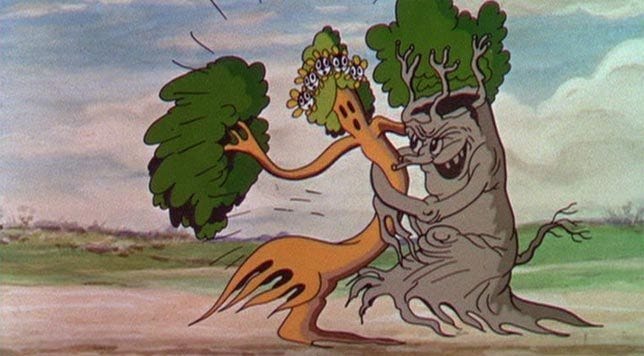
The bluebells transform into literal bells and start ringing their flowered heads in alarm, not unlike a fire station’s warning bells. The bird’s caw turns into a siren of sorts. The lilies work tirelessly to dump water onto the fire using their flowers as buckets. A few of the more cowardly residents like the mushrooms go running for the hills. Chaos ensues until the birds band together, drill holes into the clouds, and rain showers down onto the meadow, extinguishing the deadly fires. Everyone rejoices and lives happily ever after for the most part.
It’s a great story on paper, sure. That’s obvious to anyone with a knack for wit and making something out of nothing. However, at the risk of repeating ourselves, the magic is in the animation. The magic is in the movement. You have to see the trees running into the lake to put their pants on and the birds using their nests to dump water onto the flames to really understand the methodical creativity at play here. It’s pure genius in the form of a Disney short film.
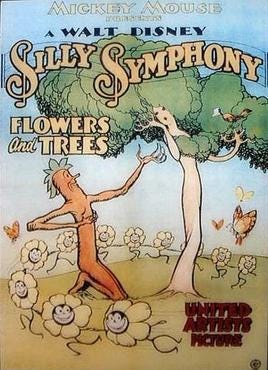
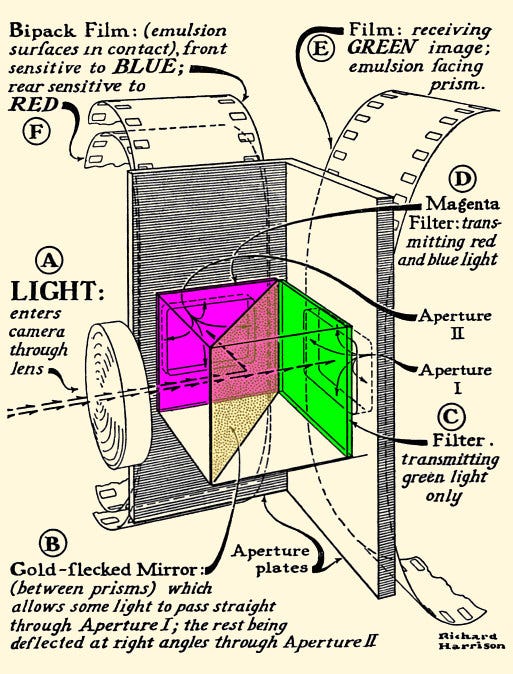
The magic is also in the film — yes, the actual physical strips of film. Flowers and Trees was not originally destined for color. At some point during production, Walt Disney was approached by a man named Herbert Kalmus. For our purposes, we’ll call him “Herb.” Herb and his team had just polished off their creation of the first three-strip Technicolor film after obsessively mastering the system. Walt decided to try the new method out on Flowers and Trees, which was already in production as a black-and-white short. That decision is something we should all be thanking our lucky stars for and here’s why. The word Technicolor gets thrown around pretty casually nowadays. It’s often used as a fluff word to make a film appear more impressive due to being more “manually” created. However, no modern films actually use the original groundbreaking three-strip Technicolor that made color movies a thing.
A Technicolor system consists of a special camera, a unique film process, and a print-dye transfer hyperspecific to the laboratories of the Technicolor Corporation. We’re not sure if we quite understand the process ourselves, so we’ll leave it at this: the three-strip Technicolor process was so earth-shattering because, unlike its two-strip predecessor, it was the first system to ever incorporate all three primary colors. What does that mean? Well, most color movies up until the ‘30s only used red and green combinations to create all of the other colors in the film. The result was a sort of hazy muddy pink appearance. This new version used red, green, and last but not least, blue. By using all three primary colors, Herb literally gave filmmakers the rainbow. It was surreal at the time, giving films like Flowers and Trees extra-saturated and vibrant color with a clear focus. Hard to say if anyone realized the historical implications of this new creation. It’s the reason why we are still able to view these films in 2026 in all of their colorful glory. Not only did the three-strip system change the game of color, but it also changed the game of film preservation. It stabilized the film, allowing it to be viewed over and over again and stored for future viewing without heavy degradation. Without it, a whole half-century’s worth of movies would be lost to the hands of time. If Herb was still with us, we’d encourage everyone to send him a big bouquet for his work.
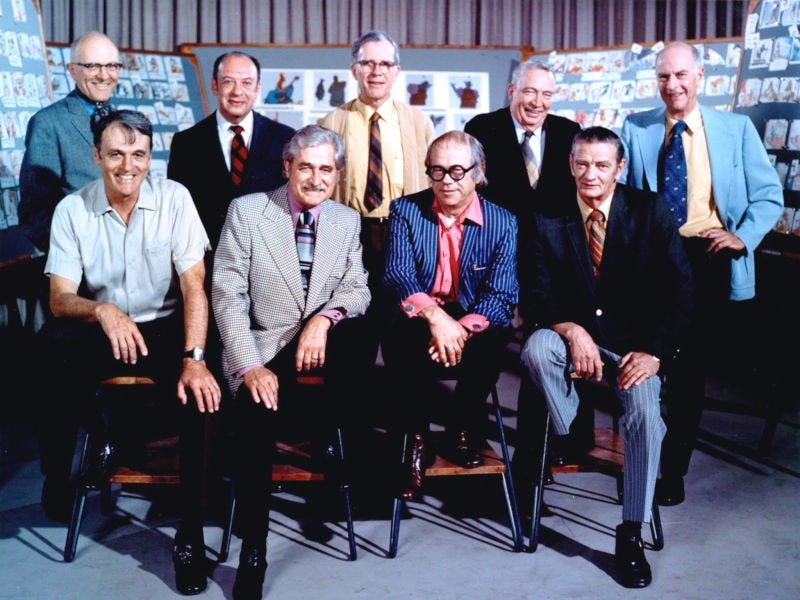
Okay, back to the cartoon. The oddball creativity shines through the cartoon of it all thanks to three main animators - Les Clark, David Hand, and Tom Palmer. These three were known as members of Disney’s “Nine Old Men,” the brains and hands behind some of the company’s most iconic animations from the ‘30s until the ‘70s. They weren’t mere pioneers of animation; they were advancers of the art. Alongside director Burt Gillet (hey, remember him?), Les, David, and Tom’s work in Flowers and Trees launched animation into a new category of cinema and with that, into the court of public and industry opinion. Their film offered proof that animation is not simply a novelty form of art but has the capacity to bring realism to the screen just as much as a live-action film can. For Disney, it was a way to reach new audiences, invoking a new sense of awe in viewers. Whether the movie-making empire realized it or not, it offered a new mode of storytelling to help us try to understand how our world works.
Flowers and Trees brought to life the woods behind the house and the flowers in the gardens, personifying them and evoking a newfound curiosity about how these beings live their lives and we live among them. At the end of the day, yes, it’s a cartoon, and no trees do not walk around putting out fires. Adults know this, and most kids know this. Those facts are obvious, but that’s not the point. The point? To bring fantasy not just to life, but into life itself.
Flowers and Trees came out 94 years ago on July 30th, 1932. So you should probably watch it today.
No posts
Comments
Nothing yet. Say the first thing.
Sign in to join the conversation.