
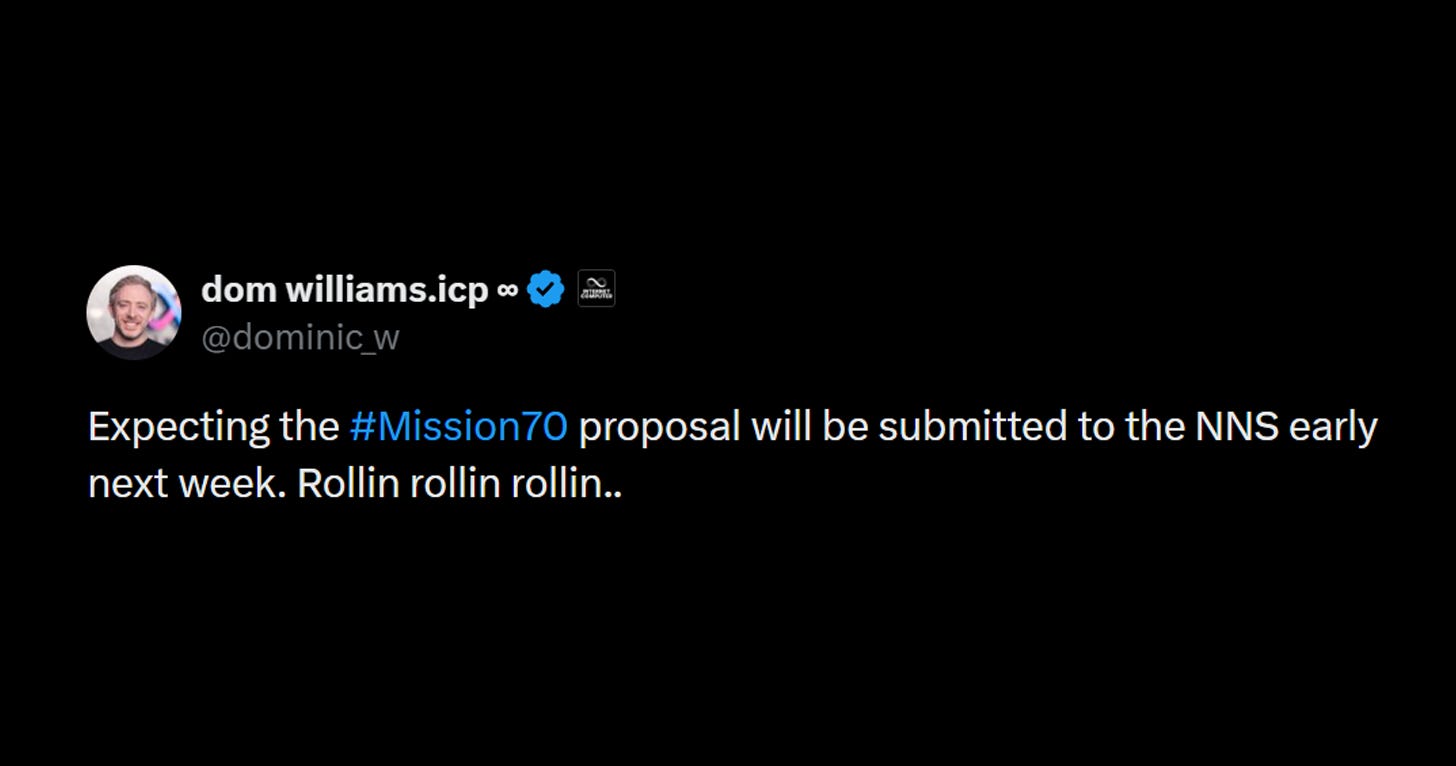
Six weeks ago, Dominic Williams dropped what might be the most consequential document in ICP’s history. The Mission 70 whitepaper landed on January 13th, 2026, laying out a detailed plan to slash ICP inflation by at least 70% before the year is out. The community read it, debated it, argued about it, and now it’s finally time. On February 21st, Dom confirmed on X that the formal NNS proposal is expected early next week.
If you’re new to Mission 70 or just need a refresher before you cast your vote, this is the breakdown you need. And if you’ve been following along since the whitepaper dropped, there are some details in here worth revisiting with fresh eyes, now that we’re actually on the doorstep.
NNS: ICP’s on-chain governance system.
Dissolve Delay: How long your ICP is locked before you can unstake it.
Maturity Modulation: A mechanism that adjusts how much ICP you actually receive when you disburse staking rewards.
Cycles: The computational fuel of the Internet Computer.
The Internet Computer has had an inflation “problem” for a while, even though if you compare it to other blockchains, you can barely call it “inflation”. But nonetheless, ICP gets minted in two major ways:
Voting rewards paid to neuron holders who participate in governance;
Node provider rewards paid to the people running the physical infrastructure that makes the network function.
Those two streams have been pumping out new ICP at a rate that the current level of network usage simply hasn’t been able to offset through burning. The result is persistent sell pressure from both stakers disbursing maturity and node providers converting their monthly rewards.
The Mission 70 whitepaper outlines a plan to reduce ICP’s raw annual inflation rate from 9.72% to 2.92% by the end of 2026, combining supply-side reforms with demand-side acceleration through increased ICP burn from network usage.
The name itself is the goal: reduce net inflation by 70%. Here is how they plan to do it.
This is the part that affects most ICP holders directly, so pay attention:
This is the headline change that everyone reacted to when the paper came out. All existing neurons would go through a one-time migration where their dissolve delays are capped at 2 years. If you have a 6-year delay today, you would wake up at 2 years. If you have 8, same result. Everyone gets capped.
Before you panic: if you’re a non-dissolving neuron, this migration does not touch your age bonus. Whatever you’ve accumulated over years of not dissolving, you keep it. That was a meaningful detail that got lost in some of the early community discourse.
On the other end, the minimum dissolve delay for voting drops dramatically, from 6 months down to just 2 weeks. This matters because the current 6-month barrier is genuinely high compared to other chains, and the last 6 months of dissolving don’t even earn rewards anyway. The new minimum is designed to lower the barrier to governance participation and attract more short-term holders into the system.
Right now, the dissolve delay bonus increases in a straight line. Lock for twice as long, get proportionally more rewards. The new system uses a convex curve, specifically a quadratic function, which means short-term stakers get meaningful but modest rewards while long-term stakers get significantly better incentives. The curve gets steeper at the top. They are also raising the maximum dissolve delay bonus from 2x to 3x, so even though the maximum lockup is shorter, the bonus for hitting that max is actually higher than before.
Projected rewards under the new system puts a 2-year neuron at around 7%. That is down from the roughly 12.3% available to 8-year neurons today, but it also means you’re committing for six fewer years.
Neurons that have historically maintained an 8-year dissolve delay will receive a special flag and a dedicated 10% reward boost that stays active until the end of 2030. Nearly five years of elevated rewards as a thank-you for long-term commitment. The catch: if you start dissolving, you lose the flag and the boost. Same mechanic as the age bonus. You keep it by holding, you lose it by leaving.
This one hasn’t gotten as much attention as the staking changes, but it might matter more for long-term inflation control. Right now, the reward rate decreases from 10% at Genesis down to 5% over 8 years post-Genesis. We are nearly at that mark. Once we hit it, the rate becomes constant at 5%, which means the absolute amount of ICP minted for rewards would keep growing indefinitely as total supply grows. The fix is a cap on the daily reward pool, frozen at the level it reaches at the 8-year mark. After that, it becomes a governance parameter that can be adjusted over time rather than something that grows on autopilot.
When all those neurons suddenly migrate to a 2-year cap, there will be a large cohort of neurons hitting their dissolution date at the same time. The whitepaper proposes a queue similar to what Ethereum uses for validator exits: if too much ICP is scheduled to dissolve on a given day, the excess gets staggered over subsequent days. This is a sensible safeguard against concentrated sell pressure from the migration itself.
The current modulation formula is, by the whitepaper’s own admission, overly complex. It uses 30-day moving averages, weekly returns, and four-week means, and it has a symmetric range of plus or minus 5%. The problem with symmetric bounds is that user behavior isn’t symmetric. People tend to disburse maturity when modulation is positive, which creates an inflationary bias.
The new system compares the 7-day moving average price to the 365-day moving average price. If the current price is below the long-term average, modulation goes negative and discourages minting. If the price is above the long-term average, modulation goes slightly positive. And here is the clever part: the bounds are now asymmetric. Negative modulation can go as low as minus 10%, but positive modulation is capped at plus 2%. This corrects the inflationary bias directly. They also add a daily speed limit of 0.3%, so if you initiate a 7-day dispersement, the modulation can only change by about 2.1% maximum during that window. More predictable for stakers.
The combined effect of all staking changes reduces voting rewards inflation from 5.88% to 3.45%, a 41% relative reduction.
The other major source of inflation is node provider rewards, and the whitepaper takes a hard look at the economics.
The Internet Computer currently runs 1,424 nodes, but only 701 were actually assigned to active subnets at the time of writing. That is a 49% assignment ratio. Several large Gen-1 node providers in the US and Europe have assignment ratios below 30%, meaning their nodes are sitting mostly idle and still collecting rewards. Gen-1 hardware is also fully amortized at this point. Operating costs run between $300 and $800 per month per server, while average rewards are around $1,500 per month. A reward-to-cost ratio of 2 to 5 times is hard to justify when the nodes aren’t doing much work.
The proposal is a 40% reduction in Gen-1 node rewards. The whitepaper models out a scenario where 66% of Gen-1 providers transfer to cloud engines or exit entirely. Combined with the reward cut, total Gen-1 rewards would drop by 80%. Even so, the whitepaper argues that most node providers can still cover costs and earn positive margins at the new rate.
There is also a proposal to distribute monthly payouts throughout the month rather than on a single date, which would smooth out the concentrated sell pressure that currently hits when all node providers receive rewards at once.
On the technical side, the network has 442 SEV-capable nodes, the newer Gen-2 hardware with enhanced security features. The proposal creates dedicated subnets using only SEV nodes and reduces their size from 13 nodes to 7 while keeping cycle costs the same. This would roughly double available subnet capacity without adding a single new node.
The combined effect of these node provider changes reduces node rewards inflation from 3.84% to 1.97%, a 49% relative reduction.
Here is something important that gets glossed over in most Mission 70 discussions: the supply side changes alone only get to a 44% reduction. To hit 70%, the network needs demand acceleration. That means more people actually using the Internet Computer and burning cycles.
The whitepaper bets on two major catalysts.
Cloud Engines are private subnets that enterprises can spin up for their own workloads, configurable to specific security, performance, and resilience requirements. Think of them like the ISP boom of the 1990s, where independent providers built internet infrastructure and sold access to enterprises. Under the cloud engine model, node provider associations can sell this functionality directly to enterprise customers. Node providers receive 80% of the revenue, and the remaining 20% goes toward buying back and burning ICP, making cloud engines deflationary by design. Every cloud engine running on the network is burning ICP. DFINITY has reportedly already spoken to node provider associations that are interested in selling into the enterprise market.
Caffeine is DFINITY’s self-writing application platform, designed to let non-developers build fully on-chain apps. As more applications get built and deployed through Caffeine, more cycles get burned. The whitepaper describes a continuum where apps built in Caffeine can be exported into traditional development environments and vice versa, creating a seamless pipeline that drives ongoing on-chain compute usage.
To hit the full 70% target, the cycle burn rate needs to increase from roughly 0.05 XDR per second to 0.77 XDR per second. That sounds like a dramatic jump, and it is, but the whitepaper notes that the burn rate already exceeded this level for several months in 2025. The demand-side target is not entirely out of reach.
The cloud market context helps frame the ambition here. Cloud computing generated about $1 trillion in revenue in 2025 and is projected to hit $2 trillion by 2030. DFINITY is pitching cloud engines as ICP’s entry into that market, and even a small slice of that would represent enormous cycle burn.
The whitepaper dropped January 13th. The community spent weeks dissecting it. Most of the community agreed with cutting rewards, though debate remains on the degree of the cuts. That’s a pretty healthy starting point for a governance vote of this magnitude.
On February 21st, Dom confirmed the proposal is expected early next week. The NNS vote is where all of this becomes real. Not a whitepaper. Not a forum thread. An actual on-chain governance decision that will change how ICP works, how your neurons earn, and how the economics of this network function going forward.
If this passes, 2026 becomes the year ICP’s tokenomics actually changed. Supply-side measures bring inflation from 9.72% down to 5.42% by 2027. If demand acceleration hits its targets, it falls further to 2.92%. That’s a 70% reduction from baseline.
If you’re an 8-year neuron holder, the migration caps your dissolve delay at 2 years, but you keep your age bonus and you receive a 10% reward boost flag that lasts until 2030. The system is acknowledging your commitment rather than penalizing you for it.
If you’re a newer or shorter-term staker, the lower minimum dissolve delay of 2 weeks opens up governance participation to you in a way the current 6-month barrier never did.
If you’re a node provider, the 40% Gen-1 reward cut is a real hit, and the whitepaper doesn’t pretend otherwise. But it also models out the cloud engine opportunity as a path to new revenue that is structurally deflationary for the token.
If you’re just an ICP holder trying to understand what this means for the value of your tokens: Mission 70 is a serious, detailed attempt to address the inflation problem this community has been talking about for years. The supply side numbers are not aspirational. They are concrete changes to specific parameters. The demand side is where some uncertainty remains, but the infrastructure to support that demand is actively being built.
If you made it this far, thank you for reading. And if you want more ICP articles like this one delivered straight to your inbox, consider subscribing to my Substack.
Talk to you later. BasedGiant.
No posts
Comments
Nothing yet. Say the first thing.
Sign in to join the conversation.