

I made a post questioning whether CaffeineAI serves a real purpose, or whether it's just an app chasing a narrative. So instead of guessing, I decided to pull every Caffeine-related canister I could find on-chain and inspect what's actually inside them, to see whether people are building real things or just testing it once and shelving it.
Caffeine is DFINITY’s “build an app by describing it” tool. You type what you want, it deploys a working web app onto the Internet Computer. My assumption, which I shared about a week ago, was that this was a “toy”: a wave of launch-day demos that nobody actually kept. A neat trick that produced throwaways.
So I checked, because that’s the whole point of this Substack. Here is what I found, and where I had it wrong.
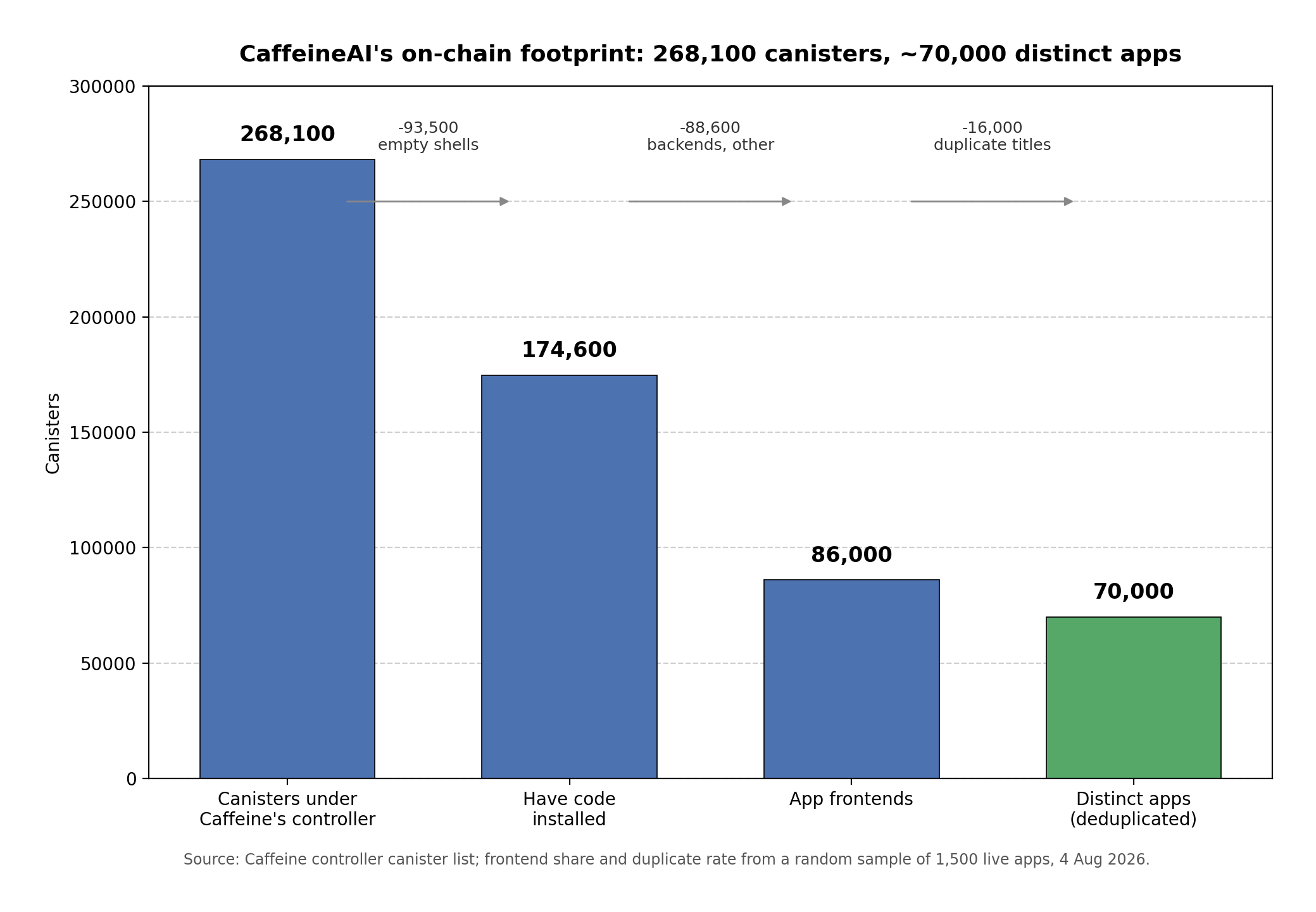
Caffeine apps share one on-chain fingerprint: every canister it deploys carries the same controller. That controller currently sits on 268,100 canisters, about 22% of everything on the Internet Computer. Strip out the empty and duplicate ones and you get roughly 86,000 deployed app front-ends.
That number alone doesn’t prove anything. Because that could be a big pile of dead pages. So I pulled a random sample of 1,500 of those apps and actually probed them.
Of the 1,500 apps I checked, 99.7% were serving a live page. Only 1.1% were empty placeholders. I went a step further and pulled the JavaScript bundle for 300 of them to make sure they were real deployments and not blank shells. All 300 of them loaded. These are real, complete apps. Are they complex applications? No, they are simple websites for the most part.
That already killed my “abandoned demos” assumption. But the thing that actually changed my mind was reading the titles.
Scattered through the sample were things nobody builds to test a toy:
A diagnostic and orthopaedic clinic in Bhilai, India
A pharmacy in Perundurai
A pizzeria in Gorakhpur
A textile export B2B tool
A Polish FPV drone-event platform
A Persian coffee shop
Nobody generates a website for a real orthopaedic clinic in Bhilai to “check the tyres” on an AI app builder. Somebody wanted a working site for an actual business, and Caffeine gave them one. Under a conservative count, about 42% of the live apps are recognizable business tools or local-business sites. The real figure might be higher, because a chunk of what my classifier couldn’t label turned out, on manual inspection, to be more of exactly this: real apps with local or non-English names.
I was judging Caffeine as a developer tool, against things like Claude Code, and by that standard it looks thin. But developers aren’t the users. The users are the pizzeria in Gorakhpur and the pharmacy in Perundurai. Caffeine isn’t competing with developer tools. It’s competing with WordPress, Wix, and Squarespace, the “I just need a website for my business” market. Judged against that, a globally distributed base of small-business sites deployed by non-technical people is exactly the point, not a disappointment.
Being wrong about Caffeine being a flop doesn’t mean flipping to the hype. Three things keep honest:
Serving is not the same as being used. A canister keeps answering as long as it holds cycles, and Caffeine appears to pay for that hosting. So 99.7% “live” measures Caffeine’s willingness to fund hosting, not whether anyone visits these sites. It’s the cheapest possible sign of life. I have no traffic data, visitor counts, or retention. A website can be live and have zero users. And unfortunately there is no way for me to check against that.
“86,000 apps” is inflated. Titles repeat heavily, and one app appears roughly 2,200 times across the network. About 19% of named apps share their name with another, which is the signature of redeploys or repeated tutorial prompts, not 86,000 distinct ideas. The honest distinct-app count is closer to 70,000, and that’s still an impressive number.
The junk is real too. Right next to the clinic and the pizzeria are Valentine’s-day novelty pages, a dead memory game, an “Amazon Clone,” and about 16% of apps that never even got a title.
The honest read is roughly 70,000 distinct, near-universally hosted apps, with a real and geographically diverse small-business core mixed with a big layer of experiments and duplicates.
The open question I still can’t answer is whether that base is growing or stalling, because this is a single snapshot. That needs tracking over time, and it’s what I’m considering for a future article.
I’m on record saying “Caffeine has no reason to exist”, but the chain says otherwise, and I’m happy to take that back.
If you found value in this article, please consider subscribing!
No posts
Comments
Nothing yet. Say the first thing.
Sign in to join the conversation.