
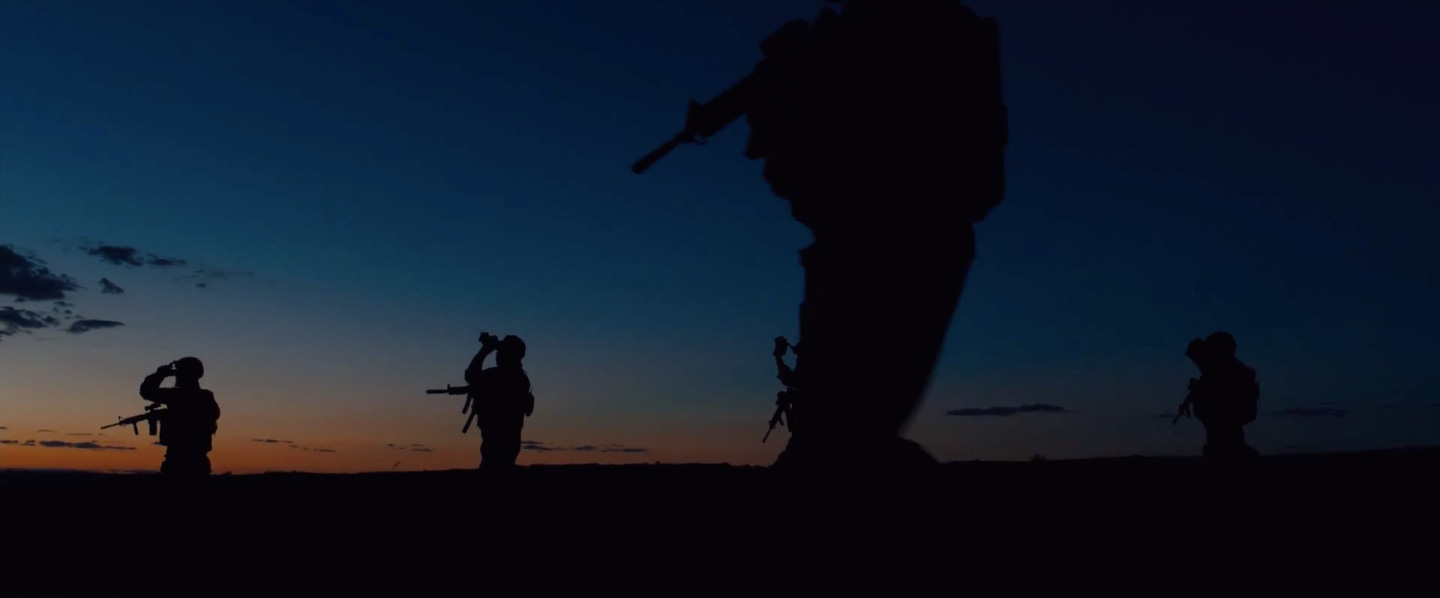
“You should move to a small town, somewhere the rule of law still exists. You will not survive here. You are not a wolf, and this is a land of wolves now.” – Sicario (2015)
Children’s literature has gotten soft. Disney turned every woodland creature into a cute little forest friend, and tacked a happy ending onto every dark fairy tale. The bloodstains were scrubbed out, death was swept under the rug, and the moral lessons became saccharine platitudes about being kind and sharing ... a helpful aid to management of kindergarten classrooms, perhaps, but worse than useless for the moral instruction of the young, who will one day need to navigate a world where the shadows of the human soul conceal sharpened knives, and the truth is not always what well-meaning young women with associates degrees in early childhood education might wish. Children go along with it, but deep down they know that they’re being lied to, that the adult are keeping something from them when they pretend that every story has a happy ending, that everyone can be friends and get along if they’re just sufficiently nice to one another.
Contemporary children’s literature has gotten even worse under the pressure of politics, with bookshelves filling with stories about antiracist babies who grow up to become boys who become girls, and girls who save themselves from dragons and therefore don’t need help from the boys who foolishly refused to become girls. This is less moral instruction than moral inversion, literature meant to turn children against their own natures, stories that deliberately deceive developing minds in order to neuter them, soften them, make them malleable and unthreatening for a managerial culture in which the socially acceptable lie is always preferable to the uncomfortable truth.
Fables For Young Wolves is not that sort of book.
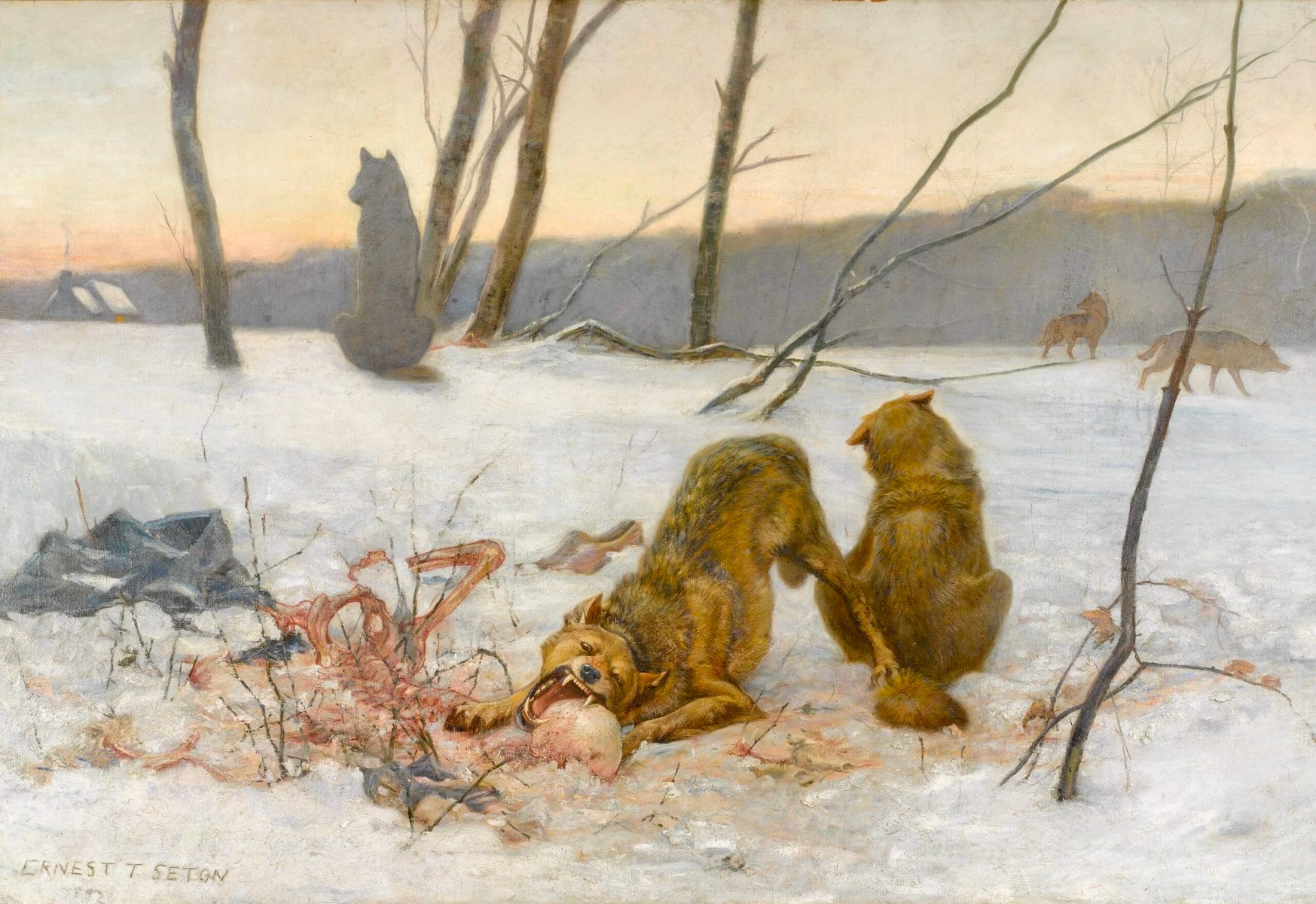
The stories in Fables For Young Wolves are true fables in the Aesopian tradition: tales in which animals are used as symbols for particular facets of human character, or for particular kinds of humans. Foxes are wily, crows are wise but conniving, pigs are greedy and vulgar, asses are stupid, sheep are conformist and dull, dogs are loyal but credulous.
For after being brought up from childhood with these stories, and after being as it were nursed by them from babyhood, we acquire certain opinions of the several animals and think of some of them as royal animals, of others as silly, of others as witty, and others as innocent. – Apollonius, on Aesop (quoted in the foreword).
The titular wolves around whom the fables revolve are true wolves: noble, cruel, cunning, vicious enemies to their foes but faithful to a fault to their friends, playing roles of villain, victim, and hero as each tale requires. As the most psychologically complex of the animals, they stand for everything that is highest in the human soul, and so are also suited to plumb the depths. These are not Disneyfied vegan wolves that make friends with rabbits: these wolves are hunters and killers, and unashamed of it.
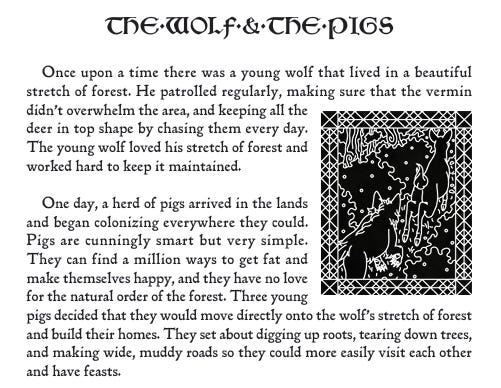
Thomas O. Bethlehem’s fables are intended, as all fables should be, to impart lessons about human nature and about the world, not as we might wish it to be but as it is, with the intent that the young reader will be guided away from bad decisions and towards the good. Many of the stories are anecdotes of a couple of pages, which communicate simple ideas about controlling your base impulses, having your friend’s back, knowing who your real friends are, the consequences of helping those who cannot be helped, and so on. Interspersed between these are longer and more psychologically complex tales which build upon well-known folk-tales such as the Boy Who Cried Wolf, the Three Little Pigs, the Wolf in Sheep’s Clothing, and Little Red Riding Hood.
The longer tales are by far the most interesting. Bethlehem subverts these stories, but in a very intriguing fashion that actually draws out their inner meanings to gripping and poignant effect. It is not a postmodern deconstruction, so much as a premodern reconstruction that brings their lessons into sharp, immediate focus. The moral of the classical Boy Who Cried Wolf, for example, is simply that if you lie too often, eventually no one will believe you; Bethlehem focuses instead on the spiritually poisonous consequences of a deepening web of lies, not only for the young shepherd himself, but for the villagers who become ever more invested in the false legend he weaves around himself. His Wolf In Sheep’s Clothing is a deeply unsettling account of the consequences of living a lie, showing how you eventually become what you pretend to be. Bethlehem’s take on the Three Little Pigs places the wolf in the role of protagonist, and asks us to imagine why the wolf would want to turn the pigs out of house and home, and what success looks like for a young wolf.
My personal favourite was his version of Little Red Riding Hood, which places the young girl and her bitter spinster aunt in the roles of the villains. Bethlehem makes this a story of a young girl who strays off the right path, which she finds too difficult and circuitous for her liking, trading her innocence and youth for the cheap excitement of secret transgressions through easy shortcuts and access to forbidden mysteries, and who ends up playing with the hearts of both wolf and hunter with disastrous consequences for everyone, herself included. This is a particularly powerful parable, warning girls against listening to bad advice from vicious old women who know just how to appeal to their worst instincts, and warning boys against the dangers of giving their hearts to the wrong kind of girl.
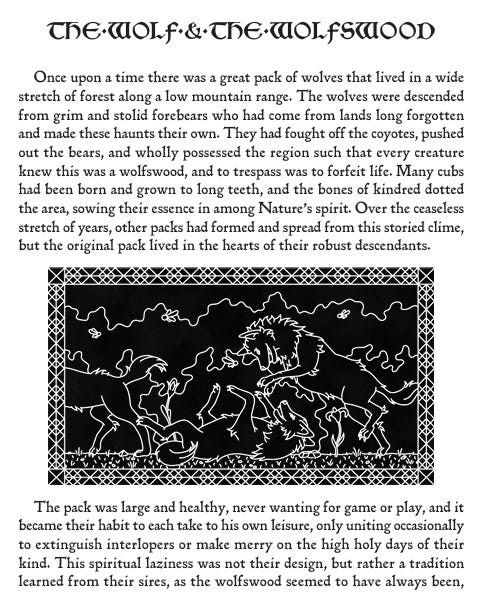
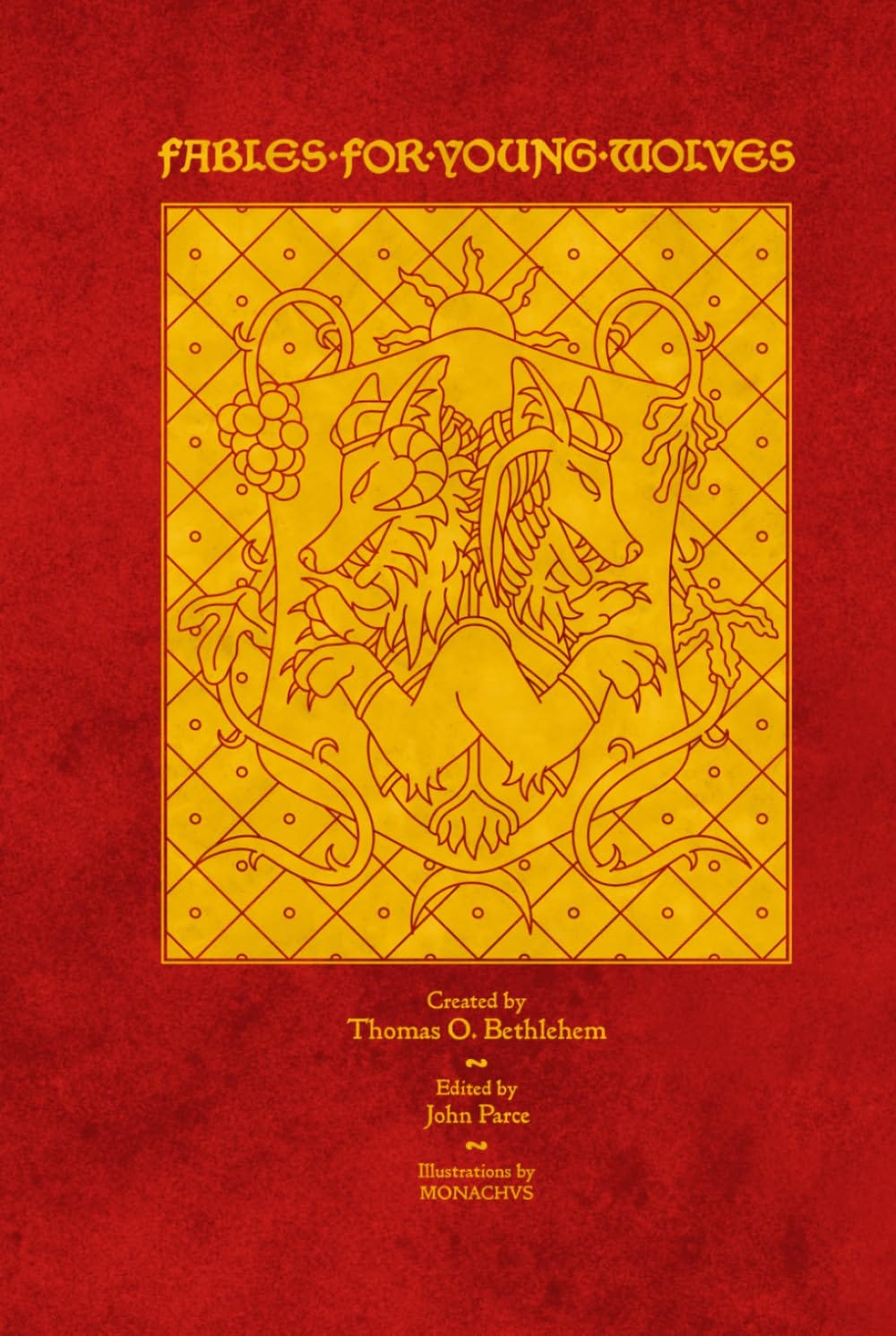
Physically, the book is a gorgeous artifact: printed in a beautiful yet very readable medieval font on thick, high-quality paper that turns easily and is not easily torn by clumsy young fingers, and sumptuously illustrated with gorgeous wood-cut style ink drawings by Twitter anon Monachvs. If I had to complain about any aspect of the book’s design it is that it does not quite do the beautiful artwork justice: many of the illustrations are a bit too small to easily make out, and would benefit from half- or full-page presentation. Perhaps a later edition will make this change; while the book would necessarily become a bit thicker, at 114 pages it has a bit of room to expand.
I’m not sure exactly what age range Bethlehem was aiming for, but my impression is that he intended his fables for young children. Depending on how advanced a reader one is, the vocabulary may occasionally present something of a stumbling block: in order to give the writing a classical, timeless feel, the author occasionally uses words that younger or less advanced readers might struggle with. That is as much feature as bug: too much literature is as intellectually stunted as it is spiritually blunted, and it is no bad thing to have to pause every now then when you’re reading to your child before bed-time to explain the meaning of a new word.
The stories are paced in such a way, and told in such a simple and direct fashion, that a child can quite easily grasp their essential meanings. That’s essential to the core purpose of moral instruction of the youth, but since that instruction is specifically of the kind that prepares them for the complexities, ambiguities, and challenges of adulthood, adults will find much to provoke their own thoughts. These are the kinds of stories that linger in the mind after one reads them, reminding the reader of lessons they themselves might have forgotten.
I opened this review with a quote from the 2015 Denis Villenuve masterpiece Sicario: “You are not a wolf, and this is a land of wolves now.” We can all sense that we are at one of those inflection points in history when the weak men bred by good times have sufficiently chewed through the load-bearing structures of the social order that hard times are imminent. Few of us were raised to be wolves; to the contrary, our society encourages us to be pigs that we might be ruled by our appetites, sheep that we might be sheered, lambs that we might be led to the slaughter. Neither the wider culture nor the educational system have pre-emptively adjusted to the harsher conditions we see coming on the horizon: they still seek to make boys and girls grow up meek, pliable, agreeable, gullible, and defenceless. We do our children no good service by failing to prepare their spirits for the gathering storm. Fables For Young Wolves is a book that recognizes that this is a land of wolves now. As Bethlehem tells us in the book’s introduction:
You don’t hear too much howling at the moon anymore, but that doesn’t mean we can’t, or won’t again soon.
If you have any young pups in your family, this would make a brilliant Christmas present for them.
Fables For Young Wolves is available in paperback and hardcover from Amazon; there is no Kindle, and that’s probably a deliberate choice. Personally, I recommend the hardcover: it’s only a few dollars more, and the quality is worth every cent. Here’s another glowing review if you’re not convinced yet; and here’s another; the Amazon reviews are universally impressed, and the book has a full five star rating. Seriously, check it out.
As always, thank you for giving this piece a few minutes of your attention. I know, I know: you want something a bit more substantial than shilling for someone’s book. I mean, I get it: I tend to shed a few subscribers every time I do one of these. But it’s also Christmas, so tough, you’re going to be getting a couple more of these over the next couple weeks. That said, I’d like to remind you that I don’t get a cent for these reviews. No kickbacks, no percentages, no quid pro quos. I do these purely out of the goodness of my heart, out of a desire to share my audience with deserving writers whose brilliance gets all too easily lost in the churning clamour of the attention market. Meanwhile, I am myself entirely dependent upon the generosity of my supporters, towards whom, as always, it is quite impossible to encapsulate my gratitude with mere words.
No posts
Comments
Nothing yet. Say the first thing.
Sign in to join the conversation.