
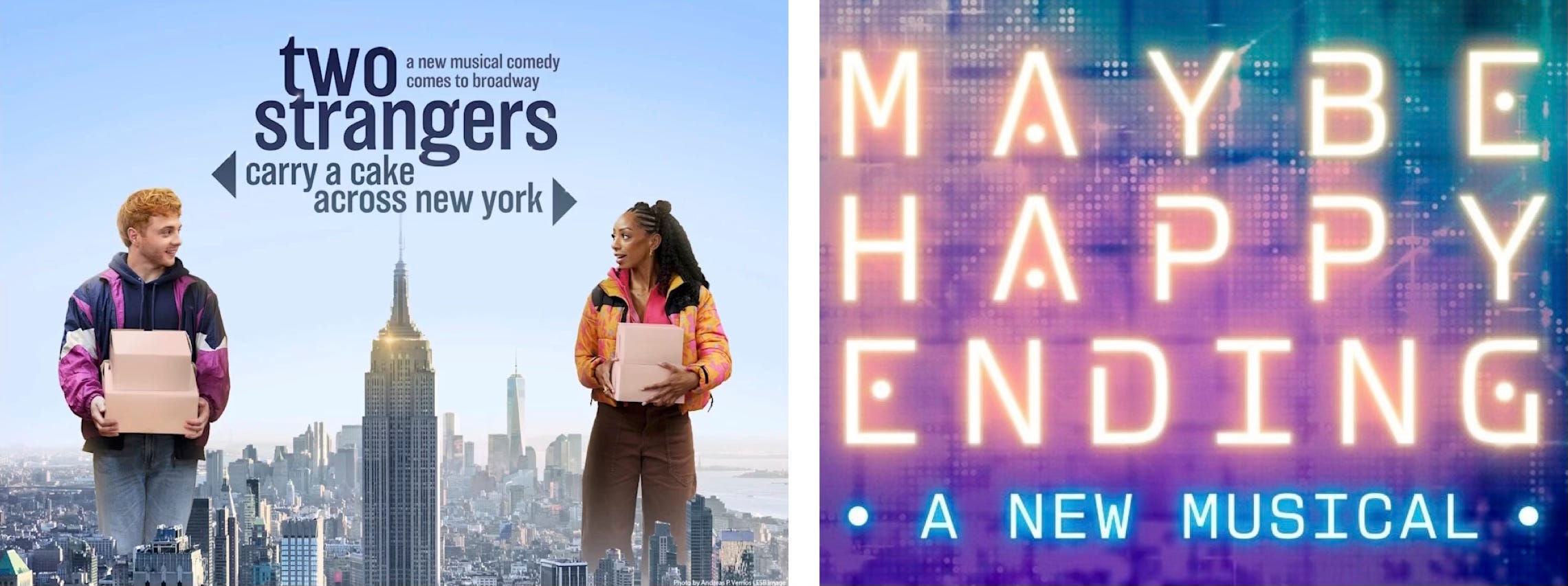
Two Strangers (Carry a Cake Across New York) feels like a wave of the future. This thought assailed me as I watched the show’s cast of two carry their musical across the stage of the Longacre Theatre.
Broadway producers, crushed by costs, desperately seek to pare casts down to the minimum. Two would appear to be their magic number. (One-person musicals, of course, exist, but Broadway ticket buyers, I suspect, prefer a plus-one up there for their bucks.)
The good news on the receiving end is that, personally, I enjoyed Two Strangers (Carry a Cake Across New York), which we will henceforth refer to as Two, for the sake of brevity. Two has…. well, two essentials working for it that, I think, delineate the make-or-break point for any two-person musical: it has two terrific performers and a clever austerity of staging.
Producers, by definition, love austere staging; which is to say, one cheap set. Two has impecuniously such a set: a pile of luggage that pirouettes for the duration of the show just like your luggage does on the airport baggage carousel (especially when you are late grabbing it).
There is something forlorn about this orbiting luggage pile, by design. It looks lonely and abandoned. Just like Two’s protagonists.
Sam Tutty and Christiani Pitts play these two solitary souls, who meet via the baggage they bear (and eventual bare). The two actors are haplessly lovable — Tutty, as Dougal, a puppyish, motor-mouthed British 20-something, abandoned, ignored and seemingly lacking all social filters — come to America for the wedding of a dad he has never known and is desperate to meet; Pitts, as Robin, a simmering, spiky repository of sister-of-the-bride resentments and regrets — assigned to pick up the groom’s nebbish son at the airport and see him into the city.
And that, ladies and gentlemen, is our setup.
Two is a rom-com, and proud of it. It also is a musical, with music, lyrics and a book by two neophytes: respectively, Jim Barne and Kit Buchan, whose very first (!) show this is. Two premiered six years ago in Ipswich (under a more prosaic title: The Season) before making its way, renamed and reworked, to London’s West End, and now, here. The score evokes Pasek and Paul and Dear Evan Hansen, which is not at all a bad thing, via lyrics that peel back the inner wounds and outward desires of its two characters perceptively and sensitively. This makes for a diverting musical trip, not wildly memorable, but given emotional heft by the performers. Tutty, who has been playing his part, literally, for years, inhabits Dougal with an effortlessness comprised of enchanting empathy and craft. I actually think I preferred Pitts’ work just a bit more because of the palpable effort that goes into it, adding a touching undertone of desperation to her character’s inherent toughness. But that just may be my own undertones echoing.
Two-person musicals have haunted me this month with an irony that is illustrative. For more than a year now I have been trying to catch Maybe Happy Ending, last season’s Tony Award-winning Best Musical. A few doubled background characters aside, Maybe Happy Ending is basically a two-person musical about a pair of futuristic bots falling in love as their batteries expire. In other words, another rom-com x 2.
If two-person musicals are a producers’ economic escape hatch, then star-turn musicals are a ticket-buyer’s economic nightmare. The presence of the estimable Darren Criss as one-half of Maybe Happy Ending blew ticket prices for the show into the stratosphere. When I first sought a press seat during previews, I was informed that I was out of luck; there were none to be had. Okay, that happens. I remain grateful for every press seat I am handed. But when I turned to the box office for entry, I found myself staring down $400+ pricing.
I am not that guy.
So, I waited and checked, and waited and checked again, feeling increasingly embarrassed (just a little) that I write about this stuff but still had not seen Maybe Happy Ending. Seasons came and went. Darren Criss came and went, returning more than once (I think he’s back in now). Finally, earlier this month, his understudy was on, prices plummeted and my stars aligned, schedule-wise. I even took my two daughters along (three tickets were still cheaper than one when that one included Darren Criss).
We had a ball. The show is terrific — again the work of two new, young composer/book writers, Will Aronson and Hue Park, again derived, musically, from Pasek and Paul (to my ears) but gorgeously orchestrated (by Aronson) for strings predominantly, sweetened by electronics that give luster and emotional sheen to the score in a manner that feels profoundly timeless, despite the futuristic setting.
Helen J Shen, as Claire, is simply luminous, acting and singing with penetrating delicacy and power. Stand-in Steven Huynh played her opposite “helperbot,” Oliver, and touched all the bases with Crissian flair.
Unlike Two’s naturalism, Maybe Happy Ending is a dystopian fantasy acted out with hyper-stylized roboticism, full of rigid gestures that, of course, define bots as bots but limit them as individuals. It all works beautifully, don’t mistake — Michael Arden’s direction is impeccable, amplified by immensely complex, often quite beautiful (and anything but austere) projections. Still, the robotic motion grid renders Darren Criss’s Oliver somewhat easier to replicate, I suspect, than Sam Tutty’s Dougal might be. I mean bots are supposed to be interchangeable.
Let’s leave it at that.
Maybe Happy Ending’s dramatic arc matches Two’s (and all other rom-coms): they meet, fall in love, break up and (just maybe) reunite. Then again, isn’t that what all musicals used to be about? Traditionally. Until, with the dawning of Stephen Sondheim, we progressed to something more complex. Does this make Two Strangers (Carry a Cake Across New York) and Maybe Happy Ending a regression, leading to a future of two-person musical rom-coms in-waiting?
Let’s hope not.
Comments
Nothing yet. Say the first thing.
Sign in to join the conversation.