
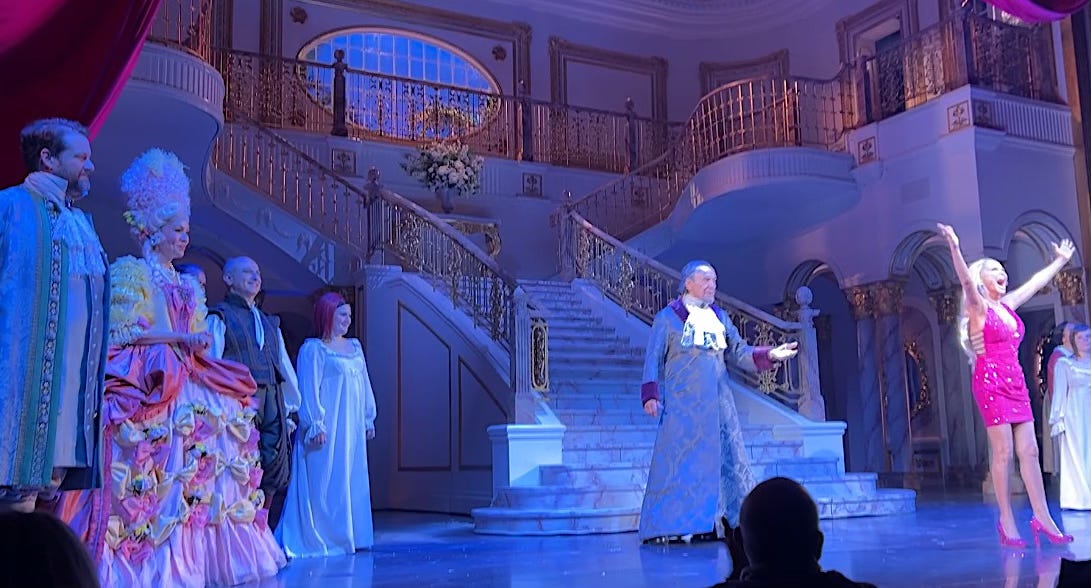
I called Stephen Schwartz to talk about Queen of Versailles after I saw it. I wanted to talk it over, as we have talked over his new musicals for a while now.
We signed up for our Zoom, when, suddenly, Queen of Versailles posted a wrenching closing notice —just weeks since opening. Out of the blue, Stephen and I found ourselves in an unanticipated, morning-after, post-mortem.
“The world changed around us,” he said, when I offered my condolences. “We were out of town in Boston last summer, and the show was received differently, receptively. Audiences now seem to think Queen of Versailles is a glorification of this evil Siegel family, which, emphatically, it is not.”
For any of you (like me) who may have missed the Siegel saga entirely, socked away in our own reality-show-free-zone: Jaqueline Siegel and her elder real estate mogul husband, David, are real people, who tried to build in Windermere, Florida, the largest private home in the annals of American McMansions, modeled upon and named for Versailles itself, only to be tripped up by the 2008 market crash and recession. Their lives and heavy losses were chronicled in a hugely popular 2012 documentary, titled (what else?): Queen of Versailles, which Stephen adapted as a musical with the resplendent Kristin Chenoweth in mind (his original Glinda in Wicked), playing the transcendently rapacious Jackie.
“We were living in a different America last summer,” Stephen went on. “There was more of a willingness to see Queen of Versailles as a cautionary tale and also see parts of ourselves in it. When Kristin, as Jackie, says to the audience at the very end, ‘I’m not that different from you,’ our goal was for people to think: ‘Actually, I can see that. Let me think about my own choices and my own attitudes.’ People are less willing to do that now, for very obvious reasons.”
I asked Stephen — who really doesn’t have to subject himself to writing new Broadway musicals anymore, but does, because that is what Stephen is, a Broadway composer: “Why Queen of Versailles?”
“The show was brought to me by Lindsey Ferrentino,” he answered, “a writer I admire very much, and by Michael Arden, who’s a friend and a director who, since he’s become a director, we’ve been looking for something to do together. Frankly, the first time they brought it to me I turned it down. This was a long while ago — before 2016. I turned it down because I didn’t like the people. Yeah, I didn’t want to spend years of my life with these people. Then, after the 2016 election, we talked about it again. I now felt there was something happening in America that I needed to understand. This was a different country than I thought it was. And I needed to grapple with that and try to understand.”
I nodded when Stephen said this, remembering when we all were still trying to understand.
“I didn’t really get down to work until the pandemic,” he continued. “I went back and looked at the documentary again and found I had more empathy for Jackie than I’d thought. Yet, that didn’t mean the documentary glorified her or celebrated her. There’s no misunderstanding Lauren Greenfeld, who made that documentary; no one thought that Lauren Greenfeld was celebrating the Siegels. But somehow that has happened to our show.”
I told Stephen, that I’d found Queen of Versailles entertaining and disturbing and unlike any musical I’ve ever seen before, in many respects — which is what keeps me going to new musicals after all these years.
Lavishly mounted (how could it not be?) the show trains a bifocus on the cheesy Versailles of the Siegels and the original Versailles of Marie Antoinette and Louis XIV. All are onstage, via Michael Arden’s sleek conjuring of both dominions. The performances are spot on, perhaps too much so, with F. Murray Abraham nailing the alternating adoration and abusive venality of David Siegel in dealing with his wife, his family and his time-share empire. Kristin C. amalgamates Jackie Siegel bling and Broadway diva blare, inspiring (in me) genuine awe at her still major musical theater talent, if not sympathy (at all) for the very grubby dame she is playing.
The most sympathetic characters in Queen of Versailles are also the most sympathetically well-played — Stephen DeRosa and Isabel Keating as Jackie’s unapologetically plebian parents, and, especially, Nina White as the Siegels’ truth-telling, Goth teen daughter, Victoria, who tragically killed herself at 18 (in real life, and in the second act) leaving behind a diary that her parents later published (a questionable choice, at best), and that Stephen mined for, what I found to be the show’s best song, “The Book of Random.”
“That was actually, the first song I wrote,” he told me. “I had the diary, which the Siegels titled: Victoria’s Voice. I extrapolated lines from it; most of what’s in that song are things that Victoria actually wrote in her diary. The second song I came up with was ‘Caviar Dreams.’ This is a family that grew up watching Lifestyles of the Rich and Famous in the the 80s; that’s when American values started to change: Be rich, be famous, always have more, because whoever has the most, wins. And do it with absolutely no shame.”
At intermission, the night I saw Queen of Versailles from an unusually ritzy Row D press seat, I stood up at Intermission and found a uniformed young martinet standing in the aisle before me (and beside Row C), a shiny shopping bag in her hand. It took me a minute. “Are you delivering something?” I asked, aghast, thinking: Uber Eats?! Yes, she nodded. “What?” I wondered. She pointed to a QR Code embossed in the armrest of Row C. “VIP tickets come with perks like delivery of merch and food to your seat,” she recited. “Just scan the code.”
I was flabbergasted. But not surprised. “It’s like you’re part of the show up there,” I exclaimed. She smiled wistfully and murmured: “If only.” I smiled too, and shrugged. “I wish it for you.”
The pampered object of her delivery returned late, unsurprisingly, with the orchestra already striking up for Act 2. Poor delivery kid had to scramble back up the aisle in the dark.
Stephen’s score for Queen of Versailles possesses a country western kick that is kind of new for him. I liked it. “It is a bit more country than I normally am,” he acknowledged. “It just felt like these people — even though Jackie actually grew up in a suburb of Binghamton — these people are country.”
Certainly, Queen of Versailles’s score is as melodically engaging and lyrically enticing as Stephen’s best work always is, but it also manages, in doing so, to be slightly discomforting. Great performers belting catchy, new Stephen Schwartz songs about irredeemably unappetizing people can make for one disconcerting evening. Which, in the spirit of Sweeney Todd, can be transcendent. But in Queen of Versailles gilds the vast space between scarfing Sweeney Todd meat pies and scarfing Big Macs, a distance that can leave one a little dyspeptic.
“I do think there’s an audience that would really respond to this show that has decided it doesn’t want anything to do with this show,” Stephen concluded. “And I think that’s sad.”
I do too. Where both of Stephen’s Wicked movies speak eloquently through fantasy against the specter of Fascism, Queen of Versailles feels like the MAGA beast itself, onstage and singing. It’s real. And that’s scary. We can’t look away.
Comments
Nothing yet. Say the first thing.
Sign in to join the conversation.