
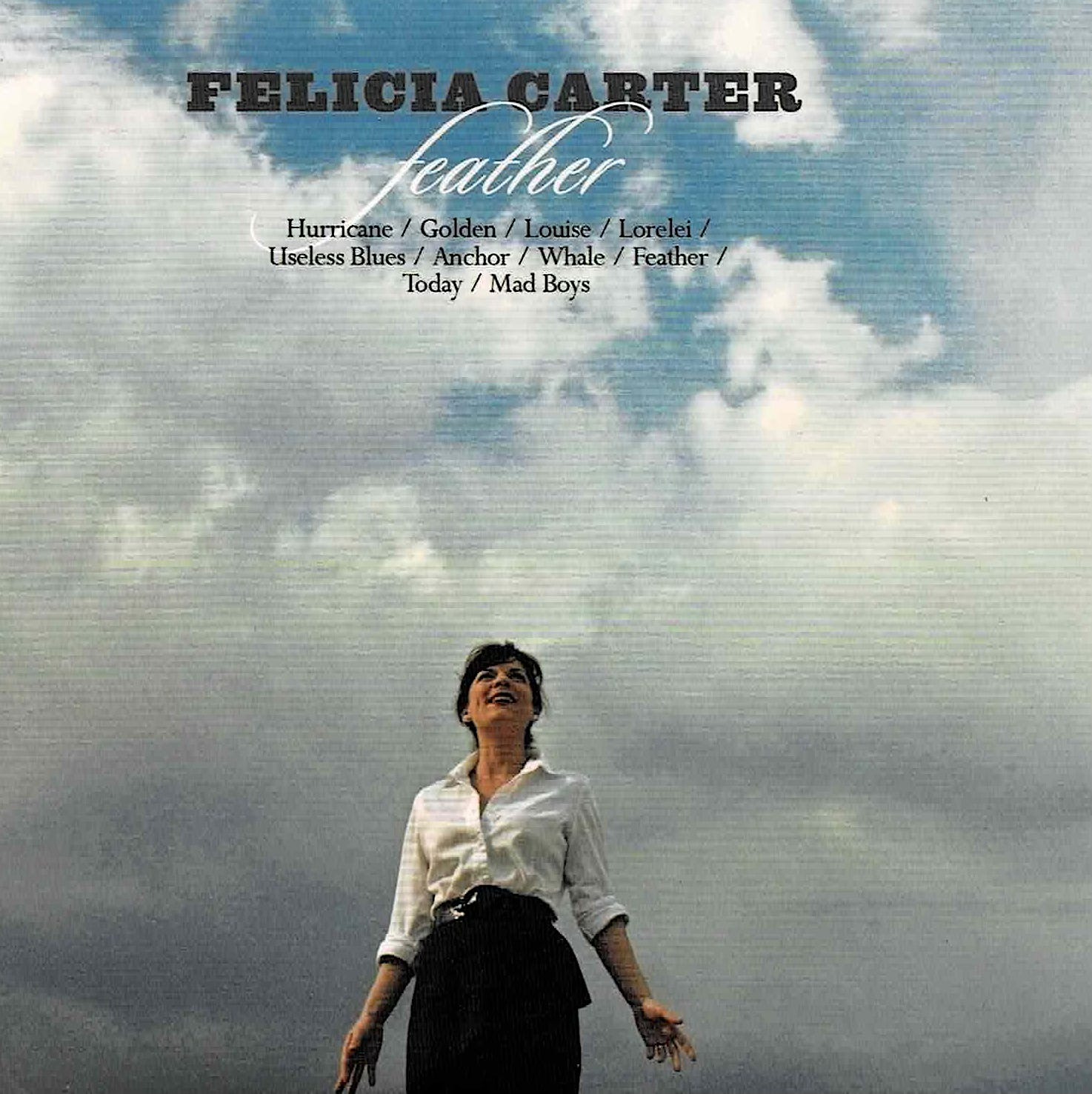
Voices come and go on the internet, as we all know, echoes in the digital din. This is a story of one voice that resounded for me, resulting in a kind of digital resurrection. One way or the other, AI had nothing to do with it.
The story begins on the music streaming site Pandora way back near its inception, around 2005. I heard a voice there and thought: “Hey, that’s good.” I looked for a name on my screen — something I don’t necessarily do that often. The name on my screen read: Felicia Carter.
The voice returned. I heard it again on a random-mix Pandora channel I’d created around Blossom Dearie. The resemblance to Ms. Dearie was only cursory — a lilt, some understated musical wisdom, a deceptive grace with a lyric. But that voice popped up and made me look up, again… and again — on channels created for Beverly Kenney, for Lee Wiley, for Ella and even Billie. The more I heard Felicia Carter the more I listened.
The song that finally did it for me was “Almost Like Being in Love,” a perfectly lovely song, written by Lerner and Lowe for their musical Brigadoon; sung most memorably by Gene Kelly in the MGM movie. As written, the song, is a rhapsody of newly besotted love. That’s how Gene Kelly puts it over in the film.
Felicia Carter sang it with a tripping, giddy joy. But there were shadows. She truly is a jazz singer, I thought, as she percolated on the song with infectious swing and more vocal heft, I suddenly realized, than the delightfully micro-voiced Blossom, or the wistfully evanescent Ms. Kenney, to say nothing of Billie Holiday, whose timbre and back-phrasing she at times seemed to embrace.
Like all of them, Felicia Carter held back to deliver, flitting over the song with a sweetly reticent pizazz. Here and there, though, she let loose with some rich, long vocal lines that went deep, and sad; revealing a trained voice of inherent power and a bittersweet, throat-catching vulnerability. I began to smile when she did this, and nod. Felicia Carter was, for me, no longer easy listening.
Inexorably, I created a Felicia Carter channel on Pandora. Sometimes I let it run all day, but there was only so much music to fill it, which became frustrating. Apparently, Felicia Carter had not recorded much, though it was difficult to tell; an obfuscation factor of music streaming on the Net.
Needless to say, I am not a Net guy. I used Pandora because I never figured out how to work Spotify. I prefer CDs (actually)with liner-note-dense booklets; or records, of course, or even well-deejayed radio. I mention this merely as a passing explanation for why it literally took me years before I finally thought to google Felicia Carter’s name.
I found no Wikipedia page. No website of her own. This was well into the 2010s at this point.
Finally, I uncovered a two-paragraph bite on a site called All About Jazz that referred to “Baltimore vocalist Felicia Carter.” A two-disc CD was referenced, issued in 2007, called Feather/Step Lightly, consisting of original tunes by Carter (music and lyrics), interwoven with a clutch of standards.
This was the music I’d been listening to on Pandora. The names of her exceptional band on these cuts were also confirmed. Their swirling jazz classicism and fearless improvisational kick had impressed me, underpinning her vocalese inseparably: pianist Bob Butta, bassist Amy Shook, drummer Frank Russo, and guitarist Donato Soviero, plus trumpeter Tim Leahy, trombonist John Jensen, baritone saxophonist Pat Shook and a tart taste of harp from Julia Martin.
The musicians were, in fact, so tight, I assumed they were Felicia Carter’s working band. I now pictured them burning through late nights together in Baltimore jazz clubs.
There was brief mention of a debut album called In the Pink...& Songs in Blue, released in 2001; also an original music-theater piece of some sort performed at LaMaMa ETC in Manhattan around 2003. The most recent credit was dated way back in March 2008 — music and lyrics provided for a D.C. Public Television documentary about the B&O Railroad.
After that, the trail went cold.
So cold, in fact, that periodically, over the next few years, I would type “Felicia Carter obituary” into my Search box, and hold my breath.
How could someone this good simply stop and disappear, unless by natural (or unnatural) causes?
No obituaries surfaced, but no further echoes either.
So, I continued to just listen. Felicia Carter’s originals came to captivate me. The lyrics were sharp. Many tunes were informed by the blues, which she sang with authority, tilting my imaginings toward her possibly being Black, until I stumbled over a couple of live clips on YouTube, plus the actual cover photo of Feather/Step Lightly. Wherever she was, Felicia Carter was probably not a person of color.
My daughter Lea attended college in Baltimore. She started during the Pandemic when everything, including the Baltimore jazz scene, was in lockdown. Once the world reopened, I visited Lea, and began nosing around the local clubs with questions about Felicia Carter. Musicians and club owners grinned when I asked after her, grins of approbation. Yeah. Felicia was good. But nobody knew where she’d gone.
This lasted until the year of Lea’s graduation. With my in-person time in Baltimore at an end, I took another wack at the internet. My years as an obituary writer for the New York Times had honed my online search skills. I’d learned to pursue more aslant entryways into personal web info on my subjects. And so, one slow day, instead of again typing “Felicia Carter singer” or “Felicia Carter vocalist” or “Felicia Carter jazz” into my Search box, I typed “Felicia Carter vocal.”
Back came a website for Joyful Voice Studio (www.joyfulvoicelessons.com) and a very generic homepage with a painting of birds on a limb (nightingales?) and the message: JOYFUL VOICE STUDIO. Vocal Coaching for Singing, Public Speaking, & Performance. Find your Voice, Build your Confidence... Voice Lessons in Baltimore, Maryland.
I clicked on an About tab and a tiny cameo-shaped photo of a woman who looked vaguely familiar materialized. It took me to the second graph of her Bio to find this: “For over 20 years, I sang jazz professionally as Felicia Carter...”
Holy crap.
I typed instantly into an email template the question: “Hello Felicia Carter, are you there?” and trepidatiously hit Send.
A reply came back some hours later from a Gmail address. “Yes.”
I wrote back simply: “I’ve been looking for you.”
Coming Next: FINDING FELICIA (Part 2)
“WHERE’VE YOU BEEN ?”
A talk with Felicia Carter.
Subscribe for free to receive all new posts here, or Subscribe to Barry Singer (on The ARTS) B*A*C*K*S*T*O*R*Y for even more.
Comments
Nothing yet. Say the first thing.
Sign in to join the conversation.