
On the cusp of a new millennium, in the summer of 1999, I wrote about something really silly for the New York Times Arts & Leisure section. The coming theater season would have not one, but two new musicals derived from The Wild Party, Joseph Moncure March’s notorious 1928 satirical verse epic that celebrated and skewered the Roaring Twenties from its very first line:
‘’Queenie was a blonde, and her age stood still, / And she danced twice a day in vaudeville.’‘
The fact that The Wild Party’s infamous Jazz Age hedonists would be seducing one another in song twice in one season backed by two different nonprofit New York theaters seemed like… well, the height of Roaring Twenties profligacy. I proceeded to chase this story down, interviewing most of the players involved, including the composer of the Public Theater’s $5 million version, Michael John LaChiusa, whose work I had championed in the pages of the Times over the previous years. With consummate, characteristic disingenuity, Michael John told me simply: “The poem is so hot and sexy, it’s no wonder everyone wants to set it to music.”
Neither Wild Party outlived that 2000 season. The one produced Off-Broadway by the Manhattan Theatre Club ran for 54 performances, with music by Andrew Lippa that gave a contemporary pop bounce to the proceedings. It wasn’t bad; it just missed most of the bite of Moncure March’s take-no-prisoners verses.
The other Wild Party, produced on Broadway by the Public Theater, survived for 68 performances, with a LaChiusa score that mined every drop of Moncure March’s cruel honesty (and honest cruelty), but, as staged by the Public’s Artistic Director, George C. Wolfe, seemed overwhelmed by its own raunchiness. I still liked it more.
In the intervening years… well, I really never thought about either Wild Party. Yet, when I heard that Encores! was reviving the LaChiusa version, I found myself excited by the prospect. Not in a nostalgic, backward glancing way. Rather, I was jazzed to hear that Encores! was casting its revival with two black leads for the first time. That, I thought, could be it. The perspective this show had been missing.
And so it was.
Moncure March’s Wild Party conjures a hodgepodge of lowdown show-biz hoi polloi, a polyglot of races, who turn up for a late-night bash at the flat of Queenie and her live-in paramour, Burrs, a cheap comic, “whose act came on after hers.” In the original Broadway production these roles were handled by the singular film actress, Toni Colette, and the singular Mandy Patinkin — both White, though Moncure March more than intimates that Queenie was a light-skinned Black woman (“her face was a tinted mask of snow”) passing for White. Vanessa Williams, a light-skinned Black actress, originally was slated to play Queenie on Broadway in 2000, but pregnancy compelled her to step away and the producers replaced her with Colette.
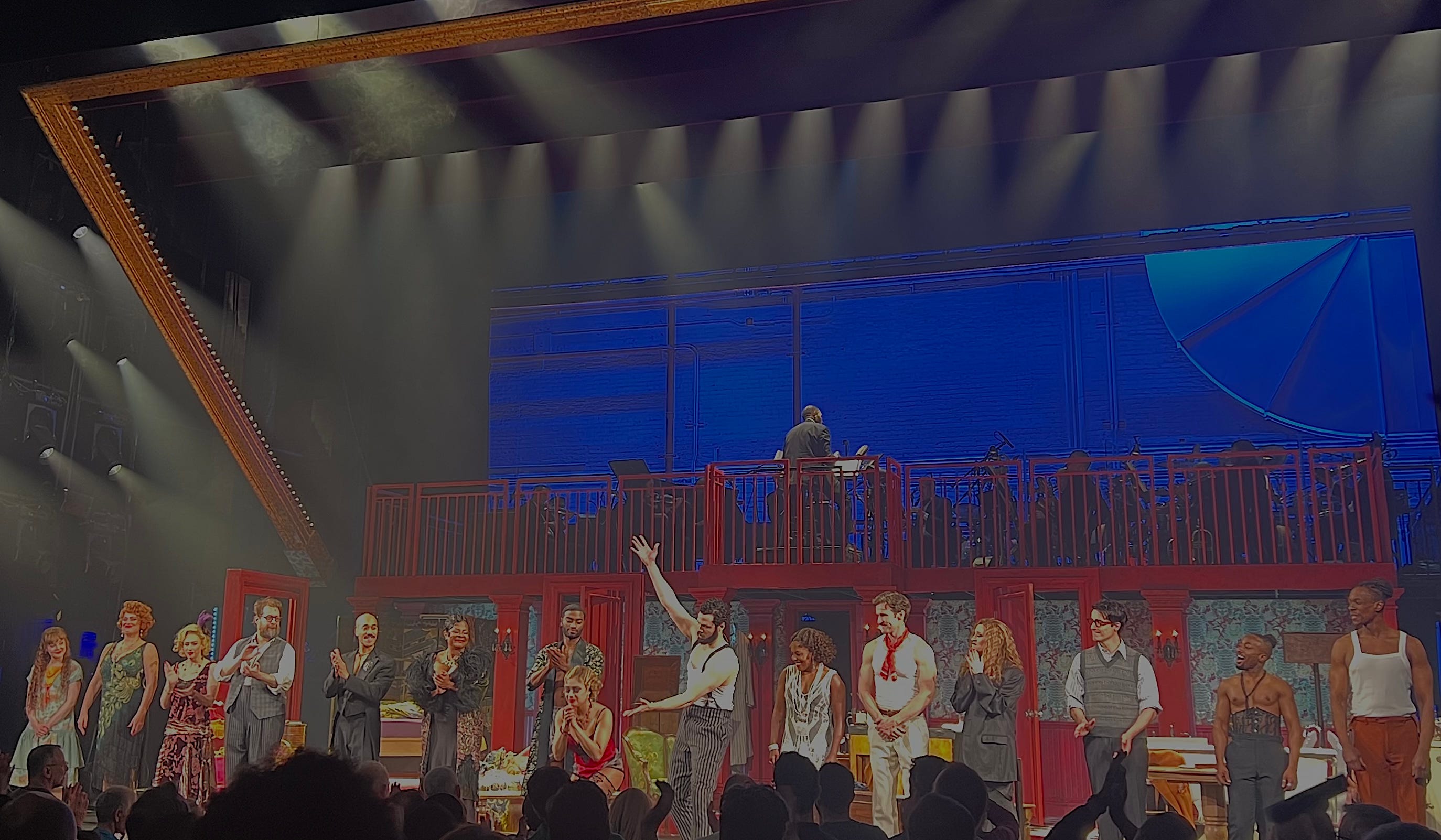
At Encores!, these two lead caricatures gained depth, poignancy and even gravitas played by two actors of color: Jasmine Amy Rogers (a Tony-nominee last season for the title role in Boop! The Musical) and Jordan Donica (also a Tony-nominee, as Lancelot in the Lincoln Center Theater 2023 revival of Camelot).
Ms. Rogers played Queenie as written; all voluptuously self-aware, with a keen sense of Queenie the dancer, though perhaps a too sweet singing style. The role is tricky. Aside from being a Queen Bee, Queenie is not all that interesting — unless she is actually passing. Nothing more about this possibility is explored either in Moncure March’s poem or the LaChiusa/Wolfe script, or the LaChiusa score, for that matter. The mere fact of Queenie being played by a Black woman, however, amps Queenie with all the implicit backstory we need.
Her boyfriend Burrs is a psychopath, and a clown. An over-the-top Mandy Patinkin inhabited this unhinged character so furiously back in 2000 that he unsettled his entire company and nearly got himself fired, and sued. Burrs is dangerous; a bully and a jerk, but Moncur March also clearly thought he was sexy.
The majestic Jordan Donica as Burrs seemed, to me, an odd (but intriguing) choice — a singing actor of profound dignity and restrained power — or so I mistakenly thought. Donica tore into Burrs with the intensity of… a Mandy Patinkin, taking personal possession of songs tailored by Michael John LaChiusa in Mandy’s wailing, wild man key.
He entered, shockingly, in blackface — performing Burrs’ shucking and jiving vaudeville act. Putting Donica in the grotesque painted mask that Burrs would have been expected to wear as a Black comic onstage in the Roaring Twenties proved a masterstroke. Blackface redefined Burrs, reframing his pathological rage with pain, even pathos. Burrs’ violence, his every dark musical note, suddenly seemed the lashing out of a Black man compelled to perform in his own black mask.
All of The Wild Party’s partygoers, Black and White, were transformed by the color shifts of this production — acquiring a degree of sympathy by proximity that Moncure March’s original characters never sought or earned. Their mere presence at Queenie and Burrs’ party suddenly meant something.
Characters originally conjured as White by Moncure March, remained so at Encores!, like the burlesque dancer, Miss Madeline True, and her near-catatonic street conquest, Sally, who were viscerally depicted by Meghan Murphy and Betsy Morgan, respectively.
Characters originally conjured as Black by Moncure March (however crudely), also remained so at Encores! — like the prizefighter, Eddie (“A short, squat brute/Gorilla-like, hirsute”), combustibly portrayed by Evan Tyrone Martin. Others were recast by Encores! with Black actors, like the D’Armano brothers song and dance team, slinkily portrayed by Wesley Barnes and Joseph Anthony Byrd.
Where Eartha Kitt, back in 2000, inimitably inhabited the over-the-hill stage diva, Dolores (“She was somewhat Negro/And a great deal Jew.”), Tonya Pinkins kicked out the jams in this part at Encores!; a return for Ms. Pinkins to The Wild Party, having played Queenie’s lethal rival, Kate, back in 2000. Adrienne Warren ably filled Kate’s shiny silver pumps at Encores!, with a swank and hunky Jelani Alladin as Kate’s gigolo escort, Black, who melts Queenie’s heart, triggering Burrs’ final meltdown.
Michael John LaChiusa’s score basically offers every member of the cast a spotlit showstopping turn surging with early-Duke Ellington Orchestra, Cotton Club-era pastiche, all blare and sass, with more than a touch of Leonard Bernstein-like swagger. The co-hero behind this excellent score is its original orchestrator, Bruce Coughlin, who enhanced the music with eloquent voicings and textures, played with Jazz Age sizzle by the wondrous Encores! Orchestra, as guest-music-directed by Daryl Waters.
I was curious to know whose transformational idea it was to cast Queenie and Burrs with black actors and to put Burrs in blackface; and whether these choices had triggered any rewriting of the original score and script. I checked in with my friends at Encores! and was told that the idea came entirely from the show’s director, Lili-Anne Brown, supported by LaChiusa and Wolfe (who maintained casting approval). Ms. Brown, I was informed, was “very specific about casting a light-skinned Black woman for Queenie,” and a Black man for Burrs, smeared with blackface in the spirit of the era’s greatest black comedian, Bert Williams, who infamously had been forced to do so.
The authors, in response, made only a few small changes. The fact is, their Wild Party did not require rewrites to make it the explosively gripping experience it became at Encores!. The Wild Party merely needed to have its mask of snow unmasked and laid to waste.
Comments
Nothing yet. Say the first thing.
Sign in to join the conversation.