
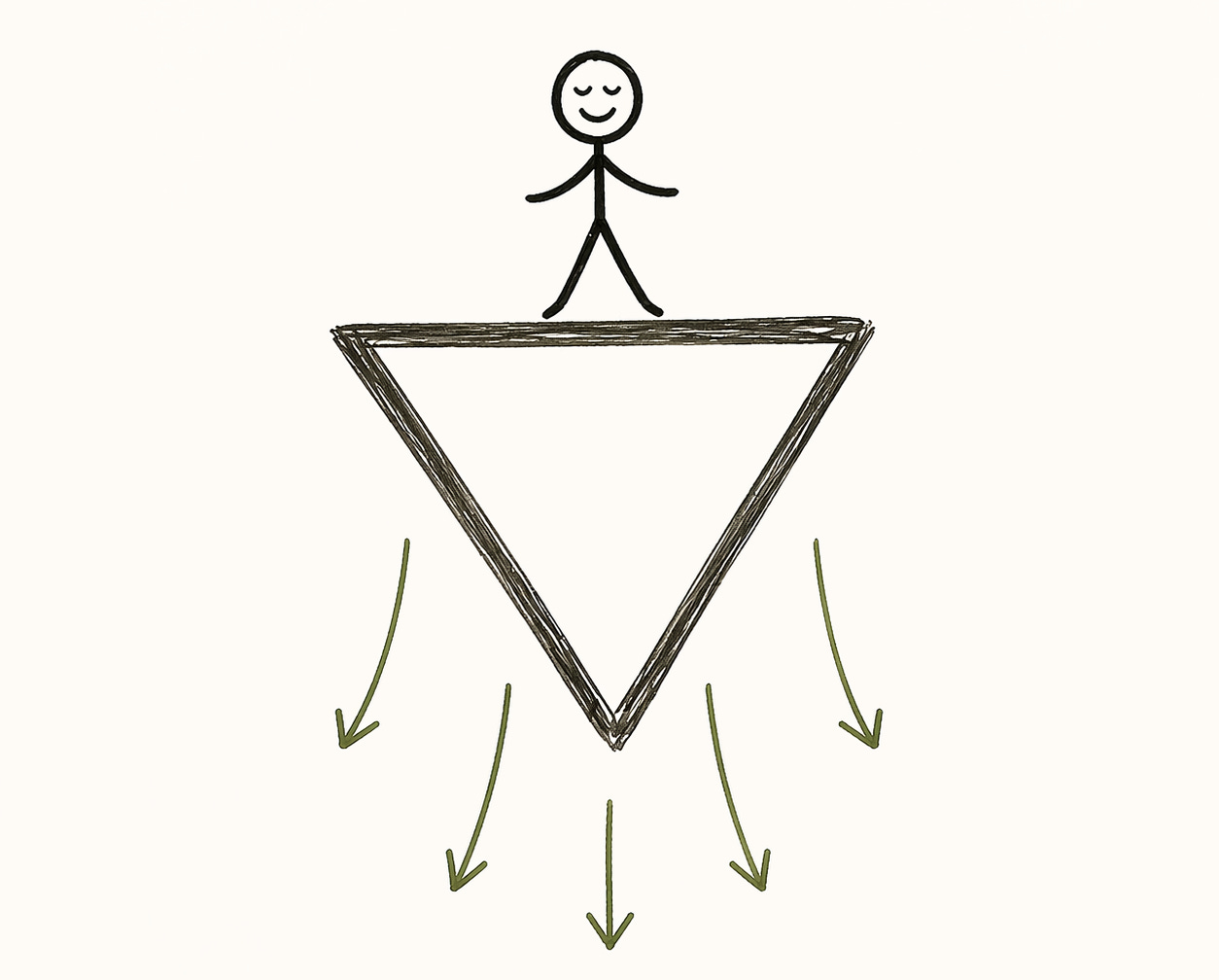
In this conversation, Sylvia and Barry explore one of the tools with the most immediate effect: the “upside down triangle.” Sylvia approaches it practically—how do the steps actually work in real time? Barry keeps it simple: you visualize the triangle and let it pull you back down when you get too high. Not away from excitement, but back into groundedness.
He’s honest about what that grounding feels like. There’s often a small hit of disappointment—not failure, but the soft deflation of fantasy. For him, that’s not a problem—it’s proof the tool is working. Sylvia’s line of questioning keeps everything anchored in lived experience: how does this actually function when someone is in it?
The conversation then turns to skepticism. Sylvia names what she sees in practice: people often agree to do The Tools® without fully entering them. Barry doesn’t argue for belief. He returns to one instruction—treat it as an experiment. No fixed opinion, just observe what happens. Skepticism, in his view, is the ego trying to stay certain before experience can speak.
Finally, they move into the quieter territory of perception in clinical work. Barry describes becoming “porous” in session—receiving impressions, images, intuitions that don’t always match what’s being said, but often prove accurate. Sylvia echoes this from her own experience of learning to step back and let something else lead. What emerges between them is less a method than a stance: less certainty, more openness, and a willingness to trust what shows up.
With love,
Barry & Sylvia
Almost 10 years ago I was sitting in my car on a highway. Hungover. Again. Tired. Again. I saw myself from a distance and wondered: where is that radiant woman with hopes and dreams I once was?
That was the moment the mask cracked open.
I had spent years being very good at keeping it together on the outside. Hard-working, perfectionistic, always performing. Nobody saw what was underneath. I barely saw it myself.
The Tools® found me in that crack. And I want to be honest with you: it did not fix everything overnight. It still hasn’t. I still practice. I still go through it every day. But in the end this work saved my life.
Being part of this community is truly a gift. The dark shadow meetings. Barry’s Substack. The conversations. All of it lands.
Getting to sit down with Barry and ask him these questions was an honour.
Thank you Ashley. Thank you Barry. And thank you to all of you for being a place where this work is taken seriously.The only way is through.
With active love, Sylvia
The “upside down triangle” is used to quickly ground over-excitement and bring a person back into reality.
A subtle drop in enthusiasm or disappointment can actually indicate the tool is working correctly.
The Tools® are most effective when treated as experiments rather than beliefs to adopt.
Skeptics don’t need convincing—just an invitation to observe what happens without fixed opinions.
Effective change comes from direct experience and consistent use, not intellectual understanding alone.
In therapy, insight often emerges intuitively through impressions, images, and nonverbal cues beyond words.
Noticing and reinforcing even very small signs of client progress is key to sustaining momentum.
Sylvia Holtslag is a self-leadership coach based in the Netherlands. She has worked with the Tools® for nearly a decade, using them in her practice to help people break through fear, self-criticism and old patterns. She works with clients all over the world in Dutch and English.You can find Sylvia at sylviaholtslag.nl and on Substack at Sylvia Holtslag.
Comments
Nothing yet. Say the first thing.
Sign in to join the conversation.