
Why Don’t We Hear About AI Data Centre Issues In China?
Before reading further, glaze over with the words “AI”.
The kids disparage AI; they say things like “Oh, that’s AI”, when they think something is below standard.
Only older folks like us get over-awed by “AI”.
We think: “Must be about math…must be very hard.”
AI is actually not ‘intelligent’; it is a “Large Language Model” (LLM), where skads of information are fed into a glorified calculator and regurgitated according to specific response requirements.
LLMs apply our collective knowledge about solutions to classes of problems through their training on these humongous amounts of carefully picked data.
Essentially an LLM is good at selecting and injecting a solution it has been trained on, according to the kind of question you ask. This function is extremely useful… but it isn’t “intelligence” in the slightest. Humans can outperform the LLM significantly at reasoning tasks by absorbing a small amount of the data that the LLMs has consumed.
LLMs predict the next word in answers that use your prompt to start the process. A program like ChatGPT “conditions” its reply based on two- to three-word phrases, and tries to anticipate the next sentences.
It also has “jagged answers” – it will fail at many problems (including basic math) and you don’t know when it is going to fail. I have asked AI to incorporate certain information and it totally forgot to do so. Idiot app.
That’s the difference between “intelligence” (you) and “cleverness” (AI).
They don’t do rational inferences.
Lots of data does not translate into correct deductions.
And AI works a bit like psychopaths: an entity devoid of emotions which mimic emotions.
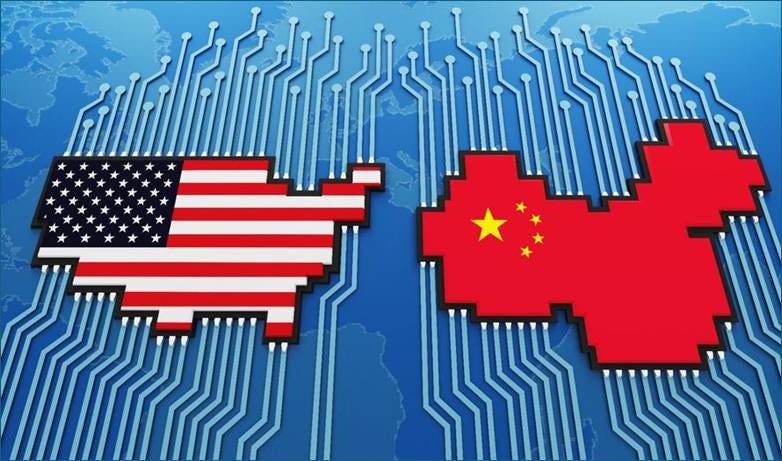
But the Western (US) model of AI is not needed.
Chinese labs were forced to invent mathematical and architectural shortcuts because of U.S. export controls on advanced processing units like those from Nvidia.
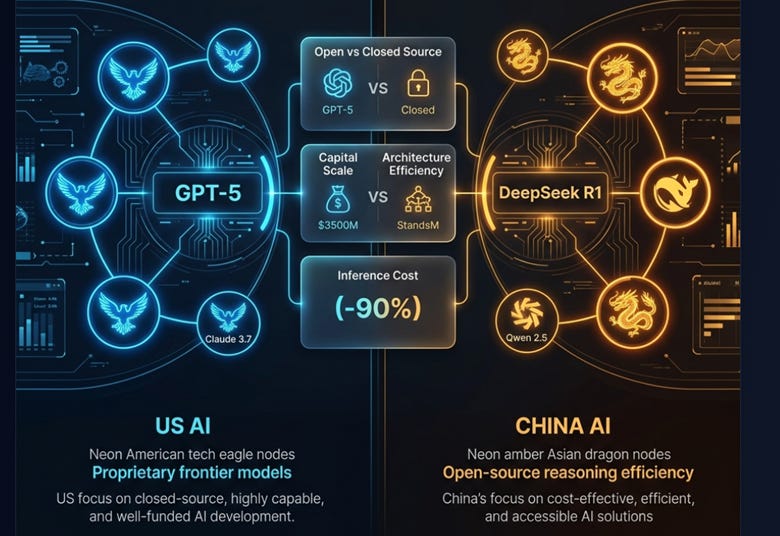
By building smaller AI centers, the Chinese approach is notably more energy-efficient than typical US averages.
And the Chinese are using Open Source models – shared discoveries - against the US proprietary approach.
Have you ever wondered why you don’t see any headlines about China groping around for huge new power stations?
That is why.
Their centers are designed small and can work with the power they already have.
All of the above would not matter if there were some internal reason why AI is needed by all of us. Which brings us to the issue of the CEOs running the AI companies and why they created what they did.
Those executives built huge AI engines to process all data, in a search for a game-ending tool that would rule the market.
Let me stress this: we are trying to build enormous data centres in North America because a few tech owners want to make a killing, and they figure they need to have something that feeds on all the data.
Sam Altman of OpenAI and Peter Thiel of Palantir channeled a “monopoly” strategy, in the belief that all founders should “aim for monopoly” to create a successful business.
Monopolies are good, Thiel said, because “they are much more stable, longer-term businesses, you have more capital, and…it’s symptomatic of having created something really valuable.”
That’s what capitalism does: it drives you to ownership of everything to make the most money.
Thiel is now in Argentia waiting for the US to collapse. It sounds like the kind of advice he would have gotten from an AI response.
{Thiel: “Where do I go if my society collapses? AI: The Nazis went to Argentina.”]
But there are other ways to build AI models beside the monopoly boil-the-ocean model.
We can build significantly smaller AI models that focus on specific topics or interests, and perform very well.
Labs in China, for example, are producing compact models that match Western performance while using significantly less computing power, which drastically lowers operational costs.
This was a big shock to the Western profit-driven large-AI model, and arose in 2025.
There was a moment akin to that shock on October 4th 1957, when the Soviet Union launched the Sputnik satellite, and shattered American assumptions about US technological supremacy.

On January 20, 2025, a relatively unknown Chinese AI lab released DeepSeek-R1 — a reasoning model that matched OpenAI - American’s pioneering AI company founded by Sam Altman and Elon Musk - on math, code, and logic benchmarks. It was OpenAI that had sparked a global boom in generative AI – the kind of AI that creates new content in music, text and images by studying patterns in existing data.
Within a week, chip maker Nvidia lost $589 billion in market capitalization in a single trading session — the largest one-day loss for any company in US stock market history. The trigger wasn’t just that DeepSeek matched frontier performance. It was the price tag.
The kicker was: DeepSeek used about a dozen times less computing power than OpenAI.
Over the following 14 months, Chinese labs consistently matched or approached Western frontier performance across every major benchmark, using less computational hardware.
Alibaba proved you didn’t need the biggest model — you needed the best architecture.
Chinese models aren’t just as good — they’re dramatically cheaper. DeepSeek’s process ha a price advantage of more than 50 times that of ChatGPT: DeepSeek’s subscription costs $0.50/month versus ChatGPT’s $20.
A RAND report published in early 2026 found that Chinese AI models run at roughly one-sixth to one-quarter the cost of comparable American systems.
DeepSeek’s pricing forced ByteDance, Alibaba, and others to cut their own model prices or offer free tiers. The market is converging on Chinese pricing, not Western.
Unlike proprietary Western models, the Chinese models are publicly available for free download.
By prioritizing cost-optimized models, algorithmic distillation, and application-specific reasoning tasks, Chinese developers achieve high performance with less raw computing scale.
This allows localized or specialized hubs to operate effectively without matching the massive footprint of Western generalized data centers. Chinese labs innovate with smaller, highly optimized software-hardware co-designs.
Chinese AI models like DeepSeek and Western frontier systems (such as OpenAI and Anthropic) achieve comparable performance on math and coding benchmarks, but they use very different algorithmic and engineering strategies. Chinese labs focus heavily on low-level efficiency and sparse architectures to work around hardware export controls, while Western labs lean into raw compute scale and proprietary infrastructure.
Chinese models often deliver 60% to 90% lower token pricing, providing a much higher efficiency ratio of cost-to-Intelligence.
Because of its lead, the US had an estimated 5,427 data centres in 2025, compared with 449 in China.
But China is constructing data centres at a blistering pace – 30 percent annually from 2016 to 2023 – and the gap between the superpowers is rapidly narrowing. “China’s large manufacturing base and less stringent regulatory environment mean that the construction of data centres and supporting energy infrastructure can happen far more rapidly than in the US,” said Leah Fahy, senior economist for China at Capital Economics.
Advancing AI is now an “electricity problem as much as a chip problem”, said Howard Yu, director of the Center for Future Readiness at IMD Business School in Lausanne, Switzerland.
Chinese AI data centers operate under different strategic constraints and efficiency models than American facilities.
While U.S. hyperscalers focus heavily on raw compute scale and brute-force training for frontier models, Chinese labs maximize algorithmic resourcefulness and industrial integration to offset hardware limitations.
US data centers house massive clusters of cutting-edge accelerators like Nvidia’s advanced hardware. Due to export controls and domestic scaling limits, Chinese centers often deploy alternative architectures or smaller local footprints.
To compensate for hardware gaps, Chinese developers lean on software innovations like Mixture-of-Experts (MoE) designs that activate fewer parameters per task, lowering inference and training costs.
Chinese policy and infrastructure prioritize real-economy deployment across manufacturing, automation, and public services.
China is also the first to try one future-facing approach: instead of bringing large amounts of water to data centers, bringing the data centers underwater.
The first commercial underwater data center, developed by Beijing Highlander Digital Technology, began operating off the island province of Hainan in 2023. The servers are sealed inside pressure-resistant containers below the surface, with seawater used to absorb heat and reduce cooling demand compared with land-based facilities.
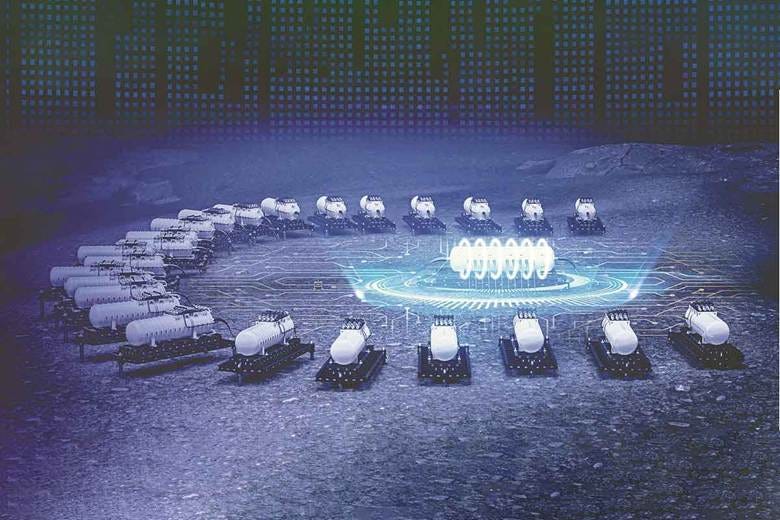
In May, China launched another underwater data center online off the coast of Shanghai—this time powered by offshore wind energy—pairing high-powered computing with green energy.
In China, data centers usually cost $5.5 to $6.5 million per MW for construction, so we can assume that the average Chinese data center would run closer to $6 million per MW. In the US, on the other hand, data centers cost about $8 to $12 million per MW. For a 400MW data center, then, construction in China would be about $2.4 billion, while in the U.S. it would be about $4 billion. That means construction alone would save China $1.6 billion.
Cooling systems use enormous amounts of water, and, once again, water is cheaper in China. In the U.S., water costs about $5.18 per thousand gallons, while it costs nearly half that ($2.57) in China.
For nearly 2,200 Nvidia racks, an American data center would spend just over $5.6 billion on hardware while a Chinese one would spend nearly $4.2 billion. A Chinese data center would be spending about 25% less on hardware for the price of purchasing many fewer units.
Adding it all together, China can make data centers significantly cheaper than the U.S. can. By saving on construction, China would have the advantage in raw cost for a data center buildout.
For the US, electricity constraints are worrying. The U.S. has a small power supply compared to China, and expansion is likely required to accommodate the rate of data center buildouts. China already generates more than twice as much electricity as the US, a lead that is expected to widen amid an aggressive state-led investment in the country’s energy grid. BloombergNEF, a research provider, estimates that China will add more than six times as much electricity generation capacity as the US over the next five years.
For powering a data center for three years, China’s massive electricity buildouts give it the edge. A kilowatt-hour (kWh) of electricity for industrial users, on average, costs about 9 cents in the U.S. while only 6 cents in China.
And because of the great pay differences, an American data center would spend over $184 million on personnel for three years, while a Chinese one would spend almost $33 million.
Under the “East Data, West Computing” initiative, China’s government is concentrating the construction of new data centres in the country’s sparsely populated interior, where land and renewable energy sources are abundant compared with the heavily built-up eastern seaboard.
The American equivalent would be to locate the data centres in some MAGA-dominated state where everyone avoids vaccines and will thus die off, leaving cheap land.
What the Chinese are working on now, is to get those compact AI models to do more work in a compression of numerical functions…i.e. make the computing better.
Ultimately, I am betting that this will be the most effective approach.
First, you find the most effective ‘brain’, then you build the body.
Western CEOs got it backwards, because they jumped first at owning everything, and thus needed to build these giant centers.
Their short-sighted greed is screwing us (again).
Artificial intelligence is a technology that takes many forms. It is in fact a multitude of technologies that shape-shift and evolve, not merely based on technical merit but with the ideological drives of the people who create them and the winds of hype and commercialization.
Nothing about this form of AI coming to the fore or even existing at all was inevitable; it was the culmination of thousands of subjective choices, made by the people who had the power to be in the decision-making room. In the same way, future generations of AI technologies are not predetermined. But the question of governance returns; Who will get to shape them?
Under the hood, generative AI models are monstrosities, built from consuming previously unfathomable amounts of data, labor, computing power, and natural resources.
Rarely have they seen any “trickle-down” gains of this so-called technological revolution; the benefits of generative AI mostly accrue upward.
The AI empires too, seize and extract precious resources to feed their vision of artificial intelligence; the work of artists and writers; the data of countless individuals posting about their experiences and observations online; the land, energy, and water required to house and run massive data centers and supercomputers.
Every tech giant is racing to out-scale one another, spending sums so astronomical that even they have scrambled to redistribute and consolidate their resources.
So much of what our society actually needs — better health care and education, clean air and clean water, a faster transition away from fossil fuels — can be assisted and advanced with, and sometimes even necessitates, significantly smaller AI models and a diversity of other approaches. AI alone won’t be enough, either; We’ll also need more social cohesion and global cooperation, some of the very things being challenged by the existing vision of AI development.
Developers and utility companies are now preparing for AI megacampuses that could soon require 1,000 to 2,000 megawatts of power. A single one could use as much energy per year as around one and a half to three and a half San Franciscos.
Utility companies are now delaying the retirement of gas and coal plants and the transition to renewable energy; Microsoft restarted Three Mile Island,
By 2030, at the current pace of growth, data centers are projected to use 8 percent of the country’s power, compared with 3 percent in 2022; AI computing globally could use more energy than all of India, the world’s third - largest electricity consumer.
Surging AI demand using the US model could consume 1.1 trillion to 1.7 trillion gallons of predominantly fresh water globally a year by 2027, or half the water annually withdrawn in the UK.
Going with smaller, focused centers also helps prevent the over-turn of our culture and conscience. To redistribute knowledge, we need greater support for production outside the large-model empires. That involves supporting researchers who can conduct independent evaluations of corporate models.
By hiding the ingredients of their models as their intellectual property, the empires of AI have been able to get away with seizing people’s IP without credit, consent, or compensation.
We also need broad-based education. The antidote to the mysticism and mirage of AI hype is to teach people about how AI works, about its strengths and shortcomings, about the systems that shape its development, about the worldviews and fallibility of the people and companies developing these technologies.
No doubt you are now wondering why – if the answers are so plainly in sight – the mainstream media is not asking the same questions about AI. How can our flawless tech leaders be investing so much in this technology?
Their reasoning is blinded by the shining star of huge profits.
Just as the reasoning of our political leadership is blinded by the lure of headlines about victory.
That’s how we can spend a trillion dollars replacing the rulers of Iran with the same rulers of Iran.
And how we spent 20 years, thousands of lives and trillions of dollars to replace the Taliban with the Taliban.
This is not a problem AI can solve.
It’s a problem that an educated electorate can handle.
In November.
See you there!
Thank you for following Barry’s Substack, focusing on the meaning behind the headlines. A regular summary of a topical book will provide more depth to enable full subscribers to stay ahead of the conversation.
In the coming weeks we will look at WHAT IF THE PRESIDENT IS AN IDIOT – Trump, power and the death of serious politics – How a reality show became a presidency.

PS - If you have enjoyed this article, please consider buying me a Coffee!
No posts
Comments
Nothing yet. Say the first thing.
Sign in to join the conversation.