
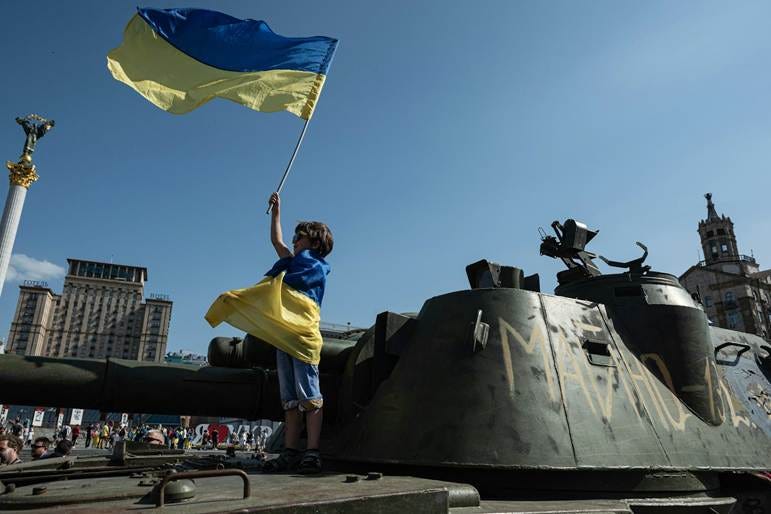
It seems appropriate at a moment when Ukraine is clawing back its territory from Russia, to reflect on a time when that would have seemed a delusional idea.
I’ve gone back over three books that I have summarized in the past for our “Book Club”, to get a feel for the days when everything was black…when Ukraine was, it seemed, destined to die.
The books are “Our Enemies Will Vanish” by Yaroslav Trofimov, “The Showman” by Simon Shuster, and “The Folly of Realism” by Alexander Vindman.
Set side by side, the three books answer three different questions about the same war.
Trofimov answers *what happened*, with the granular, often brutal detail of someone who was there. Shuster answers *who made the difference*, tracing how one man’s unlikely temperament shaped a nation’s response.
Shuster reveals Zelensky to be a normal and decent person and without pretension, who never forgot where he came from: TV comedy and soap opera. Zelenskiy is warm, emotional and genuine, without imperiousness or pride of office. His courage in staying in Kiev during the Russian attack was what doomed Putin’s plan.
Vindman answers *why it was allowed to happen at all*, tracing the war back through thirty years of policy choices made in Washington rather than Moscow or Kyiv. None of the three lets the reader settle for a single, simple explanation — the war emerges instead as the product of Ukrainian resolve, one leader’s improbable performance under fire, and a Western foreign-policy establishment that consistently chose the comfortable illusion of stability over the harder work of deterrence. Whether that lesson has actually been learned is still open to question.
The three very different books converge on the same event — Russia’s war on Ukraine — and together they form a fuller picture than any one of them could alone. Yaroslav Trofimov’s *Our Enemies Will Vanish* is a war correspondent’s frontline chronicle. Simon Shuster’s *The Showman* is an intimate biography of the man who came to embody Ukrainian resistance, Volodymyr Zelensky. Alexander Vindman’s *The Folly of Realism* steps back from the battlefield entirely to ask a harder question: why did three decades of American foreign policy help make this war possible in the first place?
Read together, they trace a single arc — from Western complacency, to a president nobody expected to lead a war, to a nation that refused to disappear.
Our Enemies Will Vanish — Yaroslav Trofimov
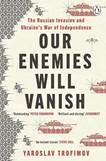
Trofimov is the chief foreign-affairs correspondent for the *Wall Street Journal*. He was in Ukraine when the invasion began, and his account moves through how the war built up, unfolded, unwound, and stands today. He traces the roots back to 2004, when electoral candidate Viktor Yanukovych tried to steal a presidential election through ballot-stuffing, only to be overturned by protest and a court-ordered rerun — a humiliation Moscow never forgave. Russia snapped back a decade later with Crimea: unmarked Russian soldiers, the “little green men,” seizing the peninsula while a captive legislature voted to secede. Many Ukrainians in the east were indifferent or even hopeful, lured by promises of pensions and stability. What followed instead was devastation, not prosperity — a pattern that recurs throughout the book, when Russian rule brings ruin to the very people it claimed to liberate.
The build-up to the full invasion is where Trofimov’s access pays off. He contrasts a Ukrainian people who “quietly and stoically, [made] it a point of pride to maintain civility and order”, with a Washington that assumed Kyiv would fall in days and saw little point in arming a lost cause. Nevertheless, the US helped: a CIA director flying in secret to warn Zelensky of a Russian plan to storm the capital and kill him. This is contrasted against a Kremlin so confident of quick victory that it printed no real war plan, only a timetable — invasion after breakfast, a victory parade after lunch. Putin declared his goal was to “denazify” a country led by a democratically elected Jewish president, and predicted Ukrainian soldiers would defect en masse.
None of it happened as scripted. Kyiv did not fall in the promised hours; the fight for Hostomel airport became the war’s first real battle, with Ukrainian gunners downed Russian helicopters meant to secure a beachhead for airborne troops. Zelensky refused Western offers of evacuation and a government-in-exile. Ordinary citizens — a twenty-year-old manicurist, volunteers relaying artillery coordinates from a wheat field, grandmothers assembling Molotov cocktails — turned “mission command,” a doctrine of trusting units to act on their own initiative, into a national reflex that Trofimov credits as much as any weapon for blunting the invasion.
Trofimov also lingers on the years of drift that preceded the invasion, and on how differently Kyiv and Washington read them. After Crimea, Ukraine gained visa-free travel to the EU, and cheap flights to Paris or Vienna became ordinary even for students of modest means — a quiet but profound reorientation of a generation’s sense of where the country belonged. Washington read the same period very differently: President Obama, wary after the 2008 war in Georgia, offered Kyiv sympathy but no weapons, telling an interviewer that Ukraine would remain vulnerable to Russian domination “no matter what we do.” That fatalism, Trofimov suggests, was itself part of what convinced Putin that the West would not seriously intervene.
The book does not flinch from the atrocities that followed the retreat from Kyiv — the mass graves at Bucha, the bombing of a maternity hospital and a theater sheltering civilians in Mariupol — nor from the war’s grinding second phase, as Ukraine’s HIMARS strikes began shattering Russian ammunition depots and command posts in Kherson and the Donbas. Trofimov’s verdict, delivered a year in, is that Ukraine had already won the war that mattered most: the war for its own continued existence. Borders might still be contested and battles still ahead, but the country was not going to vanish from the map a second time. He closes on a Ukrainian soldier who ambushed a Russian column with nothing more than the words “Good evening, we are from Ukraine” — and they surrendered.
The Showman — Simon Shuster
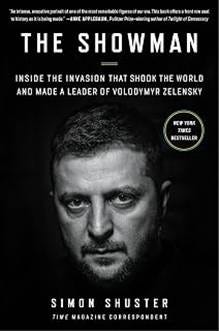
Where Trofimov gives the war, Shuster — a Time correspondent who has covered Ukraine since 2009 — highlights the human being at its center. Volodymyr Zelensky was a comedian and studio owner before he was a president, and Shuster’s central argument is that this unlikely background, not a conventional political résumé, is what let him survive the war’s opening days. A career politician, briefed on the odds, would have formed a government-in-exile. An actor who had spent his life terrified of losing did not.
Shuster traces Zelensky’s rise from his hit sitcom *Servant of the People* — in which he played a schoolteacher accidentally elected president after a viral rant against corruption — to his landslide 2019 election win, including nearly 90 percent of the vote in Russian-speaking regions Putin considered his own. The presidency that followed was as rocky as the campaign: by 2020 Zelensky’s approval had collapsed to single digits under pressure from a pro-Russian media empire controlled by the oligarch Viktor Medvedchuk, a Putin associate. Zelensky fought back by banning Medvedchuk’s television channels and seizing his assets, including a pipeline that had helped fund pro-Russian politics in Ukraine — while also quietly preparing for war, striking a deal to build Turkish Bayraktar drones on Ukrainian soil.
The book’s most striking material covers the days just before the invasion. American intelligence was detailed and urgent; French and German leaders, having spoken to Putin directly, told Zelensky the warnings were overblown. Zelensky himself doubted a full invasion was coming even as he hedged. When the attack came, Shuster describes a man whose first instinct was not fear but disbelief — and whose choice, within hours, to stay visibly in Kyiv rather than flee became the war’s defining image. He also reveals what the war cost Zelensky personally: a marriage conducted almost entirely apart from his wife Olena for the family’s safety, described in one exchange where Zelensky asks if she’s ever sad with him, and she replies that she’s never sad “with” him — only without him.
Shuster is unsparing about what Ukraine’s defenders found in the towns Russian troops abandoned around Kyiv — filth, looted homes, and in Bucha alone the bodies of 458 civilians, a third of them showing signs of torture. He also credits Zelensky’s theatrical instincts as a genuine strategic asset: the “decision generator” persona, the address to the U.S. Congress that drew standing ovations too frequent to count, the deliberate cultivation of global attention that helped unlock over $100 billion in American aid in 2022 alone. Even the First Lady is drawn into this theme — Shuster describes Olena Zelenska, herself a screenwriter, comparing the wartime volunteers weaving camouflage nets to the country as a whole, trying to bind back together a life the invasion tore apart. The book ends with a war still unresolved but with Zelensky’s central claim intact — that whatever else happens, Russia has already lost the battle for the world’s mind.
The Folly of Realism — Alexander Vindman
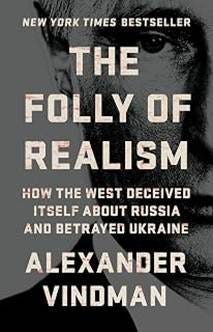
Vindman’s book is a policy argument, not a narrative — and it is also the most damning of the three toward the West. Vindman, a retired U.S. Army lieutenant colonel of Ukrainian descent who testified against Donald Trump in the first impeachment hearings, argues that decades of American “realism” — a foreign policy built around achieving what seems immediately possible rather than what serves long-term democratic values — did not avert the war in Ukraine.
It helped cause it.
He walks through a sequence of missed off-ramps, some dating back further than most accounts of the war bother to go. As early as 1991, he notes, President George H.W. Bush traveled to Kyiv and warned against “rampant nationalism” rather than embracing Ukrainian independence outright — a speech cold-war critics mocked at the time as “Chicken Kiev.”
In 2004, Washington quietly averted its eyes as Moscow poured an estimated $300 million into Yanukovych’s fraudulent campaign, even as Yanukovych’s reformist rival Viktor Yushchenko was poisoned with dioxin at a state dinner, and Washington stayed largely silent through the Orange Revolution that ultimately overturned the stolen vote — worried about damaging relations with Russia.
In 2008, NATO promised Ukraine and Georgia eventual membership without granting either country a concrete path — and when Russia invaded Georgia weeks later, the consequences were negligible, teaching Putin that aggression carried little cost. In 2014, Crimea was annexed through a mix of disinformation and unmarked troops. Western officials reportedly urged Kyiv not to resist militarily, for fear that resistance would trigger a wider war. Vindman calls this pattern “mirror-imaging” on the American side — assuming Russia wanted the same stability the U.S. wanted — while Russia was busy mirror-imaging in the opposite direction, convinced that Washington’s hand lay behind every democratic uprising on its border.
The 9/11 attacks, in Vindman’s account, entrenched the pattern further: Russia was recast as a useful partner in the war on terror, and Ukraine policy became permanently subordinate to Russia policy. Even after the full invasion in 2022, he argues the Biden administration’s caution — slow-walking HIMARS, long-range munitions, and airpower out of fear of provoking Moscow — repeated the same mistake in miniature, this time under fire.
Vindman’s proposed corrective is what he calls “neo-idealism”: a foreign policy grounded explicitly in values — human rights, democratic governance, self-determination — on the theory that values, consistently applied, produce more durable interests than short-term transactions do. He points to Roosevelt’s Europe-first strategy after Pearl Harbor and Truman’s Cold War alliance-building as precedents for values outlasting immediate provocation.
His warning about Donald Trump is the sharpest passage in the book: a transactional, grievance-driven presidency, he argues, is not a deviation from realism but its logical endpoint, and it is exactly the kind of American posture Putin has spent two decades hoping to see.
Vindman frames the stakes as global, not regional — pointing toward Moldova, the Baltics, and eventually Taiwan as the next tests of whether authoritarian revisionism pays. He closes, however, on cautious optimism: the world’s democracies, some 2.5 billion people, are larger and still growing, while Russia and China’s combined authoritarian bloc is smaller and aging. History, he argues, still runs in one direction — if the West has the nerve to act like it believes that.
Together, the authors show that a war combining social resolve and leadership courage can overcome a large opponent and wavering allies.
The biggest delusion is implied – it is a shadow that falls across all the books.
Putin believed that the conquest of a newly-independent country would be a walk in the park.
Personally, when I first heard about the invasion and how few troops Putin was committing to the attack, I thought he was insane. I had been raised on books about the millions of German and Russian soldiers who had fought in the region; I knew how many soldiers Purin should have had. He in fact invaded with one—tenth of the army that I (the rankest amateur) thought he should have had. Where was his advice coming from?
And then we remember: he was surrounded by yes-men.
Any idea Putin had would be instantly praised and never rebutted.
Reminds me of a current war-time situation. Because even as the Russian soldiers continue to die in Ukraine, American soldiers are facing off against an army that any serious critic would have convinced hm to avoid long before the missiles flew.
If a democracy becomes an autocracy, we get the worst of both worlds.
Fortunately for us, we can still vote.
The Russians still need to seize that opportunity.
But they’ve got a good example in front of them.
In front of them Ukraine is showing how it is done: despite surprise, unprepared leaders and allies who can’t believe the reality, you can make your own future.
Thank you for following Barry’s Substack, focusing on the meaning behind the headlines. A regular summary of a topical book will provide more depth to enable full subscribers to stay ahead of the conversation.
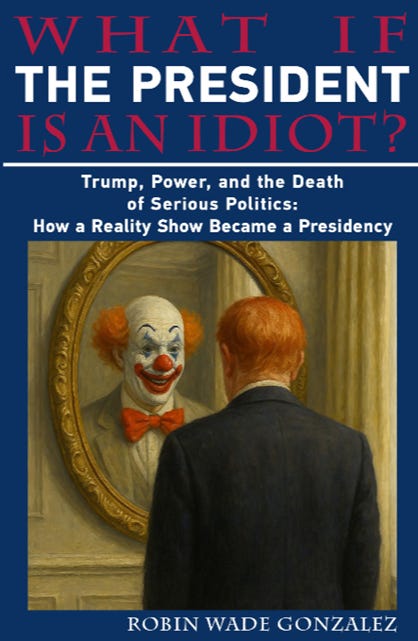
In the coming weeks we will look at WHAT IF THE PRESIDENT IS AN IDIOT – Trump, power and the death of serious politics – How a reality show became a presidency.
PS - If you have enjoyed this article, please consider buying me a Coffee!
No posts
Comments
Nothing yet. Say the first thing.
Sign in to join the conversation.