
A bell is ringing around the world and its peals are being echoed in the US.
A change in the structure of world politics is being repeated within the borders of the U.S. - and is strengthening the country in ways that the mass media often ignores.
Ironically, it is coming at a time when this new world is seeing a diminishing of America’s global stature. But in a sense, this movement creates a better space for involvement by all.
Globally, the U.S. is no longer a superpower.
In military measurement alone, Iran has proved to the world that the U.S. is no longer unique.
But a superpower is many more things than a military. It has alliances, treaties, trade agreements, and trust – the kind of soft links that America has made with the nations of the world. It is a hub of relationships based on commitments.
Now, Trump has torn up nearly every agreement that America had. And he tore up agreements that had been ratified by Congress - agreements that he did not have the authority to tear up.
Once you lose trust, it can only be regained by decades of work. Trump’s disgraceful shredding of America’s reputation will change the way the world reacts to the US for many generations.
This has been the work of one man. In his prior business career, Trump was known to betray his contractors, not pay debts, and use bankruptcy as a means of escaping his obligations. He brought that mind-set to the White House, and torched the reputations built by 250 years of leadership.
The American century is over, and the entire international ecosystem is reacting and realigning.., away from the U.S.
We are entering an era of the Middle Powers, as defined by one of its prime spokespersons, Canada’s Prime Minister Carnie. It is an era where no one is in charge – and everyone is in charge. Each nation earns its right to a reputation that others can bank on - or not.
This can be seen in the growth of new kinds of alliances in the relatively short period since the US lost its mantle of world leadership.
These alliance feature “variable geometry”—they are flexible, mini-lateral, and transactional alliances. Driven by economic nationalism and resource competition, middle powers are prioritizing functional cooperation.
With the new alliances, goods travel longer geographic distances; what was once a “hub” system with America at the centre, has become a multi-nodal engine.
These alliances adapt to a world in which American power is eroding, geopolitical competition is intensifying, and U.S. allies are growing more autonomous. There has been a shift from broad multilateral cooperation toward fragmented, bilateral trade alignment and defensive regional supply chains.
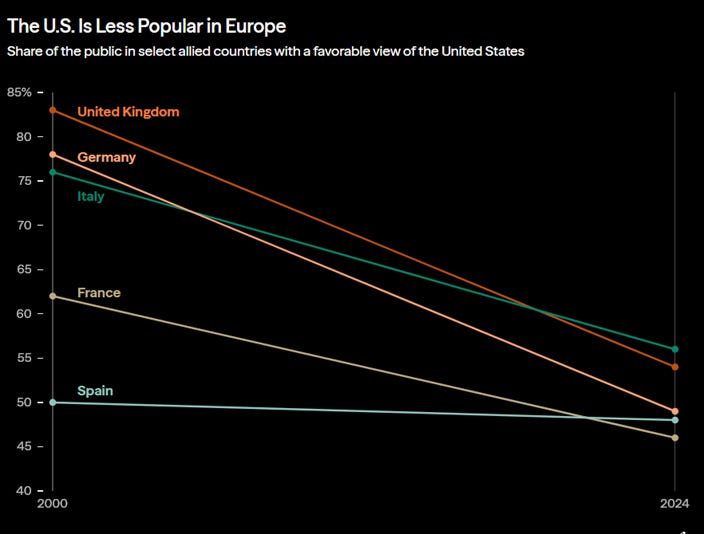
It is being driven and accelerated by a global shift in popularity away from the US.
The European Union, for example, has lined up new trade and security agreements with the United Kingdom, Canada and, most recently, India, and weeks after that the bloc signed a trade pact with Argentina, Brazil, Paraguay and Uruguay.
The provisional implementation of the trade agreement between the European Union and Mercosur (Argentina, Brazil, Paraguay, and Uruguay) also highlights Europe’s push for new economic corridors.
In the Middle East, Pakistan, Turkey and Saudi Arabia have formed a new alliance that may boost regional trade.
Canada has set up joint agreements with 30 countries, including China and India, on deals ranging from EVs to fertilizer.
The US has been struggling to keep up. While its two-way trade with 19 of its partners increased slightly last year, the world economy grew at a pace that was double that of the US arrangements.
The new global alliances will see further trade diversion away from US trade this year.
This trend is neither more dangerous nor safer than any other era in world history.
It all depends on rational decision-making…which is better served in states that are democracies. States where one man’s hand is on the tiller – like a Putin or a Trump – are prone to wild gyrations. Yes, democracies can make mistakes – like the war in Vietnam – but they can also work together to put a human on the moon.
America is no longer the world’s superpower – but it still has a ramp on which it can earn a foremost position of renewed respect among a parliament of peers.
The question for American politics right now, is: Which of its parties is most likely to lead America into that new world? Which one will build the ramp?
It would have to be a party whose own members see themselves and their community as hopeful and eager co-contributors…members of a “Middle Power Of The Many” in domestic politics.
Mamdani comes to mind as a model. In New York, he has helped the city see itself again, with weekends where quiet reigns and people mingle, free of car traffic. Where food goes to children. Where the wealthy pay a fair share.
That wave is spreading across America.
Lt. Gov. Peggy Flanagan just won the Democratic primary race for Senate in Minnesota, calling for universal health care and a higher federal minimum wage. “For months now,” she said, “I have been telling you that this campaign was about the many versus the money.
“Well, guess what, the many just won.”
Ms. Flanagan, a member of the White Earth Band of Ojibwe, could become the first Native American woman to serve in the Senate if she wins the November general election.
Similarly, Ilhan Omar - female, Muslim, socialist – once again crushed her opponent in Minneapolis with 80% of the primary vote.
The Middle Power of the Many brings everyone in.
While many have commented that the new Democratic candidate for Governor of Wisconsin is not a socialist, for example, few remarked on the fact that he was Black. It is no longer remarkable. David Crowley could become the first Black Governor of the State of Wisconsin.
The push to democracy around the world is thus changing the face of domestic politics in America.
In elections, candidates at local, state, and federal levels increasingly mirror the demographic diversity of the U.S. population.
American politics has grown much more diverse over recent decades, marked by record numbers of women, people of color, and LGBTQ+ individuals running for and winning public office.
Just over a quarter (26%) of voting members in the U.S. Congress identify as a race or ethnicity other than non-Hispanic White, making the 119th Congress the most racially and ethnically diverse to date.
Strikingly, this is the eighth Congress to break the record set by the one before it.
The spectrum shift is less obvious in the Senate,, but even that is changing. In the upper chamber of Congress, 16 senators are racial or ethnic minorities - an increase from 12 in the 118th Congress.
The shift in Congress is following a national trend. The share of the non-Hispanic white population in the United States is declining over time, dropping from around 83% in 1970 to a projected minority position - below 50% of the total U.S. population - by 2045.
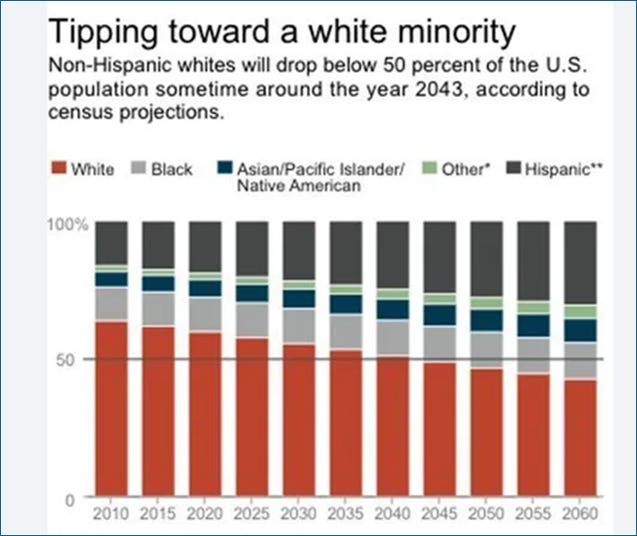
This will continue to be reflected in new racial numbers in the House and Senate.
And every time that happens, the need for people to become more conciliatory and tolerant grows.
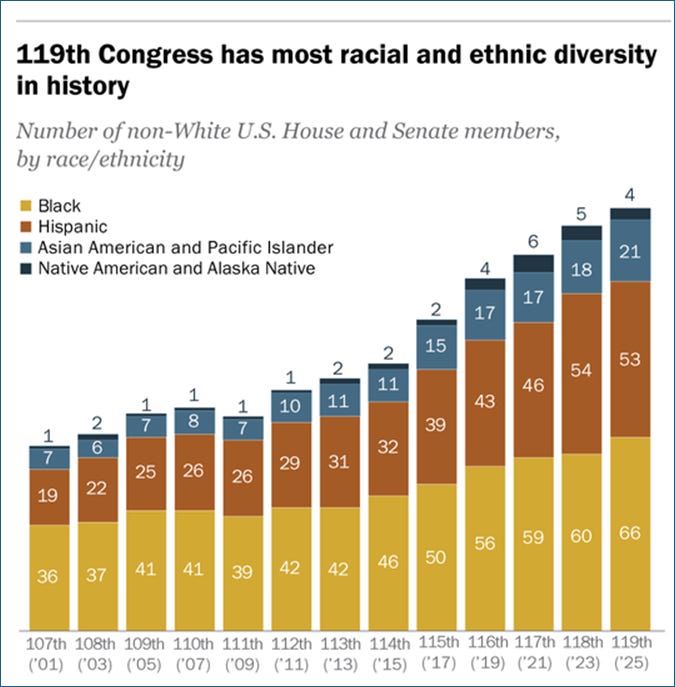
Overall, 139 of today’s senators and representatives identify as Black, Hispanic, Asian American or Native American, according to a Pew Research Center analysis.
This number has nearly doubled in the two decades since the 109th Congress of 2005-07, which had 73 members belonging to racial or ethnic minorities.
The notion that race matters less today than it has in the past runs counter to the Republican stress on the need for racial measures like immigration quotas.
And this fact is reflected in the distribution of these racially diverse representatives. The vast majority (84%) of racial and ethnic minority members in the 2024 Congress are Democrats, while only 16% are Republicans. And that percentage is going down…in the previous Congress, 20% of non-White lawmakers were Republicans.
Ultimately, what is happening in US politics is that the Democrats are “embracing the rainbow” - an approach to pluralistic politics that welcomes - and embraces - the broad diversity of our nation. For a Party to be healthy over time, every part of the coalition needs to get wins, and those wins have been happening in recent months. Because of this, a new Democratic Party is emerging, something that feels fresh, different, younger, more dynamic, and just better.
The same is happening on the global stage, where nations are exploring their full potential outside the constraints of an alliance centred on America. There is the potential for stumbles and set-backs, but far more to be gained by the rush to form new friendships and alliances.
Bringing power closer to the actual actor in the system – be it the citizen or the nation – generates more energy and progress than has existed before.
The world is changing, and it is a twofold change for the better.
What America had to give up on one stage, America will regain many-fold within its own house.
There just remains the small matter of getting rid of the current encumbrances in the Oval Office, and our worlds will be better places.
Thank you for following Barry’s Substack, focusing on the meaning behind the headlines. A regular summary of a topical book will provide more depth to enable full subscribers to stay ahead of the conversation.
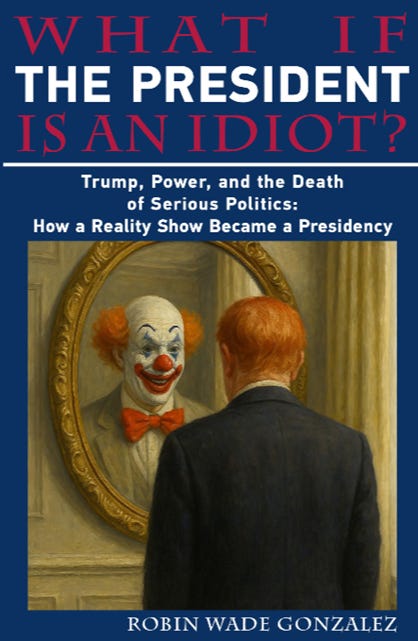
In the coming weeks we will look at WHAT IF THE PRESIDENT IS AN IDIOT – Trump, power and the death of serious politics – How a reality show became a presidency.
PS - If you have enjoyed this article, please consider buying me a Coffee!
No posts
Comments
Nothing yet. Say the first thing.
Sign in to join the conversation.