

Last week, Penn State released its annual financial report to the NCAA covering the fiscal year July 1, 2024 through June 30, 2025 (103 pages, read it here). It’s a surprisingly readable document and covers all intercollegiate athletic sports. It does not include club sports such as rugby and boxing, which operate under separate funding structures.
To summarize: both revenues and expenses, which were already at record high levels, increased to even higher record levels. Revenue ($254,867,598) growth was fueled by an increased Big10 broadcast revenue share, increased broadcast revenue share from the expansion of the College Football Playoffs, and donations (a large part of which were one-time gifts associated with the Beaver Stadium renovations).
The largest increases in expenses were the principal and interest paid on debt which increased from $14,819,769 to $22,934,838 (and will soon approach $60 million), in addition to the new cost of revenue sharing payments to athletes which came in at $18,368,391 million, as well as Alston payments of approximately $4,911,440 million*.
In the end, net operating income was a minuscule $223,679, or a margin of just 0.1%. That’s not a cushion, that’s a rounding error, and well below projections used by Penn State Athletics in 2022 to justify the borrowing and-building spree that began in 2022 and continues today. It certainly does not provide the cushion necessary to entertain the assumption of the massive increases in debt service and operational costs to come, let alone future capital expenditures.
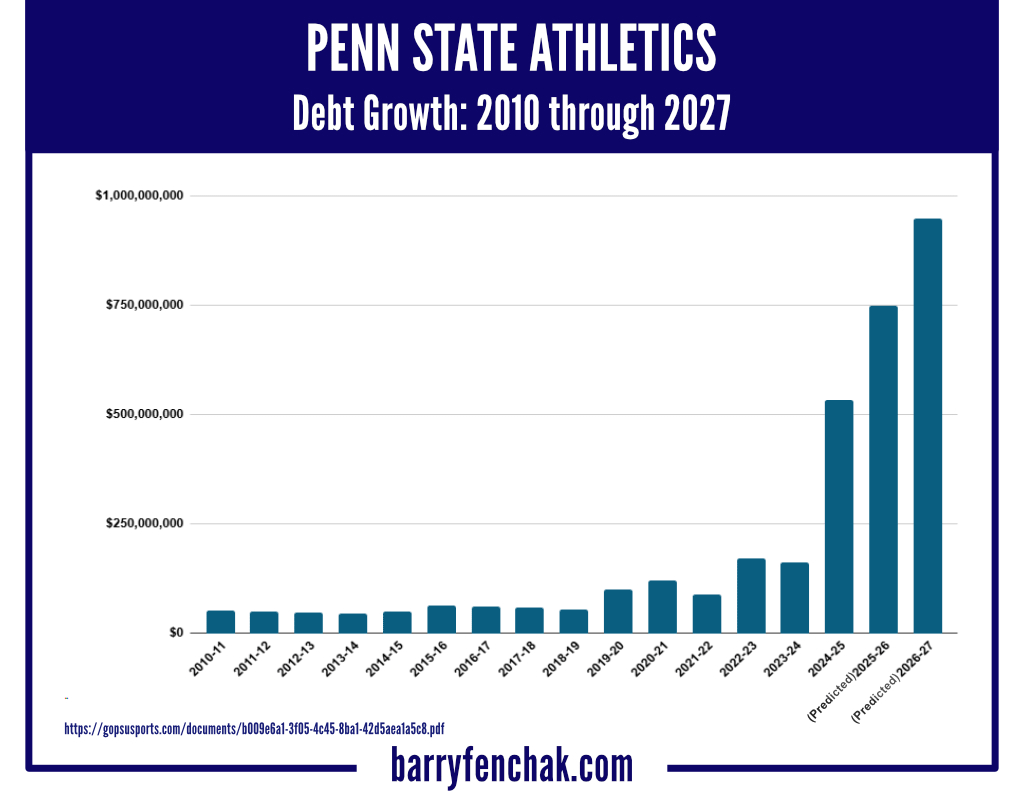
From 2010-2022, Penn State Athletics debt hovered in the $60 million range (with some COVID-era related additional borrowing before debt was reduced in 2022). There were big plans, though; in 2017, Athletic Director Sandy Barbour commissioned, for a reported multi-million dollar fee, the outside firm Populous to draft a Athletics Facilities Master Plan that included a palatial athletics administrative complex dubbed the ‘Center for Excellence’, a sports museum, and an aquatics facility that in cost and scope would have dwarfed Olympics scale projects. Renovating Beaver Stadium was far down the list.
Fortunately this plan has been largely ignored.
After Pat Kraft replaced Sandy Barbour as Athletic Director in 2022, debt began to grow dramatically. In the first year, numerous debt-funded projects were begun:
$30 million+ to renovate the athletic Training Table
$20 million+ for the Jeffrey Soccer Complex
$20 million+ for another renovation to Lasch Building (the third renovation to Lasch in 8 years, totaling $98 million for renovations to one building)
In total over $100 million, financed overwhelming through debt, carrying an interest rate of 5.0 – 7.0%.
All of this building had to be funded through debt because the Penn State Athletic Reserve Fund was unfunded and endowment distributions and philanthropic fund-raising were minimal. There was no ‘Rainy Day Fund’ and the administration was, for reasons of their own, in a hurry.
These projects all had one thing in common: they were state-of-the-art, high-profile assets that would generate zero revenue. Typically, it is far more preferable to prioritize revenue-generating projects so they can generate revenue to finance non-revenue generating projects, so the reliance on debt is lessened. The entire process and timeline was, to coin a phrase, bass-ackwards. For more detail, see my comments from the May 2023 meeting.
On the heels of the 2022-2023 building boom, in 2024 Penn State Athletics and leadership of the Penn State Board of Trustees steamrolled forward with a plan to renovate 33% of Beaver Stadium. On May 21, 2024 the Board of Trustees approved $700 million in borrowing. I’ve covered this extraordinarily disconcerting process from a governance and fiduciary point of view here, here, here, and here.
The debt used to finance the $700 million project will be taken out over a series of withdrawals, called tranches, over the 2024-2027 construction period. At the point of this most recent financial filing (year end June 30, 2025) it is estimated that $200 million of the total debt has been issued, leaving another $500 million to be added over the next two fiscal years.
With this additional debt, and barring any further debt-funded projects in the interim, the total Penn State Athletics debt should approach or exceed $1 billion by June 30, 2027. For a comparison: A decade ago, the entire Penn State University system, including Hershey Medical, carried long-term debt of just under $1 billion. Soon, Athletics alone will match it.
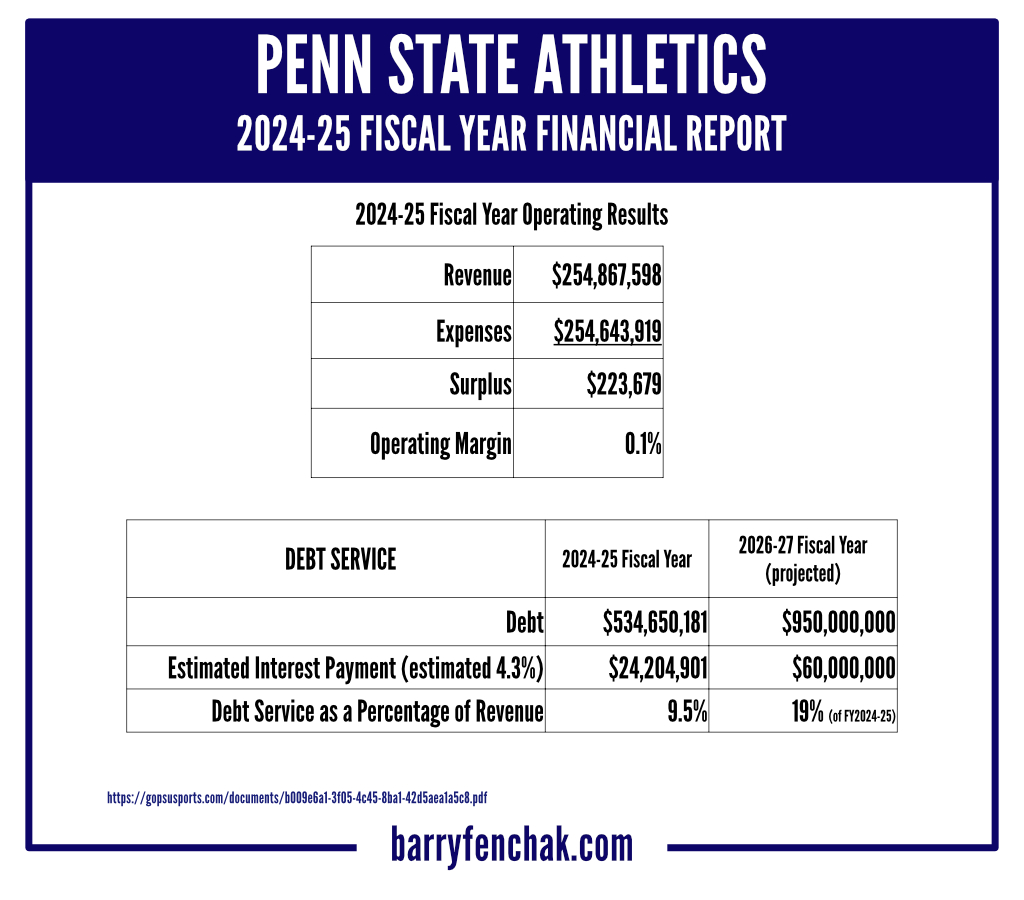
Despite being in the early stages for adding debt for the Beaver Stadium project, Sportico has declared Penn State is “the apparent pacesetter among the nation’s most indebted athletic departments”. Its debt is now more than twice annual revenue.
More importantly, this is the third consecutive year Penn State Athletics has generated minimal operating profit, leaving it unable to replenish any reserves or accelerate the paydown of debt.
This lack of operating profit also makes it more difficult to project the ability to take on additional debt or to cover unexpected and unbudgeted expenses. We have already experienced some of these unexpected issues, such as the higher than budgeted costs for Athlete Revenue Sharing payments, or the $10 million+ costs incurred to fire James Franklin and most of his staff (which will be reflected on financial statements for the next few years).
Even if Penn State Athletics takes on no more major capital projects, it will spend the next 30 years diverting approximately $60 million per year of revenue just to meet debt costs. That is a huge burden to overcome. A burden that will be passed on to the next group of University leaders. Meanwhile, 66% of Beaver Stadium rests on an infrastructure that is already 60 years old.
This is a pivotal period and the Board of Trustees have made an enormous wager on the financial future of Penn State Athletics. In 2022 they made a calculated bet that:
Revenue growth will outrun debt service
Operating cost growth will magically be reduced to one-third of the historical rate of 7.13%
No large unbudgeted expenses
No need for major capital expenses for 30 years
Donor and corporate enthusiasm will be robust
Football success will remain consistent
Things look a lot different in 2026. How will 2036 and 2046 look?
What is clear: this is not a program flush with excess cash. Instead, it is a program running at full speed with very little cushion and an additional $60 million annual debt service on its back. And when you remove the cushion, even small missteps become big problems.
* Alston payments were to begin in 2022, in the wake of the Supreme Court case NCAA vs Alston. It is likely that Penn State began making those payments at that time, though the costs never appeared as a specific line item in the athletics financial report. Those payments may have been included in the ‘Other’ category or elsewhere in the report, but the most recent report was the first one that broke out these payments specifically.
As a former Penn State alumni-elected trustee, I enjoy sharing my personal observations, concerns, and ideas about Penn State. I invite you to contact me with your opinions so that we can engage in meaningful conversations on those topics: barry@barryfenchak.com.
No posts
Comments
Nothing yet. Say the first thing.
Sign in to join the conversation.