
The Penn State Board of Trustees met Thursday and Friday, July 17 and 18 at the Pennsylvania College of Technology in Williamsport PA. My report below contains information available to the public, including quotes from public discussions. I strongly urge you to click on the links provided to find further information you might find interesting.
Attendance
Announced as absent from the meeting were trustees Russell Redding, Carrie Rowe, and newly elected Alumni Trustee Karen Keller. This would have been her first full Board meeting as an elected trustee.
Thanks for reading Barry Fenchak For Penn State Trustee! Subscribe for free to receive new posts and support my work.
Those attending only via video included most of the Alumni-Elected trustees, including: Carl Nassib and Brandon Short (neither of whom have attended an in-person meeting in the last six months) and newly elected Alumni Trustee Joe DeRenzo. Uma Moriarity attended via video on Thursday but was in attendance on Friday.
The only Alumni-Elected trustees who attended both days in person were Jay Paterno, Matt McGloin, Kelly Lynch, and Greg Pilewicz.
Aside from Trustees Paterno and McGloin, all alumni-elected trustees voted yes for all the action items listed below.
As we have seen in the past, we have a problem with with many alumni-elected trustees who are unable to prioritize their fiduciary duties to the university over their personal business (although in-person attendance does increase during football season). Perhaps the new trustee screening committee should consider a candidate’s willingness to attend the five meetings the Board of Trustees holds annually, as they cull candidates for ‘the right kind of people’.
Meetings:
On Thursday July 17th there were meetings of the committees on Student Success, Research and Technology, Governance, and Finance. On Friday July 18th the full Board met in private session in the morning, and then in a brief public session in the afternoon. You can find the agendas, supporting materials, and meeting recordings here.
The voting items, in the order in which they were presented:
4.a.1. Proposed Presidential Performance Bonus
RESOLVED, that the Board of Trustees approves an Annual Performance Bonus for President Neeli Bendapudi for the 2025–2026 performance period, in the amount and upon the terms recommended by the Equity and Human Resources Committee and presented to the Board of Trustees in Executive Session.
On top of her astronomical $2.8 million in annual compensation (see Penn State President Bendapudi Awarded 3rd Raise In Four Years – BARRY FENCHAK), the Board unanimously approved a 15% base compensation ($210,000) performance bonus for President Neeli Bendapudi. This bonus rewarded her performance over the past year:
In a show of distrust for her administration, Penn State faculty overwhelmingly voted to unionize
Research funding continued to lag well behind Dr Bendapudi’s stated target of returning to being in the Top 15 in the nation (we are currently 25th)
Tuition revenue missed budget projections by $37 million
Penn State’s academic ranking continues to stagnate near the bottom of the BigTen Conference
Enrollment yields, which are a clear indicator of the perceived value of a Penn State education, remain at alarmingly low levels and continue to trend downwards.
Penn State remains in the bottom of the Value Rankings in US News College Rankings lists.
The state continues to ignore Dr Bendapudi’s pleas for dramatic increases in the general appropriation from the state. Penn State received, as it has during every year of Dr Bendapudi’s tenure, $0 increase in its general appropriation.
This proposal passed unanimously.
4.a.2. Proposed 2026-2027 Presidential Performance Goals
RESOLVED, that the Board of Trustees approve the President’s 2026 – 2027 Performance Goals as presented in Executive Session.
Dr Bendapudi’s official performance goals remain a secret and only discussed in private meetings. The performance goals Dr Bendapudi wrote herself (read the Presidential Vision and Goals here) contain only one measurable metric (achievement of a position as a Top 15 US research institution) and no accountable targets or requirements. Instead, the Board declares that Dr Bendapudi is a ‘rock star’ and awards her more money.
This proposal passed unanimously.
4.b.1. Proposed Appointment to the Penn State Investment Council
RESOLVED, That Robert Beard, Chair of the Finance and Investment Committee, be appointed to the Penn State Investment Council replacing former Vice Chair, Mary Lee Schneider.
RESOLVED, That the appropriate officers of the University are authorized to take all actions necessary or appropriate to implement the foregoing resolution.
While this appears to be no more than a boilerplate housekeeping item, there may be a bit more underneath. The Penn State Investment Council’s primary role is involved with the governance of the endowment, which has been underperforming for years now.
Mary Lee Schneider, a member of the Board of Trustees for the last 11 years, has spent many of those years as a member of the PSIC. In fact, just a few months ago the Board changed its Bylaws in order to allow Schneider to continue to sit on that Investment Council.
There was no explanation of why she is suddenly being removed.
This proposal passed unanimously.
4.b.2. Proposed Budget for Fiscal Year Beginning July 1, 2027, with Corresponding Tuition, Fees, and Housing and Food Rates
RESOLVED, That the proposed University budget for fiscal years 2027-2028 and corresponding tuition, fees, and housing and food rates are hereby approved.
These two items, the University’s operating budget and the level of tuition costs, are always voted on as one comprehensive item. The Board approved of both with two dissenting votes: Trustees Paterno and McGloin (both alumni-elected trustees).
The headline will be that Penn State increased tuition again, but there is much more to digest here, so I will do so in a separate article focused solely on the budget. I think you will find that article to be educational and enlightening. I will guarantee you one thing: after reading it you will be tremendously more informed on the Penn State budget than are most of the members of the Board.
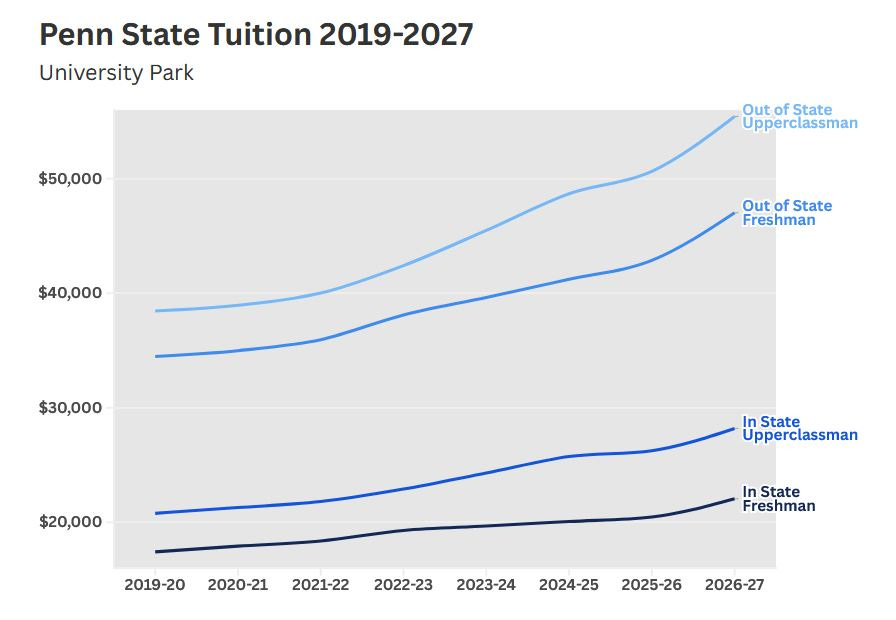
You can see Penn State’s current tuition rates here: Tuition Schedules 2025-26 | Tuition Information. As you likely know, Penn State’s tuition rates for in-state students remain the highest in the BigTen Conference. Drastically so, and it is not moving in the right direction (read Penn State’s Affordability Gap – BARRY FENCHAK).
The Board voted to increase tuition rates again: by 2.5% for In State students at University Park, and 4% for out of state students. Those are the ‘little’ numbers, let’s look at the big numbers.
The annual tuition costs will now be:
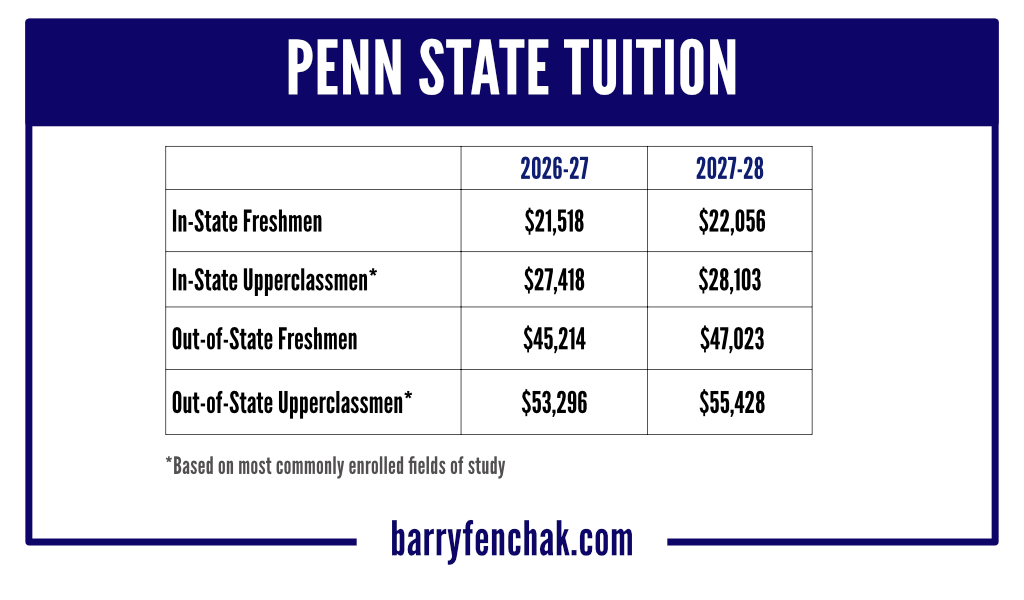
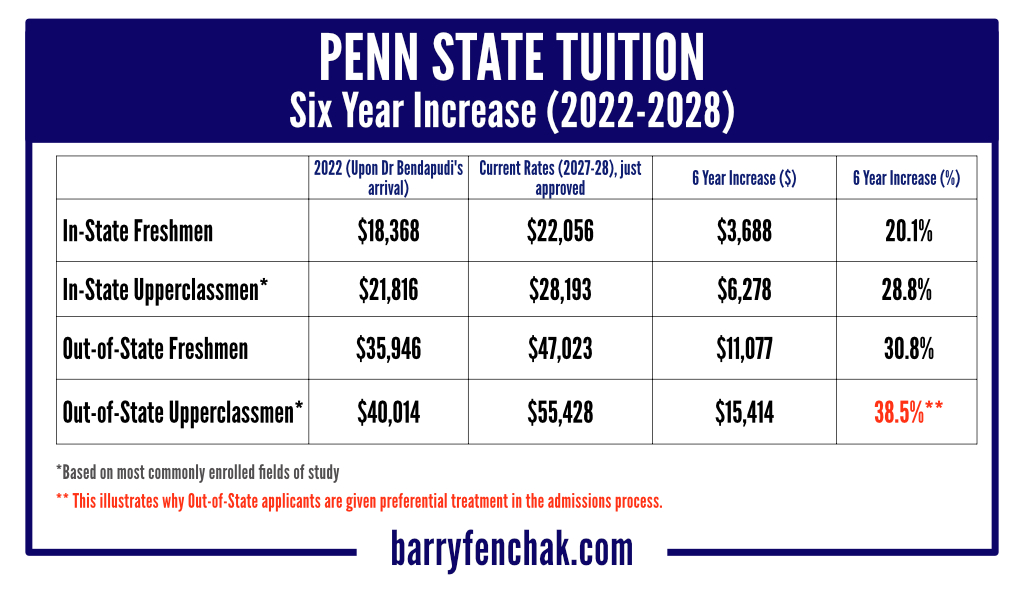
The largest increases, in both dollars and percentages, have been for upperclass students. This is not unintentional. Jacking up tuition rates for those students after they have been enrolled for two years allows for the huge tuition increases to be hidden from many prospective students and families. While the data is available for those willing to do a little digging, many families and students are still shocked when they get that first tuition bill as an upperclassman. At that point in the process though, there is not much to do but grin and bear it.
Room and Board rates, of course, also went up, most dramatically for students in the recently renovated dormitories.
Vote: Yes - 33 No - 2 (Paterno, McGloin)
4.c.1 Proposed Approval Limitation on Access to Classified Information
BE IT RESOLVED that in the future, when any individual enters upon any duties as Chairman or Vice Chairman of the Board, Senior Management Official and Facility Security Officer, such individual shall immediately make application for the required eligibility for access to classified information; and
BE IT RESOLVED AND DIRECTED that the following members of the Board of Directors and other officers or members shall not require, shall not have, and can be effectively and formally excluded from access to all CLASSIFIED information disclosed to the corporation/company and shall not affect adversely corporate/company policies or practices in the performance of classified contracts for the Department of Defense or the Government contracting activities (User Agencies) of the National Industrial Security Program.
• Joseph DeRenzo, Chief of Anesthesiology, UPMC Magee Women’s Hospital
• Karen Keller, Managing Partner, Shaw Keller LLP
Certain university business partners (US Department of Defense, etc) require that anyone with access to sensitive items of information must go through and pass a security clearance. Most members of the Board of Trustees either don’t have, or could not receive, the required clearances, and therefore cannot be given access to that information. This information is not Penn State proprietary information, which all trustees have a right to by State law.
This proposal passed unanimously.
4.c.2 Proposed Changes to the Bylaws of The Pennsylvania State University
RESOLVED, That the Penn State University Bylaws and Elections Appendix to the Bylaws be amended as set forth in Appendix II hereto. (See Appendix I)
Among the amendments to the Bylaws were:
Formalizing the process for replacing a trustee who reaches the 12 year overall term limit in the middle of one of their elected or appointed terms. The process will be: A) For that trustees term to end once they reach the 12 year mark, and B) For the Nominating Subcommittee to select a replacement for the remaining unexpired term.
Limiting the normal term limits for Chair of the Board or Vice Chair of the Board to three years (with a loophole inserted that would allow for longer terms, with Board approval)
The remainder of the Bylaws changes appear to be attempts at ‘wordsmithing’ of some of the most draconian elements added to the Bylaws in July 2024, when the Board was focused on silencing and removing trustees with dissenting viewpoints. The Board is currently facing multiple lawsuits regarding the drafting and the implementation of some of these provisions. It appears these amendments may be in reaction to those suits.
This proposal passed unanimously.
5.a. Proposed Election of Members of the Nominating Subcommittee
RESOLVED, That the following persons be appointed to the Nominating Subcommittee for 2026 – 2027: Daniel A. Onorato, Chair*, Kelley M. Lynch, Vice Chair, Robert E. Beard, Ruby Bjalme, Randall “Randy” E. Black, David M. Davis, Daniel J. Delligatti, Anand Ganjam, Naren K. Gursahaney, David M. Kleppinger *, Uma Moriarity, Tracy Riegel, Richard S. Sokolov* *Ex Officio
This nominating subcommittee was created two years ago for the sole purpose of determining inclusion, or exclusion, of candidates on the Alumni Trustee election ballots. These are the folks who will be charged with keeping the “wrong type of people” off of the board (read Penn State Board of Trustees To Alumni: Drop Dead).
This proposal passed unanimously.
As a former Penn State alumni-elected trustee, I enjoy sharing my personal observations, concerns, and ideas about Penn State. I invite you to contact me with your opinions so that we can engage in meaningful conversations on those topics: barry@barryfenchak.com’
Thanks for reading Barry Fenchak For Penn State Trustee! Subscribe for free to receive new posts and support my work.
Comments
Nothing yet. Say the first thing.
Sign in to join the conversation.