
On Wednesday, March 11th at 10 am EDT Penn State President Neeli Bendapudi will appear before the Pennsylvania House of Representatives for budget hearings on Commonwealth funding of state-related universities. House members will question Dr Bendapudi and her colleagues from the University of Pittsburgh, Temple University, and Lincoln University as part of deliberations regarding state appropriations to benefit the residents of the Commonwealth of Pennsylvania. I encourage you to watch those hearings here. As a reminder, Dr Bendapudi is the highest paid public university president in the United States at $2.8 million a year (see Penn State President Bendapudi Awarded 3rd Raise In Four Years).
State funding for Penn State has been flat for many years. In 2025, Penn State received $242.1 million in general support from the Commonwealth, an amount equal to $5,621 per in-state student. In past years I have been disappointed that these hearings appear to be nothing but rehearsed answers from the presidents to formulaic questions from the representatives. The following are five questions I would like to see well-informed members ask Dr Bendapudi. I believe her answers would be illuminating.
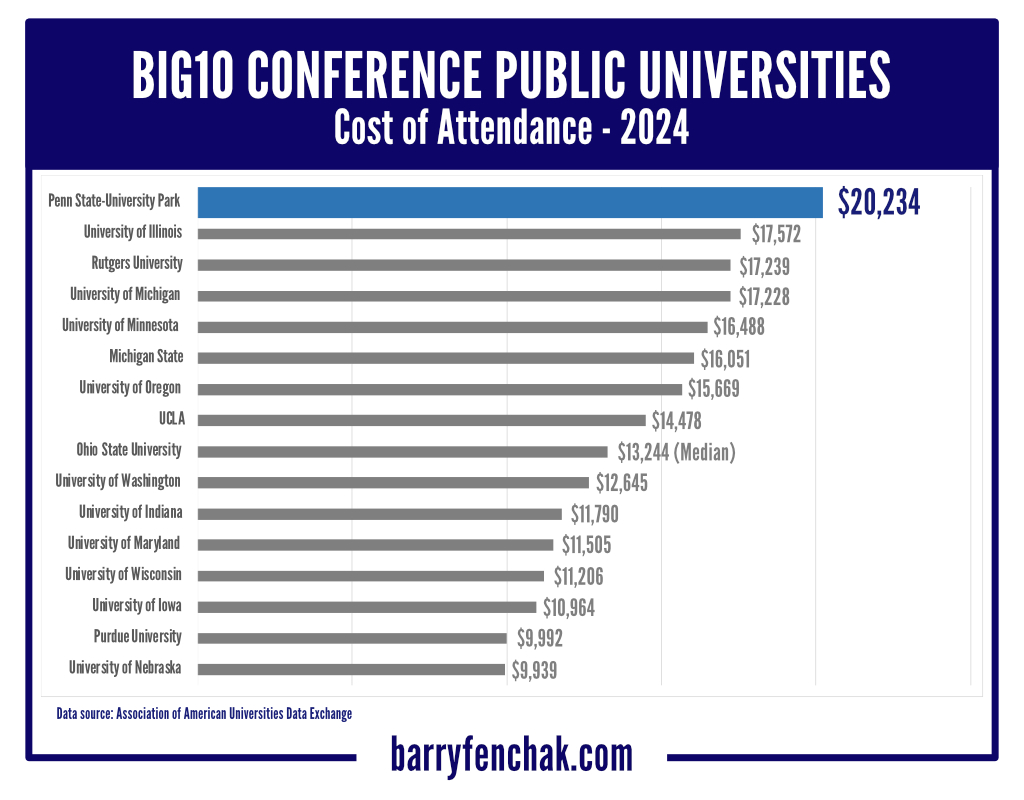
1) Why does Penn State have the highest in-state tuition of the 16 public Big10 Conference universities?
While Penn State does receive less funding per in-state student than most of its peers, many of us would support more robust funding. But Penn State has dramatically higher costs of attendance for in-state students compared to other Big10 Conference schools, of which only a small portion can be attributed to lower state funding.
A key lynchpin is how much Penn State charges for in-state tuition in comparison to our Big10 Conference peers.
At $20,234 a year, Penn State has the highest in-state tuition of our Big10 public university cohorts, while Ohio State at $13,244 a year is the median. Penn State in-state tuition is $6,990 higher than the median, or 153%.
2) Why does Penn State offer the lowest amount of aid to in-state students of all the public Big10 Conference schools?
The large disparity in tuition costs is only exacerbated by the huge gap in financial aid, an area where Penn State is the stingiest of its peers. The only number that really matters to students evaluating offers is the final bottom line: how much will they pay out of pocket for their education?
As shown in the following tables, taken from the US Department of Education database, compared to the costs at the median Ohio State, Penn State’s in-state students pay an incredible $14,306 more per year.
Penn State and Ohio State are very similar; both have roughly the same enrollment, offer a similar range of majors, and are in the same socioeconomic region, yet Ohio State has consistently out-performed Penn State in federal educational outcome metrics. And they’ve done it with a balanced budget.
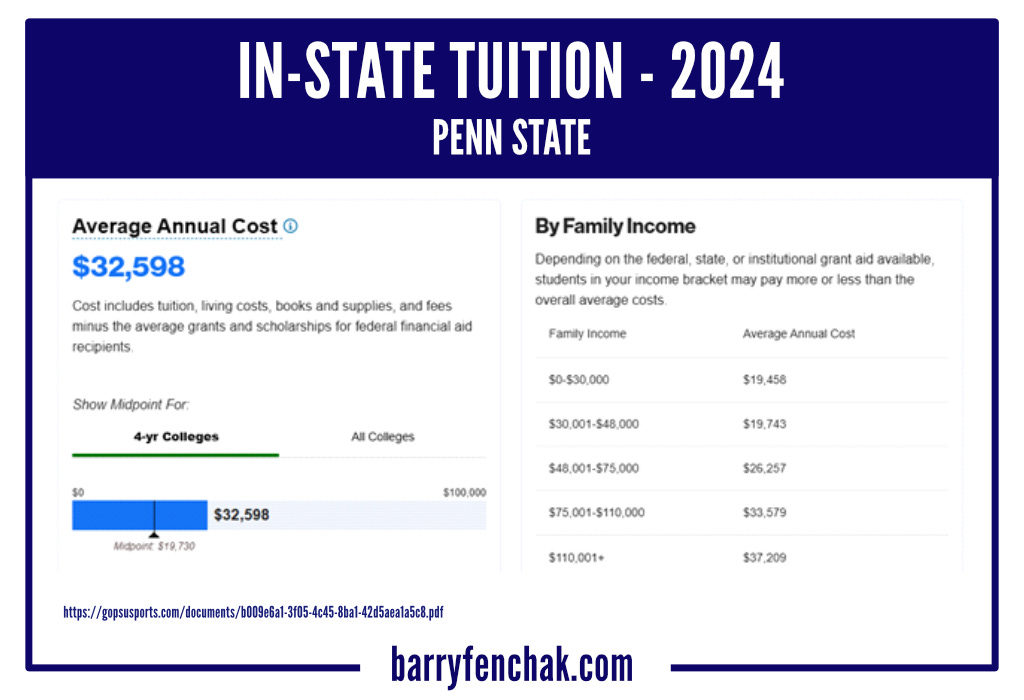
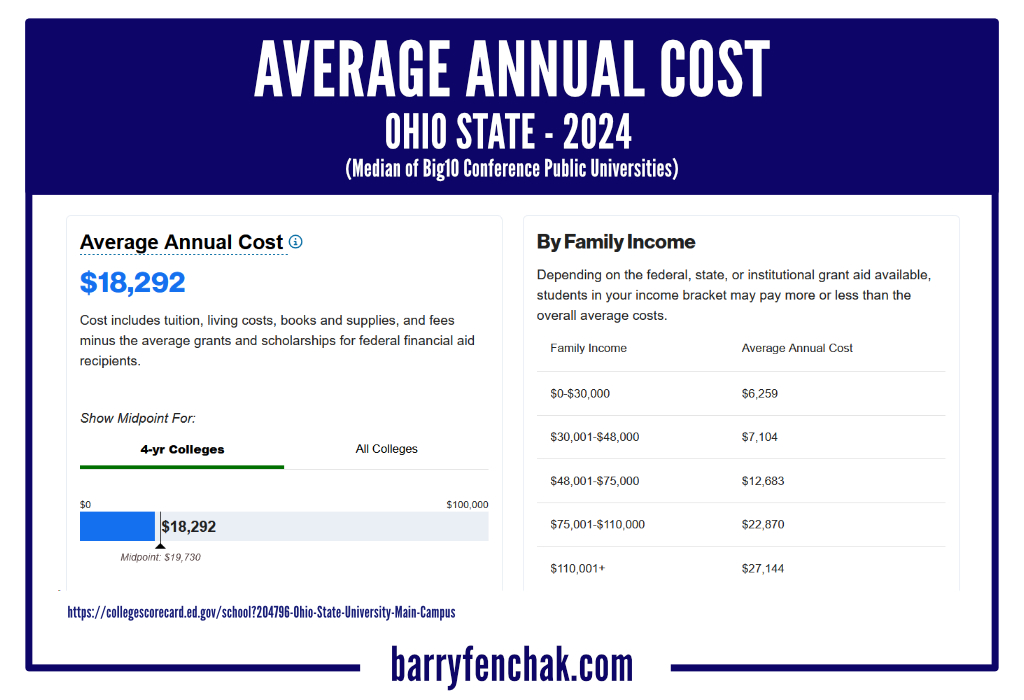
Penn State at $32,598 per year for in-state students versus Ohio State at $18,292 per year for in-state students is a net cost differential of a staggering $14,306 per year. That is the true ‘affordability gap’ Pennsylvania students face.
And at Penn State, students with more modest means ($75,000 and below) pay twice or even three times more than the median. Penn State has essentially priced in-state students of average or lesser incomes out of the picture.
How much of that $14,306 differential is due to lack of funding from the Commonwealth? Ohio State received $432.344 Million in state support and enrolls 48,148 in-state students for a per student funding of $8,979. That is just $3,358 more in support per in-state student than Penn State, yet accounts for only 23% of the difference in costs charged to our students.
The remaining difference, $10,948, is fully at the feet of Penn State.
3) Penn State ranks last, or near the bottom, in nearly every federal metric of educational outcomes in the Big10 Conference (see
Penn State Finishes Second-to-Last in the Big10 Conference USNews Value Rating,
My comments from the Penn State Board of Trustees Meeting July 19, 2024 and
Penn State’s drop in academic rankings is the worst in the nation. How bad is it?)
What, exactly, are we getting for our money?
The strongest indicator of a public university’s value is ‘yield’, or the percentage of students who actually enroll at a university divided by the number who applied and were accepted. Student decisions are strongly driven by bottom-line costs, and university offers of substantial aid packages attract quality students to those schools.
Of the Big10 Conference public universities, UCLA has the highest yield at 50% while Penn State has now hit a historic low of 17%. Only the University of Oregon is lower at 14%.
With dramatically higher costs, Penn State is a less desirable option for potential students, 83% of whom choose to go elsewhere. Of the 17% that do enroll, only 37% submit SAT scores for an average combined score of 1330 versus the median of 1360 at Ohio State (64% submitting) and Purdue (100% submitting). The top incoming freshmen candidates are going elsewhere because they are getting better competing offers.
Yield is the biggest market indicator of what incoming freshmen think of a university. If a quality student can get a better offer elsewhere, they are going elsewhere. The market is telling us that Penn State is the second least desirable school in the Big10.
4) For the sake of attempting to balance the budget, Penn State seems to have become addicted to admitting out-of-state students who pay double the in-state tuition. What steps
are you taking to control university expenditures and return the seats to more qualified Pennsylvania residents?
In order to meet increasing budget expenditures, Penn State is filling incoming
freshman classes with 50% out-of-state students who are paying double in-state tuition. Unsurprisingly, the 9.8% yield for this segment is even lower than the in-state yield of 39%.
Because Penn State is desperate for cash, it forces the university to accept incoming freshmen with lower academic quality while lowering the opportunities for
in-state students.
Dr Bendapudi has framed this decision as a pragmatic response to “limited resources” and boasted that out-of-state revenue supports the entire university. She has repeatedly placed the blame on a lack of state funding support and ignored the effects the terrible yield has on Penn State’s national value ranking — #185 in Best Value Schools, or 14th out of 15 public universities in the Big10 conference.
5) Improving the investment performance of the Penn State endowment would create a significant increase in the university’s wealth, a small fraction of which could be used to
supplement aid to in-state students and reverse the trends we discussed above. This is an easy fix, why aren’t you doing it?
The sub-optimal performance of the Penn State endowment has led to a failure to maximize growth, a failure that has cost the university several billions of dollars of unrealized gain. Even a modest improvement in investment management could be used to enhance affordability and lower the burden on Pennsylvania taxpayers.
I have stated many times that for over a decade, Penn State’s endowment has been under-performing due to poor investment management. I sued the university to get access to endowment financial records (that I should never have been denied access to) and stand by my statement. The upshot of every year of endowment under-performance is the loss of revenue that we can never get back.
Managing the endowment with the appropriate growth focus, and reducing investments in high-cost under-performing ‘alternative investments’ would have resulted in well over $2.5 billion of additional value in the endowment, with no added risk. (see What good things could Penn State do with an extra $2.3 billion in the endowment?)
As a former Penn State alumni-elected trustee, I enjoy sharing my personal observations,
concerns, and ideas about Penn State. I invite you to contact me with your opinions so that we can engage in meaningful conversations on those topics: barry@barryfenchak.com.
No posts
Comments
Nothing yet. Say the first thing.
Sign in to join the conversation.