
Prof. Barry Appleton, Appleton’s Clause & Effect Substack Blog | Reading the Trade War | Part 2 of 3 | August 20, 2026
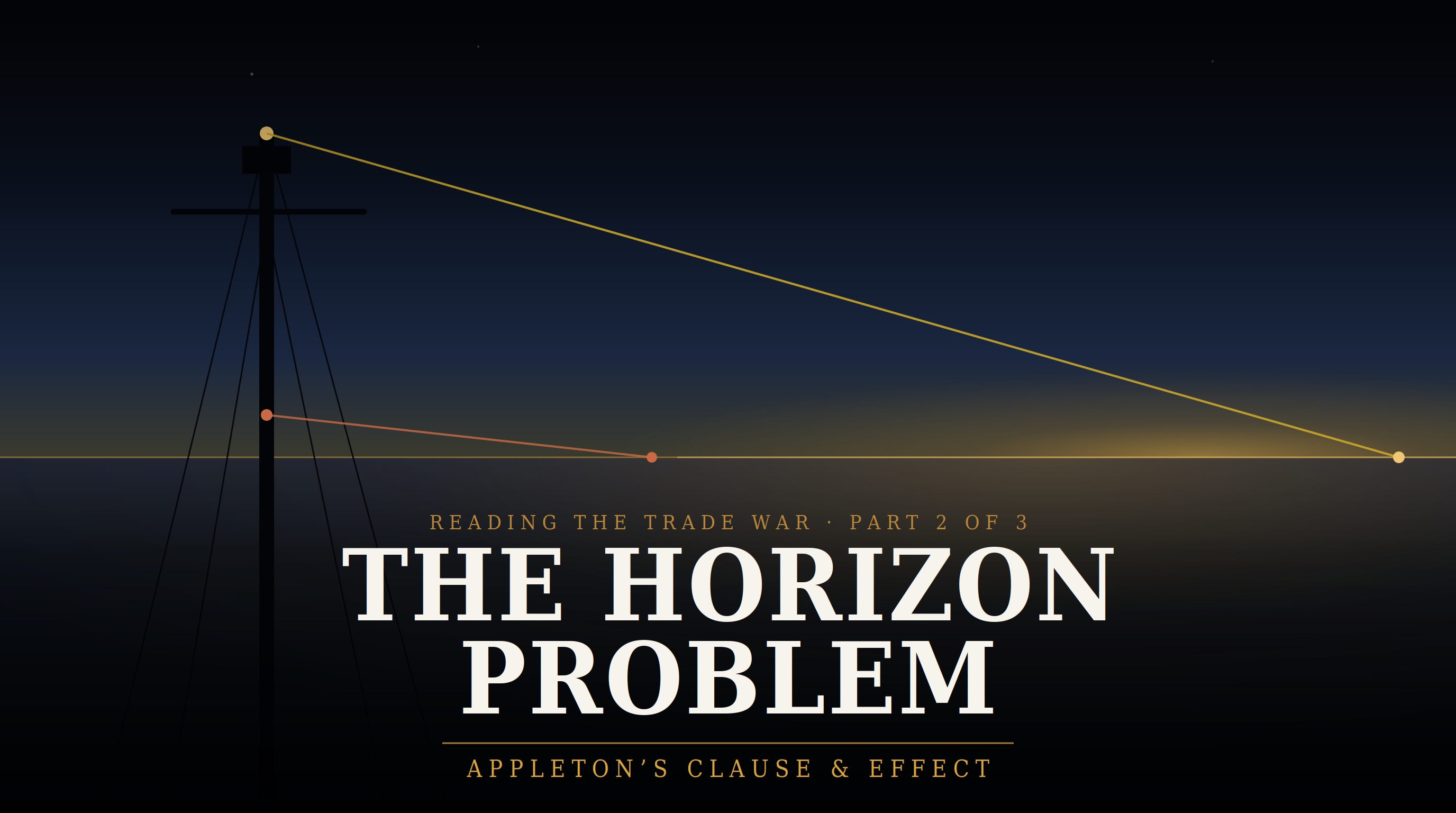
Same ocean. Same weather. The variable is your height.
This post is public, so feel free to share it.
It’s hard to understand where you are in trade talks sometimes. A lot deals with perspective and the problem of line of sight. But this is not just a trade policy problem. I taught sailing when I was young. Before anyone learns to trim a sail properly, they learn something duller: how far they can see.
The formula is unforgiving and simple. Distance to the horizon, in kilometres, runs about 3.57 times the square root of your eye height in metres (the constant folds in the earth’s radius and a small correction for how light bends through the atmosphere). Stand on deck, eyes two metres above the water, and your horizon sits five kilometres out. Climb to the masthead at thirty metres, and it moves to nearly twenty.
Same ocean. Same weather. Four times the warning.
The horizon obeys your height. Nothing else.
We all need perspective and navigational help from time to time. I have been thinking about that formula since Monday, when I spent six hours at the Balsillie School of International Affairs engaging with talented graduate students on how to read a live trade negotiation, and since early Wednesday morning, when the file they were reading gave them its answer.
Here is the view from the deck this week. Fifty per cent duties were set to hit a broad range of Canadian goods on Wednesday morning. The provision behind them sits in the Tariff Act of 1930, and no president has used it to impose duties in the ninety-six years since. Ninety minutes before the deadline, they were paused for three days, on the strength of a social media post about an agreement whose text had not been written”
The relief is warranted. The anger of the past eighteen months is earned too. Nothing below argues otherwise, and a reader who wants only to know whether the duties are coming has already been told the useful part.
But almost every commentator writing this week is standing on that deck. Five kilometres of horizon, and the entire conversation sits inside it: what was announced, who is to blame, what happens tomorrow. By the weekend, that conversation will be exhausted and leave you with nothing you can use in a file of your own.
The question worth asking is different. How high do you have to climb before this stops being a surprise?
Monday I put a problem to the room. It is August 17. The duties land in thirty-four hours. Nobody here knows how this ends. Tell me what you are looking at.
The tool I handed them is deliberately unglamorous. Deadlines in trade disputes do one of four things. They get met. They get moved. They get missed while the underlying dispute grinds on. Or they produce a partial deal that defers every hard question to a later round.
Four options. That is the whole apparatus, and its power comes from being closed rather than clever: if the outcome must land in one of four places, then every piece of evidence you encounter is doing one job, which is telling you which of the four is filling in.
What it does is convert a shock into a classification problem. Knowing the four patterns means you stop waiting to find out and start watching for evidence that discriminates between known outcomes. That evidence sat in public all weekend. The American side had signalled no willingness to extend. The USTR left a negotiating session and offered reporters nothing. Canada’s own trade minister said the job was not done. Both sides were described as digging in while the clock ran. Any one of those signals could have been noise on its own, but four of them pointing the same direction in the last seventy-two hours, against a deadline the other side had refused to move, is what evidence looks like when it is trying to tell you something.
Nobody needed a source in the room. They needed to read what was published and know what to do with it.
Most of the room called the third pattern, and most of the room was wrong. The deadline moved. That is the second pattern, and it was always on the card.
Here is why being wrong that way is not a failure of the method. Nobody in that room predicted a social media post ninety minutes before the deadline. What the four patterns bought was the ability to say, before it happened, that the outcome would be one of four known shapes, and to watch for the evidence that would discriminate between them. From twenty metres up you cannot see which way the weather turns. You can see that weather is coming, and you can name the forms it takes.
Climb higher and the machinery comes into view behind the announcements. Two habits do most of the work, and both can be taught in an afternoon.
Read the annex, not the press release. A finding is a jurisdictional key; it unlocks a power. What the power gets used on lives in a separate document entirely, and the gap between the two is where the actual policy hides. This summer’s proclamations were framed around dairy, alcohol and motor vehicles. The list titled motor vehicles contains no cars. It covers electronics, furniture, plywood, luggage, cosmetics and toys. Anyone who read only the announcement learned the wrong thing, and learned it with complete confidence.
Then ask what the silence means. A measure can be excluded, and the text will say so. It can be exempted, but that depends on a finding that a later official can reverse. Or it can be absent altogether, which offers no protection whatsoever. Energy, potash, fish and critical minerals appear nowhere in the annexes. Nobody carved them out. They were left undecided, and undecided things get settled by whoever moves first, which means the four categories Canadians have been reassured about all summer are protected by nothing sturdier than the fact that nobody has yet bothered to type them into an annex.
Protection that comes from not being on a list can be removed by adding you to the list.
That distinction takes ninety seconds to teach and is worth more than most of what will be said on television today.
Higher still, and the question changes shape. It stops being about what was done to Canada and becomes about what Canada can carry into a room.
Mexico arrived at its negotiations with 54 named items, published its rounds in advance with dates and locations, and obtained named-round treatment. Canada arrived with roughly ten priorities it would not say out loud, and came away with a paragraph.
A year on, Mexico has reduced those 54 American demands to 14, while tabling 13 of its own. Its fourth negotiating round is booked for Washington in September. Its economy minister has explained the mechanic plainly: each annual review carries fewer items forward, because settled questions do not come back. Mexico enters 2027 with a shorter list. Canada enters it with the same undefined basket, plus whatever is added. The gap does not hold steady. It widens on its own, every year, without either government doing anything further.
The method is worth studying, because it is unglamorous and entirely reproducible. Mexico has formally asked Washington for a standstill on new tariffs for the duration of the review. Canada has asked for nothing comparable in public. Mexico argues its automotive case with an empirical study submitted to American officials, showing Mexican vehicles carrying twenty five per cent while Japan, South Korea, Germany and Morocco carry fifteen. Its economy minister describes the approach as persistent, perseverant, patient, and sends a delegation to Washington every week.
Canada sends ministers when there is a deadline. That is the whole difference, and none of it requires anyone’s permission to change.
Scope was never the obstacle. A list is a manufactured good, and something has to manufacture it. The United States runs twenty-six advisory committees across three tiers, roughly seven hundred security-cleared advisers, and a statutory requirement that their views reach Congress before a joint review. That apparatus survives because Congress demands its output. Legislative demand is what carries machinery like this through changes of administration, changes of party, and changes of trade doctrine, because an apparatus required to report to a legislature every year cannot quietly be allowed to lapse.
Canada built something comparable first, built it better, and dismantled it in 2013 (the sectoral advisory groups on international trade, wound down without replacement).
You cannot trade named items when you have nothing to put on a list. The basket that Canadian negotiators carried into this round is an institutional deficit made visible, and it was visible long before this week to anyone standing high enough.
This is also the altitude at which the last eighteen months resolve into a single shape. The digital services tax, withdrawn the day before its first payment came due. The streaming levy, dropped and replaced with direct public funding. Retaliatory tariffs, largely wound back in August 2025. Three concessions, none carrying a named reciprocal item, a date, or a consequence for non-delivery.
The test I teach for this runs three questions and takes a minute. Does it obtain a named item in return? Can the party promising it deliver? Is it enforceable within twelve to eighteen months, by an administration with the staff it has? A concession failing any one of the three has not been priced. It has been given.
Put those three questions to the last eighteen months. The answer comes back the same way three times.
From the masthead you see weather. From altitude you see climate.
Softwood lumber has been in dispute for 44 years, since the first petition was filed in 1982, and now sits in its fifth distinct round. Across the thirty-five years to 2017, Canadian lumber enjoyed roughly thirty-three months of free trade. Managed trade is the default condition of this relationship. Canada has spent four decades treating the exception as the rule, which is a long time to misread a pattern that repeats on a roughly decade-long cycle and has never once resolved in Canada’s favour without an instrument both sides wanted.
Section 338 waited ninety-six years. The only president who ever made a discrimination finding under it, in 1935 against Germany and Australia, declined to impose the duties. Roosevelt made the finding and then left the tariff power where it sat, which meant that for ninety-one years the only data point available on this statute pointed toward restraint, and every lawyer who examined it drew the same reasonable and now-falsified conclusion. A dormant instrument was always an available instrument.
And ninety years ago, Canadian Political Scientist Harold Innis described a country exporting raw materials and importing finished goods, capturing a smaller share of the value at every turn. Canada today invents artificial intelligence at a world level, roughly double the American rate per capita, and keeps about 60 percent of what it invents. The staple has moved from fur to research. The structure has not moved at all.
At this altitude, this morning stops being an event and becomes a data point in a pattern older than anyone now negotiating it.
Here is where vantage stops being interesting and starts changing what you should do.
Enormous pressure will build today for Canada to cut off energy exports. From the deck that reads as strength, and it will be demanded across party lines before lunch.
It is worth noting that the existing instruments are already working against the country that uses them. The Prime Minister has pointed out that American tariffs on aluminum have driven a fifty eight per cent increase in aluminum prices inside the United States. That figure is arithmetic, and it explains why the American business community has been arguing against escalation more loudly than anyone in Ottawa.
From higher up you see the whole exchange, and it does not work.
A chokepoint you also depend on is not a weapon. It is mutual exposure, and the party holding more alternatives wins the trade. Iran held a real chokepoint at the Strait of Hormuz this year and threatened to close it. The position inverted the moment Washington blockaded Iran’s own exports through the same water. Denial bought Iran a seat at a table; it never bought a settlement.
The durable version of that position means owning a line others need and you do not, which is a different proposition entirely from threatening a line you need just as badly. That difference is invisible from five kilometres.
Every vantage has a price, and I should be straight about this one.
Elevation costs immediacy. From the masthead you cannot hear the deck, and the people down there are not wrong to find you irritating. Someone whose plant closes in November needs no lecture on Harold Innis. The horizon view turns useless the moment it becomes a reason to feel nothing, or a way of standing apart from consequences that land on other people.
It also cannot tell you what happens next. My students wanted a prediction on Monday, and I refused to give one because the honest classification of this file is deep uncertainty: you can name the outcomes but cannot price them. Under those conditions, optimization is unavailable, because you cannot maximize an expected value without defensible probabilities to multiply against it, and any model that hands you one is smuggling in a confidence nobody in the room actually holds. You choose options acceptable across every plausible case, and you stay able to say what would change your mind.
The tools predicted nothing this morning. Some students called it right, some did not, and the file could have broken the other way on a single phone call. What the method bought them was the ability to say what they were looking at, and to be usefully wrong instead of confidently wrong. That is a smaller claim than prediction and it wears far better.
Every meaningful move available to Canada today requires no American signature.
Inventory the treaty reservations Canada already holds and has never mapped; reading your own annexes needs nobody’s consent. Rebuild the advisory apparatus dismantled in 2013. Price every concession before offering it, with a named item, a date, and a consequence. Give statutory teeth to the sovereign compute strategy announced in June. Build markets that are not this one, as British Columbia has begun to do with lumber through its new trade office in the United Kingdom.
None of it is glamorous. All of it is available now. Each of the five takes months to build, and none will produce a headline in the week anyone starts, which is precisely why they keep losing to whatever deadline happens to be closest. And notice what those five share: every one of them is a way of seeing further next time.
An advisory committee is a mast. A mapped list of reservations is a mast. A priced concession is a mast. They deliver no firepower at all. They deliver altitude, and altitude is what turns a shock into a forecast.
The horizon marks the edge of what you can see from where you happen to be standing, and nothing more than that.
We have spent four decades on deck, surprised by weather that was always coming.
One piece of advice: Climb.
Reading the Trade War, three parts.
Four Headings and a Countdown. What Washington published on Tuesday night, and what Ottawa did not.
The Horizon Problem. What teaching sailing taught me about reading a trade war.
The Promises Ottawa Cannot Keep. Why a federal signature may not reach the measures Washington is asking about.
The Clause Canada Could Not Keep, on what happens when Ottawa signs a treaty obligation the Constitution will not let it deliver.
A Sovereign Advisory System for Canada, Centre for International Governance Innovation, October 2025.
Whose Law Governs Canadian Data? The CLOUD Act, Executive Agreements, and Digital Sovereignty, SSRN working paper, and the Balsillie Papers Special Report drawn from it.
The Cloud Casts a Long Shadow and The Digital Hinge of Sovereignty, on cloud law and the limits of data residency.
The Rules Washington Is Writing, on Canadian digital sovereignty under the CUSMA review.
Executive Order 14320, Promoting the Export of the American AI Technology Stack, July 23, 2025.
The argument is developed at length in my forthcoming book, Own the Rails: Canada’s Fight to Decide Its Own Digital Future.
Prof. Barry Appleton is Interim Director of the Balsillie Legal Advisory Centre at the Balsillie School of International Affairs, and Wilfrid Laurier University, Managing Partner of Appleton & Associates International Lawyers, and Distinguished Adjunct Professor of Law and Co-Director of the Center for International Law at the New York Law School.
© 2026 Barry Appleton. All rights reserved.
Comments
Nothing yet. Say the first thing.
Sign in to join the conversation.