
Appleton’s Clause & Effect | July 11, 2026 | ~10 min read
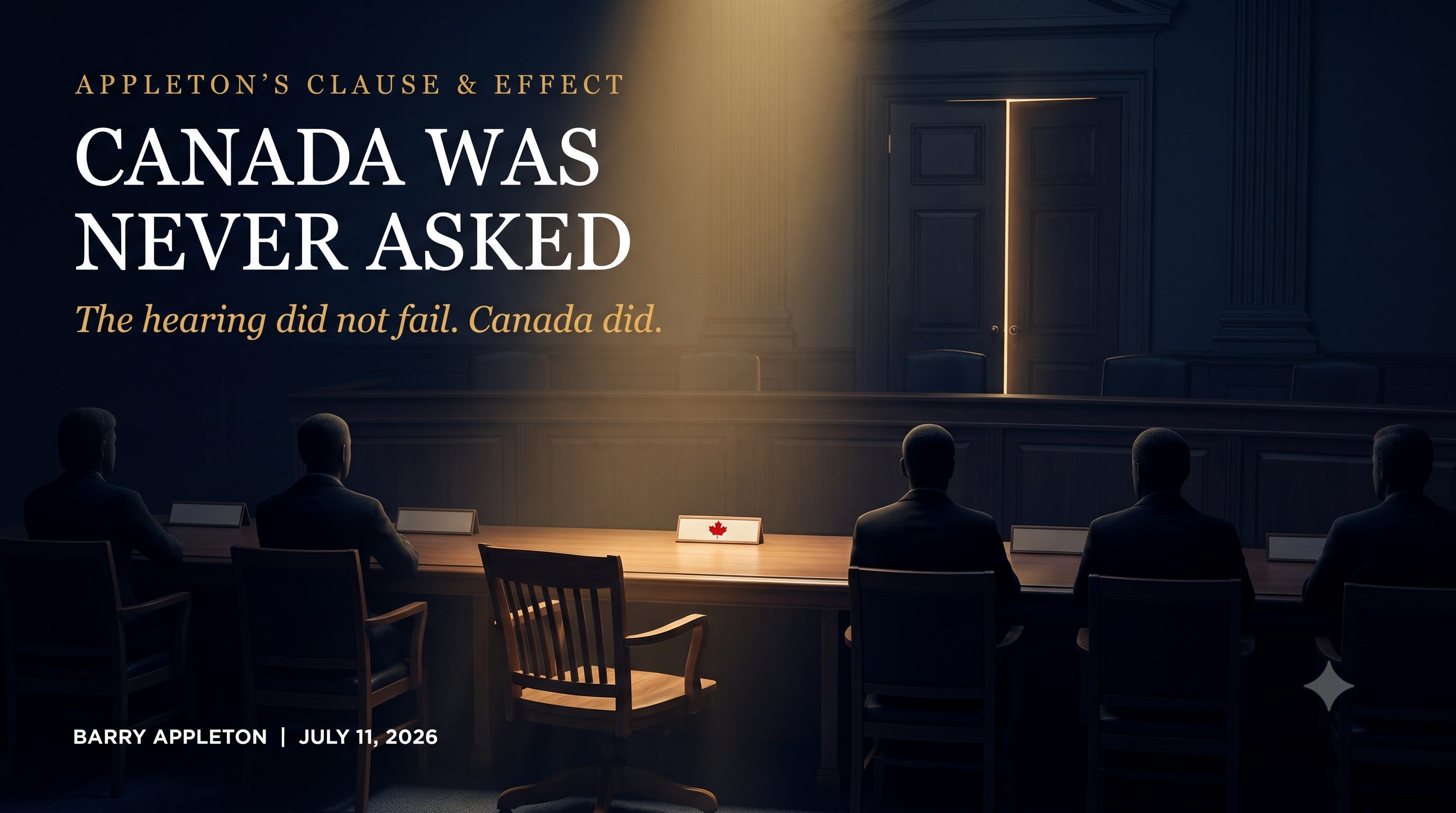
TL;DR On the third day of the Section 301 hearings in Washington, an American industry coalition told the United States government that Canada is a laundering route for Chinese forced labour, and asked for the new duties to be stacked on the tariffs Canadian goods already pay. Ten federal U.S. agencies were in the room. Nobody answered that challenge. Fifteen governments appeared at those hearings. Mexico sent its Minister of Economy. Chile, Ecuador, Guatemala, Guyana, Honduras, India, Kazakhstan, Malaysia, Pakistan, Peru, South Africa, Korea, Sri Lanka and Viet Nam all sent someone. So did the business associations of Mexico, Guatemala, Honduras, India, Chile and Brazil. Canada sent no one, and neither did a single Canadian business association. Canada’s two-page filing left the stacking question blank. The Committee questioned every witness in front of it and told them to answer in writing by 16 July. Canada was asked nothing, because Canada sent no one to be asked.
Late on the third day of the USTR tariff hearing in Panel 18, a Washington trade lawyer named Robert DeFrancesco rose on behalf of the American Trailer Manufacturers Coalition. The transcript is public.1
He told the Section 301 Committee that his industry had just filed a trade remedies case on van-type trailers from Canada, China and Mexico, and noted that each of the three is a target of this forced labour investigation. He said the steel and aluminium duties had not been enough, because foreign producers were shipping straight through them.
Then he explained what he thinks Canada is.
“When we’re talking about the Canadian producer, the Canadian producer is actually a Chinese state-owned entity... They import almost 100 percent of the trailer in a kit form into Canada from China, carrying all of those unfair labor practices right along with it, which 80 percent of which is steel or aluminum. It’s then bolted together in Canada and shipped over the border.”
And then he asked for the remedy.
“And so, unless you stack, you’re not really addressing the unfair labor practices.”
A necessary word about those claims. All of it is what Mr. DeFrancesco told the Section 301 Committee. They are his coalition’s assertions, made in support of a tariff his members would benefit from, and they are untested. Nobody cross-examined him. I have not verified the ownership of the producer he describes; I have not verified the indictment he refers to, and I am not repeating either as fact.
That is exactly the point. An allegation of this gravity was made against Canada, in a proceeding that will set a tariff on Canadian goods, and there was nobody in that room with the standing, the mandate or the evidence to test a word of it.
The proceeding’s own comment form asked, expressly, whether the new duties should be stacked on the tariffs Canadian goods already pay. It is one of the specific questions USTR put to every affected economy. Canada left it blank.
So the record now holds a detailed, named American demand that the duties be stacked against Canada, supported by an allegation that a Chinese state enterprise is using this country to launder tainted goods into the United States.
And from the Government of Canada, on that precise question, it holds nothing at all.
A charge was laid against this country, by name, in the room where the tariff will be set. Canada did not answer it, because Canada was not there, and had already declined to answer it in writing.
Let me put the number in front of you, because it is the answer to everyone who has told me this week that staying home was strategy.2
Chile sent its embassy. Ecuador sent its Ministry of Production and Foreign Trade. Guatemala came. Guyana came. Honduras sent its Presidential Office of Foreign Trade. Peru sent its Ministry of Foreign Trade. India sent its Ministry of Commerce and Industry, and its agricultural export authority as well. Kazakhstan sent its Ministry of Trade. Malaysia sent MITI. Pakistan came. South Africa sent its Department of Trade, Industry and Competition. Korea sent its embassy. Sri Lanka sent its ambassador. Viet Nam came.
Read that again. Mexico sits in the same 10 per cent tier as Canada. Mexico is party to the same agreement. Mexico is sheltered by the same line in the same annex, the one excluding “USMCA-compliant goods of Canada or Mexico.” Mexico sent a cabinet minister to defend it. Canada sent a letter.
The second day had a panel of foreign business associations, and they filled it.
Mexico’s Consejo Coordinador Empresarial appeared, with CONCAMIN and INDEX, the three pillars of Mexican industry. Guatemala’s exporters association came. Honduras sent COHEP. India sent the Confederation of Indian Industry and the Federation of Indian Chambers of Commerce. Chile sent a delegation across the entire week: its meat exporters, its forestry corporation, its fruit exporters, its wine association, its salmon producers. Brazil sent its iron industry federation.
Not one Canadian business association appeared. Not the Chamber. Not Canadian Manufacturers and Exporters. Not the Business Council of Canada. Nobody.
Canadian steel is exposed. Canadian aluminum is exposed. Canadian autos are exposed. The people whose jobs are on that table had no one in the room, from their government or from their own industry.
A tariff was being priced against this country, in public, for three days. Fifteen governments were there. Six countries’ business associations were there. Canada was represented by no one.
A section 301 action runs in two phases. First the Trade Representative determines whether a country’s conduct is actionable. Then it decides what to do about it.
Phase one ended on 2 June. On that day the United States determined that Canada had failed to effectively enforce its own forced labour import prohibition, that the failure was unreasonable, and that it burdened American commerce. That finding is made.
The USTR hearings on 7 to 9 July were phase two. They were never about whether Canada is guilty. They were about what happens to Canada.
You boycott a tribunal to deny it legitimacy. You do not boycott the hearing that sets your penalty. There is no legitimacy left to withhold. There is only a number.
The proposed duty is 10 per cent. Annex A of the USTR hearing notice says the proposed action does not cover “USMCA-compliant goods of Canada or Mexico.” Read the first three words again. The proposed action. It is not a right and not an entitlement. It is a line in an annex to a draft, entirely within the Trade Representative’s discretion to remove. It shelters most of what this country sells to the United States.
Across three days, American company after American company asked USTR to rewrite Annex A. Add these codes. Remove those. The annex is not settled. It is being edited, in public, by everyone with the sense to show up.
Canada wrote that preserving the exclusion “would maintain consistency with our shared trade commitments.” That is not a request. It is a remark.
The Committee asks questions. After each panel, officials from ten departments put their concerns directly to the witnesses, and the witnesses answer, in writing, by 16 July.
Watch who was asked what.
South Africa’s representative was asked, point blank, whether South Africa had ever stopped a single import suspected of forced labour. He undertook to get the data and come back.
Korea’s representative was asked what steps Korea had actually taken toward an import prohibition, and on what timeline. “For more detailed and clear information, I will do a post-hearing submission.”
Sri Lanka’s ambassador was asked to explain, with reference to specific provisions, exactly how his new measure bans a tainted import. He said the gazette was being printed that night.
Vietnam’s counsellor was asked whether, if Vietnam found a good was made with forced labour, its law would actually prohibit the import. “We will revert in the post-hearing submissions.”
Every one of them was tested. Every one will answer before the Trade Representative sets the rate.
Canada was asked nothing, because Canada sent no one to be asked. A country cannot answer questions it was never put.
The most painful moment in three days had nothing to do with Canada, and everything to do with it.
South Africa’s representative argued this to the Committee’s face:
“The statute, as in the Section 301, has a safe harbor. One of the principles of safe harbor is not to impose punitive measures against a country that is taking actions that demonstrate significant and tangible overall advancement in addressing the matter.”
Canada’s new anti-forced labour policy is in Bill C-35. That is the Bill C-35 argument. It is precisely what Canada would say, if Canada were saying anything. A country with one in three of its working-age people unemployed flew to Washington and argued it in person and was cross-examined on it. Canada put it in a letter.
Section V of the notice is headed Response to Significant Comments. In it the Trade Representative answers three legal arguments.
It does not answer the argument that American law itself sent this dispute to consultations under CUSMA, that the United States elected that forum on the very day it opened the investigation, that Canada accepted and the consultations were held, and that the Trade Act does not permit Washington to abandon the process it chose.
The notice records consultations with 46 economies under section 303. Canada is number seven on that list. Canada accepted. Canada participated in a U.S. initiated CUSMA consultation as forced labour prohibitions is also a CUSMA obligation. And the United States now proposes unilateral action against a country that did exactly what the statute contemplates.
I made that argument under oath on the first day, and set it out in my written comments, “Ratification Buys Nothing” and “No Duty Should Do the Same Work Twice.”
It has not been answered, because until that morning nobody with any Canadian connection had put it to them, and I have no authority to put it on Canada’s behalf.
An agency answers what is in front of it. Silence in the record becomes silence in the response. Silence in the response becomes a determination that no one contradicted.
The Committee did put one question to me. It asked whether I had comments on the specific proposed actions, and in particular on the exemptions proposed under Annex A.
That is the question. Annex A is where the CUSMA exclusion lives, and a member of the Section 301 Committee asked a man with a Canadian connection to address it. I will answer it in full before the gate closes on 16 July.
Not one person from the Government of Canada has telephoned to ask what I heard, or what I was asked, or what I intend to file. And they are right not to call.
I want to be very clear, because it is the whole of the point and it would be easy to mistake for a complaint. I am a private citizen. I appeared in my personal capacity, and I said so from the table. I came at my own cost. The arguments are mine, drawn from more than 30 years in Canada-United States trade, and they are not Canada’s arguments, because no private lawyer can make Canada’s arguments in Canada’s name. I cannot file for Canada. I cannot bind Canada. I would not pretend to, and anyone telling you otherwise is selling something.
The only person with a Canadian connection whom the Committee asked about the CUSMA exclusion was me, a man with no authority to speak for Canada. That is not a scandal about me It is a scandal about the state.
An old colleague reminded me this week that Senator Keith Davey used to quote Theodore Roosevelt. Not the line about the big stick. The other one, from the Sorbonne in 1910.3
It is not the critic who counts. The credit belongs to the man actually in the arena, whose face is marred by dust and sweat and blood, who errs and comes short again and again, and who at the worst, if he fails, at least fails while daring greatly.
It is a speech about the moral distance between doing and commenting, and a great many serious people have told me this week that Canada took the wise position by staying out.
It was not the wise position. Here is why the metaphor breaks.
Roosevelt’s man chooses to enter the arena. Canada had no such choice. We have been in this arena since 12 March, when the investigation opened, and we will be in it on the day the duty takes effect. The arena is not a room in Washington. It is the tariff schedule.
And attornment, the fear I keep hearing, is a doctrine of adjudicative jurisdiction. A section 301 proceeding is not adjudication. It is a domestic administrative process. The American power to tax imported Canadian goods was never in question and was never Canada’s to withhold. There is nothing there to submit to.
Appearing is how you object.
Mexico’s Economy Minister flew to Washington to say there was no legal basis for the action at all. Peru’s minister argued the statute required an individualized analysis the Americans had not performed. They appeared in order to object. A party that stays home has not objected. It has been absent.
You cannot decline to be in the arena. You can only decline to speak in it, and the silence gets entered into the record as though you had agreed.
The docket will close. The treaty will not.
On 12 March, the day it opened this investigation, the United States requested consultations with Canada under section 303 of the Trade Act. Canada accepted. The consultations were held. That forum was chosen by Washington, entered by both countries, and never concluded. It is a government-to-government process in which no witness list and no filing rule can shut Canada out.
Ottawa can still insist that the United States return to the process it selected, on the day it selected it, and finish what it started. That is not a comment on a docket. It is a demand under an agreement, made by a government to a government, and it is the only door Canada has not shut behind itself.
This one was the first. It will not be the last. This is the first section 301 action brought since the Supreme Court struck down the emergency tariffs in Learning Resources, Inc. v. Trump.4 When one instrument closed, the pressure did not vanish. It moved.
More are coming. Canadian digital policy is a candidate. So are provincial liquor practices, and a witness on the second day was already complaining to the Committee about Canada’s wine embargo. It is very likely another section 301 candidate.
Each will follow the same architecture: an investigation, a determination, a comment period, a hearing at which the Committee asks questions, a post-hearing round in which those questions are answered, and a final action.
Each will have a room. And in each room, an American lawyer will stand up and explain what Canada is.
That is little solace to the people who have already lost their jobs, and none at all to those who will lose them shortly because of these tariffs.
The Canadians who will pay were not in Ottawa and were not in Washington. They are the autoworker whose plant went quiet, the steelworker whose shift was cut, the millwright in a town where the mill was the town, and then it wasn’t. They dismantled nothing and broke no rule. They will be told, after the fact, what was decided about their livelihoods in a room their own country would not enter.
Only the Government of Canada can speak for Canada.
It had a chair. Fifteen governments took theirs. Canada was accused by name, was never asked a single question, and answered nothing.
Oh Canada indeed.
I will take up Canada’s own enforcement record, and what this tariff would and would not fix, in my next Substack.
Code before clause. The order is the whole argument.
Prof. Barry Appleton is Interim Director of the Balsillie Legal Advisory Centre at the Balsillie School of International Affairs, Co-Director of the Center for International Law at New York Law School, and Managing Partner of Appleton and Associates International Lawyers LP. He testified before the Office of the United States Trade Representative on 7 July 2026, in his personal capacity and at his own cost.
© 2026 Barry Appleton. All rights reserved.
This post is public so feel free to share it.
Notes
Hearing transcripts, subject to errata review: Day 1, Day 2, Day 3. Mr. DeFrancesco appears on Day 3, Panel 18. The 16 July deadline was given by Megan Grimball, Chair of the Section 301 Committee, on each of the three days: “Post-hearing comments, including any written responses to questions from the Section 301 Committee, are due July 16th, 2026.”
Requests to appear are on Docket USTR-2026-0266. The governments that appeared are listed in the witness schedules for Days 1, 2 and 3.
Theodore Roosevelt, “Citizenship in a Republic,” address at the Sorbonne, Paris, 23 April 1910.
Learning Resources, Inc. v. Trump, 607 U.S. ___ (2026), No. 24-1287, decided 20 February 2026.
Comments
Nothing yet. Say the first thing.
Sign in to join the conversation.