
Part of an ongoing meditation on spiritual warfare.
Christian tradition says the war against evil may have many fronts, but the most important battle is waged in one’s own mind.
Ignatius puts it this way. There are three kinds of thoughts: thoughts of one’s own, thoughts that come from good spirits, and thoughts that come from evil spirits. The work of the Spiritual Exercises is broadly about learning to resist evil thoughts, to pray for good thoughts, and to discern between them.
How do we resist evil thoughts? Here Buddhism and Christian mysticism broadly agree: by not engaging with them. Evagrius writes in his introduction to the Praktikos:
The hood (koukoullion) is a symbol of the grace of our Saviour [and] God: it shelters their mind (hegemonikon) and nurses their childlike [relationship] with Christ in the face of those who are always attempting to beat and wound it. Anyone who bears this hood on his head is truly chanting the [inner] meaning of the psalm: “Unless the Lord builds the house and guards the city, in vain do the builder and watchman labor” (Ps. 126:1). Recitations like these produce humility and uproot the primordial vice of pride that cast down to the earth Lucifer, the Dawn-Rising [Star] (Is. 14:12).
Shantideva writes:
“Harmful beings are everywhere like space itself.
Impossible it is that all should be suppressed.
But let this angry mind alone be overthrown,
And it’s as though all foes had been subdued.To cover all the earth with sheets of leather-
Where could such amounts of skin be found?
But with the leather soles of just my shoes
It is as though I cover all the earth!
And thus the outer course of things
I myself cannot restrain.
But let me just restrain my mind,
And what is left to be restrained?”
(Bodhisattvacaryavatara 5:12-14)
(Trungpa puts it like this: "It is easier to put on a pair of shoes than to wrap the earth in leather.")
Evil is so pervasive and cunning that to fight it would be a losing battle. So the stance is one of defense and disengagement.
Easier said than done of course. Here is where the rubber hits the road: since most thoughts are not so cut-and-dry as to immediately trigger one’s conscience, we can’t just hide under our hoods; we have to engage with the thought enough to discern whether it is helpful or unhelpful, good or evil, but not so much that it will hook us before we know.
Here is where the paradigm of combat reinserts itself. Even within a general attitude of nonengagement, skirmishes may be necessary.
Frameworks abound and can be helpful for sharpening discernment. The Christian mystics, following Evagrius, use the framework of the logismoi, the eight intrusive thoughts that lead one off the path and form the basis for the Enneagram of Personality. (They are usually translated as: gluttony, lust, avarice, melancholy, sloth, anger, vanity, and pride.) A logismos itself assails the mind or nous in five stages: assault, interaction, consent, captivity, and passion.
Assault: the logismos, ie., thought, speaks to the mind as if from outside it (I want another cookie!)
Interaction: a dialog between the mind and the thought ensues (One more won’t hurt… everyone got one at least, and it’s just been sitting there)
Consent: the thought is allowed to take root, and form the basis for action (Why don’t I ask: Would anyone like the last cookie?)
Captivity: the thought takes over in the person’s mind (Shit! Someone took the last cookie! Well now I need something else…)
Passion: the thought drives the person to self-destruction (I’m going out to get drunk…)
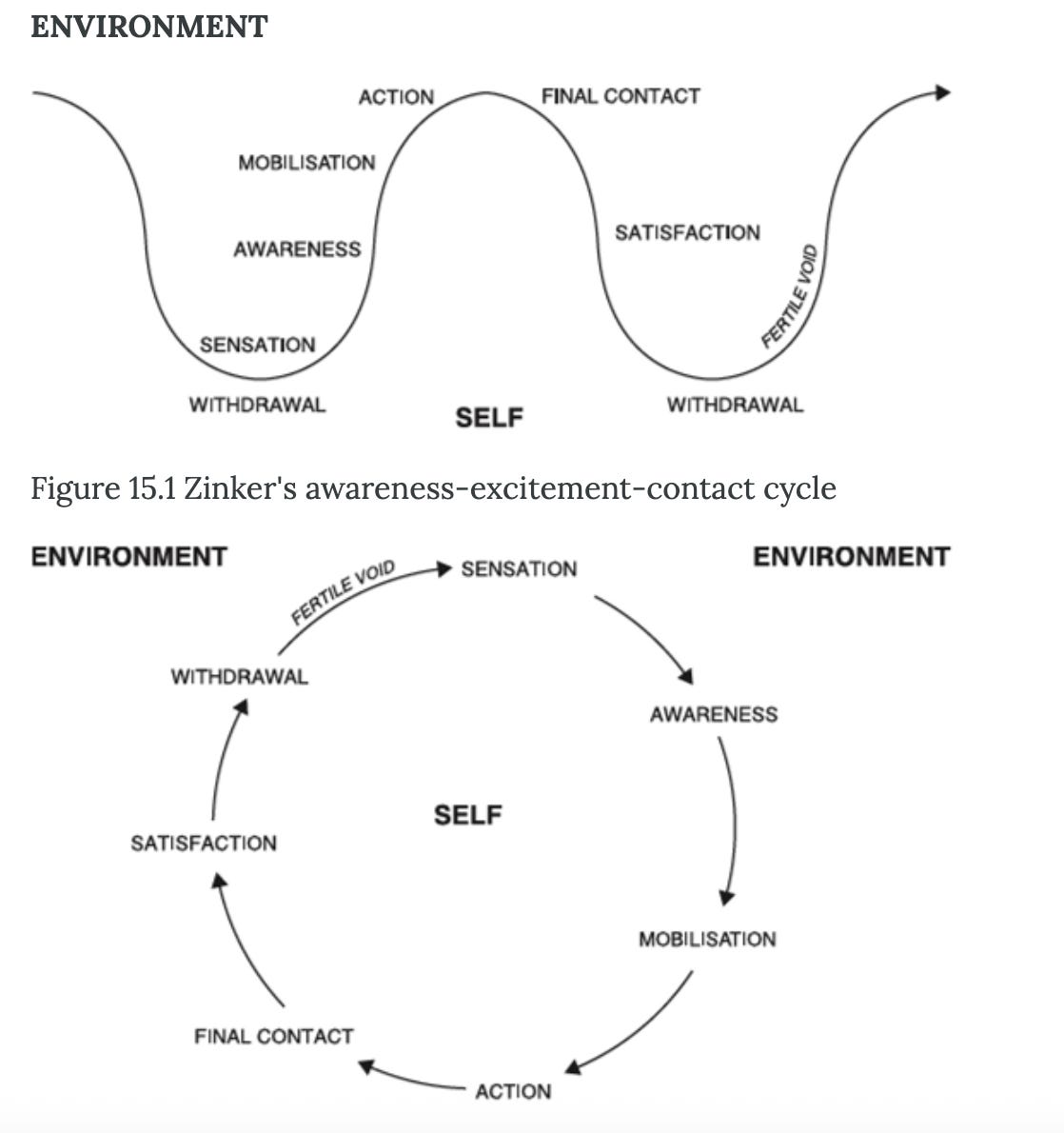
One can find more generalized stage models in Gestalt too:
So here it seems that to borrow Ricoeur’s phrase the Christian approach is a “hermeneutics of suspicion,” in that every logismos must be regarded as a potential threat, that thought and temptation are deeply interlinked. And unlike say, Buddhism’s gentler approach to temptation as a kind of error, Christianity sees the devil in the details: these temptations are actually coming from an evil, external supernatural force that can only be combatted by support from a good, external supernatural force.
Where that seems to leave one is as a kind of walking battleground.
No posts
Comments
Nothing yet. Say the first thing.
Sign in to join the conversation.