

Today marks the first day of Lent and the launch of Evagrius, a pop-up community of practitioners engaged in the discernment of spirits. It’s like Twitter, if Twitter were invented by the Desert Fathers in the mid 300s as a tool for observing the eight tempting thoughts: lust, gluttony, avarice, anger, sadness, pride, vanity, and acedia.
I’d be delighted to see you there! The membership fee is a one-time payment of $8, all accounts are pseudonymous, and the community will run for the forty days of Lent, through April 2.
People of all spiritual backgrounds are welcome and the practice is fundamentally nonsectarian. But you should absolutely have some familiarity with observing thoughts and feelings, and you should proceed with caution as working with demonic energy is inherently dangerous.
Here, I’ll go behind-the-scenes on making Evagrius: what it’s been like working with demons, and why I see these ancient teachings as highly relevant today.
Why work with demons at all?

More than 1600 years ago, the Christian theologian Evagrius Ponticus left his ecclesiastical career in Constantinople to lead a monastic life in the deserts of Egypt.
It was there that he composed the Praktikos, a manual for spiritual practitioners longing to find freedom from reactivity and confusion. Written to a fellow monk, the Praktikos is best known for its analysis of the eight tempting thoughts, or logismoi, which became the basis for the seven deadly sins, and much later, the Enneagram of Personality.
The Praktikos posits that the human mind is a theater for warfare between good and evil spirits. Our work is to remember and restore our natural state, which is the nous, or mind, contemplating God in original Unity.
But demons incessantly attack the tripartite psyche, or soul:
The demons of lust, gluttony, and avarice obsess the epithumia, our hungering or “gut” faculty.
The demons of anger and sadness inflame the thumos, our irascible “heart” faculty.
The demons of pride and vainglory confuse the logikon, our reasoning or “head” faculty.
And acedia, the noonday demon of listlessness, attacks the entire soul.
How does one resist such an attack? Evagrius instructs us to observe them and name them (Praktikos, 43):
IT is necessary to be aware of the differences between demons and to interpret their different occasions [opportunties]:
this we shall know from the [tempting-] thoughts,
and the [tempting-] thoughts from the objects [they depict;
thus knowing] which demons are less frequent and heavier,
which are more frequent and lighter,
and which leap suddenly and snatch the nous off to blasphemy.
These things it is necessary to know, so that when [tempting-] thoughts begin to move their own particular matter, and before we are driven too far from our proper state, we may speak out to them and indicate which one is present. For thus we shall with God’s help readily make progress, amazing them and forcing them to flee from us.
At this point, one may recognize this work through the lens of CBT, meditation, IFS, etc., any number of healing modalities. Reframing it in the context of demons may seem regressive and unhelpful. Certainly, this might be the case for you! But I’ve found the practice surprisingly powerful and beautiful, for a few reasons:
Naming demons puts the bad outside myself
Naming demons recognizes there are forces more powerful than me
Naming demons affords the possibility of naming angels
These points may sound horribly non-nondual, almost blasphemous in their black-and-white framing, but I’ll try to make the case for them now.

Naming demons puts the bad outside myself
Roughly 99.5% of us, when doing self-reflection, view ourselves as deficient, faulty, or unworthy. One Tibetan teacher calls this the self-pity view. Contemporary western healing modalities have very little to offer when it comes to going outside the self-pity view. In fact the whole concept of healing is likely to, at some level, reinforce the idea of woundedness, and the “healing journey” is likely to feel arduous and perhaps fundamentally interminable.
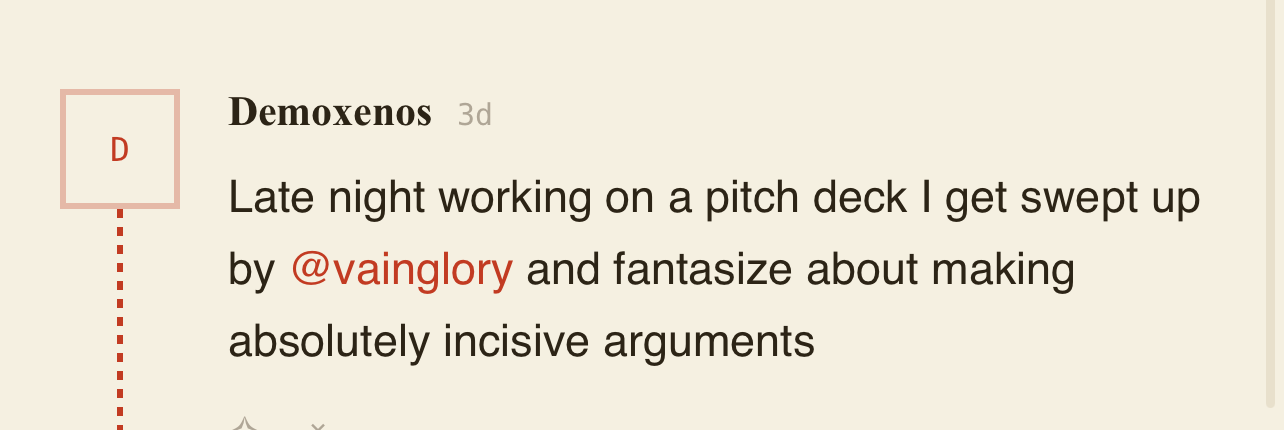
Take, for example, this post on Evagrius. “Late night working on a pitch deck I get swept up by vainglory and fantasize about making absolutely incisive arguments.” Taking the self-pity view, this practitioner (yes, me), may say something like:
“Ah yes, I am such a Type 3 (prone to vanity). I know this is due to some childhood wounding involving me receiving inconstant or conditional love from one of my caregivers. If I can only just give myself that unconditional love, perhaps one day I will make the move to truthfulness (the virtue of the Type 3).”
In contrast, following the Prakitkos, one simply names the demon: vanity! Evagrius offers quite an interesting instruction regarding how this naming is performed (P., 42):
DO not immediately pray when you are tempted; first speak some words with anger to the one pressuring you: for when your soul is acted upon by tempting-thoughts prayer cannot be pure. But if you speak to them with anger you will confuse and utterly destroy the ideas (noemata) that come from your enemies. This is also the natural result of anger in the case of good ideas.
Here, Evagrius is making a subtle point about the thumos, the irascible heart-faculty of the soul. The thumos in its natural state is excellent at enforcing boundary. Therefore, pointed at the demon itself, the thumos can manifest healthy wrath.
Too often, however, the anger of the thumos becomes self-directed, as it did in my case:
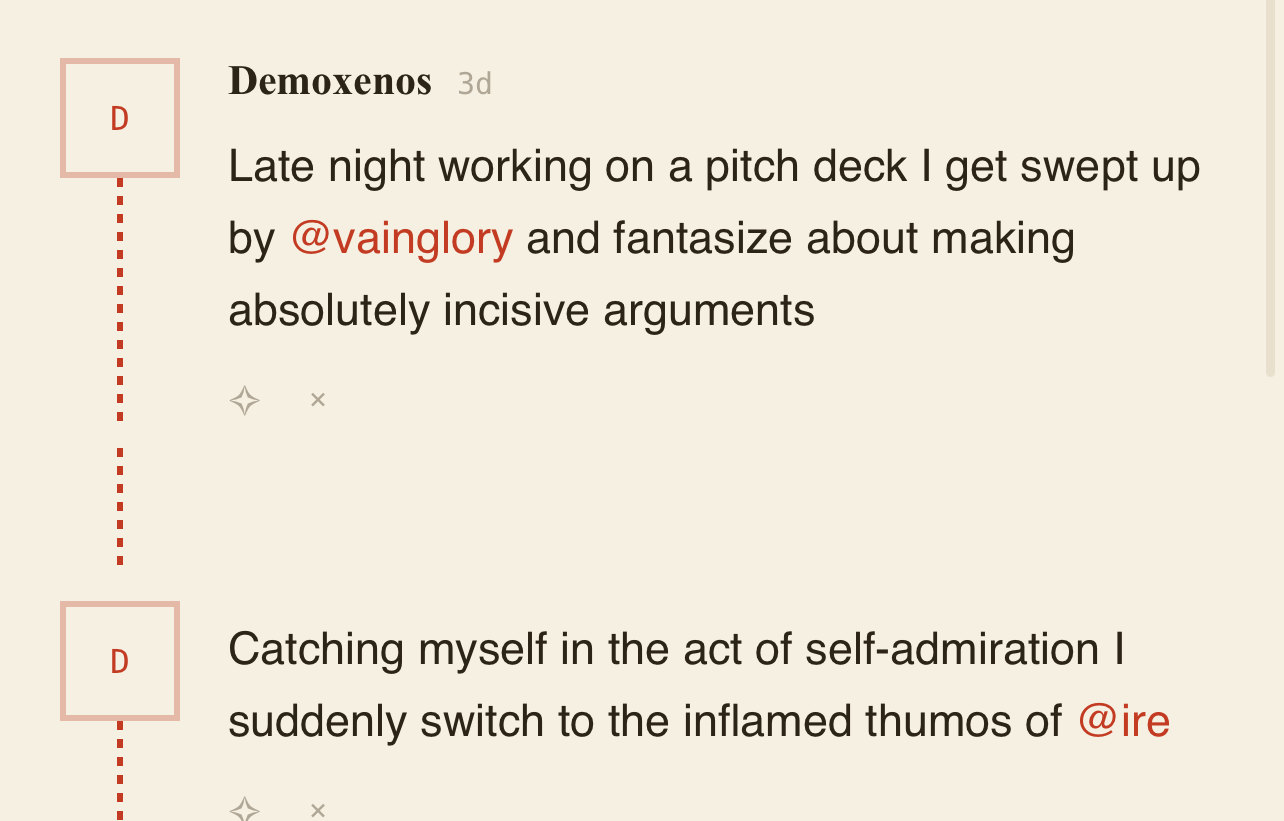
Here again, Evagrius wants us to disidentify from impassioned anger and recognize it as a demon. He is very clear about this, and makes a key point:
ON account of the strong stench in demons the soul is usually enflamed against [tempting-]thoughts [logismoi] when it perceives them approaching, being affected by the passion associated with the demon that is annoying it.
In other words, demons are very good at teaming up: vanity comes and inflames the passions, but then is quickly chased away by anger (I HAVE observed the demon of vainglory chased away by almost all the other demons), which takes advantage of the prior inflammation. Anger is particularly fast, harmful, and difficult to soothe (P. 21):
THE sun should not set on our anger (Eph. 4:26): so that the demons do not, rising up by night, terrify the soul and make the nous more cowardly the day after for the fight. For terrifying phantasms are produced by the disturbance of indignation. And nothing makes a deserter out of the nous as much as disturbed indignation.
In short, by creating a provisional understanding of demons as outside oneself, we can begin to develop a relationship with something like a “spiritual immune system,” in which our thumos, the natural indignation of the heart, can direct its energy effectively.
Naming demons recognizes there are forces more powerful than me
Now we begin to move into the more potent aspects of working with demons. Demons are, definitionally, more powerful than “us.” Here some very simple framing will help us, I’ll use the Zen terminology of “Big Mind” and “Small Mind.” Demonic energy sits between Small Mind and Big Mind. A demon is anything that is viewed as an outside volitional threat. From Small Mind’s perspective, this may be terrifying, sickening, etc. From Big Mind’s perspective, this is a very efficient way to find an resolve areas where there is clinging.
Doing this work safely may require a willingness to not hold onto anything.
Naming demons affords the possibility of naming angels
Not all outside thoughts have ill-intent; in fact, by opening up to demons, we also open up to the angels (P. 76):
THE angels rejoice when vice decreases, while the demons are glad when virtue [decreases]. For the former are servants of mercy and love, while the latter are subjects of anger and hatred. When the former approach they fill us with spiritual contemplation, while the latter cast the soul into shameful fantasies.
In fact, this is what happened to me:
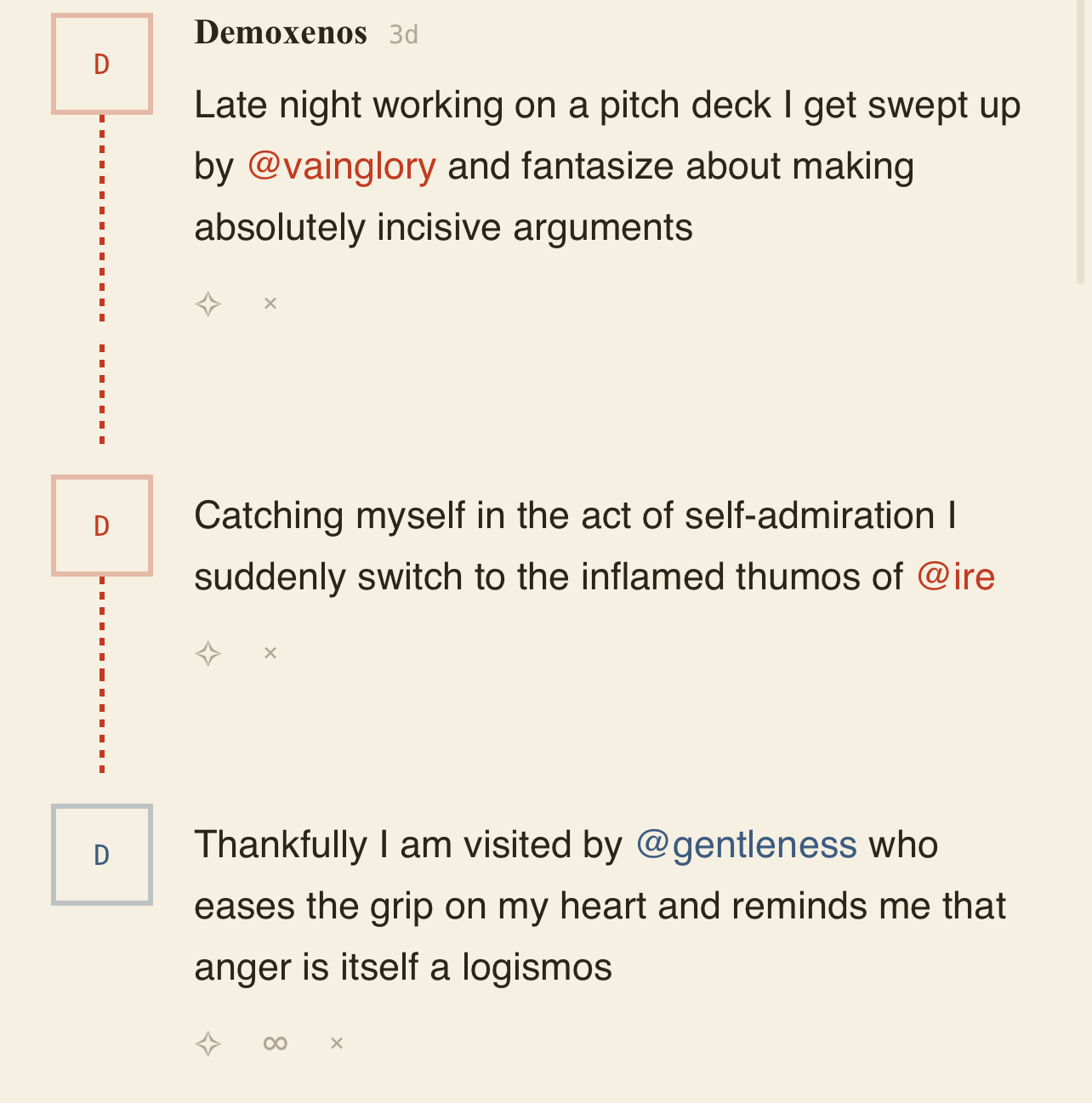
Upon recognizing anger (which I named ire here) as a demon, Gentleness was what came in and soothed the thumos. For Evagrius, the whole point of this aesthetic chapter of practice is to achieve apatheia, freedom from the passions:
“The proof of apatheia is that the nous begins to behold its own proper gentle radiance; that it remains tranquil in the presence of visions during sleep; and that it looks at matters calmly.”
Apatheia itself opens the gates to the knowledge of reality and the kingdom of Heaven.
“Faith, my child, is steadied by the fear of God.
And fear in turn is strengthened by continence.
This latter is made unshakable by patient endurance and hope:
from these is born apatheia, which brings into being love.
Love is the door to knowledge of nature, which leads to theology and the supreme blessedness.”
A healthy spiritual immune system has a fundamental quality of receptivity, which is protected by a dispassionate thumos.
Closing thoughts
People come to Lent with various aspirations. Some may want to give up social media or alcohol. Others may want to give up inner attachments, and here the eight logismoi can be a helpful guide. Still others may just want to dedicate the time to heightened spiritual sensitivity and contemplation.
For me, building and using Evagrius has been about spending time in the desert. One quality of the desert for me is that it is unfamiliar. This spiritual tradition, its language and its ideas, are outside of my training and in some sense my cultural upbringing (although in another way, it deeply underpins my cultural upbringing). And so there is kind of a ruggedness that is required in working with the material. The other aspect of going to the desert is that one expects visitors, and steps into a heightened way of relating with one’s experience. I think about people who suffer from mystery illnesses and try an elimination diet: they remove everything from their diet except potatoes, and then slowly add things back, monitoring carefully to see what happens.
This is roughly what I intend for Lent, renunciation not from a place of self-flagellation or going to war against evil. Instead, renunciation that says: I will not do what does not work, and then earnestly engage in contemplation of what that entails.
Comments
Nothing yet. Say the first thing.
Sign in to join the conversation.