
This week’s issue opens with Salah Salem’s 1953 defense of military rule, and how the officers’ contempt for civilian authority has hardened under Sisi into a governing doctrine. It then turns to Sisi’s inauguration of the Octagon, the new Strategic Command Headquarters in the New Administrative Capital, and what its design reveals about the regime’s fear of another 2011. The issue also covers the expected reshuffle of the army’s top brass, the Air Defense Corps’ annual celebrations, and the deeper dysfunction hidden beneath Egypt’s claims of military modernization. It closes with the Judges’ Club election, where Mohamed Refaat Gabr’s victory signals growing friction inside the regime’s own institutions, even if it does not amount to a democratic opening.
Major Salah Salem (1920-1962), one of the Free Officers coup plotters, speaking to Akher Saa Magazine, in his capacity as Minister of National Guidance, on 7 October 1953:
A strange phrase reaches my ears from time to time: “civilian and military,” or “civilians and military men!” If only the matter stopped at mentioning the two terms, but it often goes beyond that to drawing comparisons between them. You hear that the military has monopolized power, all power. You hear that civilians no longer have any role in this country. You hear that the military, by some miracle, has become experts in all fields and every domain. As for civilians, they understand nothing, do nothing, and excel at nothing. But who says this? We, the military, certainly have not said it. We have never said, and I challenge anyone to prove otherwise, that we are angels. We have never said that we are geniuses or exceptional beings who defy the ordinary. Rather, this is talk, much of it empty talk, which some people like to repeat and attribute to the military, though the military is innocent of it. And where are those military men who have tyrannized?
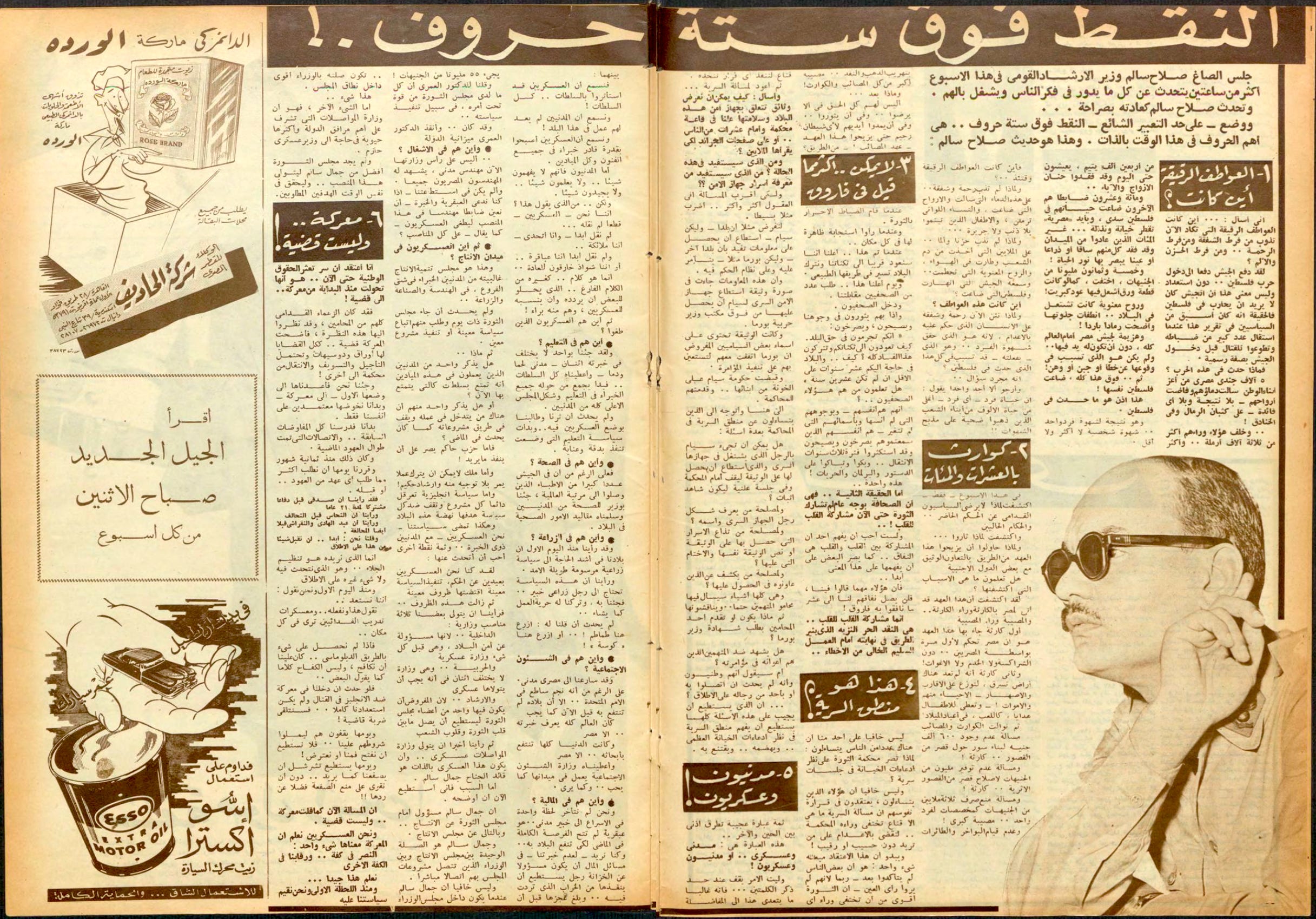
Salem was obviously gaslighting his readers. He denied that officers looked down on civilians while ridiculing civilian complaints, dismissed military domination as “empty talk,” and recast the ruling officers as victims of unfair slander.
Under Sisi, this old contempt has become the organizing logic of the state. The Second Republic treats civilian rule not as a constitutional principle, but as a danger to be neutralized. The army’s role is no longer limited to defending borders. It is now constitutionally empowered to define the state, guard its “civil status,” police politics, and intervene whenever officers decide civilians have failed. Even the idea of a civilian defense minister was dismissed by the military spokesperson in 2013 as an insult to the army.
This worldview has spread through the bureaucracy. Retired officers have been pumped into ministries, governorates, public companies, local councils, and civilian agencies, while military courts have expanded their reach over ordinary life. Under Sisi, the officer is not simply above the civilian. He is the supervisor, auditor, planner, judge, contractor, and governor. The result is a republic built around the barracks’ disdain for civilian society, a state increasingly run as if the population were a hostile terrain to be occupied, disciplined, and watched.
Sisi inaugurated the Strategic Command Headquarters in the New Administrative Capital on Saturday wearing full military uniform, returning to army dress for one of only a handful of occasions since he became president in 2014. The setting was the sprawling complex widely known as the Octagon, presented by the state as the new technological brain of Egyptian power. The ceremony unfolded through flags, salutes, orchestras, documentary films, drone displays, aerial performances, choreographed symbolism, and the familiar language of national destiny. At times, the production felt lifted from The Hunger Games: a ruling order displaying discipline, hierarchy, and intimidation to a captive public through spectacle.
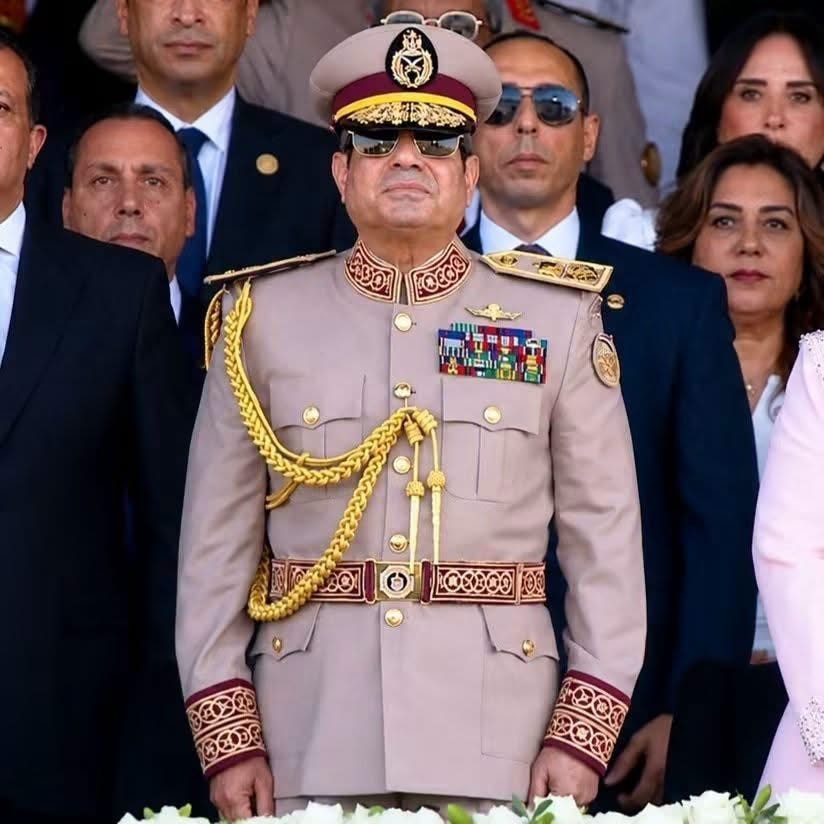
The official explanation was that the headquarters would ensure “integrated planning and coordination” across the branches of the armed forces, enhance combat capabilities, maintain permanent readiness, and use advanced technology to secure the state’s strategic objectives and protect its resources. Pro-regime coverage described the Octagon as a command-and-control hub linking the armed forces with ministries, governorates, and state institutions, equipped with data centers, communications networks, logistical zones, and residential facilities designed to sustain operations under exceptional circumstances.
Judged by the standards of conventional war, this is a strange and risky bet. Modern war rewards dispersion, redundancy, mobility, deception, hardened communications, and the ability to keep command functioning after central nodes are hit. A giant, iconic headquarters in the desert concentrates risk by gathering command functions, logistical zones, data centers, political leadership facilities, and residential infrastructure inside one militarized geography. The more the regime boasts of the Octagon as the “brain” of the state, the more it advertises the symbolic and operational value of the target it has built. If officers’ residential zones and family facilities are part of the same strategic ecosystem, the contradiction becomes even sharper, because the project that claims to protect the command structure appears to place commanders, infrastructure, and families within the same target geography.
This critique, however, only goes so far. The Octagon is not irrational when read through the regime’s own threat perception. The dominant perceived threat of the New Republic is domestic rupture: crowds in the streets, workers on strike, neighborhoods resisting demolition, protesters surrounding ministries, and another moment when the coercive apparatus finds itself physically exposed to the people it rules. Sisi’s state has not been designed around the citizen as a political subject. It has been designed around the citizen as a security problem.
This is the argument I make in Counterrevolution in Egypt. The post-coup remaking of Cairo and the construction of new desert cities were never simply urban policy. They were part of Sisi’s broader project to turn Egypt into a perfect military camp. Planners I interviewed described the post-2013 transformation of the city through the language of “security access”: demolitions, road widening, bridge construction, tree removal, and the destruction of older urban fabrics. Khaled Fahmy put it bluntly: the new highways and bridges atomize society, eliminate public space, and deprive Egyptians of the places where they gather and become politically visible.
Sisi has already stated the logic behind this geography of power. In an earlier Police Academy speech, recalling the 2011 uprising, he described watching the clashes around the Interior Ministry on Mohamed Mahmoud Street. “In 2011, I was watching television while they were attacking the Interior Ministry,” he said. He then explained the lesson he drew from that moment: he told Interior Minister Mohamed Ibrahim that the ministry had to move out of Cairo, and that the state itself had to move from Cairo to another location.
At the Octagon inauguration, Sisi made the connection even more explicit. After finishing his written remarks, he said it was “very important” to remember “the events of 2011” through 30 June, because God had saved Egypt from “a very great danger” and from “ruin and chaos” that could have continued until today. He then explained why the Strategic Command had been placed in the New Administrative Capital. There was a time, he said, when the Supreme Constitutional Court was besieged, the cabinet was besieged, the Ministry of Defense was threatened, and Media Production City was surrounded, forcing crises to be managed “under pressure,” fear, and the risk of decisions that could cause “great harm or great ruin” to Egypt.
Sisi’s conclusion was unusually direct. “The state had to leave the capital,” he said, “so that this would not happen again.” He repeated the point: parliament is no longer there, the cabinet is no longer there, and the Ministry of Defense is no longer there “as it was before.” For him, the relocation of state institutions was not only an urban-planning decision or an administrative modernization project. It was a security doctrine born from 2011, designed to prevent crowds from surrounding, pressuring, or paralyzing the institutions of power in Cairo.
He then returned to the economic indictment of the uprising. He said he “always” invokes 2011 because some may think 14 or 15 years have passed and the subject should be over, while Egypt is still paying the price. The dollar, he said, was LE6 at the time of the 2011 crisis and is now LE50. He claimed the measures taken then cost the state $450 billion, blamed the period for worsening people’s living conditions, and linked it to the later war on terror, which he said cost Egypt tens and hundreds of billions of pounds, along with martyrs and wounded from the army, police, judiciary, mosques, and churches. The point of remembering such a day, he said, was to summon “the lessons, sermons, and warnings” so that “such mistakes” are not repeated.
The Octagon should be read as counterrevolutionary urbanism as much as military modernization. It is a command city built for a regime that experiences society as the main battlefield. A project designed to protect the ruling order from Egyptians may also weaken Egypt’s defense against a serious foreign adversary, because the same centralization that helps isolate power from society can turn the state’s military brain into a spectacular target.
Comments
Nothing yet. Say the first thing.
Sign in to join the conversation.