
In honor of the 30th anniversary of Infinite Jest, I’m sharing the following excerpt from my new Unherd essay on Cormac McCarthy’s reading of Infinite Jest by David Foster Wallace. The essay covers McCarthy’s feelings about the novel, his contemporaries, his cynicism about modern publishing, and my own views and coining of the term “publishing-industrial complex” to explain it all. Link to the full article below.
Imagine Vladimir Nabokov submitting Lolita to a Master of Fine Arts degree program. First, under the tenured wisdom of his failed-novelist-professor, Nabokov’s style would be radically de-escalated and purloined of some 30,000 imperishable words, including every adverb. This, of course, is a mere paper cut compared to what would be coming down the pike for the unfortunate masterpiece and its schlepping emigre author. Next, the 10 or so randomly assembled mediocrities would zero in on Lolita’s title: it would be strongly if not threateningly suggested to steer away from the Latinx toward something more in Nabokov’s ethnic wheelhouse, perhaps Larissa, or Lilya.
Just barely skirting expulsion and social ostracization for the pedophilia of the first draft, the author, by the end of term, would revise Lilya to be about a widowed man who takes his 12-year-old biological daughter on an innocent and sexually eventless road trip, learning a thing or two about fourth-wave feminism and gender theory along the way. There’d be incredulous lines over the steering wheel like, “How do you know that?” and “How old are you?” (Not to mention the “You go girl”s from the reader.) Having been recognized as a “Master of Fine Arts” for this ability to be editorially coerced by 20-year-olds, Nabokov would spend a sleepless fortnight after graduation researching 140 literary agents so as to pretend in his query emails to be a fan of their client lists of nonentities and “comparable” titles. (Nabokov would have failed to secure an agent through one of those end-of-term backroom deals every student-novelist dreams of, having permanently rubbed the professor the wrong way.) He’d find obscure interviews online with agents who say with hauteur and scarcely credible pride, “Don’t even bother cold querying me, I never look at the slush.” Of the 140 agents, 10 would respond and request sample pages. Eight would ghost Nabokov. One would write him a moderately personalized rejection with the cadence of the admiring pass, “confident that many agents will want to toss their hats in the ring.” The last agent would, because he knew Nabokov’s professor back in grad school, sign him. Champagne would be opened. Véra would smile to Volodya over the foaming brim.
Three months of torturous silence later — Nabokov’s new agent having disappeared into a vague and nebulous paternity leave without warning — the author would receive an email with a draft of Lilya riddled with inspired deletions and insightful suggestions for rewrites. If Nabokov plucked up the courage to so much as balk, the agent would, after another mum trimester in which he’d leisurely switched American coasts — never intimating exactly which one he’d settled on — buck him up threateningly. “I worry that sending Lilya off in its current state would threaten all of the hard work you’ve put into this, and publishing this version would be a mistake for you and your career. My job is to give you honest advice — I can’t sell this, Nabokov. I know this is a lot to absorb, but we’re almost there. Talk soon?”
Terrified of the state of agentlessness — that Hades of non-representation — and his stomach dropping at the thought of his ambitious six-figure student debt rendered all for naught, Nabokov would have submitted to the next round of unnecessary edits, finding some substitute stepmother approved of by young Lilya for the novel’s hapless pops, or perhaps an age-appropriate stepfather, having discovered in a brisk, bland, and anti-Nabokovian 55,000 words that Humbert was queer-curious the whole time. Nabokov would then use the bulk of his small advance from a Big Five imprint to hire a freelance editor to further gut Lilya for upmarket “readability,” the book no longer bearing any trace of his voice anyways, and his new editor turning out to be more of a point-person of obscure purpose than someone who edits books.
With the publisher putting zero publicity effort behind it, Lilya would get a handful of listless, monotonously congratulatory reviews from critics Nabokov had vague connections to from his MFA days. There would be some TikTok video reviews, Substack essays with three likes — then, mysteriously, only two, the user having died perhaps — and it would never be read again, if it had been at all. Netflix would cut Nabokov a check for $5,000 for film rights and never develop it. He would land his Cornell job and work off his debt from college by toiling forever at college. Jeffrey Epstein would be lost to the wilderness on what to christen his jet. And posterity would not remember Lilya’s name except, I suspect, to chide the past for its tepid conformity. Which is what we shall begin doing now: chiding the past from an enlightened vantage.
I hate to pass along such news, but it’s the 30th anniversary of David Foster Wallace’s Infinite Jest, the preeminent MFA novel, which in the heady days of the Clinton surplus passed through the aforementioned burning hoops of the publishing-industrial complex with flying colors. In fact, it introduced many of the colors as it leapt and gamboled. Three decades of nimbus have grown round its obsolescence, and yet its publishers insist on goading us every 10 years with a freshly introduced reissue of the dead horse. This time, the publishers have tapped singer-songwriter Michelle Zauner, an introductress who has gone into the belly of the beast cognizant of her “own innate and internalized misogyny,” an obligatory non-sequitur that lets the reader know they’re in the good, coercible hands of someone in way over their head.
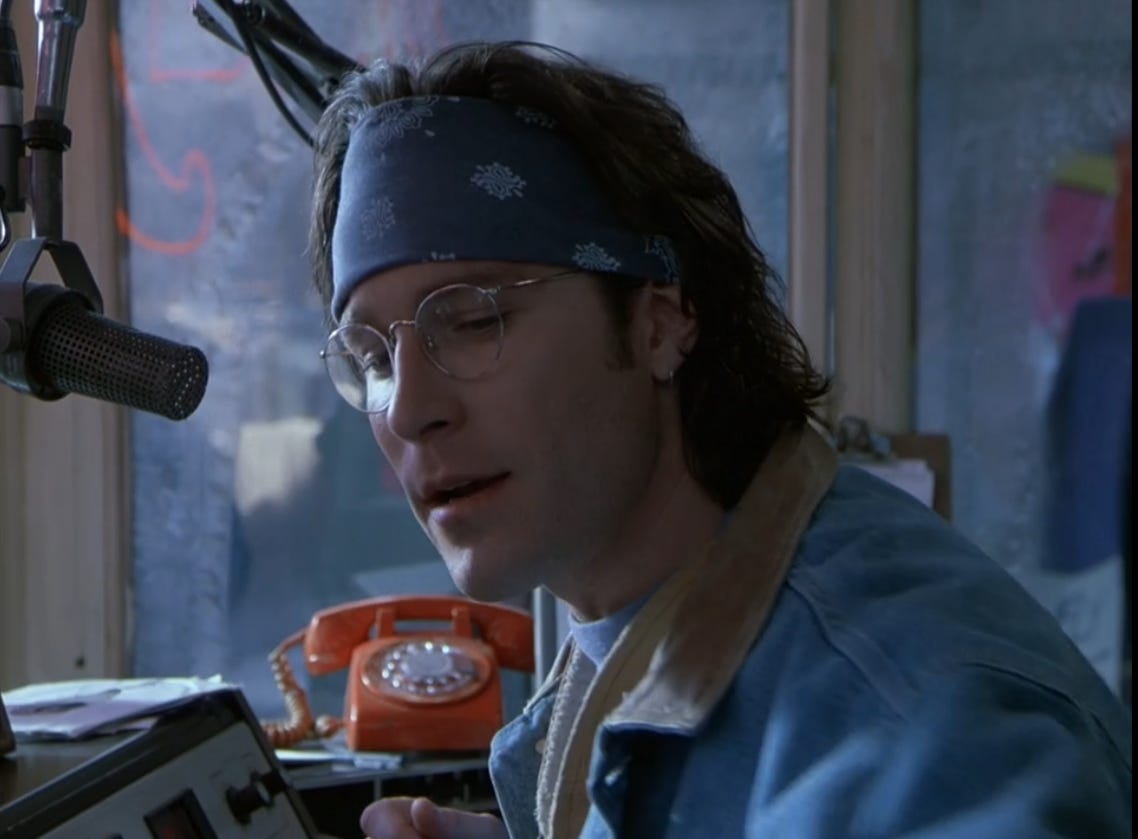
But a country that amended its constitution to prohibit alcohol and then changed its mind a decade later has the mettle to make sure this doesn’t happen again: we can’t allow a 40th anniversary reissue written by, say, Clavicular in a booksmaxing phase. It is high time to marshal a final confrontation with the insidious philistinism of David Foster Wallace. That sweaty bandana of his and what publishers let him do to us with it. Wallace, the middle-aged student who never left the classroom; the teacher from whom no college was safe: Amherst, University of Arizona, Harvard, Illinois State, Emerson, Amherst redux, Bennington Writing Seminars, Pomona. Just try and keep Wallace from going to college — go ahead, try. He’s still there, on desks and bookshelves in dorm rooms. His presence there has become inappropriate, and we can’t let this go on a moment longer. We must think of the children.
But it’s not we who are going to confront Infinite Jest. Not head on. Cormac McCarthy, our dashing and fearless hero, is going to confront it for us. The terse, macho cowboy who thought Proust was a waste of time because no one was killed is going to read more than 1,000 pages about tennis and beta-male marijuana addiction. The writer who never had a running TV in any of his novels, let alone electricity or plumbing and so offed one of his most famous scalp-hunters in an outhouse because that was his idea of modern comfort at the time — well, this tough customer is going to get his fill of couch potatoes. There are limits to man’s imagination, as Wallace will shortly show us, and so this time around I’m not asking you to tax the gray cells by picturing America’s greatest novelist wasting his time with America’s most overrated: I’m going to tell you exactly what happened when Cormac McCarthy read Infinite Jest.
Full article here.
Comments
Nothing yet. Say the first thing.
Sign in to join the conversation.