
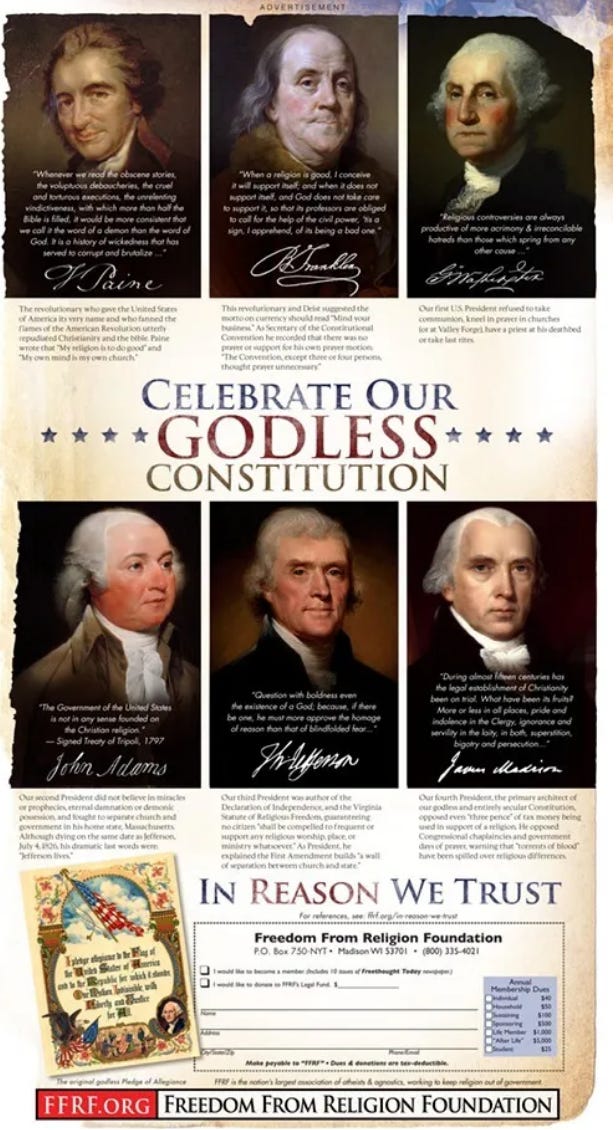
Looking for a concise counter-argument to the annoying, fabricated assertion that our Founding Fathers were pious, God-fearing men? Read below…
I just wrote a piece on America’s original constitution, The Articles of Confederation, our confederal founding and decentralized original intent for Unherd. The reviews for my piece came in hard and fast: “florid pretentious piece of trash,” “prolix,” more difficult than Finnegans Wake. But defenders of America’s original intent have had to bear up under much worse, and in honor of our confederal founding I suggest you give it a try.
Now, our confederal origins are such a poorly taught history that “confederal” bears the red squiggly line of the typo here on Substack. In fact, the whole episode is America’s first hornswoggle: a class of creditors coercively swapping out a decentralized polity for a consolidated central government. Lucrative! In so doing they turned the American Revolution into a Reformation of English polity. They also removed religion from the law.
Citizens of Massachusetts were never supposed to be able to cast a federal vote that effected how Texans live. As a confederation, we were supposed to be a simultaneity of disparate polities and beliefs. In this paradoxical spirit, I want to show you how decentralized is my own mind. I am an anti-Federalist and consider the Federal “Founders” to be traitors. But I am also a patriot, and can’t stand to see our atheist “Founders” labeled as Christians. I am, yes, deeply proud of their secularism.
The anti-Federalists were the Christians; the Federalists were the anti-Christians. Enjoy.
In celebration of the 250th Anniversary of the founding of America, the Trump Administration and its supporters in the MAGA coalition have begun pushing a false history of America’s origins. Back in May, J.D. Vance, Tulsi Gabbard, Marco Rubio and others gave speeches at Rededicate 250, a government-organized Christian prayer rally where, amongst “rededications” of the United States to God, they propagated the spurious narrative that America and all of Western civilization were founded by pious Christians and based on Christian principles. Of course, the exact opposite is true: Western principles and America in particular were founded by religious skeptics in contradiction of Christianity.
For folks supposedly passionate about American history, they give the impression of not having read our founding documents. After all, the greatest counterargument that the Constitution is not a Christian document is the Constitution. The pious may search in vain for a single mention of God, Jesus Christ, Christianity or the foundations of a Christian politic within the document: there are none.
There are of course purposeful references to the concept of religion, namely the explicit forbiddance of religious faith or tests as requirements to hold public office. The only other mention is the First Amendment’s wall of separation between church and state, a principle that, far from being Christian in origin, is anti-Christian in origin, being as it is an explicit refutation of the then Christian practice of barbaric punitive violence between sects for practices of free speech. At the time of the Revolution, Christians in Europe were still burning each other alive and menacing scientists for looking through telescopes. (Christian violence is not quite in our distant past either: the last four decades furnish us with Christian atrocities in Lebanon in the early 80s, the terrorism of the IRA, the Christian genocide in Bosnia, and American bombings of abortion clinics.) This scourge of organized religion was not lost on the amendment’s non-Christian author, James Madison, who said, “Religious bondage shackles and debilitates the mind and unfits it for every noble enterprize and every expanded prospect.” Later in life, Madison’s religious skepticism fully evolved into, at the very least, agnosticism, writing of the Christian concept of God that the universe was “visibly destitute of those attributes.”
The Declaration of Independence, a poetic expression but not a governing document, does make scant reference to an intentionally vague universal “Creator,” but this is the non-theological “Supreme Being” of deism, not the Judeo-Christian God. This makes sense as it was written by a deist and fearless public scorner of Christianity, Thomas Jefferson. In the 18th century, before the discoveries of evolution and the big bang, deism was a halfway house for agnostics and anti-theists who had moved beyond religious skepticism but were yet without the scientific knowledge and modern confidence to posit a universe without some prime mover at work, or simply did not want to risk public affiliation with atheism for understandable self-protective reasons. The deistic “supreme being” was the prime mover or demiurge of the pre-Christian, secular Greek philosophers whose works the founders turned to when inventing our nation. Deists did not believe that this supreme being intervened in human life, nor did any theology describe cosmology with any truth or accuracy. They also did not believe in the divinity of Christ, and so cannot be referred to by the meaningless compound “Christian deists,” and certainly not by the term “Christian.”
Jefferson, who hoped “that the human mind will some day get back to the freedom it enjoyed 2000 years ago,” that is, the intellectual freedom before Christian governance caved in the principles of secular civilization in Rome, was famously scurrilous toward Christianity and religion in public. In private he was even more unequivocal, writing to friend Alexander Smyth about the Bible, “I do not consider them as revelations of the supreme being.” The Jefferson Bible was Jefferson’s defilement of the New Testament, removing every mention of God, miracle, and Christ’s divinity, winnowing it down simply to the ethical preachments of Christ. This personalized text was held in his Monticello library where it was outnumbered by works of pre-Christian philosophers such as Livy, Tacitus, Aristotle and Plato by orders of magnitude. Jefferson was accused, quite accurately by the Charlie Kirks of his day like the rabid Yale President Timothy Dwight, of being an “arch-infidel” (in the parlance of the time, an atheist) for statements such as “history, I believe, furnishes no example of a priest-ridden people maintaining a free civil government” and “It does me no injury for my neighbor to say there are twenty gods or no god. It neither picks my pocket nor breaks my leg.”
In private, Jefferson speculated fairly conclusively that our first President George Washington was not a Christian. “I know that Gouverneur Morris [an atheist founder], who pretended to be in his [Washington’s] secrets and believed himself to be so, has often told me that General Washington believed no more in that system than he himself did.” Washington’s private life bears this out as well. As President, he refused to take communion at church, leaving before the services. Reprimanded for this by his Reverend James Abercrombie, Washington ceased attending church altogether, not wanting to set a “zealous example” to the nation. Abercrombie, as well as two other of Washington’s priests, concluded in terse, private correspondence that the man was not a Christian, but a “deist.” Washington’s last public address was written for him. Before delivering it, he removed and swapped all mention of Jesus Christ, Christianity and God with non-sectarian deistic terminology. When he died, Washington called for no father of the cloth to give him last rites.
To round off the founders on our money – whose pecuniary mottos of “In God we trust” were interlarded into our currency in the mid-20th century when our nation last played with Loyalty Oaths – we come to Benjamin Franklin. A genius of comical imposture and America’s first troll, Franklin is perhaps the easiest to identify as a non-Christian. Like Jefferson and Washington, the pious of the time like First Great Awakening found George Whitfield privately urged upon Franklin a conversion to Christianity. Even deists as irreligious as Dr. Joseph Priestly despaired of Franklin’s infidel soul, and John Adams explicitly identified Franklin as a man of no religion in his Paris diaries. Franklin’s Autobiography is in part a testimony of his intellectual journey away from Christianity and that doctrine of “revelation” of which he said it “had no weight with me.” He wrote that the pamphlets he read against deism as a young man convinced him of deism. He considered Christian doctrines “unintelligible, and others doubtful.”
After all, it was the establishment of Christianity as a polity in Rome that marked the collapse of a Western civilization on the cusp of the steam engine and Industrial Revolution. This ushered in the 500 year-period of the Dark Ages, when even the knowledge of how to build an arch was lost and child soldiers were sent into religious Crusades in Palestine. It was Christianity that burned and permanently destroyed thousands of secular works of the ancient world, leaving Renaissance and Enlightenment philosophers and our own founders with mostly the post-Socratic Greeks to reach toward when founding America, the pre-Socratics being laid to sectarian waste. Far from being the foundation of Western society, Christianity devoured its foundations. And now with oligarchs who own the data of every American like Peter Thiel spreading bizarre new visions of anti-Christs, Thiel-funded J.D. Vance claiming aliens are “demons” amid official UAP disclosure, and a Trump Administration full of false history, Christianity seems poised to collapse civilization all over again.
Comments
Nothing yet. Say the first thing.
Sign in to join the conversation.