
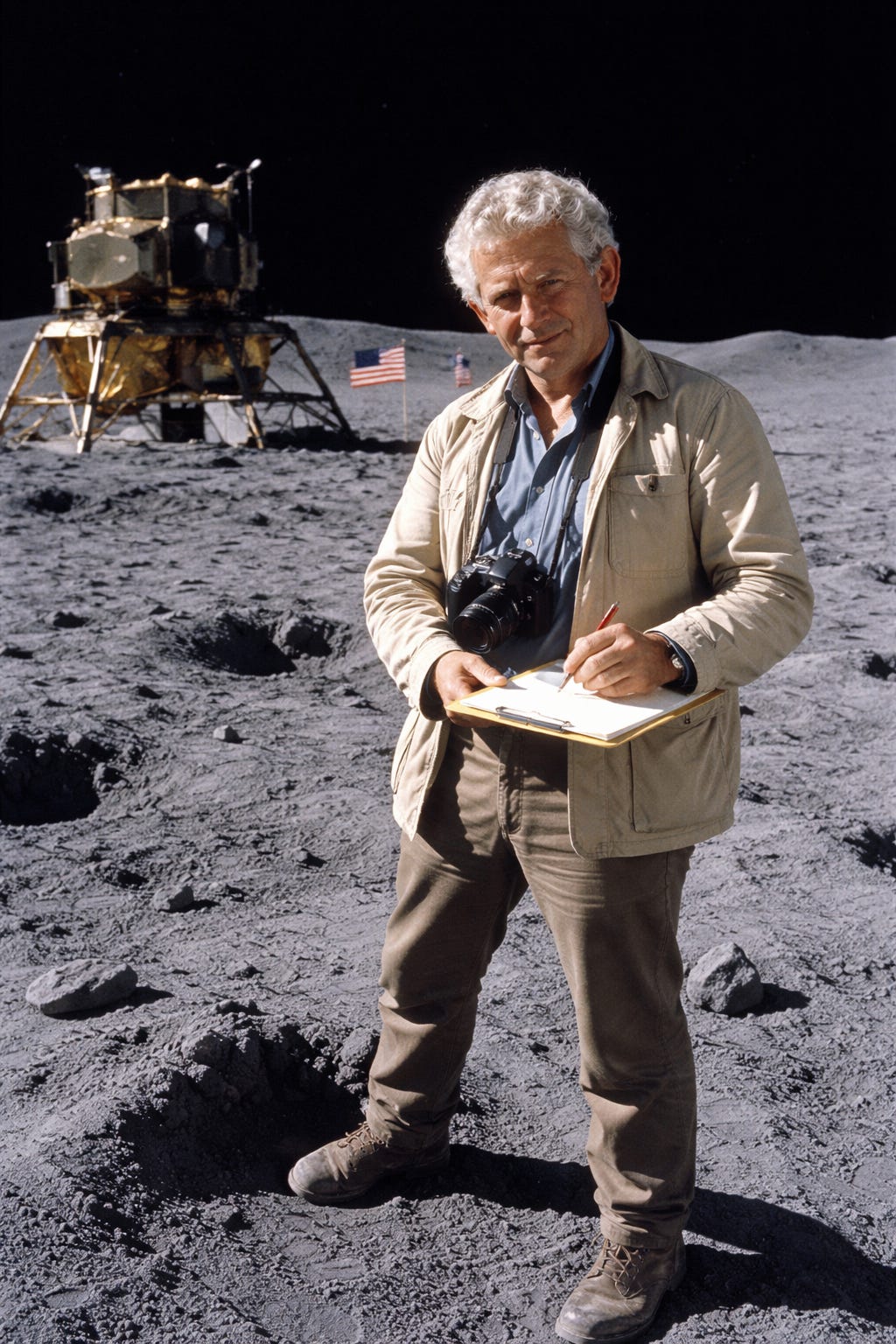
I know a town that sails the sun
I know a town where light is dry and boats come home with silver in their hold
where boats come home with silver in their hold
(Do not grieve the death of little fish
They are lights that search the deep)
I know a town with sighs of sea
white with the tides of me
white as the spine of the sea
The Harbors of the Moon, Norman Mailer
Actually, Aquarius was bored. Sitting in the Manned Spacecraft Center movie theater, he noticed that the Press was also bored… Aquarius could detect surly traces in himself, as if he were annoyed with the moon—it should not be so simple to trespass her zones. […] In fact he could not forgive the astronauts their resolute avoidance of a heroic posture. It was somehow improper for a hero to be without flamboyance as if such modesty deprived his supporters of any large pleasure in his victories. What joy might be found in a world which would have no hope of a Hemingway? Or nearest matters first, of a Joe Namath, or Cassius Clay, Jimmy Dean, Dominguin?—it was as if the astronauts were there to demonstrate that heroism’s previous relation to romance had been highly improper—it was technology and the absence of emotion which were the only fit mates of the brave.
Of a Fire on the Moon, Norman Mailer, 1969.
I have been smoking Mailerjuana. As I mentioned in my last piece about porn I have been reading Norman Mailer’s Lipton’s Journal, where he recorded his auto-psychoanalytical experiment with stoned cerebration in an attempt to touch his genius and feel for secret psychic depths he was otherwise unable to locate and map. Similarly — and without marijuana, and without, for now, the implication of genius — these small Substack columns are my attempt to capture moments in the development of a thought, and see if any useful insights glint in the light of the next day.
So then, the following about the moon is a record of the effects Mailerjuana has had on my brain. The spirit of the writing is that I have not quite edited it. I should say, too, that reading Mailer intensively for the first time brings me to a place of being fourteen, fifteen again, when I had just discovered Nietzsche and Heraclitus and Blood Meridian and Pound and Rimbaud and I stayed up till 3 AM in my bedroom every school night writing poetry until floaters exploded in the corners of my eyes and patches of colors on my blanket flickered in their shapes and my mind moved naturally into open space with a dialectical rhythm. This was an age, in the countryside of Lunenburg and the summer coasts of Cape Cod with my window open and the sea breeze blowing across my shoulders, where every line of poetry seemed a possibility of modern civilization.
I still think dialectically and optimistically, but the dialectical is a mode I now choose to enter — it is not my resting state of mind. Or rather, yes, I take longer pauses in my loyalties to a mood or a thought or a dictum before I swing out into orbit and question it and attack it and see if it holds. I take longer before I see where the dark side of the moons of my loyalties lie and if they can take light, or if the bright white halves can handle an unexpected shadow or two. And yet when I swing out, I swing out on the axes of a few unalterable principles. One is total artistic freedom.
So you see, I am already in lunar orbit…
1.
Before Artemis II broke from the webbing of Earth its black pilot Victor Glover gave a message the American ear has not heard in over an epoch. When asked about being the first black astronaut to orbit the moon, Glover politely accepted the premise of the question before saying, “I also hope we are pushing the other direction, that one day we don’t have to talk about these firsts, that one day, this is just — listen to this — that this is the human history. It’s about human history. It’s the story of humanity — not Black history, not women’s history — but that it becomes human history.”
The pivot from the question implicit in this question (“Hey wait a minute, you’re black! How does it feel being black?”) to the vantage of deep posterity speaks to the high seriousness of the moonshot and its vantage beyond our gravitational fields. Astronauts, after all, are required to venture beyond the fleeting fads and fashions of the Earth. They are taking steps beyond the human and beyond the prejudice.
But how far beyond the Earth are they really allowed to venture? How far beyond the Earth are astronauts—color, creed and credulity aside—capable of contemplating?
When I was a child watching documentaries about space (this in the heyday of PBS String Theory specials, the era before Ancient Aliens), my father would muse optimistically over my shoulder that NASA ought to send philosophers and artists out into space too. What would Dostoyevsky make of the moon, he wished to know. The authors of the Bible. Sartre, Camus. There was implicit in this utterance the psychical wish which pricks wistfully at the holes of our hearts branching in the wee hours of the night into the warring ventricles of religion, atheism, astrology, agnosticism for the long-awaited reunion across the deep crater of physics and metaphysics. The resynthesis between the specialist’s observation and the genius’s interpretation. Yes, here are black holes and stardust and optical warps from event horizons, but what do they mean? It all started with the Big Bang, yes, but was there a before and why can’t you explain its first planck second? And could a non-physicist perhaps see beyond the edge of the edge of this question? This was what, on a weekend afternoon, my father would have liked to learn and contemplate: the full panoply of archetypes blasted into the unknown.
For from the very first launch of Apollo 11 (interesting orthographic echo between Apollo 11 and Artemis II), NASA failed to properly dock the moon and the exploration of space to the consciousness of man. In the mid 20th century following the moonshot, all our frontiers of new, optimistic knowledge suddenly went cold and dark and silent on us. Our frontiers became zones of dissuasion. “Argh, feel your pain: we thought the moon would be epic too, but it’s ultimately just a big ole rock, y’know?”
It began with the deadening language they communicated the unknown to us in.
Artemis II was the first manned voyage to the moon in nearly half a century and they orbited the moon on Easter, when Jesus too returned from the dead. On that Sunday, Captain Glover recited verses from the New Testament about the Resurrection. Which brings us to our Biblical dead-end. Man orbits the moon with two millennium year old cliches. We no longer name things. The confident felicity of Adam is gone.
We’ve come to the end of our tongues in a strange land and our language is perished on our lips.
2.
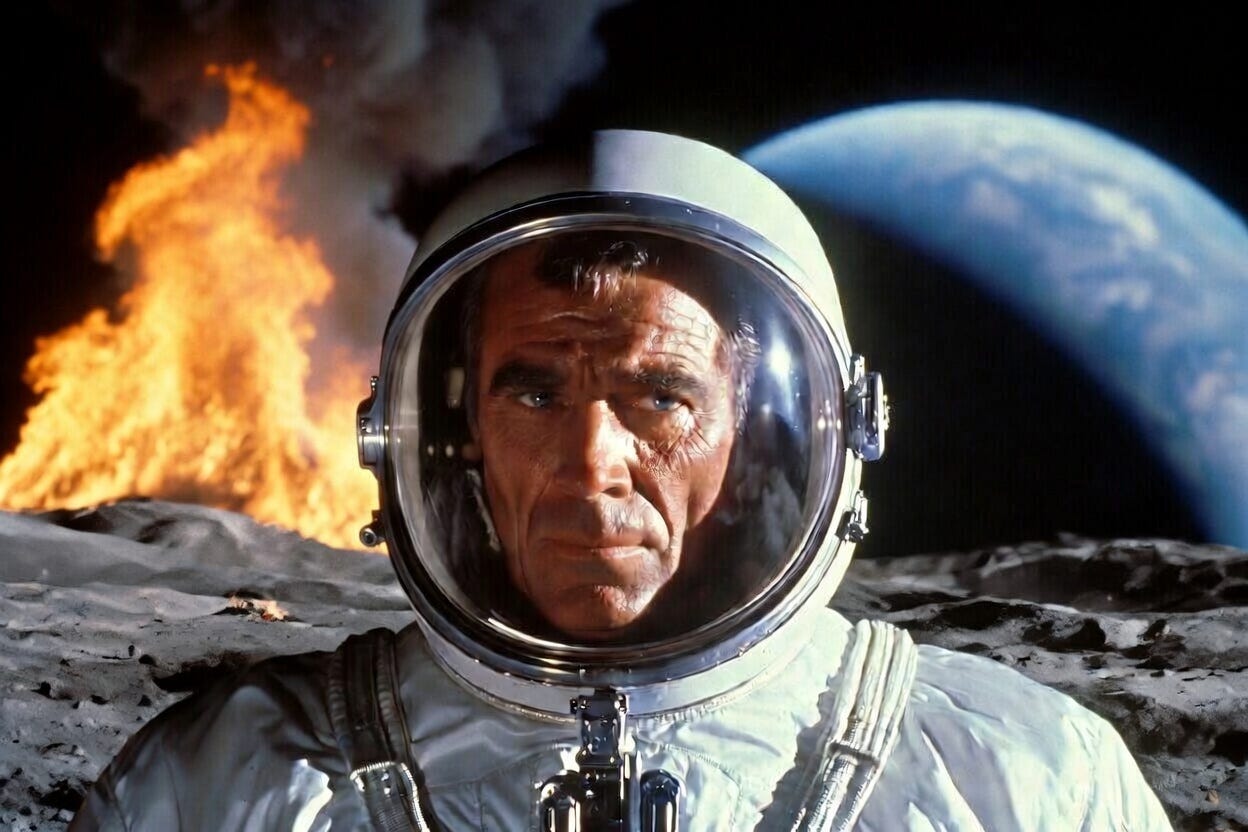
There is a place on the moon called the “terminator.” Already echoes of pop culture work their way in with an Austrian accent to destroy the beauty of this phenomenon. But how Germanically fitting, as it was the war effort and rocketry-obsessions of a mustachioed Austrian qua Charlie Chaplin impersonator that eventually put us victorious Americans on the moon. Wherefore art thou herr Werner Von Braun? If you listen, he speaks from the waves of the lunar sea. “Nature does not know extinction,” says Braun, the Nazi/NASA mystical physicist who defected and put us on the lunar face, “all it knows is transformation. Everything science has taught me, and continues to teach me, strengthens my belief in the continuity of our spiritual existence after death.”
Thomas Pynchon epigraphed Gravity’s Rainbow’s “Beyond the Zero” section with this mystical dictum, a novel about the fate of the parabola — the Earth’s gravitational field and the terrestrial geometries of all that does not achieve escape velocity. It is well we remember the parabola is the shape of a thrust that fails to escape gravity, and the two fates of the rocket are failure (parabolic assault on the enemy or self) or success (the straight line of escape). So let us come right up against the permanent darkness of the zero then by defining the lunar “terminator.”
Let us peek over its rimmed invisibility into a nighttime on the moon.
The terminator is the line between sunlight and the “permanent” dark side of the moon. The line of darkness that draws leftward across the face of the moon each night in its phases until the moon is eclipsed and is a secret once again in the outer dark. The terminator is a bad, unpoetic name for a beautiful concept. Phenomena take on artistic complication when considered from the perspective of human misperception. From Earth-errancy. (Let us add “error” to “Earth” and call it Eden.) From Eden we beautifully misconstrue. But the terminator is just the line of darkness that moves across the face of the moon. What of the permanent boundaries between the light and the dark side of the moon?
Selenographers — the geographers of the moon — fail when naming the boundaries of light. They call the edges of the moon that stand between day and night limbs. How lame. And yet for the bulk of mankind’s cerebrational history we thought there was a permanent dark side of the moon, a permanent boundary line the terminator draws toward one day at a time. If you lived on the moon, each day you’d have to travel deeper into the eventual crescent to stay in the light, until at last you were gathered into the silver of curvature, then nothingness.
But where have we named the darker lights? Where is the melodic word for this misperception? For the idea of a line that eternally divides the dark side of the moon from the light is a gorgeous mystery. One we’ve dreamed of since anciency. A permanent line between day and night falling through the rim rings of a crater, falling halfway across one of the seas of the moon and a lunar floodplain.
Of course, the concept of a permanent dark side is not real — it is just how the moon presents to the human eye. It is how it misleads us beautifully into the contemplation of the unreal. It is a metaphor for our positioning to the irrational and the unknown: how man casts a terminator line out across the furthest reaches of what he seeks to know.
3.
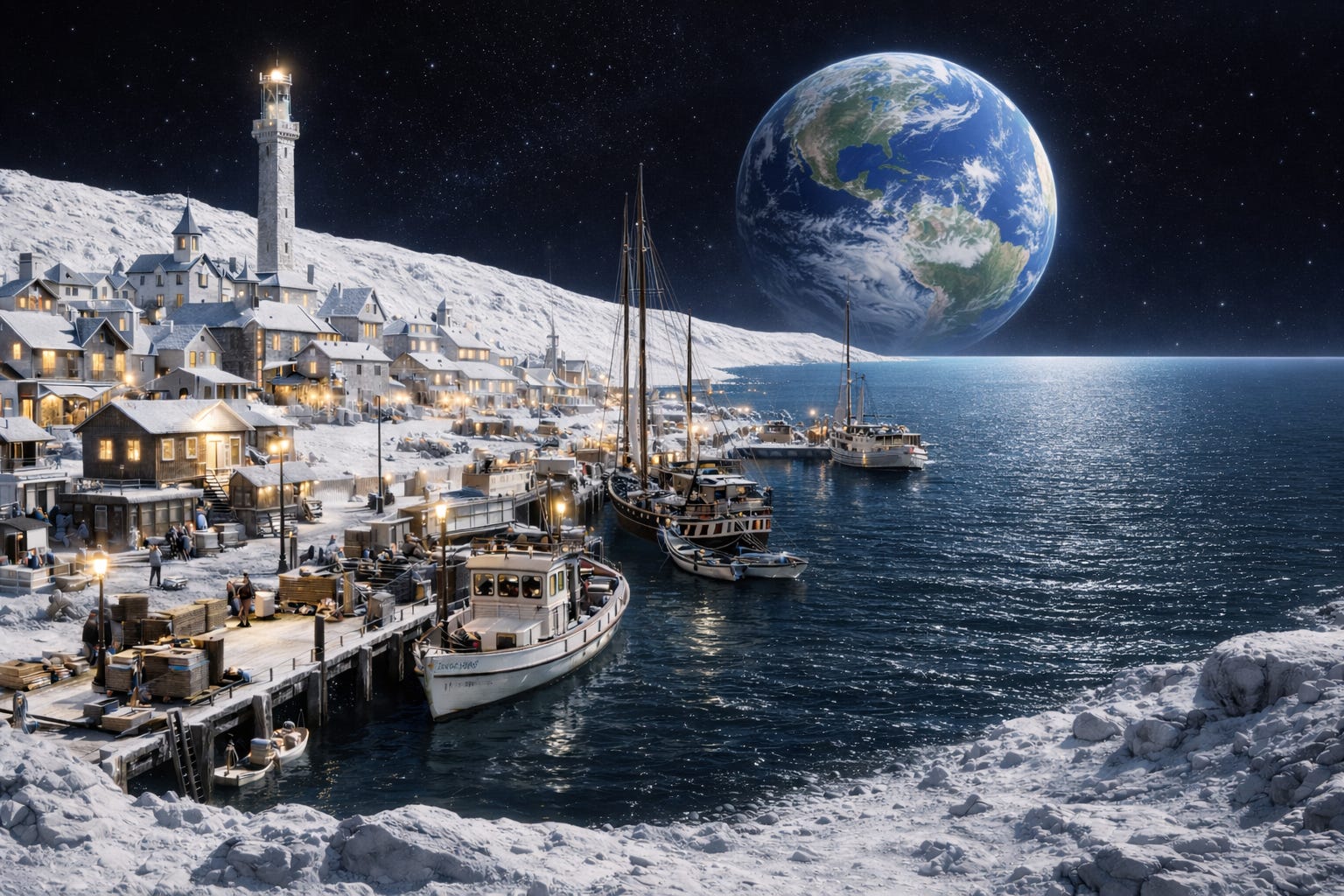
So man’s earliest misperceptions answered the beauty of the moon with the petnames of his infatuation. We named its landmarks from the skewed state of first love. We saw seas in her light, harbors in her craters and basins in her shades and mountain streams between. We are lucky we named her when our geniuses spied shorelines so that the moon still has maria’s (seas) and mon’s (mountains) and floodplains and rilles and we can look up at her full face within our old fascinated attraction and contemplate with poetic precision her waterways. We are lucky we can still see what does not exist. Indeed, some nights on the coast of Cape Cod the sand takes the moonlight so bright and so cool you feel you are walking the white beaches of the moon, and the lit waves before you the darkened whitecaps of her seas.
Just think what horrid names we’d give to her features now if we had discovered her in the year 2026. Think how we “honor” the discoveries of the unknown today. I shudder when I prophesize the outposts on Mars. We do not name a new planet Athene, for instance, but XR-2678-P1, or GLP-1 Base Inhibitor… The learned Greeks did not believe in gods either, and yet they named their planets after them.
But NASA’s list of recently discovered planets are not names: KMT-2021-BLG-0852L b, TOI-1232 b & c, and “other notable additions,” HD 36384 b, TOI-2095 b, and MWC 758 c.
Hey, NASA, FUCK OFF.
These are not names, and they are not even pronounceabilities. They are anti-melodic groupings of one-syllable initials. They answer to no inner echo of melody, no need for sonic pleasure which is a requirement of intelligibility.
We do not name anything for we do not move symbologically. Look: we no longer come up with narratives for would-be Presidential assassins, no very grand lies about military intervention. We don't even have the thirst for half-scale war, as recent right-wing defections from Trump’s traipse in Iran have shown, for intervention necessitates a “theater” of war and we do not like theater.
Anti-federalists vs Federalists, Democratic-Republicans vs Federalists, Democrats vs Whigs, Democrats vs Republicans. By 170 years this is the longest stretch that our two American parties have kept the same names. (Where does it say we only get two for the rest of time?) Somewhere along the way the morphology of names, of nomenclature ceased and instead there arose a morphology of definitions and principles below the surface of the existing names. The same stands for categories like socialist and capitalist. Up until six years ago no socialist would have entertained the idea of undercutting and threatening the social benefits and wages of workers via mass migration (Bernie Sanders, a representative of 20th century intelligibility, still does not). Yet today when we think of socialism we think of open borders and climate change and Hasan Piker, who profits off the monetization of boredom and the exploitation of metadata, ie surveillance capitalism. This “ideology” should be called something else, but not socialism. “Left” and “right” become incoherent if one means to trace them back in an exact genealogy to their origins: one would shape a defective double-helix that has stagnated into arid parallels.
I once, in a literary review, wanted to refer to a sentence that alliterated several words beginning with the letter A. I thought, surely there must nice poetic terms for words that begin with a specific letter. Say, “alphal” or “omegal” for A and O words. I found the closest humans have got for the letter A is “A-initial lexemes.” Or, if that doesn’t suit your meter, there’s this which fits the iambic pentameter, “Alphabetically indexed signs (A-class).”
We have so much we refuse to name.
This extinction of morphology is the great lunar tide of human energy ebbing away underfoot, and if I draw you too far afield in this observation it is only to point out certain tidal shifts across all of civilization. People stand gazing at the ebb and the tide rushing out feels nice on the feet, because human energy still exists on the way out and it is fascinating to watch it draw away. Onlookers do the same when a tsunami draws the water to her monstrous breast. Where does it disappear to? What is drawing it, what tugs? A moon of some near apocalypse? How far is its tideline?
But where our lingual morphology ends, our journey into existence ends. And so, too, with the advent of Neuralinks and cybernetic minds, our physically organic, evolutionary morphology also ends.
4.
We have approached the shores of the moon in the wrong spirit, and so I cannot summon the requisite elan, or eclat — or is it esprit? — to write properly about her. I went too Earthly just now. (Did you feel an elanlessness, eclatlessness, or espritlessness in the preceding section?)
In the epigraph where Norman Mailer outperforms me we see that he grew bored with the moon also. But why?
But let me first haul ass downtown from 86th street on the 1 train. After Artemis II went into lunar orbit I teleported to bookstores all over New York City looking for Atlases of the moon. I wanted to take in all the lunar features. I wanted to idolize her craters and hillheads. But they repelled me. Each and every book about the moon repelled me. Or rather, they did not repel me but their paltry offerings were so far in arears of what I desired from them that I resented them for their Vincenzo-themed failure. I loathed them. How could they do this to the moon? How do this to signore Vincenzo? I extinguished all the picture books and dopey ChatGPT-esque selenographies and picked up a “real book” about the moon — you know, one made almost entirely of words — and it didn’t put Apollo 11 into orbit until 372 pages in, with less than 100 to spare.
The boredom with the moon comes because we have sent no Essexes into the darks of her terminator. We have hunted no Moby Dicks in her tropics. No Titanics have gone down in her craters. We have not eaten her lotus leaf in a strange isle and spent a decade in the drugged arms of her Circes. We have not gazed across the floodplain at her sirens and tied ourselves to the rocket to resist her volupty.
The Greeks would have launched Thales and Sophocles upon her shores, or Pythagoras who was a mathematical genius as well as a religious mystic. (These were not always separate things, and need not be.) We would then have lunar geometries and moon-dramas staged on amphitheaters built into the crescents of craters and we would be suckling on the teat of their milky ways two-thousand years hence, wondering why the ancients were so brilliant and so vibrant and named everything so beautifully and aptly, and why are we so cynical and lacking in spirit and imagination? Why have we declined so far from them?
Yet it was left to us to make the trip. We have made a transit reserved only, perhaps, for the dead, or for the artist who can visit the dead on the edge of their underworld.
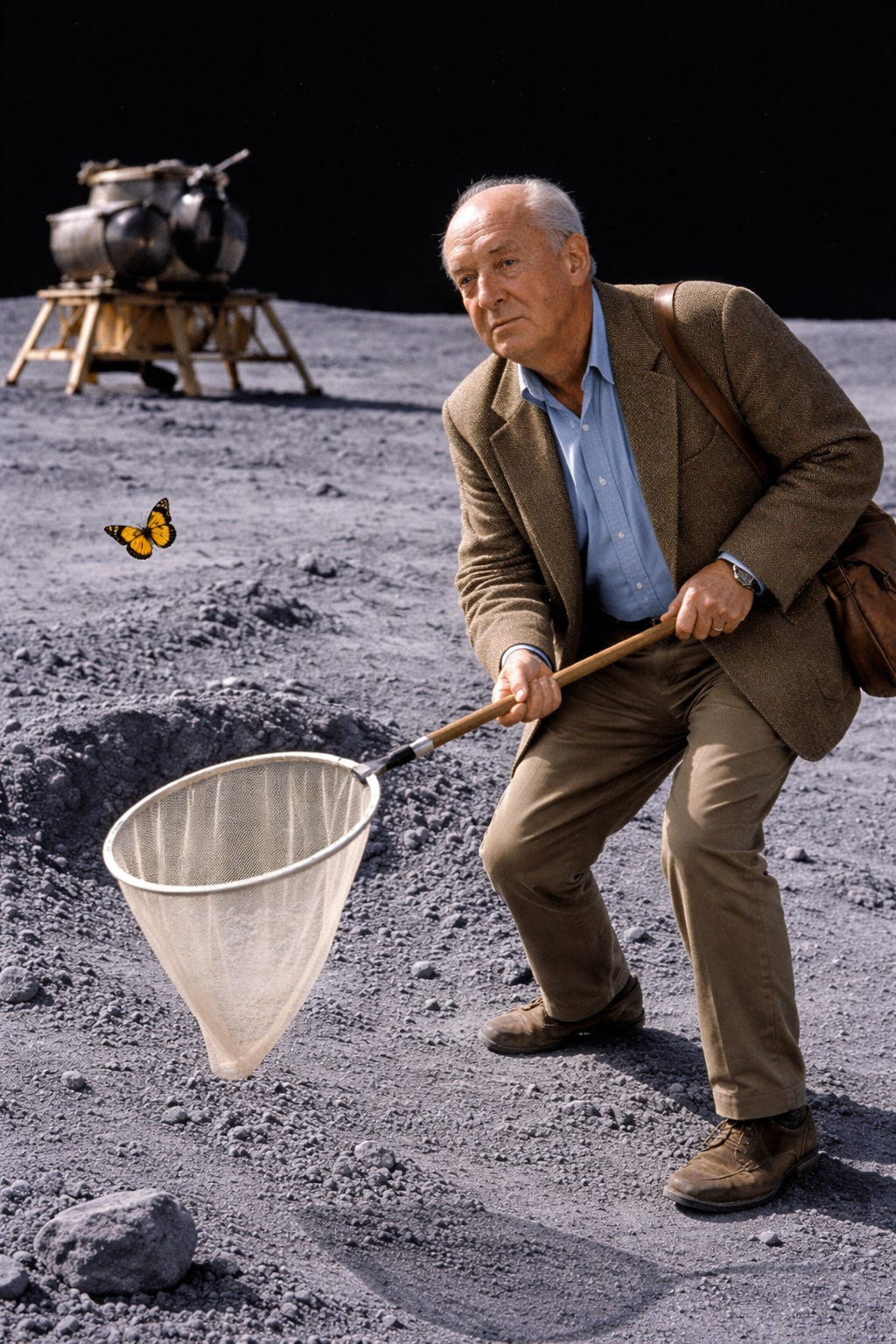
If I could send anyone to the moon and read what they’d write, I can think only of the dead: Mailer, Nabokov, McCarthy, Milton, Shakespeare, Nietzsche, Paul Virilio. I wish I could send these minds to space and have them dawn the space suit and pocket the moonrock and gambol the craters and recline in the shadows of the hills and write about it. Any of the sentences they’d write about hurtling beyond the skies of the earth or floating weightless toward our moon or walking its surface would be the greatest sentence ever written.
In their pens’ absence, through our modern history no myth moves through the moon. Armstrong and Aldrin gave us no sentence of the moon, no couplet of the crater. One cannot even remember the names of the others who walked her beachheads. Consciousness has had no taste of her orbit. The only myth left to us is conspiracy—conspiracy which is the absence of myth. The cynical belief that we never even went. That is our “myth” of the moon.
So why shouldn’t we be dead bored with the dead rock?
5.
“The rise of Marxism,” Hugh intones, “is but a corollary to the fundamental historical malady of this century: false perception.... Our real duty is to become the mind of America.... The aim is to develop teleological mind. Mind that dwells above facts ...” [Emphasis mine]
Hugh “Harlot” Montague, based on James Jesus Angleton, Harlot’s Ghost, Norman Mailer
As I am about to deploy the term “Deep State,” let’s get one thing absolutely out of the way. When I say “Deep State” I refer to the entity that Gore Vidal and Noam Chomsky christened the “National Security State,” and which the pro-Assange-Snowden left pretended no longer existed only when right wingers caught wind of its presence and renamed it the “Deep State.” Because the left has abandoned much of her nomenclatorial battlements we are left to speak mostly in the right wing’s language. And thus, the intellectual left today is like the original Apollo 11 landing vessel the astronauts left behind on the moon: visible in obscure zones when you feel like traveling 238,900 miles from normality.
If the Deep State is a secret satellite orbiting the world and pulling on the tides of our civilization, Gore Vidal was her light side — her rational historian — and Mailer her dark side — her psychohistorian. In other words, Vidal is Thucydides who traced the betrayal of the Constitution and Mailer Herodotus who probed the imagination of the pocket cults.
The revelations of the last decade of UAP disclosures, whistleblowers, and the Epstein Files have met Mailer at the face of his psychoanalytical portraits. The various secret organizations that couped our republic and run our government are modern day mystery cults.
America’s transition from Republic to Empire after the Second World War was our first conspiracy theory. But America could not tell her citizens that she had become an Empire with clandestine apparati. Whereas Rome had only the senators to lie to, America had her huddled masses. So she pretended to remain a Republic with some existential fires to put out while sunbathing in post-war Europe and the Pacific. I will write about this conspiracy theory, this lie, in more detail in the future, but suffice it for now that you swallow whole my maxim that this denied, repressed, sublimated transition between republic and empire created a psychosis in the American. Citizens cannot help but be psychical portraits of their country and so we live in a country where people construct their worldviews either entirely by uncorroborated conspiracy theory, and the other half who refuse to absorb the real, declassified conspiracy theories: that which is no longer denied. Lo: people will still roll their eyes when you try to tell them about MK Ultra or Project Stargate. Or the Pentagon’s declassified UFO videos. They simply don’t believe it’s true. Even when the government tells them it is.
The creation of these mystery cults created a mystic vacuum. Since the Manhattan Project, the Deep State has run countless secret physics programs, or USAPs (Unacknowledged Special Access Program)s, alienated from the public, from the truth, the discovery of knowledge, the nature of reality, and human achievement in the fields of physics. The existence of these secret programs are long declassified. Look, for instance, at the technology the CIA and President Donald Trump announced it deployed in Iran to recover a downed pilot: Ghost Murmur, in which quantum magnetometry located the pilot’s heartbeat in a mountain range from forty miles away. What are the metaphysical implications of such technology? Of quantum manetometry? We don’t know, for the Deep State — which is to say The State — controls the disclosure of human knowledge.
This, of course, resembles the structure of a totalitarianism.
Every year the widening of these secret programs casts a growing penumbra upon civilization, and steals from us our mysticism. It tilts us from the contemplation of God, because it tilts us from all that is coming-into-knowledge, all that is new.
This alienation between man and discovery widens until we are effectively locked into a simulation of civilization: politics replaces the soul, science becomes the dead end of “string theory,” and art is generated by computers. We are confronted with the reversal of Neil Armstrong’s maxim: “One giant leap for man, one small step for mankind.” For the knowledge is there, but it has yet to be disclosed. The effort required to reach it far exceeds the energy of bridging its actual distance.
The secret of the substance of the soul is stolen from us and we are vessels with leaky spirits spilling out upon the wind.
6.
The artist must leap this gap into the unknown and construct a new cosmogony. If NASA will not send us, we must summon the escape velocity to name our world. We must tie the unknown and the true nature of reality to the consciousness of our times. Philosophers must leap the gulf too, but they must leap with the strength of the artist in them. Einstein created General Relativity — it came to him the same way Lolita appeared to Nabokov — and it turned out later, in his verifying calculations, that it also happened to be true.
The artist always throws, if they are a genius, a terminator line somewhere, across something. A mystical boundary across some span of nature and the irrational mystery of it lures us toward it: does the horizon simply end? Shall we fall off the Earth? Maybe we should journey out to the edge to see. Thus does the artist pay the right respects to our lunar mistress. Thus does man requite the love of the moon. It is in the way the landscape throws the lights and shadows of the artist’s terminator from her moutainheads and basins out into the lighted known and the shadowed unknown which wins the artist their immortality.
And perhaps in death the artist’s soul makes a transit to the place they cast their shadows. And they live there by the light of a fire on the moon.
Dear reader, what writer or philosopher or artist or personage would you send to the moon and have them report back and why? I’m curious to discover the spoils of your imagination.
Comments
Nothing yet. Say the first thing.
Sign in to join the conversation.