
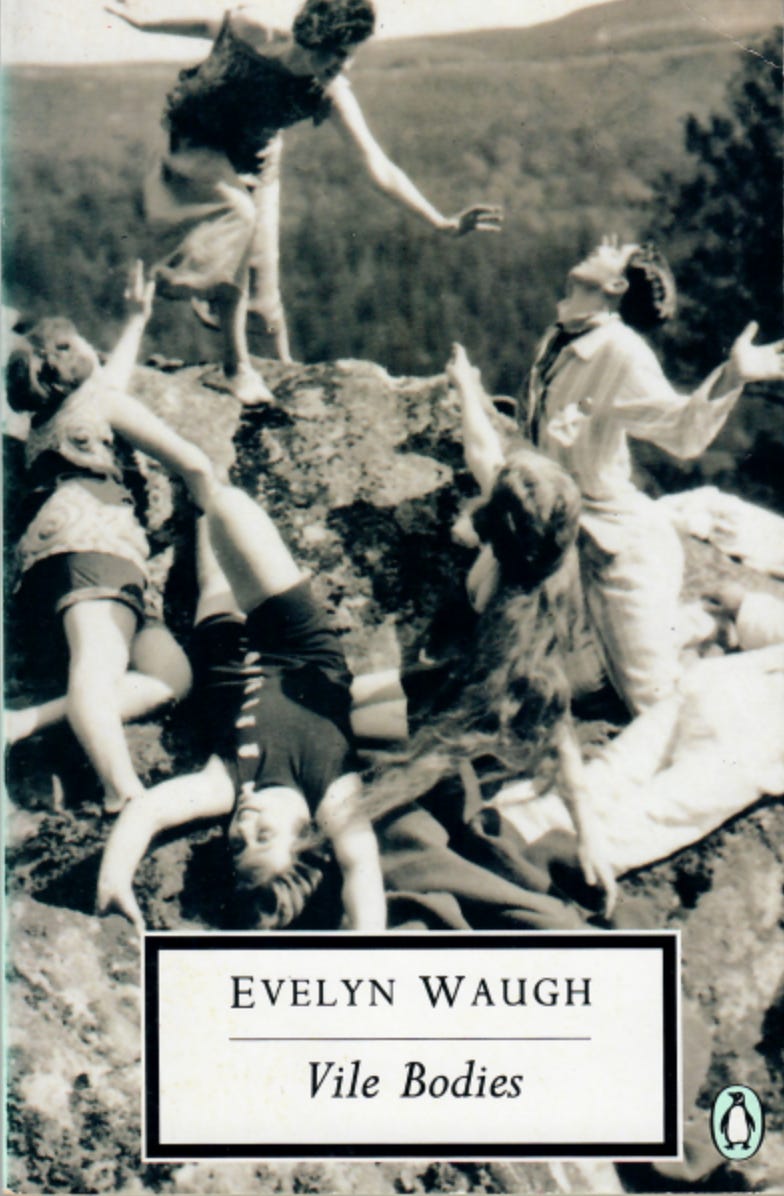
Review of Volume 2 of The Complete Works of Evelyn Waugh: Vile Bodies published by Oxford University Press. Originally published in The Evelyn Waugh Society, issue 53.1. In the pantheon of physics novels, there is only Anna Karenina (special relativity), Blood Meridian (quantum mechanics), and Vile Bodies (quantum mechanics).
‘Are your books meant to be satirical?’ No. Satire is a matter of period. It flourishes in a stable society and presupposes homogenous moral standards—the early Roman Empire [Martial] and 18th Century Europe [Swift]. It is aimed at inconsistency and hypocrisy. It exposes polite cruelty and folly by exaggerating them. It seeks to produce shame. All this has no place in the Century of the Common Man where vice no longer pays lip service to virtue. The artist’s only service to the disintegrated society of today is to create little independent systems of order of his own. I foresee in the dark age opening that the scribes may play the same part of the monks after the first barbarian victories. They were not satirists. Evelyn Waugh, “Fan-Fare,” Life. April 8th, 1946 [Martial and Swift mine; if not yours]
I was taking a few weeks’ indulgence in answering the question we Wavians love to be posed (unless your name isn’t Vincenzo), “Vincenzo, which Waugh should I start with?” when by chance the very man who introduced me to Evelyn Waugh asked if I would review the towering Oxford University Press edition of Vile Bodies—the very Waugh with which I started. Serendipity of this sort has a tendency, in Waugh’s novels if not in his life, to morph into the cruelest of mistresses before too long. After all, it was halfway through writing Vile Bodies that Evelyn Waugh divorced Evelyn Waugh. (Waugh’s first wife, Evelyn née Gardner, left Waugh for John Heygate—and she was not the first Evelyn in the relationship to have affections for another man.) Not only that, but the deep psychical gout of the 1929 divorce nearly led Evelyn to take his own life—or, to put it another way, Evelyn Waugh nearly divorced Evelyn Waugh—which might have left Vile Bodies gapingly unfinished at Chapter Six with columnist Simon Balcairn’s own suicide, one of the dark peaks of the novel’s famous cruelty.1
I wavered at the assignment and was dealt, naturally enough, an increasingly Wavian hand: the review was initially assigned elsewhere and would I take over the job pronto, and to boot (or Boot), I would not be given a copy of the text I was reviewing by my editor. Well. With the cards of coincidence stacked against me, yet with my last quantum review of Cormac McCarthy making for, I hope, awe-inspiring reading, I set out boldly to see if Vile Bodies still glints in the dark age of our 21st Century, and if the editors of The Complete Works of Evelyn Waugh had dipped any of it in amber. After all, if these were the Wavian fates at play (another way of saying original sin), then I didn’t really have a choice now, did I? And I may as well prepare for the worst.

Oxford’s Coat of Arms and anti-Lit. Theory Undergarments
Comments
Nothing yet. Say the first thing.
Sign in to join the conversation.