
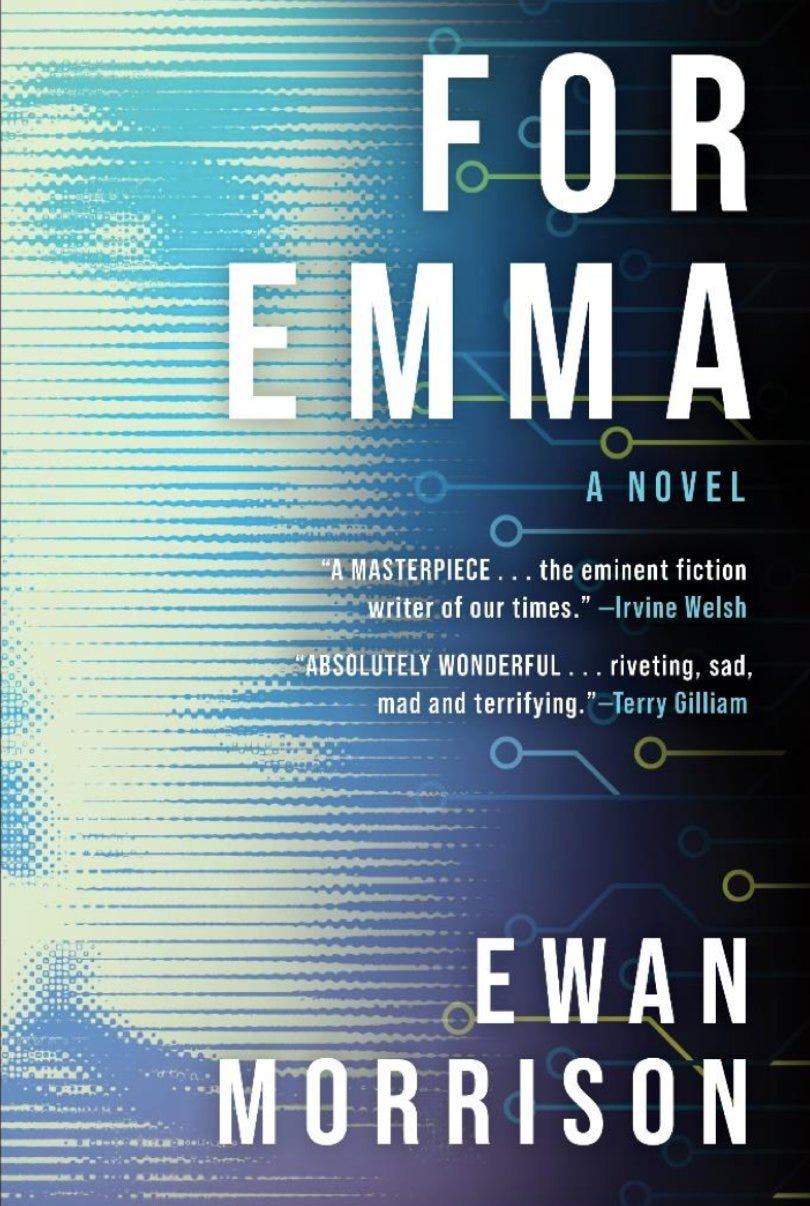
Ewan Morrison’s “For Emma” is now available for purchase in the US and UK.
Civilization has now crossed to the elegiac side of intelligence, not because the dunce’s dream of replacing intelligence with computers has finally come to pass, but because after decades of its degrading misuse we’ve come to consider intelligence replaceable. Despite the lack of any conclusive evidence and the superior counter-arguments of leading experts in consciousness like Sir Roger Penrose and Dr. Stuart Hameroff, it’s become the most banal, unanimous position amongst the forgettable personalities of podcasts, social media “intelligentsia,” and the computer science experts they interview that science, governance and imagination are but moments away from being amelioratively eclipsed by “artificial intelligence.” (If ever a cult of stupidity deserved replacement it’s this one, and if ever a phrase required a quotational escort it’s the tumor growing upon the four much abused syllables of “intelligence,” which manages to negate the very definition of sapience while passing fraudulently for its ultimate goal.) This, mind you, has become a position held even by artists and thinkers who consider such an incursion unjust, to say nothing of the imbeciles who lay enthusiastically supine to generative AI’s glorified plagiarism-skirting software, using it to help them “come up with ideas.”
But whether or not human intelligence is actually swappable with artificial mimicry is irrelevant to the fact that this replacement will be attempted by the very autistical technofeudal dingbats who couped the global economy in the early 2000s and funneled human behavior into finite algorithmic patterns that a computer can imitate, only because a computer dictates them. Thus reviled at human fate’s bad breadth, aggrieved father Josh Cartwright decides to assassinate Zach Neumann, the CEO of multi-billion dollar AI microchip corporation Biosys. No, it’s not a copycat of Luigi Mangione, but the prescient plot of Ewan Morrison’s Silicon Valley techno-thriller, For Emma, written much in advance of that mentally ill heartthrob’s mewing murder of CEO Brian Thompson. (For the record, Mangione’s generic handsomeness has always struck me as rather AI-generated itself, and his motivations just as artlessly unintelligible.)
For Emma was begun in advance of the tremors, too, of 10/7, though the anti-AI domestic terrorist act to which its plot builds takes place on 10/01, one of just the mercifully few days a year when the calendar reads in binary. Much of the novel is built on these sorts of acute perfections, such as the slogan of Neuralink-modelled microchip implant pioneers Biosys, “The future is within you” (or will be soon whether you like it or not, Cartwright surmises) as well as the epigraph which opens the novel on an emotional syllogism:
“The death of a child is the greatest reason of all to doubt the existence of God.” Fyodor Dostoyevsky (1821-81)
“With artificial intelligence… we are creating God.” Mo Gadwat, Former Google Executive (1967-)
The dates appended to the quotes show not just the temporal and intellectual distance culture has travelled from the days of Dostoyevsky’s fragile pathos to the gullible brio of AI “thought leaders,” “evangelists,” and “gurus”—this being the patois a nation populated by born-again Christians but ruled by cynical atheists deserves—but the unanswered death date left open on the leeward side of 1967 gives an ominous echo of the novel’s assassinational plot, asking of it almost to be an epitaph.
For Emma does not quite pass a judgement on whether such an assassination would actually be morally justified, but asks of the non-fictional foray into AI and human experimentation with microchips to become memorial at any rate. It is a conspiracy novel, and a very plausible one at that, comprised of video diary entries from Josh Cartwright to his deceased daughter Emma, a scientist at Biosys who dies after volunteering for its illegal human trials with AI-powered chips. The diary entries detail Cartwright’s grief, potential auditory hallucinations of Emma, covert reception of a tranche of Biosys files video documenting Emma’s experimental torture, culminating decision to assassinate the CEO to buy humanity time to fight back, and the detailed procedure of bomb making.
Biosys and its CEO Zack Neumann are up to, essentially, what the real global economy is being groomed for by the Neuralinks and Palantirs of the world: the implantation of AI-infused microchips in human brains and the angling of the final technofeudal nail in the coffin of human capitalism and human personality. But whereas the CEOs of those real companies have taken as of late to voting for the right, this doltish dystopia was first championed by neoliberalism, and continues surreptitiously under its blazon of “progressivism,” which Morrison nails. (In truth, dystopia will continue under any political blazon that suits it, like the idiotic Republican pun DOGE which used the commendable promise of cutting waste to hand over formerly inaccessible data on every single US citizen registered with the IRS to Peter Thiel’s Palantir.) The World Economic Forum enthuses annually about the obsolescence of human intelligence and this gaiety is handed down in consensual form to the left that the greenest, most moral, and most progressive future is one in which AI diagnostics and implants take over medicine, meat is grown in labs, and home appliances eavesdrop on one’s privacy. How perfectly Morrison captures the left-appeasing corporatist speak of these companies, and the oligarchical relationship between these tech companies and state governments. Here’s Biosys’s CEO:
‘Imagine if you can,’ Neumann said as he paced the stage, ‘a future in which humankind has discovered how to cure all illnesses, how to achieve lasting and true equality for all the peoples of the world, imagine a unified planetary economy based on 100% sustainability.’
The screen images showed smiling people from many races, holding cornucopias of fruit, other smiling among medical contraptions beneath the graphic of a rainbow, then the Biosys logo wrapped itself around an image of the globe.
Biosys’s hologram AI, their Alexa or Siri if you will, is a “mixed-race twenty-year old female, a kind of hybrid between a supermodel and an activist, with a lip piercing and blue hair,” which is almost exactly the only phenotype ChatGPT could produce for, say, Thomas Jefferson, in its first satirical weeks of image generation.
Behind this veneer, however, Biosys is conducting illegal human trials in the South Pacific, leading to the tormented deaths of their human guinea pigs, including Cartwright’s daughter. They are colluding, as we know corporations do, with search engines and governments. “I learned,” says Cartwright,
that Biosys made two trillion in dollars from experimental vaccines during the last pandemic and used that leverage to buy shares in the two biggest Big Tech corporations, so it could control its public image on social media; that Biosys had huge economic ties with the CCP, who were involved with ‘organ harvesting,’ and experimental gain-of-function research to create super-viruses and human-animal-hybrid organs… I’d found proof that they’d done many more clinical trials in Indonesia – funded by government sources and the [redacted by the fictional editor] foundation…
Their use of surgically implanted microchips to map the human brain achieve some short-term success in the amelioration of physical and mental health issues of their host, but end up eating away at the brain in attempts to control and then dictate human behavior and action. All while being “lauded as a miracle breakthrough in health and security by the WHO, NIH, and CDC,” naturally.
The novel is built on an almost Balzacian level of procedural detail, which lends the plausibility its horror. This includes accounts of just how integrated smart appliances and internet-connected surveillance technologies are into every inch of the home and the public square, as well as how to detach oneself from all of it. So too the intricacies of existing frameworks of hate speech laws are explained as they start to ensnare Cartwright in his Biosys research and activity in conspiratorial chatrooms:
…since I’d used the college computers, I’d placed the college in violation of International Hate Speech Law and this had left The Community College of San Francisco open to prosecution – under the UN Hate Speech Charter, section 178 (b) (c) (d) & (f).
They said my contract was terminated immediately and I had to attend a meeting that would be recorded for legal reasons.
[…]
Human Resources NOTE attached a screenshot of the so called ‘Hate Speech’ that I’d posted on the shared site – it said:
Where have the Indonesia news stories on the new Biosys nanochip-trial deaths gone? Erased by Big Tech search engines overnight. Check out the Top 3 Big Tech search engines $98B investment in Biosys.
I’d overlooked the fact that, fake ID or not, my college had signed the State Security Information Sharing Act, 2019, and so every word and search I typed, encrypted or not, had been flagged by a US Govt. Department of Homeland Security bot.
This is what the world would look like if it were dictated by Bill Gates’ vision of using AI to police “misinformation.”
As the day to assassinate Neumann approaches, Biosys begins shutting down Cartwright’s life, like a Big Tech cancellation. I will leave the plot in the hands of Morrison from here, before saying that For Emma also includes a masterpiece of an episode of modern humanist crematory funerals, reaching the poignant, atomised horror of Evelyn Waugh’s The Loved One. Morrison’s novel, his eighth, is a triumph in that it reaches deep into the territory of Michel Houellebecq’s best works, wherein the critique of both neoliberal capital and received cultural liberalism is so penetrating as to make very poor leftists of those to whom it does not give profound pause, or alter the course of their private politics.
But more importantly, it is a triumph as a piece of art. For Emma is ultimately of two voices (not counting Emma’s benevolent hauntings), as the diary entries are transcribed by an anonymous editor of a publishing company who interrupts only to remind the reader of their impressive CV (“Mental health is an issue that I have some expertise with as an assistant editor on The Burnout Survival Guide and Single and Happy Forever”), congratulate themselves on the cashcow they’ve got on their hands (“I shuddered to think how important this could be”), and introduce naïvely self-assured doubts of the possibility of Biosys’s experiments (“As far as I can find, from my searches on the top biomedical sites, such recordings of permanent surgical brain chip experiments on actual humans do not and cannot possibly exist. As editor, this gave me some peace of mind…”). These doubts come to an end when Biosys starts targeting them as well. But this voice provides a comic counterpoint and a serious ironical dimension to the emotional Cartwright, reading as if if Dr. John Ray kept interrupting Lolita to give pleasingly inane comment. In fact, the editor’s voice is perhaps the novel’s most complex, and its subtle dystopian portraiture of modern publishing (and personnel) relinquishing what little was left of its talents to AI is one of its scariest elements because it’s actually happening right now.
Instead of fighting against this coup, publishing companies have already begun using AI for marketing analysis and topic curation—the bland dowsing rods that long ago replaced talent as a publisher’s main criteria for signing a book. Worse still, some publishing companies allow generative AI technologies to train on their books, which is the same as saying they allow them to plagiarize their works, as generative AI’s procedure is to copy, agglomerate and modify existing human content just enough to skirt copyright laws. Hark, too, at the codicil in Trump’s doltishly named Big Beautiful Bill that would disallow the regulation of AI for ten years.
Morrison himself has become an integral voice in the fight against this moronic inferno (to do my own borrowing from Saul Bellow), though he’s up against three decades of a headstart. With or without direct replacement, the power allotted to algorithms has been grooming the publishing-industrial complex for replacement by generative AI technologies like ChatGPT for decades. In the early 2000s Google co-opted magazine traffic and began to sell ads against it, without investing a single cent of their own into producing human content. Gone were print advertising and magazine budgets. To stay alive, much of print journalism that hadn’t vanished overnight retreated to die slowly online instead. Magazines could no longer prioritize writing for humans to gain visibility and subscribers and sell ads, but for the algorithm Google uses to rank its search results instead and funnel readers into digital subscriptions. This is called Search Engine Optimization, or SEO. It’s not as exciting as microchips, but harbor a prejudice against it, dear reader. For born of it was the insidious one-line opening “paragraph,” and destined for obsolescence were voice, nuance, word count, and style—things computers cannot assign value to. This is the only reason generative AI technologies like ChatGPT have a snowball’s chance of replacing mainstream writing: because mainstream writing has been devolving toward the vapid, voiceless, informative “style” of algorithmic writing for decades.
But let us end on a high note: computers will never achieve consciousness because consciousness is based on non-computable processes. Mathematician Kurt Godel proved with his Incompleteness Theorem in the 20th century that human mathematical understanding cannot be contained in computational procedure. In summa, any system of formal logic based on mathematical proofs and rules (an algorithm) can produce a statement that is true, but that cannot be verified as being true by the system itself. It is human understanding alone, outside the system of regulating algorithms and based on something fundamentally transcendent to computational processes, which can understand the statement as being true. Penrose and Hameroff, the only theorists who have actually pinpointed a precise physical location of consciousness called “Orch (OR),” have shown that consciousness precedes and transcends computational processes and is seated in the quantum processes of microtubules and taus in the brain. Consciousness operates by laws of quantum physics we do not yet have a perfect understanding of and which AI scientists do not even consider in their simpleton technologies, but which Penrose sketches the outlines of with his theory of twistors. But I have a feeling I’m losing you. It is enough that you buy For Emma, and resist the looming coup. You are not a computer.
Comments
Nothing yet. Say the first thing.
Sign in to join the conversation.