
On July 7, ICE murdered another migrant, who lived in this country for 35 years, who never committed a crime, who raised a family and ran a construction business. His name was Lorenzo Salgado Araujo of Houston, a 52-year-old formerly from Mexico, but always from this land. Yes, always. ICE officers shot him in the stomach, in his car, for allegedly evading them (they claim he rammed their unmarked vehicles, a claim they often make even when videos show otherwise).
None of which, even for citizens, deserves the “death penalty.”
This Substack is reader-supported. To receive new posts and support my work, consider becoming a free or paid subscriber.
What has been missing in all this talk about migrants from Mexico and Central America is that we have roots in this land as deep as anyone’s. Not just because Texas used to be part of Mexico. But because most Mexicans are Indigenous to this continent… before borders, before migrations from Europe, before “America First.”
We simply can’t be immigrants to our own lands.
For a generation or more, Indigenous peoples like the Mexica, Maya (including from Mexico and Guatemala), Zapoteco, Mixteco, Purepecha, Raramuri, Pipil, and many more have migrated to the United States. Estimates are that there are four or five million tribal peoples from Mexico and Central America (not to mention the Indigenous people from South America or the Caribbean). This is on top of the six million U.S. Indigenous people: Dine, Lakota, Paiute, Shoshone, Hopi, Pueblo, and so many more. To complicate things more, the de-tribalized Indigenous peoples of Mexico, who have lost ties to original languages or customs due to conquest, colonization, and acculturation, make up most of the over 40 million people of Mexican descent in the U.S.
Why does this matter?
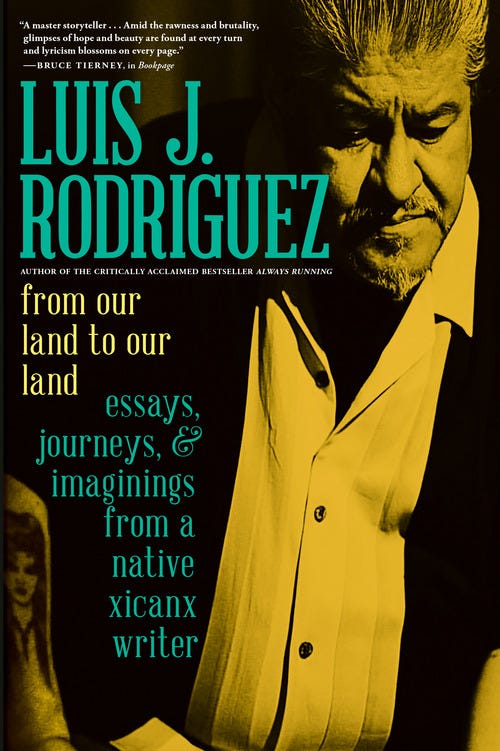
I wrote a book of essays called “From Our Land to Our Land” (Seven Stories Press). It came out in 2020 just as the Covid-19 surge began. Although it became a Los Angeles Times Book of the Month selection, and had favorable reviews, the Pandemic hurt its sales. C’est la vie! Others lost lives so I understand this is a terribly minor issue. Nonetheless it’s one of my most important books. The main essay describes how my mother walked over an international bridge from Ciudad Juarez, Mexico to El Paso, Texas to have me born. This makes me an “anchor baby” although this is a misnomer. My mother had roots with the Raramuri peoples of the Sierra Tarahumara, Chihuahua, Mexico. They have lived in the area, like many other original peoples, for tens of thousands of years. Or as they say, “forever.” When I was born, the U.S./Mexico border had only been there for 106 years. My mother wasn’t entering a “foreign” place. She was going from our land to our land.
My being born a U.S. citizen was an accident of history. That “history” included an invasion by the U.S. against Mexico from 1846-48 when the U.S. had 20 million people, with a highly organized army, and Mexico had 7 million people and a makeshift armed defense (including boys defending the Castle of Chapultepec in Mexico City when U.S. troops attacked). Many Indigenous peoples on both sides of the border of the time had little or no allegiance to either side. Both countries trampled on their land.
To reiterate, regardless of borders made up by others, my mother and I were already “home” when we crossed that summer of 1954. Our family has bones buried there that go back, in some cases for original peoples, up to 35,000 years. Just the same, growing up in Los Angeles, I was called a stranger, a “wetback,” and told to “go back to where you came from.”
To reiterate, I am “home.”
Borders are made up things. Millions of human beings across history have died for fabricated lines through living communities. “Nations” in general are supposed to consist of common cultures, histories, languages, ethnicity, and territory. But as we know, many “nations” were carved out from distinctly different peoples. Even the U.S. border has tribes like the To’hono O’odham in Arizona/Sonora and the Kumeyaay of California/Baja California who have international fences through their ancestral lands. Similar to the Mohawk Nation of Akwesaswe in the U.S./Canada border.
The United States recognizes 575 Native American tribal nations within its parameters. All this adds to the complexity of our so-called nationhood, especially when people from around the world have come here over the past 250 years ago. As much as white supremacists want to declare the United States a one race/ethnic/religious country that others must assimilate into, the realities are much more complex and diverse. Presently, this country is made up of all races, ethnicities, nations, and religions. It’s not “white replacement,” but a human gathering ground, a key meeting place, from which we can be even more human, more relational, more in kinship.
Still, doing Trump’s fascist regime’s bidding, ICE has been largely targeting Indigenous-looking people from Mexico and Central America (I’m aware those detained include Dominicans, Venezuelans, Haitians, Somalis, other Africans, Asians, and even Europeans). Because of this, ICE has even stopped and detained U.S. Native Americans. They can’t tell us apart! Go to any ICE detention center, of which there are some 1,460 around the country holding approximately 60,000 people: Indigenous people everywhere.
So Lorenzo Salgado Araujo should not have been killed, let alone pulled over. May you rest in peace, Lorenzo, while we on this planet do all we can for the justice you and your family deserve. As the people say: No human being is “illegal”! We didn’t cross the border, the border crossed! us! Abolish ICE!
Lorenzo Salgado Araujo, presente!
This Substack is reader-supported. To receive new posts and support my work, consider becoming a free or paid subscriber.
Comments
Nothing yet. Say the first thing.
Sign in to join the conversation.