
Text within this block will maintain its original spacing when published
The seed of an iron flower
must grow in gravel
or else make its own
if it is taken from the desert
and sunk in loam.
What a hard garden,
lovers: iron is used
to the routine of oil
but gets the bloody rust
in damp: there, the oasis,
a devotion in the sand,
prays flesh, virus to mammoth,
and supports them all,
but when the regular iron
flowers in sensuous ease
it languishes; the bloom
weeps dust. Spear-shaped,
venomous as plows were thought to be,
the leaves fall sick
and make a desert: iron's
oasis in delight
and field of strength.
If you’ve been following along with the development of close reading thoughts, we left off on Rosenblatt’s transactional theory, which would go on to launch the wide net of Reader-Response Theory. There’s a whole bunch to unpack there, but the two that I find to be the most interesting are Stanley Fish's Interpretive Communities (presented in 1982’s Is There a Text in This Class?) and Norman Holland’s identity theory (from his 1973 Poems in Persons). Fish argued that there isn’t necessarily a concrete meaning to any text, but rather that meaning is derived actively based on the particular societal literary group you belong to. This would be sort of an onion in terms of the layers to your particular grouping. So my interpretations of any poem are based on my being an American, a man, a fan of poetic criticism, a New Yorker, a Bronxite, a Millennial, etc. I would share interpretations with individuals within these groups. They will read my interpretations and they will resonate because we’re drawing from the same meaning pool. It’s pretty easy to see why this holds water.
Holland made the argument a bit more personal. He saw a poem as an inkblot of sorts, onto which the reader projects some aspect of themselves. If the poem features struggle, you inevitably acknowledge it as the same sort of struggle you have gone through. You see trauma and victories that mirror your own. If we share interpretations it is because we share certain responses to the triggers that the poet has crafted. This doesn’t mean that a reader creates things that don’t exist within a particular piece, though. There are some other theories (that I won’t be featuring just because I don’t mess with them, frankly) that are totally free form and essentially say that the reading is just actively looking to slap their particular framing on whatever text they come across. Holland was more so saying that as you read something, the components of a poem that catch your attention and seem so brilliant to you only do so because they are seeing an aspect of their psyche reflected back at them. In Holland’s view, close reading reveals more about the reader than about the poem.
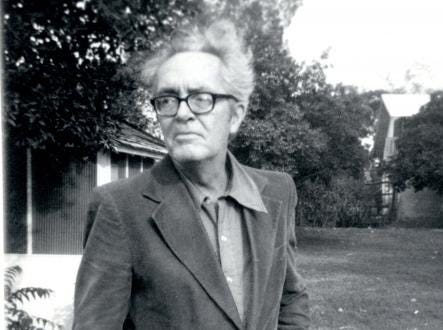
Those sort of gives a good launching point for today’s piece. I mentioned last time that I would be featuring a piece from Alan Dugan’s Pulitzer winning first collection. This piece is one of my favorites from the collection and I suspect it is for reasons that both Fish and Holland would feel appropriate for their theories. I am very much born of the “smooth seas don’t make skilled sailors” world. It took a long time for me to even partially shake my belief in the necessity for intense struggle. It is still my instinct to evaluate someone’s character based on how much shit they’ve trudged through. As for the Holland bit, if you read enough of my recommendations then you’ve got plenty of inkblot interpretations to know a shit ton about me.
Dugan opens the poem with deliberate density. The image - a seed of an iron flower - doesn’t come easily to the mind. We sort of get hung up on the iron flower longer than we should, and certainly then we spend extra time considering the seed. What do you imagine? Something like a sunflower seed? Something wind carried? A samara? It’s a mess. Add to that the trochaic “of an iron flower” jamming up the tongue and you end up with a heavy line that demands time and attention. Same for the second line, punched with the harsh “gr” sounds. Think of some gr words. Groan, grind, grip, grit, grapple, gravity, grudge, gristle. I could do this for a while but I think you get the point. They’re aggressive (it’s hiding in there, too) and physical words. Dugan takes advantage of this and uses it to underscore the roughness these seeds need.
The enjambments are also doing a lot of heavy lifting. The third line is full of monosyllables, but the idea of the seed creating its own gravel carries enough complexity that it ends the line on a punch. There is some build-up with the fourth line, where we are left wondering where the speaker is going, that pays off in the slant rhyme of own/loam. This slight musicality is immediately followed up by the even-more-musical “what a hard garden/ lovers: iron is used/ to the routine of oil/ but gets the bloody rust/ in damp” Seeing the line like this, in one continuous flow, helps us to see the way the stresses and sounds are playing off of each other. Resist the urge to pause at the line breaks in the poem and instead read it aloud straight across. You’ll see the way the voice rises and falls so smoothly. I especially like those last 8 syllables, which feature the repetition of 3 unstressed followed by a single stressed. It makes it so fucking smooth. There’s a sort of tonal irony there because he’s literally saying that this tough machine rusts in smoothness and traditionally ideal conditions, but he’s saying it in such a smooth way.
There’s also something funky happening here with the punctuation. There are three colons in this piece and two of them appear relatively close to each other. In placing them this way, Dugan is unpacking ideas Russian-doll style. “there, the oasis/ a devotion in the sand” is just a dope turn of phrase that I really wanted to put on the pedestal it deserves.
Here we get a stretch of early Dugan that I was referring to in the last post. He is more verbose than in later life, but not needlessly so. It feels like he is playing with language and sounds in a way that speaks directly to his youth. His later work feels like someone who doesn’t have time for that shit anymore. But here, we get to enjoy his playing. From "rust” through “venomous”, there is a repetition of both the short-u “uh” sound and the schwa. If you don’t know what the schwa is, today is your lucky day. Not only is it the coolest name in linguistics, it is also the most common vowel sound. It’s basically a softer, shorter “uh.” We use it all over the place. And Dugan uses this little guy as the star to tie together the whole center of this poem. It feels cohesive and complete because of the way he spaces out and highlights these sounds.
And when our speaker abandons all the “uh” sounds, we notice it. When the leaves fall sick, that sickness lands with a weight. We are brought out to the desert to see the iron finally get what it wants. It leaves us in the struggle.
No posts
Comments
Nothing yet. Say the first thing.
Sign in to join the conversation.