
I grew up feeling like God’s deepest desire was for me to somehow die a martyr.
As a young adult, if I weren’t totally suffering in some area of my life for Jesus, then I obviously wasn’t sold out for Jesus enough.
Now, like most things in our Christian walk, there’s some truth there. It’s nuanced. But as I entered my 50s, I started to ask why the voice of God in my head was always a disappointed one.
“You could have tried harder, Sheila.”
“Sheila, you know I love you, but I’m so disappointed you’re not living up to your potential.”
Sure, Jesus loved me. But I also made Him sad on a daily basis.
And I started wondering—How did I come to believe that I was never trying hard enough, giving enough, suffering enough to make God happy?
And after a lot of journalling, and even some therapy, I realized that in my late teens and early twenties I read Christian books voraciously. I read novels about giving everything up for Jesus and dying. I read books about giving everything up. I read books about spending an hour a day praying (“could you not watch with me one brief hour”?), about realizing you were making money, men, leisure, work, education—really anything—an idol.
Books had shaped me. In some ways for good—but I’ve also had to spend years untangling my view that when Jesus looks at me, I make Him cry.
In our work at Bare Marriage, we’ve also uncovered how the vast majority of best-selling evangelical marriage and sex books hurt women.
And I don’t say that because I merely disagree with the theology that:
women are obligated to give husbands sex when they want it;
women should have sex to keep husbands from watching porn;
girls should dress so they’re not stumbling blocks to the boys around them;
men should make the final decisions in marriage;
all men struggle with lust.
I don’t just disagree with these things; we’ve measured the effects of these teachings. And they’re uniformly bad, resulting in more abuse, more divorce, lower orgasm rates, higher rates of sexual pain, lower rates of long term self-esteem, and so much more.
These teachings are harmful, but they’re also throughout evangelical best-sellers.
(See more about our research here.)
Books are not just a matter of theological debate; books are often a matter of long-term well-being vs. long-term harm.
In our surveys, we found that the most harmful beliefs were taught not by pastors or by families, but from books and media.
When we asked women where they learned the harmful beliefs we were measuring, the biggest source of that belief was not a pastor preaching or parents passing it down, but rather women reading books, magazines, or listening to podcasts.
In our final chapter of The Great Sex Rescue we left a warning for pastors, explaining that they can be giving wonderful, healthy messages about marriage and sex and parenting, but if the people in their congregation are studying harmful books in Bible studies, or getting harmful books out of the church library, or listening to Focus on the Family, people are going to be hurt anyway. Pastors have to understand it’s not just about teaching good things, but also warning people away from harmful resources.
Interestingly, when we were conducting our research for The Great Sex Rescue, I had to read the 15 best-selling evangelical sex and marriage books. Not wanting to spend money on them, I took them out of our church library—from a church that was egalitarian and quite healthy. But despite their egalitarian, healthy stance, they still had all the horrid books on their shelves. (I didn’t return them, and I told them why!).
So here’s the question I want to ask today:
Given that books can do harm, do church libraries have a responsibility to vet their books?
I realize that not all churches have libraries. I asked this question on Facebook this week, and many noted that most megachurches have bookstores, not libraries.
But as a Canadian, I don’t think I’ve been in a church in a long time that HASN’T had some sort of a library. So this affects a lot of churches.
I had hundreds of comments on that post with people debating about whether churches should vet books, and I’ll summarize the issues here, and what people generally agreed on by the end:
Church libraries are different from public libraries.
Most acknowledged there’s a difference between a public library that is focused on knowledge, and works AGAINST censorship, and a church library that is focused on shepherding and helping people. If people come to your library for spiritual help, then they shouldn’t be hurt in the process.
Usually the people using a church library are more vulnerable.
The biggest users of church libraries tend to be tween and teen girls reading fiction, and adult women seeking self-help books. If people are seeking self-help books, that means there’s a problem they’re trying to solve. Thus, giving them bad books is going to actively hurt them.
One woman shared a story similar to mine of reading as a teen:
As a teen, I spent a lot of time in my church library. A lot of the most harmful ideas I encountered or even internalized came from books I either found there or received from well-meaning adults.
It’s easy for parents to assume they don’t need to vet the books their kids get from church. And it’s easy to assume that teens are fine getting books from the adult section, because it’s all “good Christian content.”
I don’t want to restrict access to knowledge, but I do think there should be more discernment there. Maybe warning stickers like the ones you sell. Maybe signs (plural for libraries that span whole rooms!!) that explain how books are chosen and that remind young people that not everything that sounds Christian is good. This should explicitly apply to both fiction and nonfiction.
Books in my childhood church library reinforced Islamophobia, rapture fears and one-world-government conspiracies (albeit indirectly, as far as I remember), purity culture, and no doubt awful marriage and parenting advice. I don’t know how much of it my pastors or even my parents agreed with. Probably more of it than I’d like to think, unfortunately.
Another said this:
My mom became our church’s librarian a few years ago – we have a small church, so she and one other person take care of the library together. In our experience, the two groups of people who frequent the library are 1) kids looking for something interesting to look at/read and 2) people who are looking for Biblical help with something they are struggling with. Based on that, we figure the church’s books should be safe for kids/teens, and they should also provide safe answers for people who are searching. My mom has gotten rid of lots of books that didn’t meet those criteria. She has also intentionally added books to the library, as well. We have another shelf for people to leave books they don’t need/want from home anymore. Those books are free for people to take, but none are ever added to the church library without first being thoroughly vetted.
And pretty much everyone agreed with this:
People assume if a book is in the church library, the church approves of it.
If a church library has a book on its shelves, that is an implicit endorsement that the church agrees with this book and supports this book.
Another woman expressed it this way:
Let’s say a women in an abusive marriage decides to check out a book from the church library ab marriage- she believes that the church would only put out books they would endorse (bc that’s what common sense would tell you). She finds “The Excellent Wife” by Martha or “Lies Women Believe” by Nancy. She takes them home and reads them. Now she is even worse off than she was before. She now has been told that she is not entitled to anything in marriage and must suffer in silence bc that is God glorifying. Those are only 2 of the several examples I could give. Are we really going to take that chance with Gods precious sheep? Would you put a toxic book you didn’t want your kid to read in your library at home? No you wouldn’t! We need to be just as deliberate and careful about our church libraries as we are about our home libraries. That just seems like common sense to me.
Given these issues, what should should churches do about the books on their shelves?
I think churches have a moral responsibility to vet the books. The danger and harm done is just too big a risk.
Don’t want to read all the books? Here are some quick ways to vet:
1. Use a search engine to find reviews of the book.
That gives you a sense of whether it’s a good one or not!
2. Look up the 1-star reviews on Amazon and /or Goodreads
Most books will have some 1-star reviews, and these are often more helpful than 5-star reviews. If the 1-star reviews are stupid, it’s likely a great book! If they’re thoughtful and seem to have merit, it’s likely bad.
3. Check out our one-sheets of harmful books
We have some resources that can help. We’ve done a series of one-sheets with all the problems with some of the best-selling sex & marriage books that you can find here.
You can also browse our rubric of healthy sexuality teaching to see where books may fall.
Or, if all that fails…
4. Acknowledge openly which books are vetted and which aren’t.
In our Patreon group where we were initially discussing this, my daughter Rebecca had what people seem to agree is a great idea:
Divide the library into three very well-marked sections:
Books the church endorses
Books that aren’t vetted
Books that are only here for research purposes
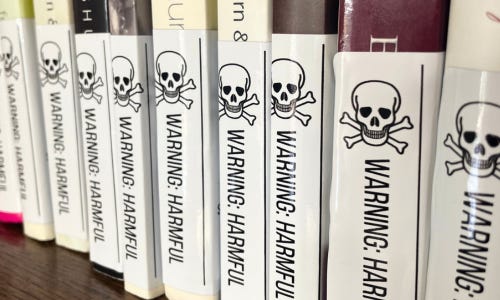
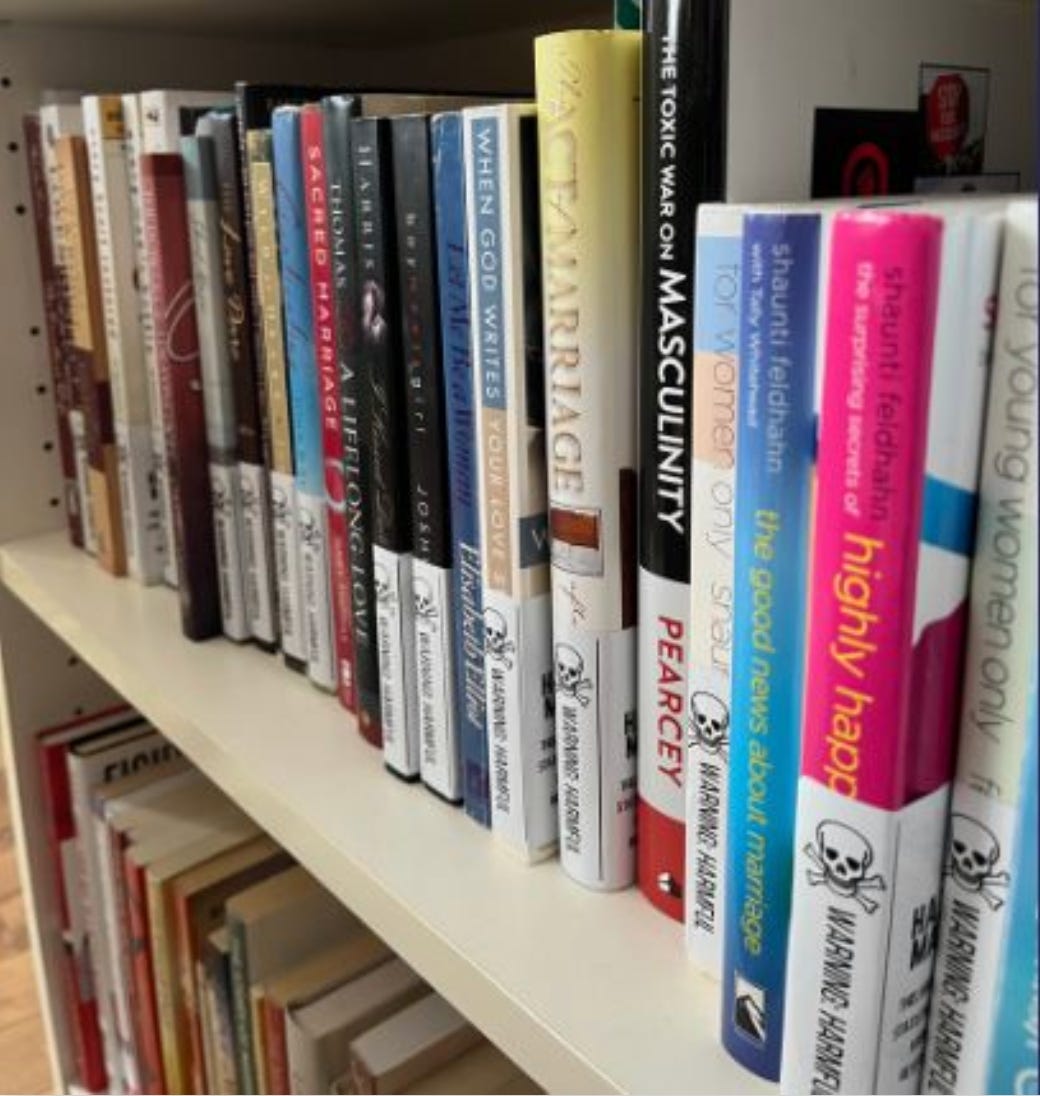
And if you want to drive home #3, we’ve got some great stickers!
Someone you know needs to see this post so they’ll become a church librarian! Share it so they’ll see it!
Volunteering to be the Church Librarian could be an amazing opportunity to get toxic books away from people in your church
Yes, church libraries can be really harmful.
But also: what a great opportunity to volunteer somewhere that can make a huge difference!
I’m constantly getting sent pics by people who work as church libraries, showing me what they’re getting rid of from their libraries—all the every man’s battle books; Love & Respect, all the Shaunti Feldhahn books or James Dobson books. Wouldn’t it be great to get those gone, once and for all?
And to put standards in place so the books never end up there again?
And think of the positive impact you can have if you start buying GOOD and heathy books for the library!
If you’re looking for a place to volunteer, consider the church library!
Here are a few great comments to motivate you:
I fill in at our church office from time to time. My husband and I have also had some candid conversations about your books with one of our pastors. I scanned the library while filling in last summer. I pulled out Love and Respect, Every Man’s Battle and a few others. I brought them to that pastor, he cringed, and then tossed them in his trash can.
When I was a teen, my parents volunteered to reorganize and repaint the church library. They gave me the job of going through the books. Clearly, no one ever threw anything away. I’m not sure someone even laid eyes on some of the stuff. Problematic doesn’t even begin to describe it. We corrected that and set up a labeling system as well.
I am the volunteer at our church. I will pull things I know to be harmful, but I can’t read everything first. (Most book are donated.) We have a disclaimer posted on the wall that everyone should read and discern for themselves. We do also have 2 special shelves: one for resources specifically recommended by our pastors and one for resources recommended by the librarian (me). This is how we highlight titles that are known to be good, or connect to a sermon series, or whatever.
Thanks to all who chimed in on Facebook! And now I’m excited to see all the new church library volunteers that will come out of this post!
If you haven’t subscribed to Bare Marriage yet, YOU SHOULD! It’s always free. Always evidence-based. Always healthy. But you can also support us monetarily, and help fund our research, academic papers, translation, and more!
Are you subscribed to Bare Marriage yet? What are you waiting for? It’s FREE! And always evidence-based and healthy too. But if you want to support us monetarily, that helps fund our research, academic papers, and translation efforts!
You may also find these helpful:
Our Great Sex Rescue toolkit, with printables about the effects of all the different toxic teachings we measured
Our Hazardous Materials stickers to put on toxic books you want to keep for research purposes!
Comments
Nothing yet. Say the first thing.
Sign in to join the conversation.