
In our 4 different studies of 40,000 people altogether, we’ve managed to put numbers to this. We know the harm that’s done when people internalize purity culture messaging, like “boys will push your sexual boundaries, so girls need to b the gatekeeper” or “girls should dress so they’re not stumbling blocks to girls around them.”
But the bestsellers of purity culture, even though purity culture has waned, still sell. And I think we need to have a wider conversation about the ethics of publishers continuing to publish books that we know do measurable harm. For instance, when girls internalize those modesty messages? They’re 52% more likely to experience sexual pain disorders, and 67% more likely to marry abusers.
This matters.
So today, I’d like to take a look at just one book so we can see the problem up close.
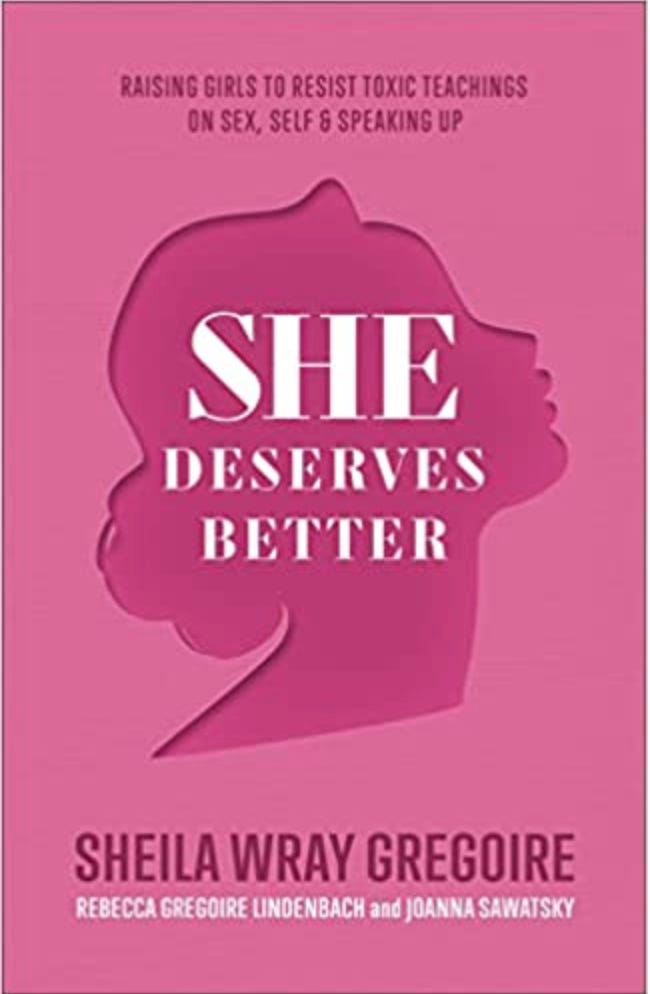
Eric and Leslie Ludy (who got together first when he was 21 and she was 16) wrote one of the “Bibles” of purity culture–When God Writes Your Love Story. We talked about it at length in our book She Deserves Better, and I want to focus on one specific passage.
It tells the story of 16-year-old Jason grooming and raping 12-year-old Rebecca, and then moves on to the story of Todd and Karly, both college-aged students who were in love and had consensual sex when they got carried away. What’s the commonality between these two stories? They’re both about “losing your virginity”, of course!
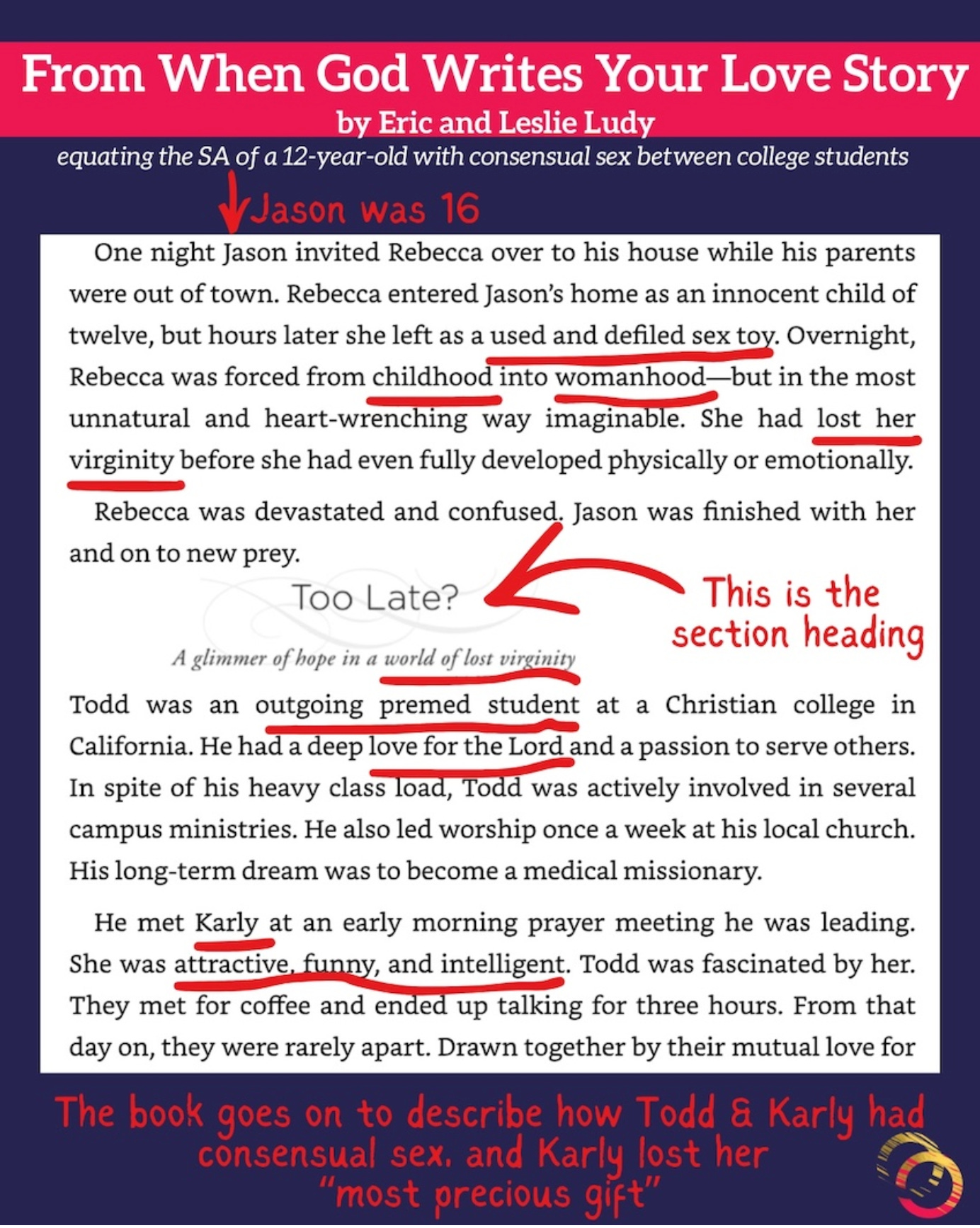
For further context, this chapter is about how you can deal with lost virginity, and how God loves you anyway and there’s redemption. (I guess we should be thankful they said that you’re not ruined for life, at least).
But it’s how they frame the problem of “lost virginity” which is so heinous.
Look at the words they use to tell Rebecca’s story: so much is in the passive voice. They don’t say that Jason attacked Rebecca; they say:
she “left as a used and defiled sex toy.”
she “lost her virginity”
she was forced from childhood into womanhood
Think about how else they could have told this story:
For months 16-year-old Jason had been deliberately grooming 12-year-old Rebecca. Rebecca felt flattered by the fact that Jason wanted to be her friend, and liked hanging out with him. One day, when his parents were away, he invited her over to his house, and she went.
There, he raped her. He brutally traumatized this child that he had deliberately deceived.
See what I mean? They could have told this story as being something that Jason deliberately did to Rebecca, to emphasize that sexual assault is only ever the rapist’s choice and action. But instead, they told it as if this was something that Rebecca just had happen to her.
They called her a “used and defiled sex toy.” They didn’t say that she FELT like she was used and defiled; they said she was.
They also said that she had gone from girlhood to womanhood–as if raping a girl makes her into a woman (does the act of rape make a boy into a man?). But let’s be clear what’s happening here: Rebecca wasn’t a woman because she was raped; Rebecca was a traumatized child.
They now hear, “I am a defiled sex toy.” They don’t hear “this boy did something heinous to you that caused you trauma”, they hear “this episode changed the very essence of who you are.”
The Ludys may think that they wrote this chapter to offer hope to those who “lost their virginity,” but their emphasis shows they understand absolutely nothing about trauma or the dynamics of sexual assault.
But that’s not the only thing they got wrong.
In the story of Todd and Karly, once they have sex, Todd moves on from Karly and is disgusted by what they’ve done. But Karly? She’s “lost her most precious gift.”
They don’t describe Todd as losing his most precious gift; they only describe Karly that way.
Now, let’s be clear: all biblical commands and admonitions around sex are given equally to men and women (at least in the time of Jesus and the epistle writers!). There is not a “this is holy for him” and “this is holy for her.” To say that she has lost something when he hasn’t has nothing to do with the Bible, and everything to do with American purity culture.
Someone you know needs validation that purity culture was awful! Share this so they’ll see it
We talked about this at length in She Deserves Better, and the male/female double standard and how harmful this is to sexual assault victims, besides the fact that our sexuality is not defined by one encounter, but rather by choices we make everyday. I don’t want to repeat that all here, but I’d encourage you to pick up She Deserves Better! It’s specifically written for moms of daughters, but I think most women who read it do so to reparent themselves, and find it very validating and healing.
Eric and Leslie Ludy wrote a highly problematic and traumatizing book that should never have been printed, and needs to be retracted now before it can do more damage to another generation.
Which leads me to the big question I wanted to ask today:
What should it look like for publishers? What should we do now?
Here’s how When God Writes Your Love Story ranks on Amazon right now:

For comparison, She Deserves Better is currently ranked 50,000, so this book is right now selling better on Amazon than our healthy alternative. This is actually quite a decent sales ranking, because I know the royalties that we make off of She Deserves Better.
That means that the author and the publisher are still making quite a bit of money from this book which traumatizes sexual assault victims.
And because they’re still making money, it’s very unlikely that the authors or publishers would willingly stop selling it.
Pretty much everyone agrees that purity cuture was either traumatizing, or at the very least went too far. This is quite widely acknowledged, and even pastors who still teach the very tenets of purity culture will tell you purity culture went too far (it’s hypocritical, yes).
So if we agree that it went too far, why are the books that sold purity culture to a generation still for sale? Why aren’t they being recalled?
Especially because, as our data from She Deserves Better shows, this does measurable and demonstrable harm to women long-term (and creates predators out of boys).
This book hurts people. It does not just spread a theology we know is wrong; it actively causes harm that we can measure.
Shouldn’t, then, the publisher of such a book bear ethical responsibility for taking it out of print? Yes, we know that publishers are allowed and encouraged to share books of all different viewpoints. But this is not just a case of a different viewpoint; this is a case of spreading messages that do long-term harm, making it more likely women will marry abusers; making it more likely women will suffer from sexual pain disorders; making it more likely that they will have long-term deleterious effects on their self-esteem.
But here’s the bind that evangelical publishers are in:
1. Most are publishing far healthier books today than in the past.
2. Their backlist is what allows them to still be profitable and take a risk on new books.
3. Much of the backlist that generates that profit is MAJOR TOXIC.
This particular publisher is Multnomah/Waterbrook (the same one that does all the Every Man’s Battle books). I know that the current editors would never publish When God Writes Your Love Story today. But I also know that the sales from When God Writes Your Love Story allow them to take the chance on newer and healthier books, most of which won’t earn back their advances. When a publisher takes a chance on a book, they never know if it will sell or not. And usually only a small proportion of books really take off, and they rely on these books that consistently sell to keep the company afloat.
What happens when the books that are keeping a publishing company afloat are actively harming people?
Here’s my opinion: Jesus compels us to do the right thing, and believe that God will honour that. It may mean the company goes under and something else grows instead. It may mean that this is the end of an era in Christian publishing. I do not believe that keeping companies afloat outweighs the harm that is being done by continuing to sell these toxic books.
This is not the fault of any one publisher; pretty much all of the big evangelical publishers had best-selling purity culture books. And it was because of these books that the messages took off.
Eric and Leslie Ludy even tell the story in this podcast that they had no intention of writing a book, but their publisher (Multnomah) approached them. Without the publisher, this book would never have been in print.
If they were responsible for that harm that was done, then they are also responsible to fix it.
It is a moral imperative. One cannot call oneself a Christian if one knowingly and willingly continues to do harm, as publishers do by continuing to sell books that we have now proven cause long term harm.
This was always our aim when we started our research projects–to show how these books and messages are harmful. We’ve done that. It’s now up to publishers to do the right thing. But I have no idea how to see that happen. So I’d like to know what you all think: How can we move forward here? Saying “boycott the bad publishers!” wouldn’t really work, because the good books are also published by these same publishers (Baker, who publishers our books, also publishes His Needs, Her Needs, for instance.) The good books that undermine purity culture are also published by the publishers of the purity culture books!
So what do we do? Tell me what you think in the comments!
Our peer reviewed article talking about how modesty messages increase the chance a girl will be assaulted/harassed in church and increase the chance boys will become predators
Our FREE video study that goes along with She Deserves Better
Our book The Great Sex Rescue which documents the harm done by messages about sex and marriage
Our podcast on the long-term effects of modesty messages
No posts
Comments
Nothing yet. Say the first thing.
Sign in to join the conversation.