
I feel like I’m taking crazy pills when I see all the noise around Christopher Nolan’s casting and aesthetic choices for The Odyssey… isn’t he the one director who has earned our trust? Not just because he revived the Batman franchise or turned a three-hour biopic about the father of the atomic bomb in a billion dollar hit — but because if you actually look at his filmography over the last 25 years, you realize every movie he’s made has been a rehearsal for this one: in theme, in narrative structure, in scale. His entire career has been building towards The Odyssey.

Every movie in Nolan’s filmography is essentially about the same struggle: lost men trying to get home, seeking peace. This theme can be physical or existential.
In Memento, Leonard’s search for home is psychological since he can’t remember anything.
The entire Dark Knight trilogy is Bruce Wayne trying to earn the right to stop being Batman so he can just live a normal life as Bruce Wayne.
Cobb needs one last dream heist before he can see his children again.
Cooper heads to the stars because he wants to save the planet for his children.
The soldiers at Dunkirk just want to survive long enough to return to England.
Even Oppenheimer is about a man who has mentally exiled himself through his own creation, another kind of curse, another impossible journey home.
And now, after 25 years and twelve films, Nolan is making a movie about the actual guy who can’t get home. The Odyssey is the original version of this story and Odysseus is the ultimate Nolan protagonist: he’s too clever for his own good, he thinks he can control every outcome, but he learns that hubris has consequences. You can’t outsmart the Gods, and Odysseus spends years paying for his mistakes as he tries to find his way home.
Nolan’s obsession with this theme might be personal. The man has spent his career making movies that take him across the world for years, away from his family. Maybe the theme isn’t just artistic, maybe it’s a confession of guilt.
But Nolan captures a very universal feeling with this focus on the journey home: we all want peace, we all have responsibilities that pull us in multiple directions, and it’s normal to feel conflicted about our choices along the way. It’s why The Odyssey has survived three thousand years… it doesn’t matter whether you’re fighting cyclopses, pulling temporal pincer movements, or traveling through a black hole, the quest for home is eternal and always relatable, and Nolan has been making that movie his entire life.
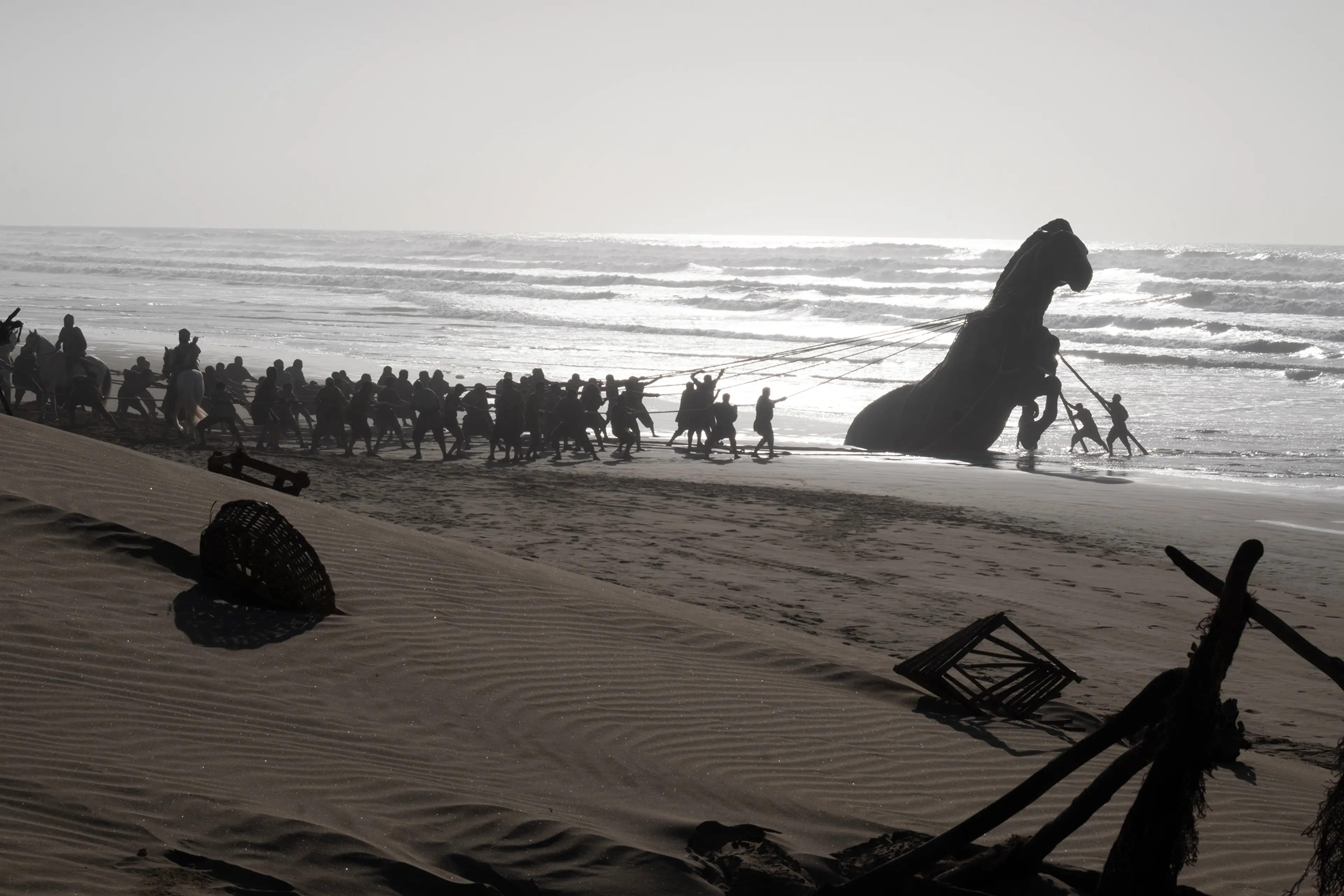
Nolan’s films are like puzzles, and his favorite tool for building these puzzles comes in the editing room as he plays and mixes with the timeline of his movies.
Memento tells its story backwards so that we can get in Leonard’s lost mental state.
The Prestige breaks across timelines because obsession warps time, showing us how the rivaling magicians lose track of what they were fighting for.
In Inception, Cobb’s grief is trapped under layers dreams, memory, and denial.
Dunkirk gives us one week, one day, one hour.
Even Oppenheimer, a biopic based on a book told completely linearly, layers multiple timelines with flashbacks and flash-forwards to make us feel the full weight of the ”most important fucking thing to ever happen in the history of the world”.
So we’ve been trained by now… we walk into a Nolan film ready to hold multiple timelines in our heads. Which is why The Odyssey feels like such an obvious choice for the director: the story starts in the middle, jumps to the end, loops back to the beginning, and picks up Telemachus’s story before we return to Odysseus.
For most directors, that type of fragmented narrative would be a challenge. For Nolan, it's the language he's been speaking his entire career.
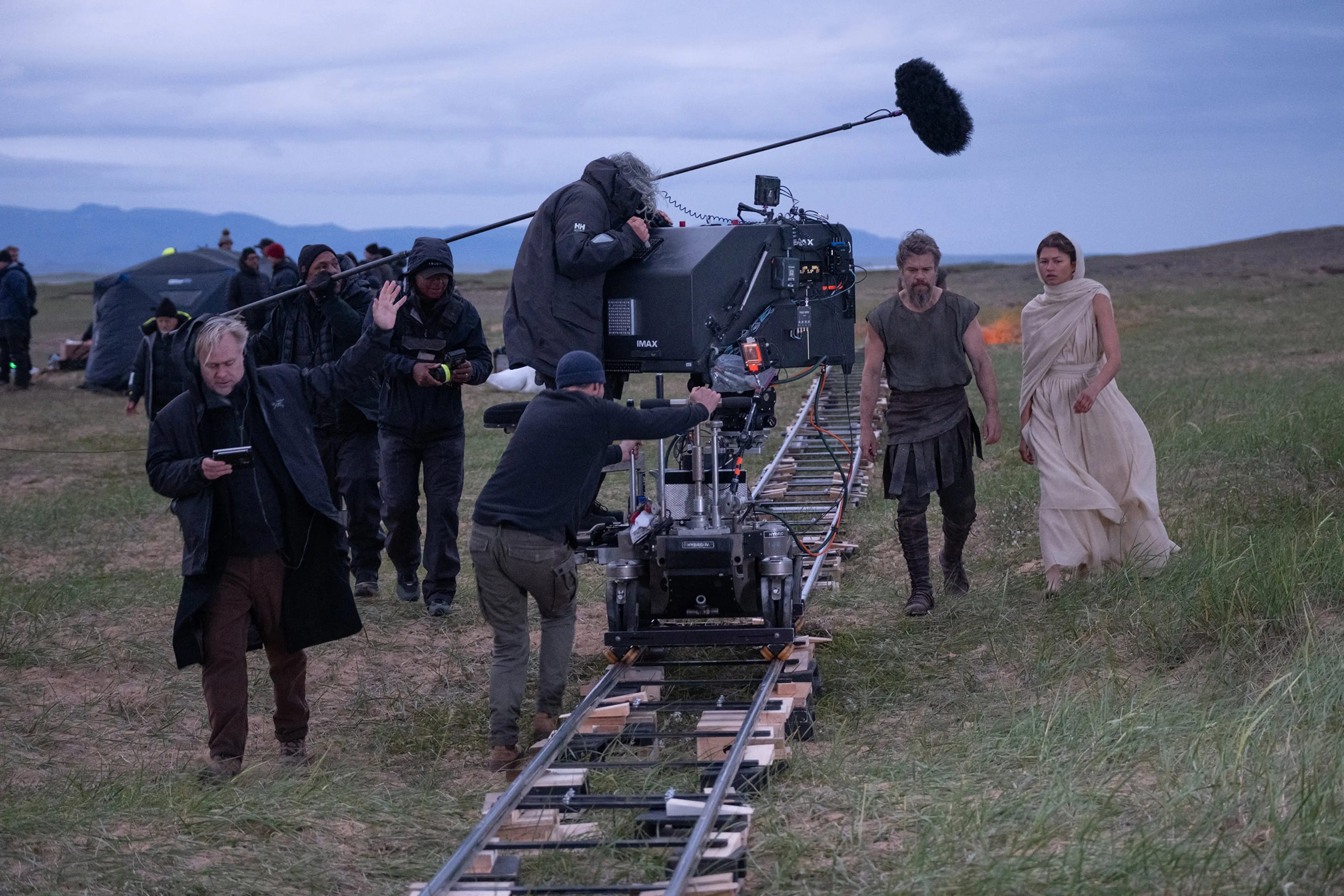
Nolan’s most visible trademark is his commitment to making the theatrical experience feel as real, as grand, and as visceral as possible. He knows audiences can feel the difference between practical effects and CGI, and he knows the best way to experience everything his films offer is through the biggest screen possible.
His obsession with practical effects started quietly and got louder as his budgets grew. By the time we got to Tenet, he was crashing real 747s just for fun. In Oppenheimer, he wanted audiences to feel the Trinity test, and so he used actual pyrotechnics and real explosives to film the atomic bomb detonation.
For a swords-and-sandals epic like The Odyssey, this matters more than it would in any other genre. The reason most of these genre films age poorly is because CGI armies, digital monsters, and green-screen landscapes show their seams. You know it’s fake, and the illusion collapses. Nolan, forever the magician, refuses to let that happen.
Scale also applies to his love affair with IMAX. It started with a handful of scenes in The Dark Knight, longer sequences in Interstellar, and then entire acts by the time we got to Dunkirk… each film pushing the format further, each one bringing new engineering solutions and new camera housings as he lobbied theaters to keep 70mm projection alive. Nolan didn’t just use IMAX, he rescued it, and now the entire industry is following his lead.
The Odyssey is a culmination of Nolan’s dedication to making things as real and tactile as possible: the cyclops = practical, the sea battles = practical, Jon Bernthal’s accent = also practical. And it’s all done on the largest scale possible, The Odyssey is the first film to be shot entirely in 70mm IMAX, from start to finish.
I love that Nolan is taking another big swing with The Odyssey… he could have played it safe after his Oscar coronation, but instead he’s jumping straight to the biggest film of his career. No palate cleanser, no side project, no break. Just: here’s the dream project, an adaptation of one of the oldest and most revered stories in Western literature. Cash in that blank check.
Which raises the obvious question: what does Nolan make after the movie that synthesizes his entire filmography? Does he start exploring new territory and ideas? Maybe a story with a linear narrative or something more intimate? Or does he just keep finding ways to go bigger? Which at this point feels impossible but I wouldn’t put it past him.
Regardless of what’s next, I’m hyped for July 17… Nolan is finally making the movie he’s been building towards his entire career: the themes, the time-fuckery, the obsessive commitment to scale. It was always going to be The Odyssey.
No posts
Comments
Nothing yet. Say the first thing.
Sign in to join the conversation.