
In the past few days Anthropic, the AI giant behind Claude, announced that it would be watermarking all content generated by Claude. Technically this is to comply with the European Union AI Act’s Transparency Code which took effect at the start of August. Interestingly, Anthropic is not just rolling this feature out for its EU users, but globally.
I haven’t found an official reason given by the company for doing so, but I would guess the issue of transparency probably played a part in its reasoning. Google has been doing something similar for years, especially with AI generated images, while Open AI (the makers of ChatGPT) has resisted pressure to allow text watermarking. Certainly, recruiters and teachers have been complaining for years now about the ubiquitous use of AI in job applications and homework. Claude deciding to watermark content signals a change, and widens the conversation about if and (let’s face it, much more likely) how AI should be used in writing.

It’s beyond the remit of this newsletter, and certainly of my expertise, to dwell more widely into the implications of this latest development, but on a personal level, I have been surprised at how much I’ve been using AI recently and it’s led me to wonder how much my readers care about if and how I use it in my writing (poll coming up so you can let me know).’
Just to be clear, I would never copy and paste AI writing and pass it off as my own. As a research tool however, AI has proved invaluable (though never as my only source. I double check the origin of the statement if there is one, or cross reference).
When it comes to very detailed and quite obscure research, especially across languages, AI has managed to unearth things that I’d never managed to find with Google.
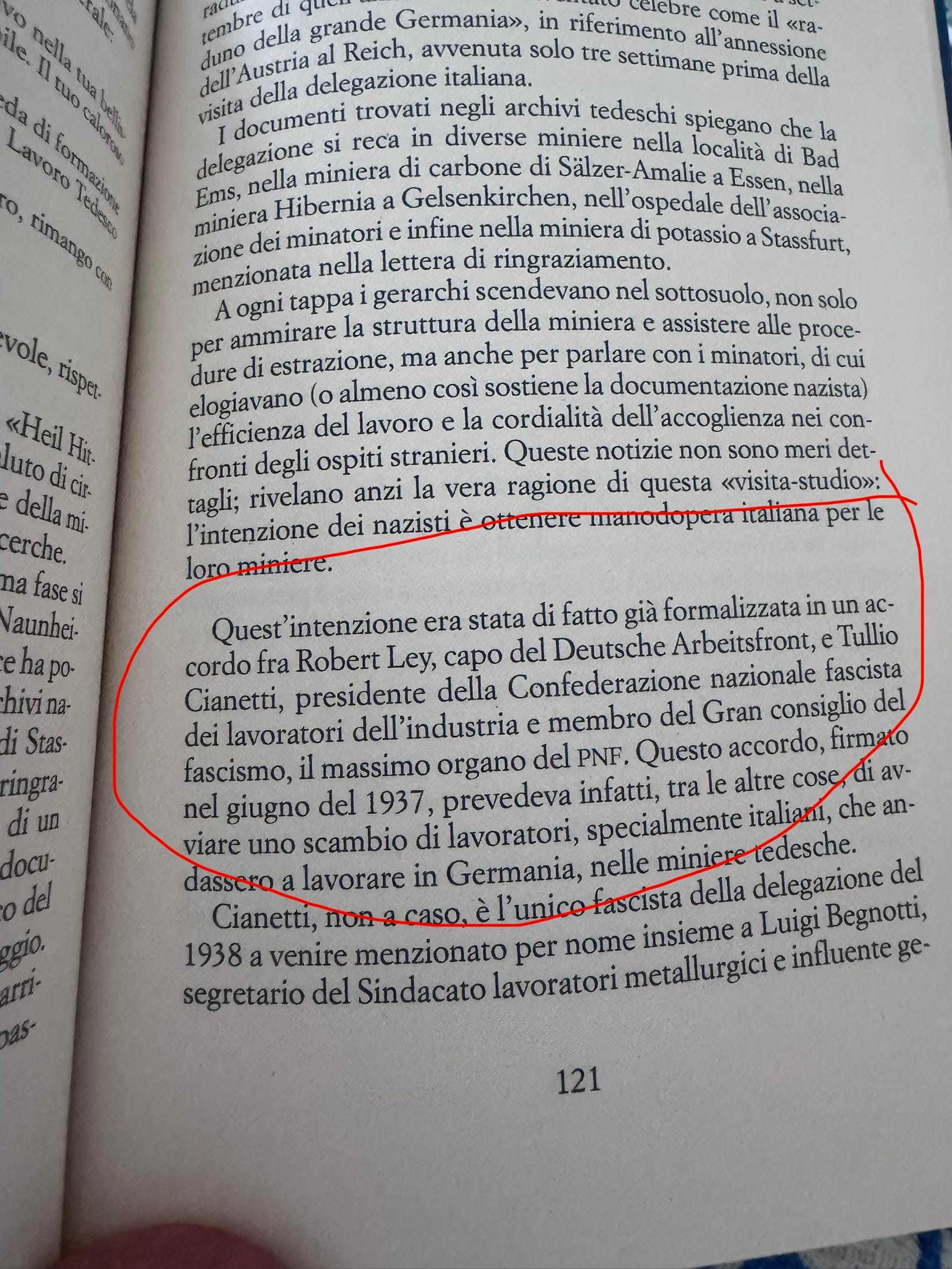
In my latest book ‘Fascismo in Famiglia’ (the story of my fascist grandfather, about whom you can read more here) I had to unearth the reason why my grandfather, who was mayor of a key mining town in Sardinia called Carbonia, went on an official visit to Nazi Germany in 1938, just a few months before racial laws were passed in Italy. In those years, Nazi Germany and Fascist Italy had already formed a diplomatic alliance referred to as the Rome-Berlin Axis in 1936, though the more binding Pact Of Steel, which pledged reciprocal military support, was signed years later, in May 1939.
These agreements didn’t really explain why someone like my grandfather, who only had a regional but not national role, would be visiting Germany in an official capacity. Endless Google searches of every variation of ‘Germany/Italy/Alliance/Coal/Carbonia’ only led to wild goose chases.
Enter ChatGPT. Obviously at this point I’m asking it very specific questions, giving names and dates that I knew were linked to the visit and after what must have been no more than 45 minutes I had my answer: In June 1937 a deal had been made between Robert Ley, of the Nazi Labour Front and Tullio Cianetti from the Grand Council of Fascism. The Nazis wanted Italian miners to work in Germany. Finally, the link to Carbonia. Bingo.
Italian speakers can BUY BOOK here
I have since moved on from ChatGPT to Claude and, like most people, now use AI as a thinking tool rather than just for research. And although I would never, EVER, churn out AI articles here or anywhere and pass it as my own work (also, I love writing, so why would I do that?) it has got me thinking about how AI might be influencing my work and whether/how much my readers care about it.
For this newsletter, I increasingly use AI to think things through, to test hypotheses, to find evidence for theories. It also allows me to access articles originally written in languages I don’t speak, which helps me analyse the different takes in languages that aren’t English.
The aim of ‘News with a Foreign Accent’ is very specific: Looking at the impact that using English as the global language has on so-called ‘international’ news. How much is lost in mistranslation, often of the cultural as well as linguistic kind?
It’s a pretty clear focus, one that is difficult to replicate because it’s based on my decades of experience as a non-native English speaker working as a prime-time news presenter in both Western and non-Western media.
So using AI doesn’t change the fact that it’s still my own work. My own hunches that I explore, based on my knowledge and near-unique lived experience that I like to think no AI can replicate.
It’s not just about journalism or linguistics, but about understanding of the state of mind of many second language English speakers, their/my insecurities around speaking in a non-native language and the EMOTIONAL side to the issue no machine can empathise with or second-guess. For now at least.
So, over to you, my trusted readers. Now that Anthropic has decided to watermark all writing created with AI, do you care if AI is used in the finished product? Would you want to know if it’s used for research, or corrections, or do you not care and just focus on the article as it lands in your inbox?
Please let me know by voting in the poll below. It’s a big issue, so would love to know your thoughts in the comments section.
Comments
Nothing yet. Say the first thing.
Sign in to join the conversation.