
0:00
-6:49
There is a saying, attributed regularly to the writer Maya Angelou which says, “you can’t know where you are going until you know where you have been.” I would equally add that you also cannot know who you really are until you know what you have been through, what you have experienced. And I think these concepts are true of us as individuals but also true of us collectively as a nation.
Some months ago, in preparation for interviewing writer Miriam Mulcahy at the Dalkey Book Festival, I read her second book ‘Walking to the Foot of the Sky’ which chronicles her walk along the Beara Breifne Way. This walk stretches from Dursey Island in far west Cork up to Blacklion in Cavan and marks the march of Domhnall Cam O Sullivan Beare in the winter of 1603. Cam O Sullivan Beare is regarded as the last of the great Gaelic Chieftains. I loved the book for its descriptions of landscape, for the authors occasional rants and opinions on various things and I loved it for the history. It has provided me with a kind of awakening of a new interest in the history of our country. Since reading it I have opened my eyes to things I have never wondered much about before – old walls, castles, and other marks our ancestors left on the landscape.
I have also become very aware that my knowledge of Irish history is somewhat sketchy. My version of Irish history runs like this:
800 years of colonisation during which time Cromwell arrived and made shit of the country, wreaking havoc in particular on Wexford and Drogheda, followed by Penal Laws which led to priests saying Mass in hedges using a nearby rock as an altar. Then came The Famine which wasn’t a famine but a genocide. Finally, there was 1916 and The War of Independence. All accurate… but after reading Miriam Mulcahy’s book, I realised there was much more to our story. I understood that (as my dear mother used often say) ‘there were large gaps in my education,’ such as who were the Gaelic chieftains and what else happened I should know about.
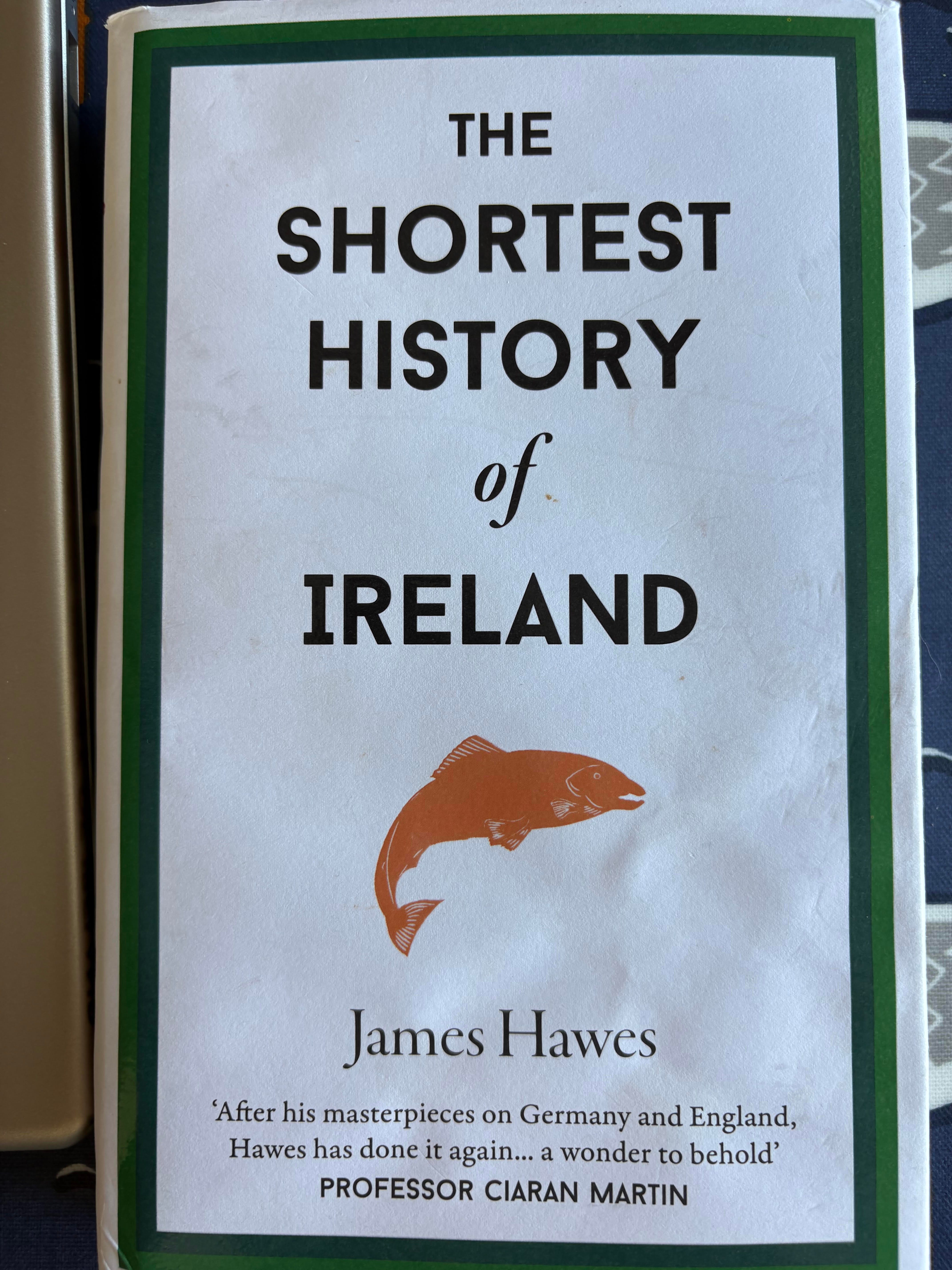
I am currently on holiday in my beloved West Cork and one of the many treats I indulge in while here is spending time and money in the lovely Bantry Bookshop and it was there that I picked up a copy of ‘The Shortest History of Ireland’ by historian James Hawes (who is also an acclaimed director of some very well-known TV series – such as Black Mirror and Slow Horses). Hawes had previously published The Shortest History of Germany and The Shortest History of England.
Once I saw the book, I remembered that I had heard him interviewed by Pat Kenny some months back and he was fascinating. So I figured that this book would fill in the gaps in my education around the history of this country I call home.
And boy did it deliver. It is a short book, and I devoured it in a matter of days. I know I will revisit it again because I feel there are probably some things I missed. But what I took away from the first reading is as follows.
The Catholic Church
I had bought into the often-repeated line that once Ireland gained independence from Britain, we just handed control of everything to the Catholic Church and whereas again that is true… it is only part of the story. What I learned from ‘The Shortest History of Ireland’ is that Catholic Church is another player in the fight for control of this country. Long before independence, the church (when it suited it) cooperated with England in order to gain power. Hawes points to the establishment of the seminary at Maynooth as an example of how England used the Catholic Church to retain control in Ireland. And the Catholic Church obliged.
And of course, the hold on education by the Catholic Church also played a huge role in the demise of the Irish language as it prioritised English. So just who was it serving? Not the people.
It’s power over the people allowed all the later scandals such as the cruelty in Industrial Schools, the abuse of children by religious orders, the mother and baby homes and Magdalen
Laundries to happen in plain sight.
I am so glad that we now live in a still spiritual but largely secular country.
Invasions and Assimilation.
Hawes repeatedly writes about the ‘magical’ (my word) ability of the Irish to assimilate invaders from Vikings to the Normans to the Planters – making them feel Irish and indeed become Irish. This aspect of the book reminded me of a sentence that I am sure many people of my age will have heard of in school, usually used in relation to survivors of the Spanish Armada which was wrecked around the west coast in the winter of 1588. And that is that “they became more Irish than the Irish themselves”. My mother also told me, on more than one occasion, that my brown eyes were probably as a result of Spanish blood back in my heritage. A fact that pleased me greatly at the time.
Ireland has always been at its heart European.
Again, most of us will have learned at school about the glory days of the Middle Ages when Ireland was the island of saints and scholars and when our monks brought their knowledge and culture to mainland Europe.
The fact that we were never part of the Roman Empire meant that after it’s collapse it was Ireland that played a huge role in restoring culture and learning in Europe.
Of course, during the long centuries of struggle to rid ourselves of the English, we repeatedly looked to Europe (Spain and France especially) for help which was often forthcoming although too often ended in disaster.
More recently our membership of the EU provided a huge stepping stone in getting us back on our feet after centuries of British rule.
Hope for the Future
The book finishes on a really hopeful note as Hawes outlines how he sees the best future unfolding for Ireland.
There is increasing talk of a United Ireland, indeed our current President made it one of the keystones of her Presidential Campaign and it was the one thing that made me uncomfortable. As someone who lived through, albeit at some distance away, and has clear memories of The Troubles in Northern Ireland, I think that a peaceful Ireland is a better idea than a United one.
But Hawes who feels that unification is inevitable due especially to changing demographics and he puts forward the idea of a federal country based on our four ancient provinces – Leinster, Munster, Connaught and Ulster. Decentralisation of power away from Dublin – which is itself a legacy of colonisation is vital he says.
In the end, this book hugely added to my knowledge of our history and ultimately provided a very hopeful ending. A united island based around our four ancient provinces… could that work? The last line of the book is “few countries have a brighter future.”
As he says – imagine that?
I cannot recommend this book highly enough. To know who we are as a nation and as a country we do indeed need to know where we have come from. The Short History of Ireland delivers this in spades and is an accessible, enjoyable, and fascinating way to discover the past without either rose tinted glasses or the soundtrack of sad victim music.
No posts
Comments
Nothing yet. Say the first thing.
Sign in to join the conversation.