
I blame Miriam Mulcahy (whose lovely book, A Walk to the Foot of the Sky I devoured) and my daughter Mia (who is a historian) for the fact that lately I have become more and more fascinated by history. I always had an interest, but it has become something bigger over this summer. I drive through villages and suddenly see old ruins and walls, signs for Famine Burial Grounds and other marks our ancestors have left all around us and I am filled with a hunger to know more. As I said in a recent newsletter – you can’t know where you are going till you know where you have come from.
I am lucky now to be able to spend more time in my beloved West Cork than ever before and this year during my various sojourns I have been absorbed by place names and the complete disconnect between the English and Irish versions. The English names are, more often than not, meaningless although sometimes kind of beguiling. But the Irish versions give us an insight into the landscape or the history and therefore are full of meaning. What is obvious is that many of the placenames in English are just a phonetic mangling of the original name. What I didn’t know (until I read the brilliant book, The Short History of Ireland by James Hawes) is that most of this mangling occurred at the same time.
Following the lovely monster, Oliver Cromwell’s adventures here in 1649 and the conquest that continued to 1653, Ireland was surveyed in great detail so that the land which had been confiscated from the Irish, could be valued and distributed to English soldiers and adventurers following the conquest. This survey which was the first ever detailed national survey in the world, was called The Down Survey. And it was this that let to so many placenames being not so much translated as merely converted from the Irish into a more manageable version for the colonisers.
For example I live in the Dublin suburb of Cabinteely – a name which means nothing at all. But as gaeilge Cabinteely is Caban tSile which means Sile’s (Sheila) Cabin, leading to the belief that there was once an inn at this important junction on the main route south out of Dublin. Knowing the Irish name gives my homeplace some sense of place, of history, of meaning.
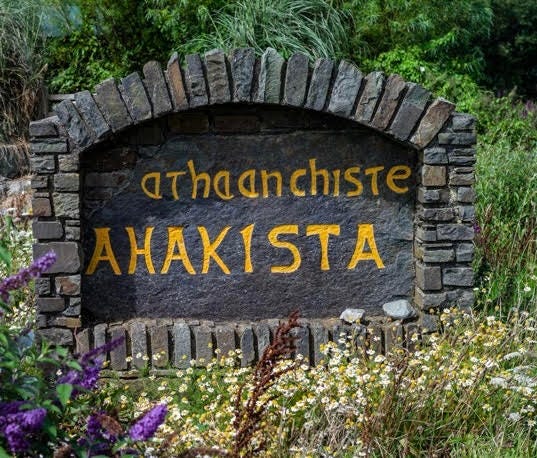
In West Cork I stay in a tiny hamlet called Ahakista which when I heard it first thought it had a real Carribean lilt to it. But it is another meaningless although attractive name until you read the Irish which is Atha an Chiste which means ‘ford of the treasure’ which clearly begs the question, what treasure? I will have to dig further to uncover that one… yeah… see what I did there?
Driving around West Cork there are lots more examples. One of my favourite villages is Ballydehob, which sounds charmingly Irish but ultimately is meaningless.. until you read the Irish which is Beal an Da Chab meaning the ‘mouth of two river fords’. Nearby Skibbereen also sounds beguiling but means nada until you read the Irish which is An Sciobairin meaning ‘little boat harbour’.
Driving back to Dublin delivers so many more examples. There is Fermoy which is Mainistir an Fhear Mai meaning ‘monastery of the Men of the Plain’, Kildare which is Kill Dara meaning ‘the church of the oak’, and Thurles which is Durlas meaning ‘strong fort’ to name just a few.
Nearer to home my nearest town is Dun Laoghaire which is in fact the original Irish name and was restored during the War of Independence in 1920. For the century before that it was Kingstown. The original name refers to the Dun (fort) of Laoghaire who was a 5th century high king of Ireland. The Kingstown moniker was granted to mark the visit of the British King George. It is interesting that most of us pronounce it incorrectly as Dunleary. My mother who was also from here used often say it correctly Dun Laoghaire… and I wonder if that was a legacy from my Grandfather who fought in the War of Independence and would have remembered when it was Kingstown. But I digress…
Anyway the point is this. Is it not time that we restore our native placenames as Gaeilge especially on signage? Why not reverse all the place names by giving the Irish prominence, followed by a direct translation so people understand the meaning and lastly give the butchered anglicised version (just so tourists don’t get lost completely)?
I think this is something we should do to honour our past, our landscapes and our history. And I am not alone. A new app has recently launched called Baile Beo which is reclaiming Irish placenames. To quote its founder David McGinn “once you realise that ‘Mainistir Eimhin’ means (Saint) Eimhin’s Monastery and Monasterevin doesn’t mean anything at all, then you start to notice that kind of thing on every road sign.” And that is exactly what has happened to me.
What is the place you live called?
No posts
Comments
Nothing yet. Say the first thing.
Sign in to join the conversation.