
In my last post, I wrote about agency drift: the gradual way control can shift away from us over time. In many cases, this does not happen through a dramatic loss of independence or a single disruptive event. It happens through accumulation. Small dependencies build up. Systems become more complex. Decisions are increasingly shaped by defaults, recommendations, and layers of mediation that sit between intention and action.
Recognizing that pattern is one thing. Noticing it in our own lives is harder.
Part of the difficulty is that agency is often framed too narrowly. We tend to reduce it to questions of independence or capability: What can I still do on my own? What tasks can I still complete?
Those questions matter, but they do not capture the whole picture.
A person may retain the ability and intent to act while losing access, pathways, or meaningful control over the process itself. In practice, agency depends not only on individual capability, but also on whether the surrounding environment still allows intention to become action.
That is what led me to start thinking about an “Agency Audit.”
This is not an assessment. It does not give you a score. It is simply a reflective lens.
The idea is simple: look more closely at the places where agency tends to strengthen, weaken, or quietly shift shape.
A few patterns appear repeatedly.
One is the gap between intent and action. You decide to do something, but multiple layers now sit between the decision and the outcome: interfaces, permissions, automated systems, institutional processes, or other people. Each layer may seem minor on its own, but together they can create significant distance between deciding and doing.
Another is over-helping. Support begins by extending our abilities, but sometimes evolves into replacing our role in the process itself. The important question is not whether support exists. The question is whether it still leaves room for participation, understanding, and choice.
A third pattern involves technology that gradually shifts from tool to substitute. Systems that once helped us carry out tasks increasingly anticipate, correct, recommend, or complete them for us. Over time, it can become less clear where our own judgment or contribution still resides.
None of these patterns are inherently negative. In many cases they are useful, necessary, or even empowering. The point is simply that they are places where drift can accumulate quietly.
One question seems especially useful for noticing this:
“If this system, tool, or support disappeared tomorrow, what would I still understand? What would I still be able to do?”
The goal is not self-sufficiency. Most of us rely on forms of support, coordination, and technology every day. The question is whether those supports are extending agency or gradually standing in for it.
To explore this more concretely, I put together a short Agency Audit reflection handout. It focuses on:
internal capacity
external support and scaffolding
the gap between intent and action
technology as tool versus substitute
patterns of friction, drift, and over-reliance
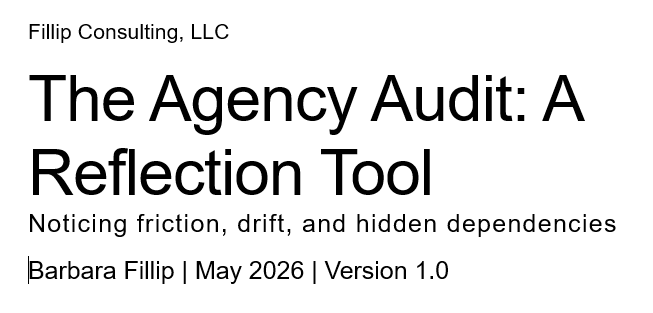
Access the document here.
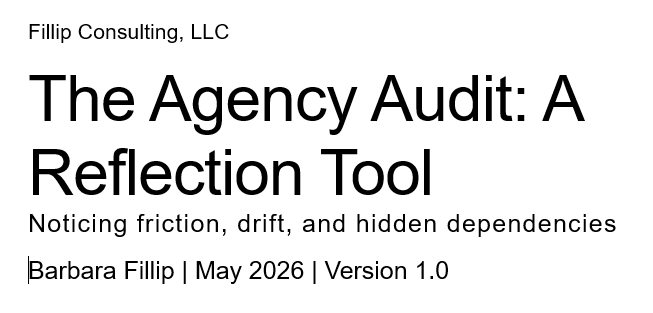
There is no scoring or grading involved. The purpose is simply to notice patterns that are otherwise easy to miss.
If you try it, I would suggest starting small. Pick one routine, one tool, or one area of daily life and follow the questions there.
The point of an agency audit is not to measure independence. It is to notice where intention, understanding, and action still align, and where they may slowly be drifting apart.
In the next post, I want to move from reflection to design. If agency can drift gradually through the systems around us, then the reverse is also true: environments, technologies, communities, and support structures can be intentionally designed to preserve participation, understanding, and self-direction over time.
Comments
Nothing yet. Say the first thing.
Sign in to join the conversation.