
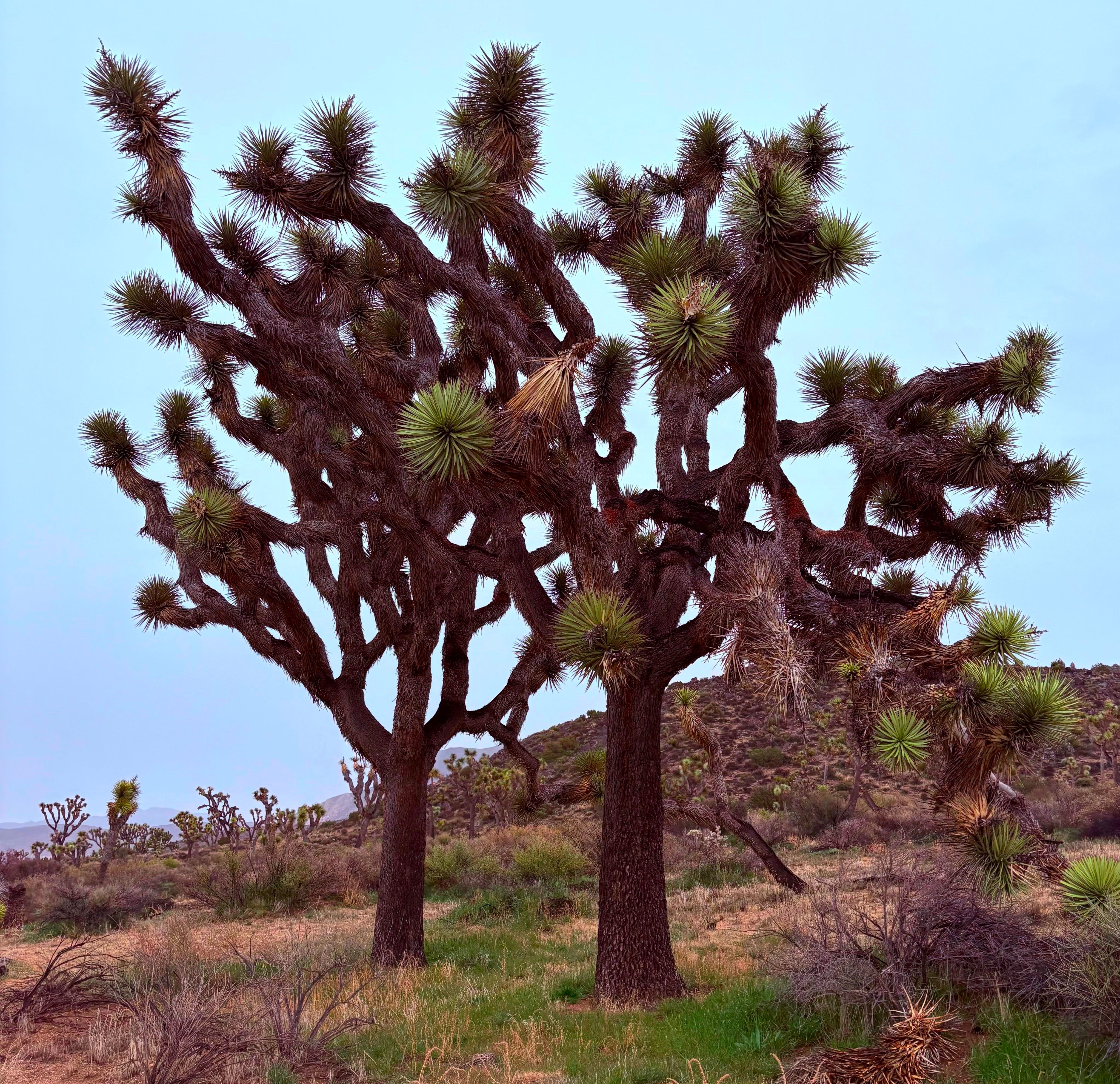
For the first time in a long time, I did not welcome the new year in the mountains of north Georgia but in the deserts of southern California—specifically, in the Mojave and Colorado deserts that meet in Joshua Tree National Park. The trip was a short one, just long enough to straddle the last day of 2025 and the first day of 2026, but since coming down to earth has been much on my mind this year, I was struck like a gong by the difference between coming down to the sand and cactus of a strange place instead of the familiar red dirt and hardwoods of home.
The high desert was so quiet. The birds were so few. I watched a dark hawk keep lookout from the top of a telephone pole for the better part of an hour without seeing anything move, until two black-tailed jackrabbits silently appeared and disappeared through the creosote bushes and prickly pear cactus below. There was no going barefoot in that desert. Sand stuck to everything it touched, and the last thing I wanted was a pad of spiny thorns piercing the bottom of my shoe. Mindful walking became a survival technique. After I brushed against a shining silver cholla cactus and yelped out loud from its bite, every low-growing shrub on the path ahead got my full attention from a careful six-inch margin of respect.
That must have been my initiation rite, since it caused the high desert spirit of the place to accept my presence and take me in. The quiet settled on my shoulders like a quilt. Two ravens winging across the wide sky gave me plenty to watch for a good long time. I tried to identify a smell, but all I could come up with was the absence of it: minerality, maybe, with the faint memory of rain. Yet even the thinness of the high-altitude air was a blessing, asking for deeper breaths coming in and longer ones going out. I was not home, but I was welcome.
In Roman times, there was a way of speaking about this. People who recognized that specific places had their own “feel”—their own history, meaning, and force of character—spoke of Genius Loci, the spirit of the place. Think of the Oracle of Delphi, Mount Sinai, Machu Picchu, or the Grand Canyon. Over and over, visitors drawn to these places say they were changed by being there, not because of the pictures they took or the postcards they sent home, but because the spirits of these places charged their own spirits in memorable ways.
The rise of Roman Christianity put a damper on the concept of Genius Loci, which sounded too off-the-hook for a monotheistic tradition, and posed a challenge to centralized Christian moral teachings as well. Who needed a gang of guardian spirits with distinct gifts when one Creator could care for everything while seated on a single throne? Yet there was no way to scrub scripture of stories about sacred caves, mountains, wells, and deserts where God did some of God’s best work, or to quell the human appetite for going on pilgrimage to such places for millennia to come.
What I learned in Joshua Tree (where more than three million people visit the national park every year) is that even the front yard of an Airbnb can express its spirit to a three-day visitor who will never forget the sand, the cactus, the hawk, the jackrabbits—or the fog that swallowed up the mountains on the morning I left, reinforcing my sense that the Genius Loci was really showing off.
By extension, I am fairly certain that you can sense the spirit of the place where you are right now, whether it’s in your own yard, on the roof of your apartment building, along the path you walk or run as often as you can, or a place you just like to sit and notice how well the earth holds you up without asking you to tense a single muscle to help.
If none of those rings a bell, maybe there’s a place out of the weather where you sense a certain presence that welcomes you inside. For some people, it’s the reading room at the public library or a cabin by the river; for others, it’s a great cathedral or a museum of fine art. Almost everyone I know can name a place in their own home where they feel most at home—most accompanied—even when there’s no one else around.
Who’s to say that’s not the genius of the place, just waiting to be noticed so it can share a charge with our sagging spirits, maybe top up the low batteries of our hearts? What if the places we’re drawn to aren’t empty landscapes waiting for us to bring meaning to them, but are holding bowls full of meaning for us until we arrive? If “genius” is too spooky for you, maybe you could try “angel”?
When I say things like this, I always tell people not to believe a word I say. Just check it out for yourself, and believe what happens next.
Thanks for reading Coming Down to Earth with Barbara Brown Taylor! Subscribe for free to receive new posts and support my work.
Comments
Nothing yet. Say the first thing.
Sign in to join the conversation.