
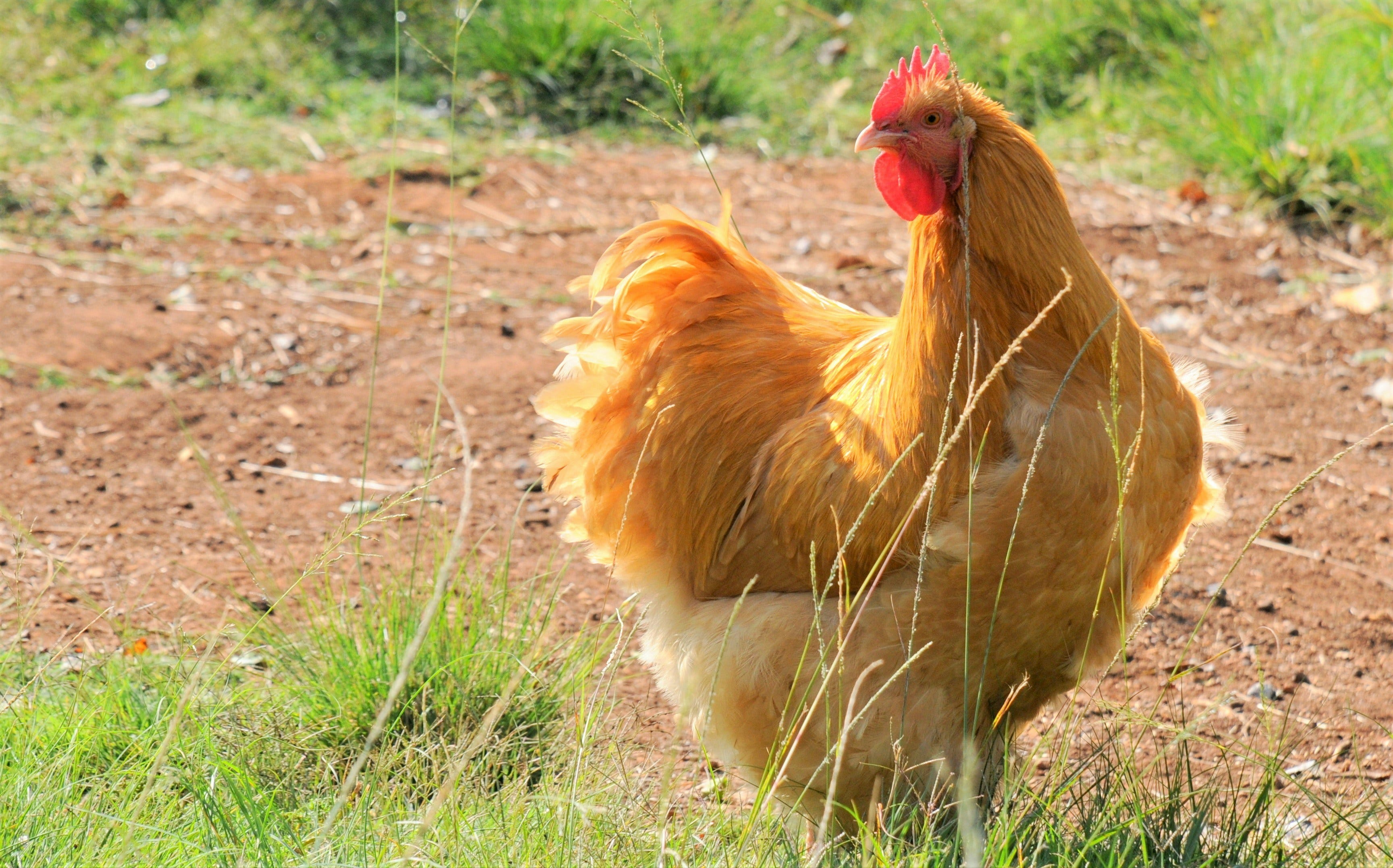
I lost my favorite hen yesterday. Three years ago, when I needed a few more chicks to fill out a new flock, the feed store only had three left. Two were speckled brown Ameraucanas sitting next to each other under a heat lamp. The third was a yellow chick in the cage below them, huddled in the back corner all by herself.
“What kind is she?” I asked the woman who was helping me. She reached into the cage all the way up to her shoulder and pulled out a cheeping gold ball of fluff.
“Buff Orpington,” she said, stroking its head with one finger. “The Golden Retriever of chickens.”
I took all three home in a cardboard box, then introduced them to the other chicks already in my coop. By the end of the day, they were all asleep under a rosy-red heat lamp, breathing in unison like coordinated swimmers so the pile rose and fell as one.
They stayed penned for close to twelve weeks, until their wings were fully feathered and they could reach a high perch. By then, the Buff Orpington was easy to distinguish from the rest, not only by her all-over gold feathers and her stockier build but also by her temperament. She was the first to come when I called the hens back to their coop at night, the first to let me pick her up, and the only one who seemed content to be carried around in the crook of my arm while I topped up the scratch feed and refilled the water. The other chickens didn’t have names because they were too hard to tell apart, but not her. Her name was Goldie.
When someone from the historical cemetery in town asked if I had a chicken with star power to serve as a live prop in a play, the invitation had Goldie’s name all over it. The play was a series of vignettes that brought some of the people buried in the cemetery back to life, including a local man who had been convicted of stealing chickens in the 1800s. The actor who played him wouldn’t have a speaking role. He would just sit at the entrance of the cemetery as people arrived, looking glum in his black-and-white prison stripes with a portable chicken pen on a table beside him. Goldie’s job was to peck at corn inside the pen for a couple of hours on two weekend nights, impressing people who noticed she wasn’t a stuffed animal but alive. It was an easy gig. Goldie got her picture in the paper and returned to her routine like none of it ever happened.
Day by day, the chickens enjoy their free-range life without venturing far from their coop. They hunt for bugs, forage under the compost bin, and take naps under the front porch of a small log cabin across the yard. Goldie worried me sometimes with her independence from the group. It wasn’t because they picked on her. She just got interested in things they weren’t interested in, and when they moved on, she stayed put. More than once, I had to help her over the paddock fence at night, since she was too big to get through the mesh and couldn’t find the little side door through which she had entered.
There have been nighttime chicken kills here before—by raccoon, by fox, by owl—usually because someone forgot to close the coop at night. With extra vigilance, that hasn’t happened in years. The daytime kills are almost impossible to prevent. Most come hard and fast from the sky, when a hawk drops on a chicken like a dumbbell with talons. All that’s left is an explosion of feathers, everything else lifted away on strong wings.
At this point, you’ll want to know why I let the chickens out at all, which is a good question. The answer is that life in a chicken pen doesn’t look to me like a fair trade for safety. There’s nothing green growing in there. All of the food is dead. There’s nothing to chase, dig, snatch, or cackle to the others to come see. There’s no special spot in the sun for a dust bath, no cool spot under the porch for a nap. Keeping young chickens penned for even twelve weeks is hard for me, the reward being how fast they run into the world when I first open the door to let them out.
I also feel for the predators, most of whom don’t kill for fun. They kill to stay alive or feed their babies, which makes breeding season a dangerous time for any kind of prey.
None of that helped last night when I called the chickens home, and only six showed up. There have always been seven, with Goldie waddling at the back—or banging against the fence of the paddock for me to come get her out. I knew what had happened before I found the first explosion of gold feathers near the coop, with two more nearby. It had taken three to kill her. She was a big girl who always came home. When she didn’t, it was because she couldn’t.
If the hawk had taken one of the other chickens, I’d have said, “Oh, the rusty brown one,” or “the one with the stubby tail.” I’ll miss Goldie in a way I wouldn’t have missed the others, because she was an outlier. Her eggs were brown, not blue. She came when I called. She clucked when I held her. Losing favorites like her has happened so often (dogs, cats, llamas, horses) that I should be used to it by now, but I always forget the fine print at the bottom of the covenant: With this voluntary decision to love, I consent to mandatory loss.
My forgetfulness is a kind of gift. If I had to renew that agreement every day, I’d be seeings hawks on every branch. I might also be slower to name the things I love, in a fruitless bid to lessen my grief at their loss. So I walk this balance beam instead, between my wish for their fullness of life and my fear for their safety. It’s a hedged bet for sure, but when it works for a while, I turn forgetful, letting the pleasure outstrip the risk until the fear is way off in the woods somewhere. Is this a blessing? I believe it is—to open the door to all there is to love and let the loss surprise me (again!) when it ends in a halo of feathers.
Give me a couple of days, and I’ll be ready to do it all over, since the only cure for lost love is more love, as long as we all shall live.
Thanks for reading Coming Down to Earth with Barbara Brown Taylor! Subscribe for free to receive new posts and support my work.
Comments
Nothing yet. Say the first thing.
Sign in to join the conversation.