
When my husband Ed and I took a blueprint of our house to the top of the hill where we wanted to build, we had already agreed to work with the hill's topography and cut no trees, which narrowed our choices to two: turn the front of the house east to face the woods or turn it west to face Yonah Mountain. That decision took about ten seconds. The house would face west, with a different sunset over Yonah every night.
This left room behind the back porch for a good-sized flower garden and a substantial tree. After the house was finished, we put a winged elm in the tree spot and a 34-foot stone circle in the garden spot, dividing the circle into four quadrants. Two of them would become shade gardens as the tree grew. The other two would stay in full sun. When friends came to visit, some saw a Celtic cross in the shape of the stone circle and some saw a Native American Medicine Wheel. I saw a lot of work, and I was right.
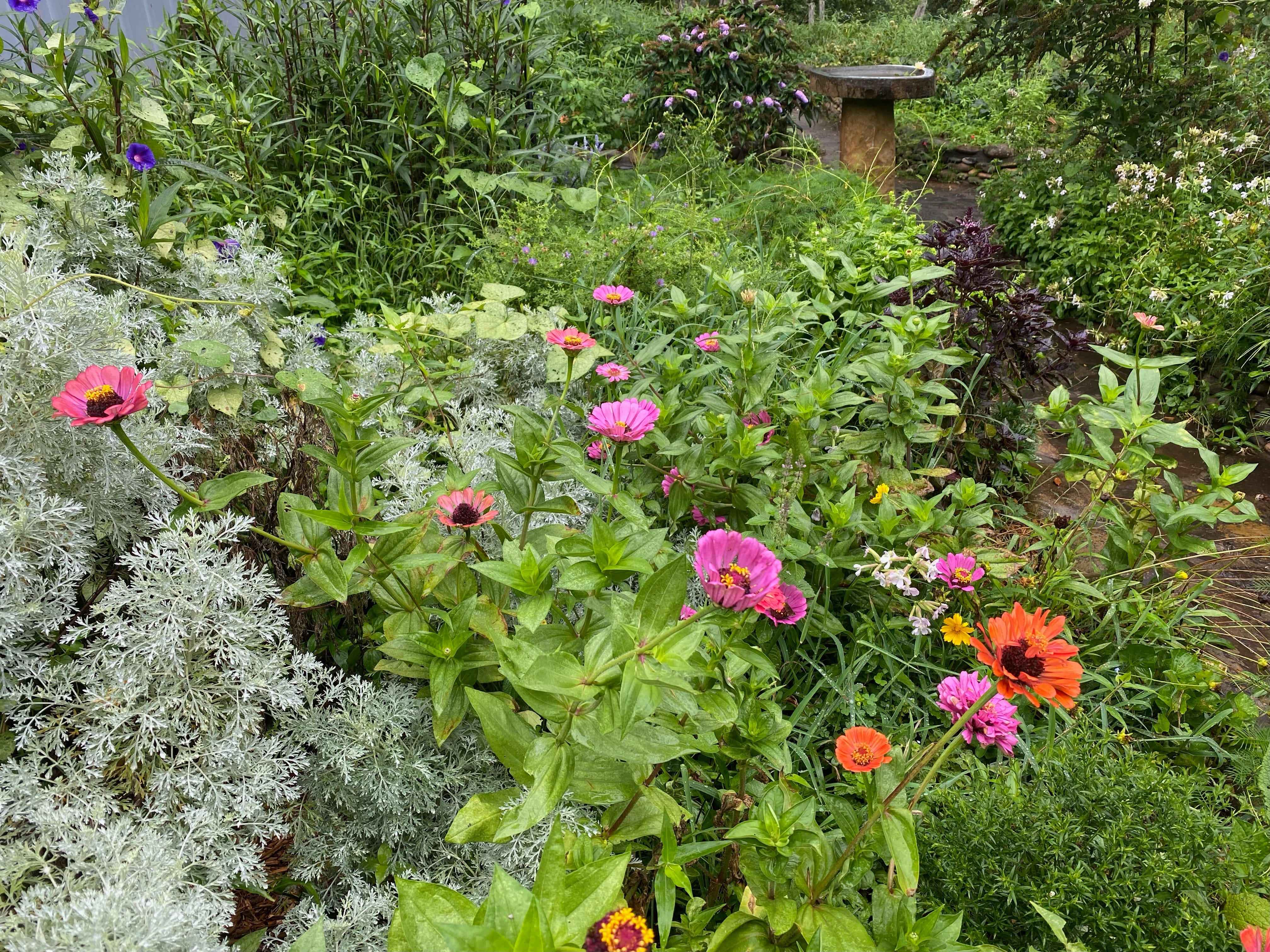
I have been planting, mulching, watering, and weeding that garden for more than thirty years now, without ever becoming the gardener of my dreams. I can identify zinnias, bee balms, coneflowers, and irises, but when people ask me the name of the cobalt blue flowers that grow close to the ground, or the fern-like vine covered with six-pointed red stars, I say, "Aren't they pretty? I don't remember their names." If there were a dating app for perennials, I'd have to identify as polyamorous (and forgetful).
I'm also soft on things I didn't plant, such as sunflowers that grow from bird droppings and lemony tickseed that blows in on the wind. This year, the garden produced one corn stalk, one squash plant, and three tomato plants without permission. There are also "weeds" I can't bear to uproot, such as blue-eyed grass and Queen Anne's lace, though I stay after the pigweed, nutsedge, horse nettle, and goose grass that will take over if left alone.
Georgia's record-high temperatures in July tested my resolve. Even when I braved the heat to weed, so much sweat pooled in my eyes that I couldn't see for more than a minute without mopping my face. So I stopped for three weeks, watching the opportunists grow taller than I had ever seen them. English roses disappeared under rogue grasses. Morning glory vines strangled last year's dahlia just as this year's buds began to show. Then the rain came! For one whole day!
Instead of waiting for it to stop, I took advantage of the 67° weather and weeded in rain that did not sting my eyes. All of the usual suspects came up in clumps, just as they had in late spring and before that in late fall of last year. It was like doing laundry. The weeding never stayed done, and still I kept doing it—tugging the garden back to my vision of it, over and over.
When I stepped back after a couple of hours to look at the muddy, tangled mess, I realized my stone circle wasn't a cross or a medicine wheel. It was a sand mandala, like the one I took college students to see in Atlanta once. The Tibetan monks had been working on it for several days when we visited, four of them in trademark robes tapping small metal tubes with rods so that colored sand came out of the tips in tiny veins. The monks laid these down with great precision, working eight hours a day on a sacred design that measured five full feet across. Just watching them made some of us hold our breath, afraid of sneezing a green grain into an orange area, or startling a monk who was just starting a new section.
We needn't have worried. Making the mandala was a form of meditation for them. They were pouring healing energy into it along with sand, and even when a line went down wonky, there was another monk with a scraper who edged it back where it was meant to be. If someone had wandered into the room by mistake, they might have thought they were watching four monks make a devotional work of art meant to last forever, never suspecting that the whole thing would be swept up at the end of the week and tipped into a body of water, so the energy in it could spread.
Both in its creation and its destruction, the mandala is an object lesson in the reality of impermanence. Though humans can't escape suffering in our lives, the Buddha said, we have the ability to dial the pain up or down depending on how willing we are to cede the fever dream of control. He didn't ask anyone to take his word on that. Try it, he said, and decide for yourself. How well is your resistance to change working for you? When you give yourself completely to what matters most in the present, does the meaning vanish when the future isn't what you hoped? Can you stop the world from spinning by braking hard enough?
Okay, okay, I say to my mandala while I'm trying to make the crooked straight again and yanking the weeds from my orderly designs—which have never been orderly, by the way, though my problems with them have certainly been perennial. Just for today, I'll pretend that having my hands in the dirt is enough, and that the energy I put into it matters more than what comes out.
I'll even grant that while the reality of my garden will never match the resplendent image in my head, it has at times surpassed that—not only in the plants I worked hard to put there, but also in the ones that just showed up—purple beautyberry shrubs out of nowhere, tomato plants that grew golden tear-shaped fruit where I meant tiny pink English daisies to be. Even those clingy morning glories, opening up at the start of every day no matter how bad things looked at bedtime last night.
I don't know what or where your mandala is, but you do, and the dharma is the same.
Thanks for reading Coming Down to Earth with Barbara Brown Taylor! Subscribe for free to receive new posts and support my work.
Comments
Nothing yet. Say the first thing.
Sign in to join the conversation.