
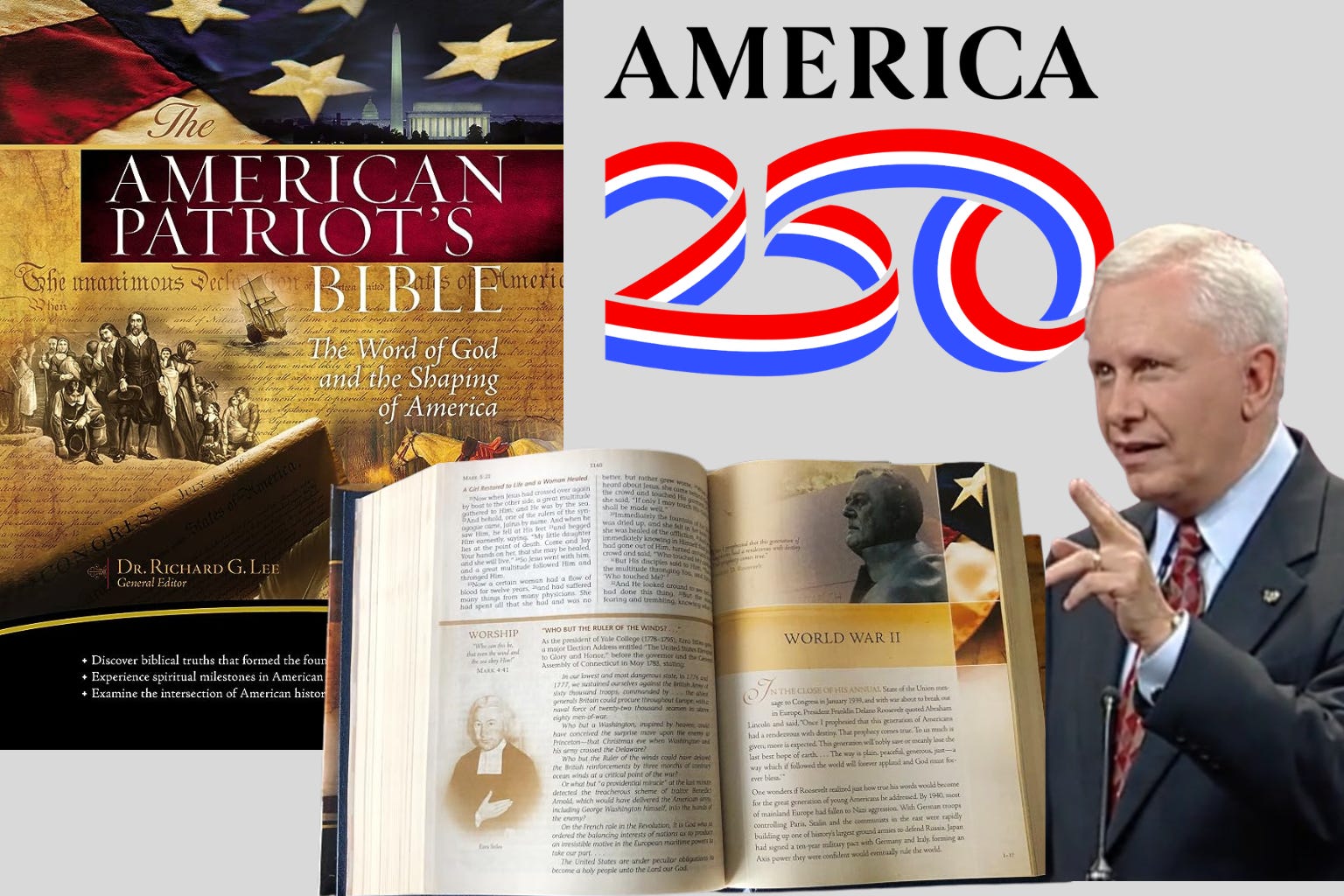
Long before there was Lee Greenwood’s God Bless the USA Bible, The American Patriot’s Bible was published in 2009 by Thomas Nelson.
What is unique about The American Patriot’s Bible wasn’t its footnotes, nor its translation (New King James Version). What was unique about the Bible were articles and stories vividly illustrating our country’s founding and history, and how God has guided and blessed our great nation.
A description of the Bible, which is available at Amazon and various other book sellers, reads: “This extremely unique Bible shows how the history of the United States connects the people and events of the Bible to our lives in a modern world. The story of the United States is wonderfully woven into the teachings of the Bible and includes a beautiful full-color family record section, memorable images from our nation’s history and hundreds of enlightening articles which complement the New King James Version Bible text.”
The Bible was the brainchild of Richard G. Lee, the founding pastor of First Redeemer Church in Cumming, Ga., and president of There’s Hope America ministries in metropolitan Atlanta. Lee served as general editor.
The first major article is from a sermon by Lee titled, “Seven Principles of the Judeo-Christian Ethic.” The sermon is available its entirety at SermonCentral.com.
In the sermon, Lee argues that America’s founding moral framework emerged from shared biblical convictions rooted in both the Hebrew Scriptures and the New Testament. He contends that the Founding Fathers, whether they were Christian or Deist, embraced these values as the essential foundation for law, government, and social order. These principles, he says, remain vital anchors in a culture increasingly shaped by pluralism and situational ethics. The seven principles are:
The Dignity of Human Life
Lee begins with the conviction that human life is sacred, citing “You shall not murder” (Ex. 20:13) and Jesus’ command to “love your neighbor as yourself” (Matt. 22:39). He emphasizes that the Declaration of Independence affirms the God‑given right to “life, liberty and the pursuit of happiness.” He warns that if a society fails to protect both the born and unborn, all other moral claims collapse because they are no longer grounded in the basic right to exist.
The Traditional Family
Lee asserts that the biblical pattern for family rooted in Genesis 2 is the backbone of social stability. He quotes the creation of Eve and the establishment of marriage: “Therefore a man shall leave his father and mother… and they shall become one flesh.” He argues that when society abandons God’s definition of marriage, the institution loses meaning and nations historically decline.
A National Work Ethic
Drawing from 2 Thessalonians 3:10, “If anyone will not work, neither shall he eat,” Lee describes America’s historic commitment to honest labor. He recounts how Americans overcame the Great Depression through shared perseverance and mutual support. This work ethic, he says, originated from biblical teaching and fueled the nation’s economic strength.
The Right to a God‑Centered Education
Lee argues that true knowledge begins with “the fear of the Lord” (Prov. 1:7). He highlights that early American universities such as Harvard and Yale were founded by Christians and originally aimed to train students to know God. He quotes Harvard’s early rule: “The main end of his life and studies is to know God and Jesus Christ which is eternal life.” He also cites George Washington’s warning that morality cannot flourish without religious principle.
The Abrahamic Covenant
Lee explains that God’s covenant with Abraham established a pattern: obedience brings blessing, disobedience brings judgment. He quotes Genesis 12: “I will bless those who bless you, and I will curse him who curses you.” He argues that America historically believed that righteousness exalts a nation, echoing Proverbs 14:34.
Common Decency
Lee describes America as a nation historically marked by compassion—feeding the poor, defending freedom abroad, and welcoming immigrants. He cites Emma Lazarus’s famous inscription on the Statue of Liberty: “Give me your tired, your poor, your huddled masses yearning to breathe free.”
Personal Accountability to God
Finally, Lee stresses that every person will stand before God in judgment (Heb. 9:27). He recounts Daniel Webster’s statement that his most sobering thought was “my personal accountability to God.” Lee concludes that America has been blessed not because it is special, but because many of its people historically honored biblical truth: “Blessed is the nation whose God is the Lord” (Ps. 33:12).
Other notable features included in the Bible are: 1) A map of the 50 states along with the year they were admitted to the Union, 2) A call to action for Americans to embrace and uphold biblical values, 3) The Bible and American Presidents, 4) Christianity and Colonial America, 5) The Great Awakenings, 6) The Bible and American Education, 7) Christianity and Equal Rights, and 8) The Bible and Famous Americans.
In “A Call to Action, Lee writes, “Let us bend our knees and humble our hearts and pray. Let us be willing to be used of God to help turn this great nation back to Him. Let us stand in the gap and make our lives to be salt and light in our families and neighborhoods and workplaces. God wants to come and bless us, forgive our sins and heal our nation.”
May God continue to richly bless the United States of America as we collectively celebrate 250 years of our nation’s founding and look ahead to a bright future of religious freedom and liberty under the His Lordship.
Thanks for reading! This post is public, so feel free to share it.
Comments
Nothing yet. Say the first thing.
Sign in to join the conversation.