
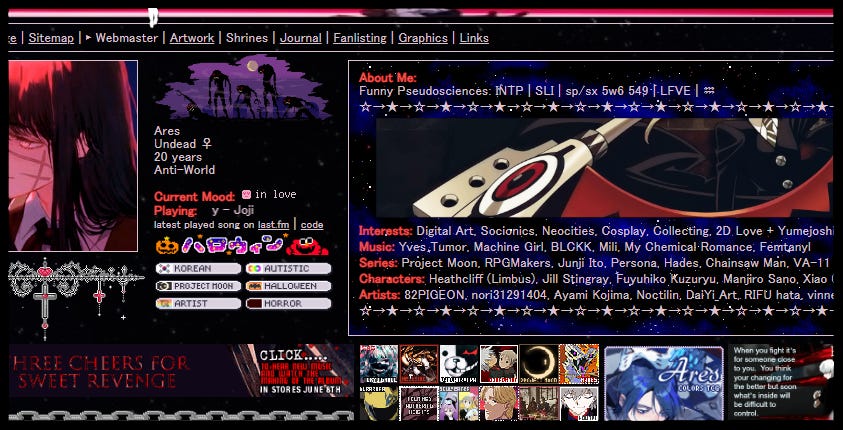
Once a week or so, I’ll visit Neocities and poke around the sites featured on its front page.
Sometimes it’s exciting to see the creative possibilities of web design realized in ways that commercial content sites and social media platforms have long ago lost interest in playing with. Sometimes I get a itchy sense of wholesomeness as I scroll through guestbooks again. Sometimes I’m refreshed to see people carving out online spaces for themselves where they can express their personalities and share their interests in forms that the cramped dimensions of social media don’t allow.
I am kind of in love with Neocities, but it’s a distant and melancholy love.
I don’t think it’s a scene I’m capable of joining at this point—though maybe I could talk myself into it?
What if—instead of doing whatever it is I think I’m doing here—I made a Neocities site with various subsections dedicated to X-Men comics, classic JRPGs, futurepop, crudely drawn web comics imagining Herman Melville and Hunter Thompson on a road trip, and blog posts about my life? Wouldn’t that be fun?!
Actually, scratch that. To all appearances, the people making Neocities sites today are largely the same people who made GeoCities sites thirty years ago: teenagers and younger twenty-somethings. I’d stand out like a rheumatic thumb. It’d be like someone my age going to the theater to see the Minecraft or Smurfs movie without a kid in tow. Very unseemly.
My social-worker sister tells me Gen Z has a penchant for pop culture artifacts (music, movies, TV, games, etc.) from decades past because, from what it can tell, the world was so much simpler and more manageable before their lifetimes. I can’t say that the people she’s spoken with or the discourse in which she dabbles provides her a wholly reliable window into the general mindset of an entire cohort—but the more time I spend looking at Neocities pages mimicking the typical design sensibilities and organization of Y2K websites, the more I’m willing to trust her on that point.
I almost wish I could say that visiting Neocities at my age is like checking out the local stop on the Warped Tour circa 2000 as a 1970s punk, or even like an elderly modernist poet hanging around with beatniks in the 1950s. There’s something bittersweet in the recognition that an old scene you were involved in has moved on—to revisit the alt-cultural garden you and your peers luxuriated in during the days of your youth (or in which you perhaps tended a smaller or larger plot of your own) and find it teeming with weird new growth, seeded and sculpted with the inexhaustible energy of a new generation.
Neocities does not inspire such feelings.
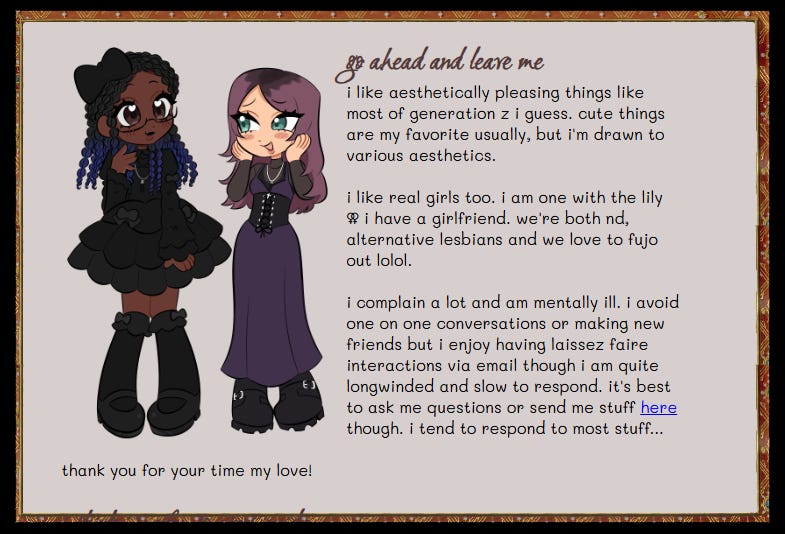
Consider the above image.
A lot of the “About Me” sections on Neocities pages read like alt historical fiction: what if the Xennial cohort making homepages during the Y2K era exhibited all of Gen Z’s stereotypical quirks regarding identity and communication? Or maybe: what if the internet’s landscape and architecture was locked in stasis for twenty-five years, and today’s adolescents weren’t on TikTok, but GeoCities (now with a trillion-dollar market cap)?
On the basis of what the cartoon webmistress and her girlfriend are wearing, I’m inclined to say Neocities is more like the former, evoking a timeline where early-adopter Xennials somehow acquired Gen Z’s preoccupations and compunctions. They are dressed exactly how goths dressed twenty-five years ago for a night at the club. (I’m pretty sure I used to own the boots the one on the right is wearing.) You could go back in time and drop the illustration onto a goth girl’s goth-girl GeoCities site in 2000, and nobody would guess it came from two and a half decades into the future.1
I am reminded once again of a friend who recently went on a rant about Gen Z fashions, accusing the whole cohort of an inability to invent. All they can do, she said, was copy and combine Millennial clothing styles. I recall telling her about those late-teenaged or early-twenties goth girls I encountered in passing a couple of years ago, dressed in black vinyl, black fishnets, and copious black eyeshadow, blasting K-pop from a portable speaker as they strode down the sidewalk on a hot summer afternoon.
I don’t want to sound like I’m critical of this particular site’s webmistress. I’m happy she’s doing her own thing. I’m happy to see anyone doing their thing in a space that isn’t owned by Mark Zuckerberg, Elon Musk, Alphabet, or ByteDance. And long may they thrive—long may they keep doing their own things, and long may people stumble upon and vibe with them.
But four times out of five, I get a sense of anachronism and the uncanny whenever I browse a Neocities page.
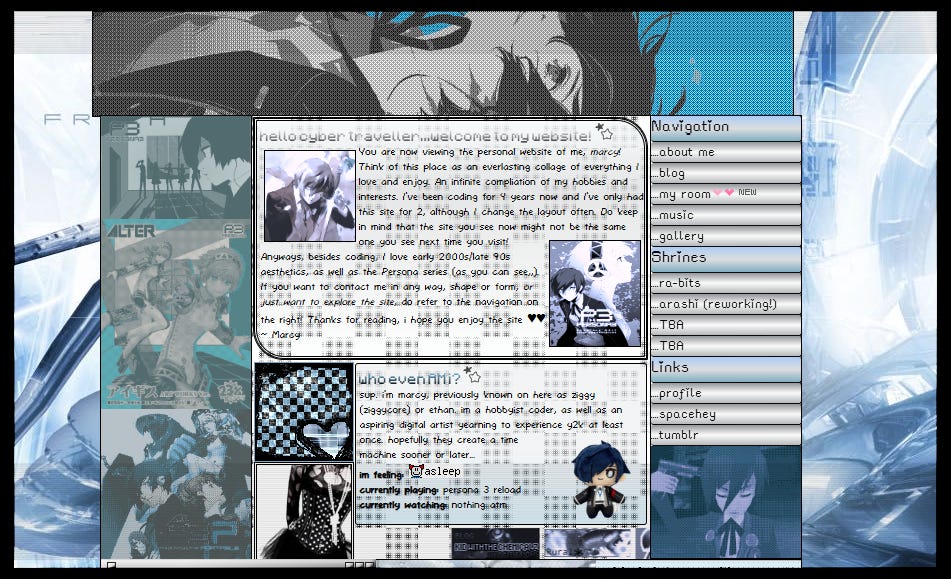
Even though the homepage era of the internet occurred when relatively few people were online (reminder: it wasn’t until about 2001 that even half of American households had internet access), anyone who was online at that time had a sense of being a privileged participant or witness to something new. For a hot minute, homepages were on the cutting edge. During those years you could say in all earnestness that the personal website stood at the intersection of culture and technology, and listeners might not groan and roll their eyes. It was exciting stuff, even if so much of it amounted to amateurishly designed vain nonsense and pop-cultural sperging.
Moreover, it had important downstream consequences. For about a decade, the homepage ecosystem was integral to the web. It was the nub from which the blogosphere, networked content sites, and the proto-platforms (say, LiveJournal and DeviantArt) and early internet celebrity blossomed. It conditioned, even if indirectly, the cultural and technical environments that Web 2.0 took root in.
But the Neocities scene is as representative of, and as of much consequence to, the contemporary internet landscape as off-the-grid homesteads are to the United States’ culture and economy. In the past, of course, the little prairie farm and the personal website each connoted something of a frontier—the former a national one, the latter a technological one. Both, mutatis mutandis, were indicative of expansion and growth. Now each is rather more like a luxury option for people of certain abilities and means.
Again—I don’t want to bash Neocities. But it’s a simulation.
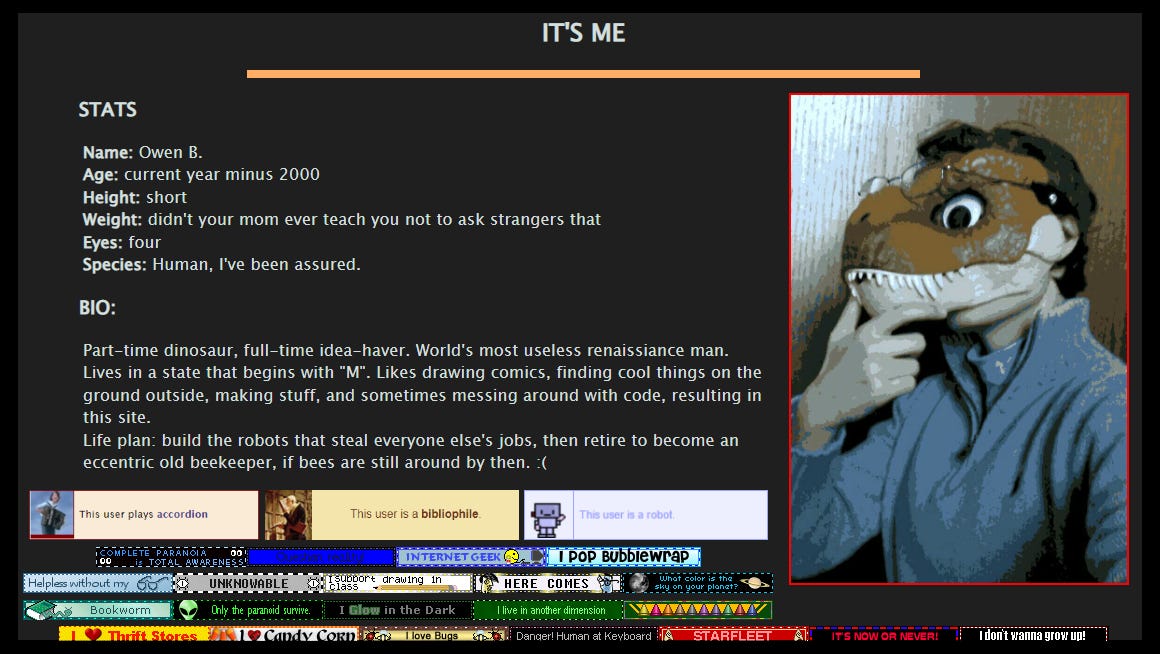
From the start, the world wide web was about communication: one made a website because they wanted to reach people via the internet, and there were few other means of doing so. Even before the social platforms seized a commanding share of the attention economy at the end of the aughts, the archetypal personal site of the nineties had long been on its way out, owing to the selective pressures of specialization, consolidation, and professionalization. Nobody was looking at them anymore. If you still had one at that point, it was like standing uneasily behind the cash register at Nathan’s in an empty mall food court on a Friday night. You couldn’t but be acutely aware that the public had moved on. The personal site died a natural death.
The experience of browsing Neocities calls to mind Gombrich’s remarks about the pre-Raphaelites in The Story of Art:
It is one thing to admire the naïve and unselfconscious outlook of the ‘primitives’ (as the painters of the fifteenth century were then oddly called); it is quite another thing to strive for it oneself. For this is the one virtue which the best will in the world cannot help us to attain…The longing of Victorian masters for innocence was too self-contradictory to succeed.
Most Neocities guestbooks I’ve seen evince how incompletely the platform’s culture replicates the “innocence” of the oldweb. Few visitors leave signatures unless they’ve got their own Neocities page to link back to, and the ingratiating notes of praise are too fulsome not to suggest an ulterior motive.2 The networking-as-way-of-life ethos, imprinted on us all by Web 2.0 (and the coterminous advanced-capitalism rot economy), can’t be overwritten by a structural retreat to outdated homepage staples.
Whenever I see a Neocities site convulsing with animated gifs (which is fairly frequently), the self-conscious artifice becomes obvious. Sometime during or after the Y2K era, everyone decided that animated gifs on websites were ugly and cringey. The gif became an indicator that a website either hadn’t been updated since like 1998, or was made and maintained by a digital bumpkin. Seeing them now bespeaks a false naivete, a desire to act out the ingenuousness of the fifteen-year-old Xennial who once plopped two dozen of them on their GeoCities frontpage because they didn’t know any better. Now it’s retro, and retro is always conscious of itself—especially when its exponents are too young to know the circumstances that informed the mindset of the people for whom today’s throwback once belonged to a living present.3
Many Neocities pages seem like a performance of willful pretending that Instagram, TikTok, Tumblr, Fandom, Substack, etc., don’t exist. They feign a rejection of the contemporary attention economy when they’re really just operating in an isolated and underheated pocket of it. Perhaps the Neocities webmaster protests the inability of the platforms to accommodate the range of self-expression they feel they require to convey themselves to a possible audience. Maybe they observe that the “ecology” of the Neocities reserve somewhat precludes the manipulative doomscroll prompts or the savage pile-ons endemic to the social apps (which they use, no doubt). But they must either be in denial of operating in an internet backwater, or acting in defiance of that awareness.
And, god damn it, I have to respect that. As an author of fiction—someone whose chosen genre has been completely occluded by every form of electronic media you can name—denial and defiance of the situation are the two poles I must constantly oscillate between in order to get anything done.
I don’t think I’ll ever be unable to see Neocities as a bizarre throwback to a reconstituted secondhand idea of the oldweb. But if it’s siphoning time and creative energy that might otherwise be dumped into TikTok or YouTube or Reddit, I’m willing to celebrate it. Even a small and partial retrieval of the “electronic zines & sandcastles” iteration of cyberspace feels like a gasp of fresh air at this late hour.
I distinctly remember browsing a GeoCities webpage where someone listed all the categories of goth, and designated herself a “perkygoff.” I’m not even going to bother trying to look for it on the Internet Archive. Here’s an artifact of such discourse, archived from a newsgroup.
I admit that I am making this inference from a limited sample. Controvert me, please.
I recently had a chat about the oldweb with a twenty-something software engineer. The music was very loud, so I’m not sure we were understanding each other, but it sounded like he had a quite distorted idea of what AIM (AOL Instant Messenger) was and what it did.
Comments
Nothing yet. Say the first thing.
Sign in to join the conversation.