
Ah, what the heck. Let’s overthink some Americana on the weekend of the United States’ semiquincentennial.
(ICYMI: Preamble, Part 1, Part 2, Part 3.)
In case you haven’t been here long, I assure you I don’t do stuff like this very often. This is an additive product of procrastination in the face of stress and angst.
My addlebrained fascination with the Eastern Roman Empire has tricked me into seeing a parallel between the histories of Byzantium and Marvel Comics. Because why not?
For Marvel, the late 1980s and early 1990s were the Justinianic conquests: a period of reckless expansion and overreach, impossible to sustain. The mid-to-late 1990s were the Byzantine dark age of the seventh and eighth centuries: a protracted fight for survival and stability in the wake of disaster.
The aughts, then, would be the Macedonian Dynasty: a season of recovery and efflorescence.
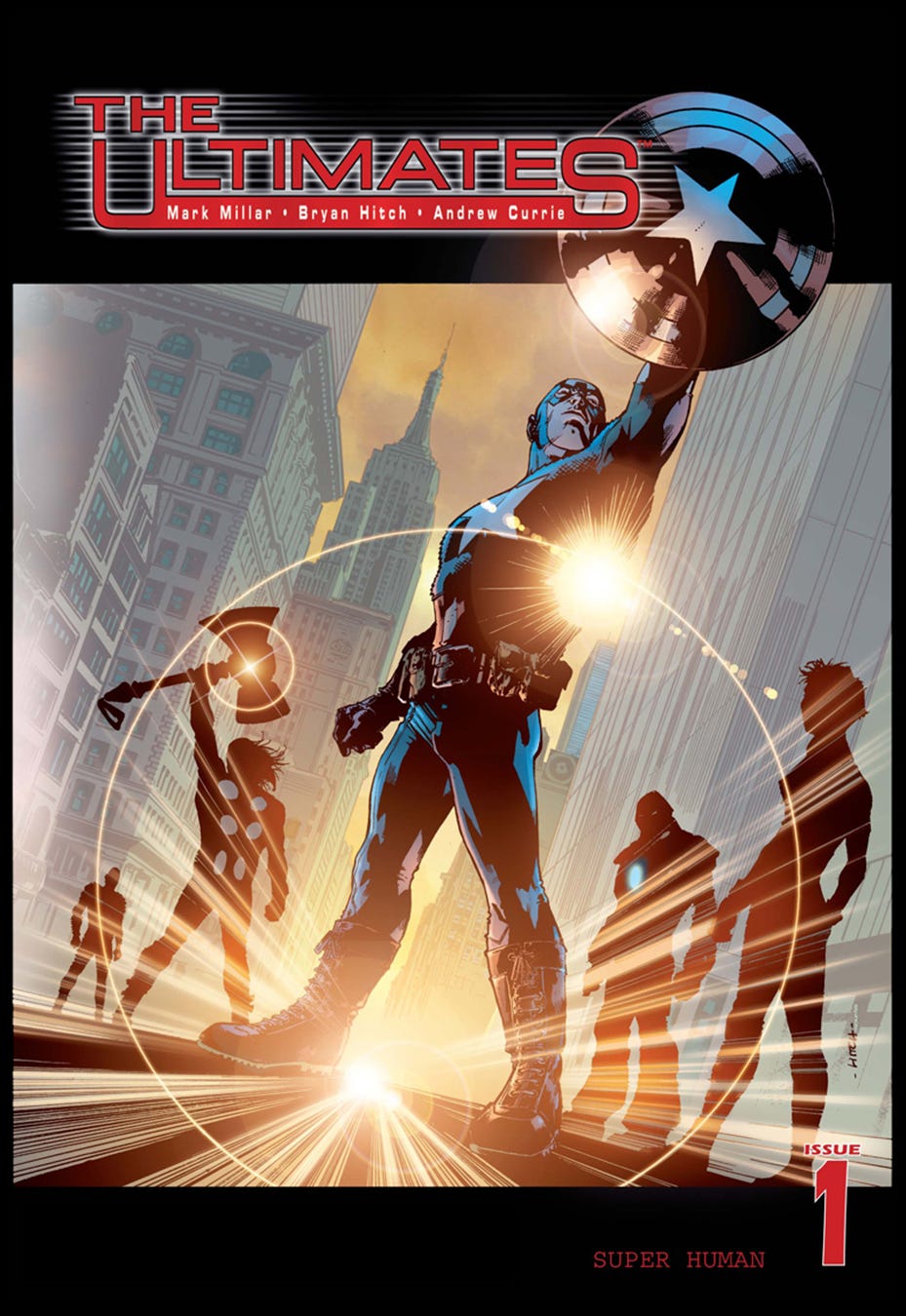
To elaborate on the metaphor: like Byzantium’s centuries of splendor, Marvel’s renaissance was coterminous with a transformation into something other than what it had been before. After its brush with death, the empire of the Romans evolved into something like a Greek-speaking Orthodox Christian nation-state with an Anatolian heartland. Marvel, similarly, broke from its origins as a mere purveyor of comic books. After the big crash of the 1990s, the company sold the film rights to its most popular characters/titles: Spider-Man and the X-Men. Whether this saved Marvel or merely sped its recovery depends on whom you ask, but there’s no question that the decision was a game-changer. By the early 2000s, the lingering stink left by the film Batman & Robin had dissipated; the first installments of Fox’s X-Men and Sony’s Spider-Man were popular with audiences and critics, and raked in hundreds of millions of box-office dollars. Wanting to get in on the action, Marvel moved towards developing feature-length adaptations of its IPs in-house. The first films in the Marvel Cinematic Universe—Iron Man and The Hulk, both released in 2008—hit theaters before Disney acquired Marvel Entertainment in 2009.
By the end of the aughts, Marvel’s heroes were well on their way towards conquering Hollywood—but its comics would never regain the pop-cultural clout they enjoyed during the 1980s and early 1990s.
There are a number of reasons for this—we’ll probe them more next time—but for now I’d like to point out that in 1980, the baseline price of a Mavel comic was 40 cents. By 2005, the price had increased to $2.25. Inflation alone doesn’t account for the difference, and neither does price gouging—at least not entirely. This stuff wasn’t printed with cheap inks on cheap paper and dropped onto newsstands, convenience stores’ spinner racks, and supermarkets’ magazine aisles as ephemeral impulse purchases for a mass audience anymore. The success of the Direct Market model (mentioned in Part 2) helped to transform comic books into a deluxe product sold in specialty stores and purchased by dedicated collectors and superfans who were glad to spend their money on glossy premium material.
I bought the first issue of Uncanny X-Men I ever owned at a gas station in Delaware for $1.25. By the end of the 1990s, this was no longer a typical point of entry into comic books.
What I’m getting at is that the time when virtually every boy between the ages of eight and sixteen in a given American suburb could be expected to own at least one issue of a Marvel or DC monthly came to an end during the aughts (if not the late 1990s). Superhero comics from the big publishers were growing increasingly difficult to access and jump into, and targeting older readers instead of kids with allowance money to spend.
Still—if you did happen to be into superhero comics during the aughts, you were having an excellent time of it.
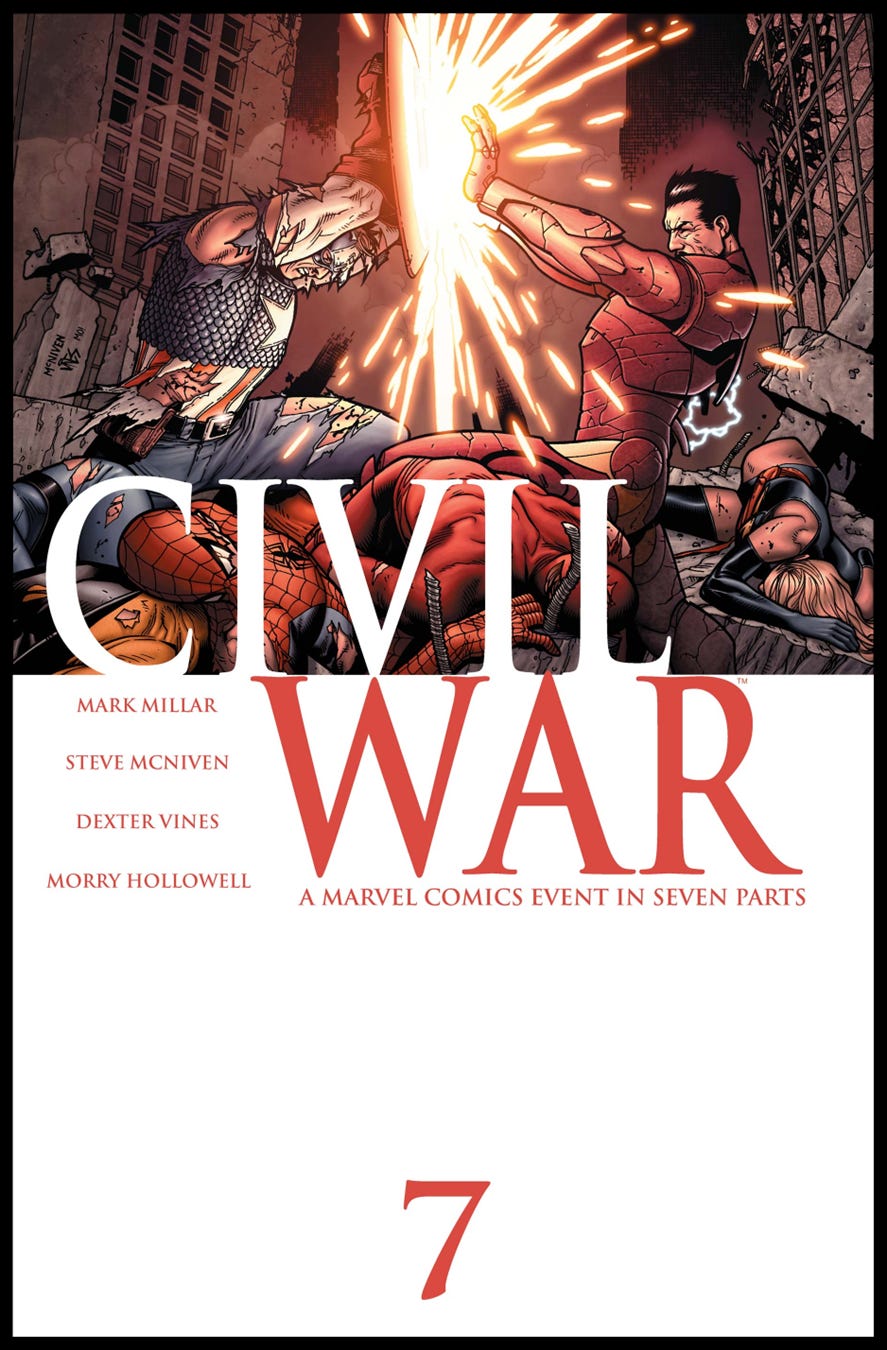
The Marvel renaissance of the 2000s also marked the birth of modern Marvel. Imagine your nephew, cousin, roommate, or whomever coming out of the theater after seeing Iron Man 3 or Avengers: Infinity War in the 2010s, thirsty for more. To the bookstore or comic shop they went, looking to absorb some of the source material. Odds are, most of the Captain America, Iron Man, Hulk, Thor, or Avengers comics published between 1960 and 2000 (roughly) would have come across as weird to them—and not just because of all the unfamiliar characters, story arcs, and costume designs they’d encounter. Totally different authorial and aesthetic sensibilities guided the comic books of the twentieth century. If, however, you put a New Avengers trade paperback from the mid-2000s in their hands, it’d probably be much more to their taste. During the aughts, Marvel Comics became the version of itself that got adapted for the big screen.
Marvel’s early-aughts revival began with the ousting of editor-in-chief Bob Harras. He had been given the job in 1995, based on the success of the X-Books—even though anyone who was paying attention recognized that his installment as their editor in 1988 marked the point where they began their long-term turn for the worse, and that comics with an “X” in their titles continued to sell in spite of his (mis)management, not because of it. In 2000, it seems his corporate overlords finally wised up and replaced him with Joe Quesada.
If you’re familiar with X-Factor #87, of Peter David’s first run—singular enough that elder nerds often cite it as one of the all-time best individual issues of any superhero comic—then you’ve seen Quesada’s artwork. During the wobbly years of the late 1990s, he oversaw the Marvel Knights imprint. Its good sales and good press stood in such sharp contrast to everything else the company was publishing that Quesada was entrusted with the keys to the kingdom in August 2000 and asked to improve its fortunes.
According to crusty old fan David Harth, the main asset Quesada brought to Marvel was an eye for authorial talent:
Joe Quesada had one goal in mind when he took over Marvel — fix the Marvel Universe. Despite some great sales in the ’90s, most of Marvel’s most important characters were in very bad places. Quesada was able to inject new blood into Marvel, bringing in creators like Brian Michael Bendis, Grant Morrison, Mark Millar, Garth Ennis, Steve Dillon, J. Michael Straczynski, Ed Brubaker, Greg Rucka, Greg Pak, Kieron Gillen, Jason Aaron, Matt Fraction, Rick Remender, Jonathan Hickman, and many, many more to revitalize their comics. Marvel under Quesada was all about pushing Marvel forward, and there are a lot of examples of that. The Marvel Universe was a very exciting place in the ’00s, with a top down control of the publisher — Marvel editorial taking a very strong hand with the stories and creating narratives across the line — that made Marvel into a special publisher.
Bolds mine—and what that bit meant, in effect, was that the EVENT cycle came back in a big way after a period of dormancy in the late 1990s and early 2000s. We don’t need to delve into any specific story details, but here’s how it worked in outline: after some months of build-up, there would be a huge editorially mandated and coordinated story that drew in a bunch of different characters from a bunch of different titles. The main chapters would appear in a limited series (typically running at least six issues), while a number of other special limited series, one-offs, and issues of the regular monthlies provided supplemental material and side-stories.
Two new factors made this different from the EVENTS of yesteryear. The first was the sheer scale of these things. According to Comic Book Reading Orders, the die-hard completionist would have had to buy thirty-nine issues of various series to get all the content of 1989’s huge Inferno EVENT (although the main act(s) in the X-Books amounted to sixteen issues). The colossal Onslaught EVENT of 1996? Fifty-eight issues. In 2006–2007, the Civil War EVENT spanned one hundred thirty-two issues. Granted, you only had to read the seven-issue limited series to get the core story, but the real gimmick of the thing was that it affected everybody in one way or another. The new EVENTS promised ramifications for the big picture. Things didn’t go back to normal once the dust settled, and the consequences were never limited to one or two characters dying, another character getting a new look, a superhero couple breaking up, etc., etc.
Secondly, these new EVENTS didn’t suck. The editors and writers got smart about planning and executing these things. Nobody wanted a repeat of Onslaught, The Clone Saga, or The Twelve. House of M, Civil War, Secret Invasion, and World War Hulk were cash grabs, sure—that’s always the ultimate point here—but they could be quite effective at fomenting a “shut up and take my money!” mood among loyal fans, and to this day, older readers usually aren’t as dismissive of them as they are of the EVENTS of the 1990s (or the 2010s, for that matter).
This also meant, however, that writers on fairly popular titles were never completely at liberty to tell the stories they wished to tell. More on this in a minute.
Harth is of the opinion that the successful reinvention of Marvel by way of top-down editorial dictation made the editors overconfident:
[H]ubris became a hallmark of Marvel. Fans complaining about editorial decisions? Make editorial even more powerful. Fans tired of the event cycle? Diversify it across the line, so there’s not only a big event, but multiple smaller events across the line. Reboot everything. The ’00s at Marvel were great, but they aren’t as great as people like to think. So many things that fans complain about right now [in 2025] have their beginnings in the ’00s … and those problems intensified over the years as general comic sales fell and Marvel scrambled to get readers back.
I’ll say it now and I’ll be saying it again: I am not looking forward to writing up the 2010s.
Moving on: this was a busy decade for the X-Books. I will try my best to keep things short.
Last time, we glanced at the Revolution and Counter-X initiatives of 2000, which attempted to jostle the X-Books out of their post-Age of Apocalypse malaise. After Bob Harras got the boot, the new management put the kibosh on the experiment and resorted to Plan B: stealing an idea from Marvel’s main rival.
When DC Comics tapped Grant Morrison to revitalize the Justice League in 1996, the newly launched JLA series became the most exciting superhero monthly on the shelf practically overnight. In his golden years, Morrison had an incredible facility for stripping classic but worn-out superhero properties down to their core elements—who the characters were, what their stories were about, and what made them interesting—and juicing them with smart and savvy writing, high-stakes intensity, and a voluminous dollop of weirdness.
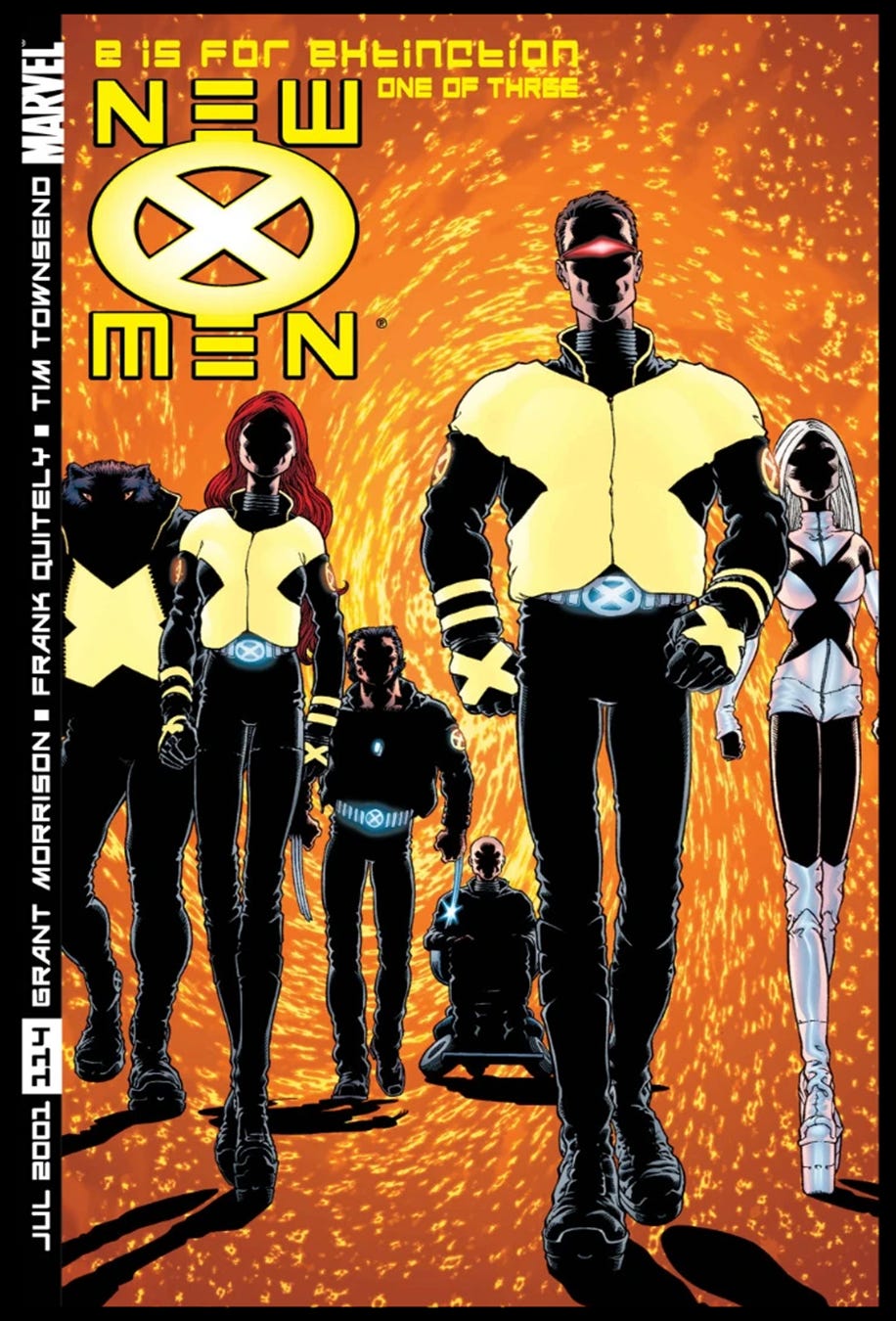
In 2001, a change of title inaugurated Morrison’s run on Adjectiveless X-Men. Now the book was called New X-Men, and few would contend it amounted to an empty boast. Whether one liked or disliked the shakeup, it was virtually impossible for fans to be indifferent to it. I wasn’t following any Marvel books at the time—I was mostly amassing and reading (and re-reading) Sandman collections—but the ballistics of Morrison’s impact are pretty easy to reconstruct. In the long run, probably only Chris Claremont himself left deeper and more indelible fingerprints upon the X-Men mythos. If you should ever want to dip your toe into X-Men comics and feel daunted by the length of the Claremont Run, New X-Men should probably be at the top of your reading list.
It is very tempting to punch out eight or nine paragraphs about all of New X-Men’s themes, ideas, and radical changes to the status quo—Morrison is a Big Ideas kind of writer—but we’ve got four (well, three) other comic series to look at and little time to waste. You can glance at a brief overview of Morrison’s run here, should you care to, but this is what’s most relevant for us here:
Morrison believed the X-Men were misunderstood and didn’t belong to the same genre as Spider-Man, Iron Man, or any of the other -Man characters:
X-Men is not a story about superheroes, but a story about the ongoing revolutionary struggle between good/new and bad/old. The X-Men are every rebel teenager wanting to change the world and make it better. Humanity is every adult, clinging to the past, trying to destroy the future even as he places all his hopes there.
From beginning to end, Morrison’s tenure on New X-Men takes this as its foundational concept.
When Jack Kirby and Stan Lee launched the original X-Men in 1963, mutants were treated as a one-in-a-million anomaly that most baseline humans could go their whole lives without ever encountering. In 1975’s Giant-Size X-Men, mutants are evidently so scarce that Professor Xavier has to travel the globe to recruit his new team. As new mutant characters continuously piled up throughout the 1980s and 1990s, this component of the lore quietly fell by the wayside. Morrison provides a reason: mutant births have been increasing geometrically. The burgeoning population of Homo superior leads to mutant neighborhoods in the cities, mutant subcultures highlighted in fashion and the media, etc., etc.
On mutant subcultures: while the X-Books had more often been flirting with the idea of the Mutant Metaphor as queer allegory during the 1990s (as an AIDS analogy, the Legacy Virus was more than a little graceless), New X-Men carries it several strides forward without explicitly naming it. There is a salient area of overlap between Morrison’s idea of Homo superior as a catalyst for revolutionary change and schools of queer theory that view LGBT persons and culture in similar terms.
As we’ve seen, Chris Claremont and his immediate successors worked from a philosophy of postwar liberalism in which the X-Men were integrationist model-minority superheroes. While I’ve no interest in trying to map the route the X-Men travelled to arrive at “queer polyamorous collectivist safespace orgy island” in the early 2020s, New X-Men represents a pivot in that direction.
One night, Americans turn on their TVs and watch renowned public intellectual Charles Xavier coming out of the closet: “I am a mutant.” After nearly forty years of publication time, the Professor’s secret is known to the world at large at last.
The old Charles Xavier School for Gifted Youngsters is no more. Now we’ve got the Xavier Institute for Higher Learning: the old manor grounds have been renovated into an actual campus, and its student body numbers about two hundred.1
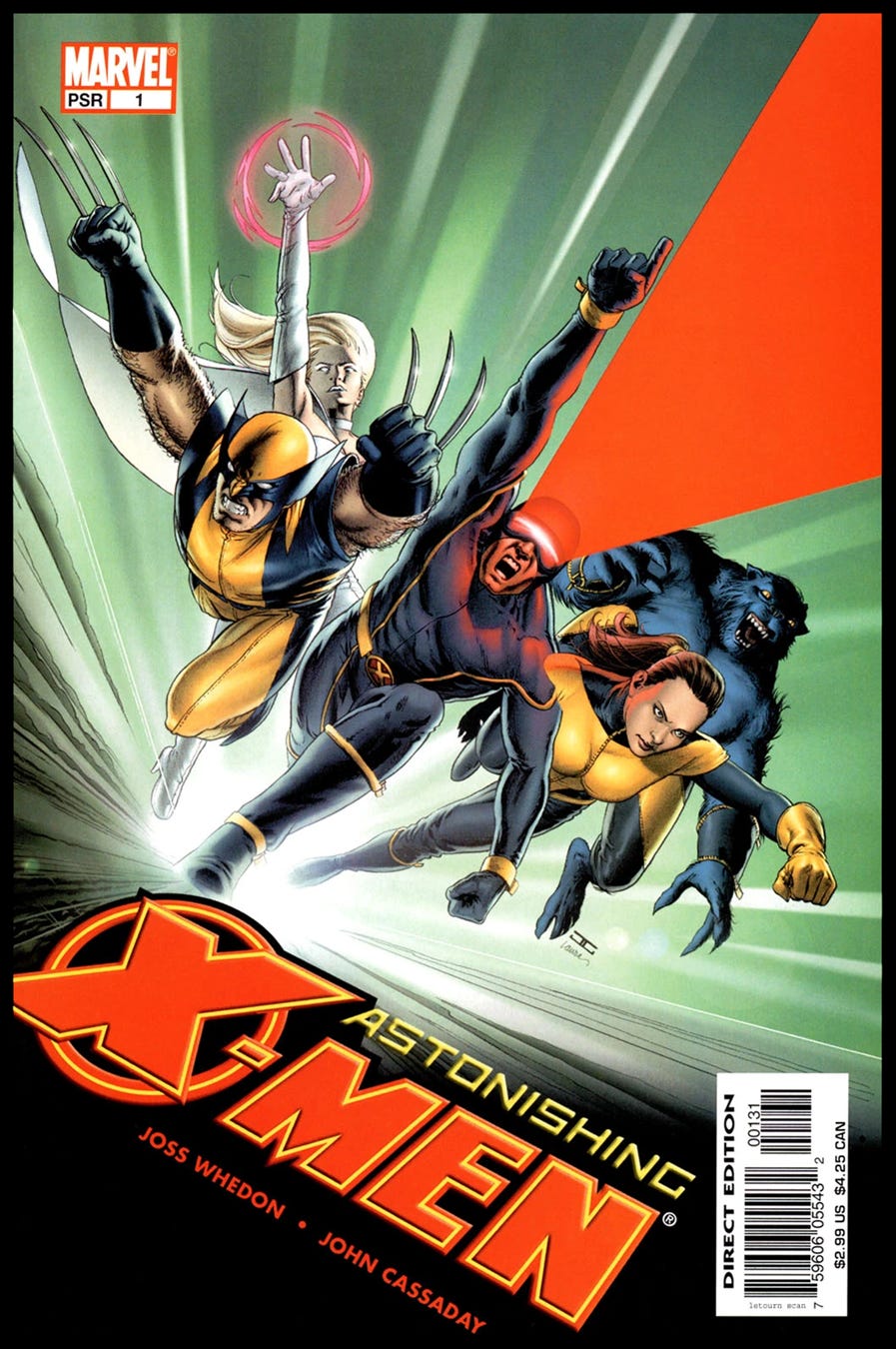
After Morrison left Marvel in 2004 (citing daily shouting matches with the editors), New X-Men reverted to Adjectiveless X-Men and was given over to Pete Milligan. The flagship X-Book shortly became Joss Whedon’s Astonishing X-Men, which presents a more familiar and traditional (but still exciting and refreshing) take on the X-Men, and none-too-subtly repudiates some of New X-Men’s unorthodox proclivities. Despite having problems keeping to a schedule, Whedon’s twenty-five-issue run is now regarded as a classic.
The other X-Books of the early-to-mid aughts were a mixed bag. When they were good, they were really good (Pete Milligan and Mike Allred’s X-Statix, Judd Winick’s Exiles). When they were bad, they were really bad (Chuck Austen’s Uncanny X-Men). When they were so-so, they were really so-so (Joe Casey’s Uncanny X-Men, Chris Claremont’s X-Treme X-Men, Pete Milligan’s Adjectiveless X-Men). But in the midst of a sweeping creative renaissance at Marvel Comics, there was at least a willingness to experiment. Casey and Milligan’s Uncanny and Adjectiveless runs aren’t must-reads, but we can’t fault them for lacking ideas or inspiration.
Then came 2005’s House of M limited series. It didn’t merely usher in a new paradigm of ballyhooed gigantic Marvel EVENTS, but permanently changed the X-Books and their position in the Marvel Universe.
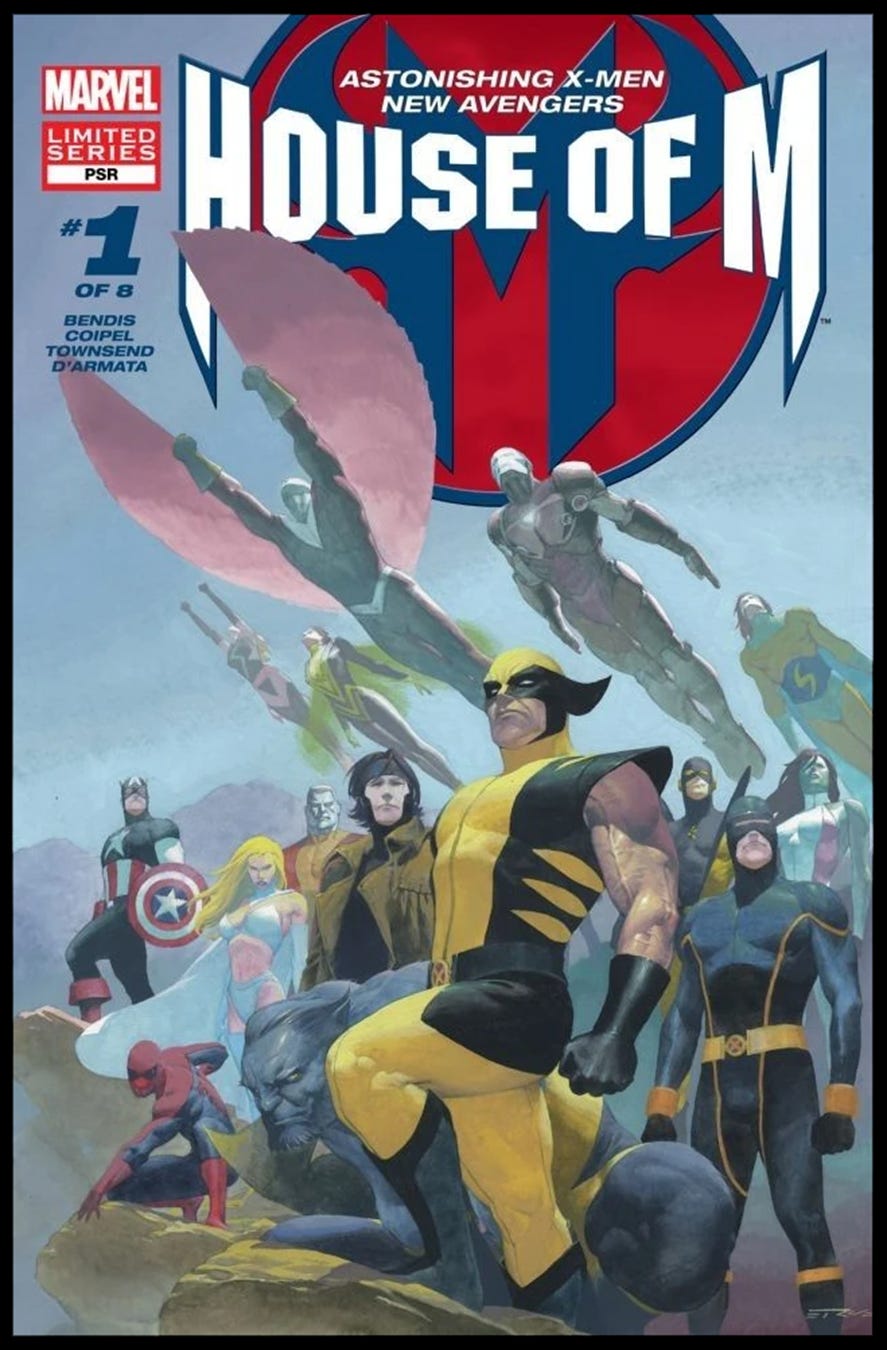
On the face of it, House of M looked like a tenth-anniversary homage to the Age of Apocalypse EVENT: everyone wakes up one day in a dramatically different reality, and only a miniscule handful of superheroes are aware that something is dreadfully wrong. Whereas Age of Apocalypse had been restricted to the X-Books, most of the major Marvel characters (Spider-Man, Captain America, Hulk, Iron Man, the Fantastic Four, etc.) got pulled into House of M too.
Despite its obvious resemblances to Age of Apocalypse, House of M was more like the Onslaught EVENT in terms of its function. What it did, in effect, was clothe a business initiative as a story.2
Once again, let’s let David Harth explain:
House Of M was basically the way that Marvel could sequester the X-Men into their own corner so that the Avengers could take their place as Marvel’s most important team. The Avengers were the team where Marvel’s most important heroes - Captain America, Thor, and Iron Man - had always hung out and for older fans like Quesada, and Marvel editor Tom Brevoort, who was Quesada’s right-hand man, the Avengers should be Marvel’s biggest team. The X-Men, though, were the flavor of the younger fans so Marvel had to move them to the side. Since the 1980s, the X-Men had been the focus of the Marvel Universe, with multiple events and summer crossovers being X-Men-centric. Quesada and Brevoort wanted to change that and House Of M was how it began.
When Age of Apocalypse ended, everything pretty much went back to normal. House of M’s conclusion, however, brought about “M-Day” and the Decimation EVENT. In short: overnight, the world’s mutant population is reduced from millions to just a couple hundred. The X-gene magically gets erased from victims’ DNA, making them baseline humans. Moreover, no new mutants are being born. The position of Homo superior is reduced from an embattled growing minority to a critically endangered species.
By an improbable coincidence, most of the mutants unaffected by M-Day happened to be clustered on the east coast of the United States. The editors and writers, after all, had to consider eligible victims’ commercial value. Someone like Wolverine was obviously in no danger of getting depowered, made irrelevant, and written out. Neither were most of the characters whom non-fans might recognize from the movies, TV shows, and video games. While a big production was made of Professor Xavier and Magneto both losing their mojo, Decimation primarily targeted members of the comics’ B, C, and D-lists.3
None of this was especially well-received by fans, but it served its purpose. Harth again:
In the years that the X-Men became the most popular Marvel property, the 1980s and ‘90s, the X-Men became their own universe. Marvel could have literally published just X-Men books if it so chose, that’s how many mutant heroes and villains there were. However, Quesada wanted to fix Marvel as a whole and the X-Men’s sub-universe stood in the way, so it was cut down to size. This was the beginning of the marginalization of the X-Men. Most people think that this started much later, after Disney bought Marvel, but House Of M laid the groundwork. Maybe Marvel was already planning the MCU at this point, and the lack of the X-Men’s film rights were partly to blame for this. Regardless, this is where the marginalization began.
House of M and its consequences also exemplify how the top-down editorial control and rejuvenated EVENT cycle incommoded the comics’ creative teams. If you were Chris Claremont writing Uncanny X-Men (again) in 2005, the status-quo changes of House of M and Decimation were imposed upon you. You couldn’t ignore them. The reality of the fictional universe you were working in was different now, and your job was to roll with it—even if it gunked up whatever long- or short-term story ideas you might have had.
On the bright side, there was still some pretty serious talent working on the X-Books, and the post-Decimation period produced some truly great comics. On any given month from 2005–2010, there were at least four X-Books in publication, and most were moving in the same editorially coordinated direction. Unlike the shambolic, aimless 1990s, it really did seem like there was a plan and a design to all these simultaneous stories. I’d even go so far as to say that the 2006–2010 X-Books, taken all together, rival the Claremont years as my personal favorite era of X-Men comics.
Taken all together is the key phrase here. The Claremont Run seems so simple now: there was a comic book called Uncanny X-Men and you bought it when it came out once a month (and sometimes semimonthly). You could also read New Mutants and X-Factor if you wanted, but most of the time you could just as well leave them alone. Each series usually stayed in its own lane and minded its own business. While I’m sure there were people in the late aughts who had a single X-Book they stuck to, it was often necessary to follow at least a few of them (and keep up with the various minis) to see and appreciate the Big Picture.
At any rate, the X-Books’ marginalization and terminal decline didn’t really begin until the 2010s. I am not looking forward to punching out the next chapter of this thing.
So! Let’s take a look at the fresh new faces and the high-school reunions of the 2000s’ X-Books, shall we?
(2003–2005)
We’re going a little out of order here—but there are a few things in NYX (i.e., “New York X”) that are worth looking at, and some fruitful little digressions to follow, before diving into the aughts’ primary “next generation” X-Book.
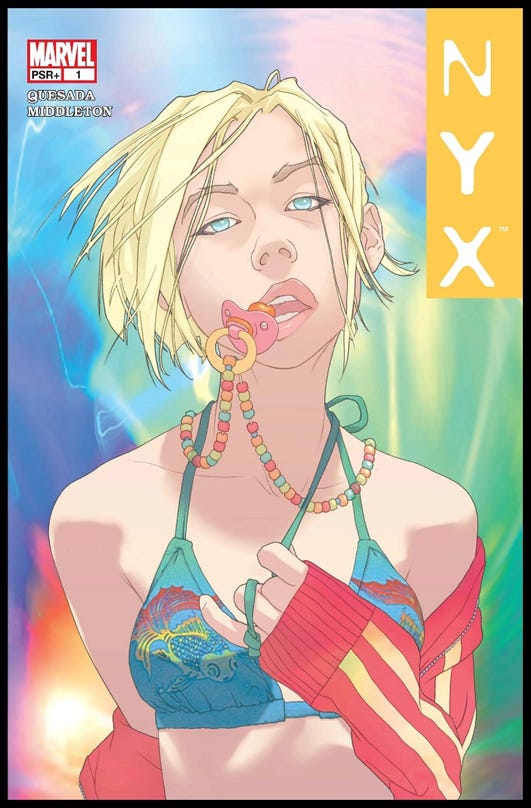
What inferences can we make from the cover of NYX #1?
First of all—yeah, Marvel was getting perhaps a little too comfortable about sexualizing its female characters. (This will swing sharply into reverse during the 2010s.) But more to the point, the cover makes abundantly clear that this isn’t going to be a typical X-Book. No X-Men appear in NYX. Charles Xavier is mentioned, in passing, when a high school teacher assigns her students to compare the recently outed Professor’s published “mutant manifesto” with Martin Luther King’s writings—but otherwise, the familiar world of the X-Men is far, far away. Whatever our definition of “superhero comic,” NYX emphatically does not qualify as one, even though several of its main characters have superpowers.
The idea originated with Marvel’s new editor-in-chief Joe Quesada. As I understand it, he tapped Brian Wood—the writer Warren Ellis selected to write Generation X during the Counter-X initiative, you may recall—to develop the concept with artist David Choe (perhaps best known today for painting murals in the offices of an up-and-coming tech firm called “Facebook” and being paid in stock options). Something went wrong, and their version of it never saw the light of day.
Wood later repurposed his basic idea for NYX in his Vertigo series Demo, and mentioned it (and Generation X) in his original pitch for the series:
In brief, NYX was meant to be an updated, “street” version of the X-Men, wherein the racism-mutant metaphor was updated to more modern times, as class-mutant. It dealt with poor mutant kids living/squatting in NYC, “just trying to get by” and live their lives on their own terms, in spite of their abilities hindering them (most of the time.)
NYX was meant to be my chance to tell the stories I wasn’t allowed to tell during my run on Marvel’s GENERATION X, an extremely conventional “teen superhero” series…
Joe Quesada himself ended up writing NYX, and constructed it from the same basic premise—more or less. Most of its main characters are troubled mutant youths living in New York. They never got an invitation from Xavier, never crossed paths with any X-Men, and are completely outside the notice of any costumed supervillain groups seeking new recruits. If the X-Men are the outcasts of the Marvel Universe, the NYX kids are outcasts from the outcasts.
The girl on the cover is protagonist Kiden Nixon. When she was six, she watched her police officer father get killed in a drive-by shooting. Now she’s an recalcitrant sixteen-year-old living in a little NYC apartment with her stressed-out single mother, her drug-dealer older bother Ty, and two nameless hyperactive pain-in-the-ass younger twin brothers. She’s not doing well in school. She gets in fights. She has issues with authority.
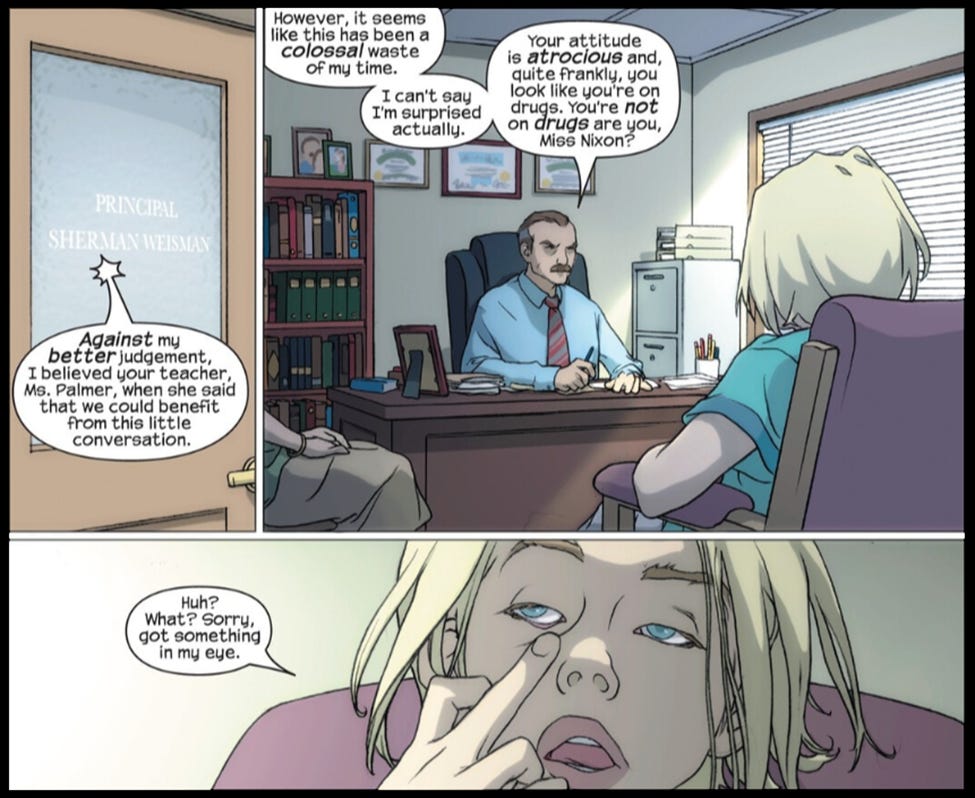
She goes to raves and takes MDMA on weekday nights. And why don’t we pause for a second to look the difference four decades made in Marvel Comics’ depictions of New York City alt-culture:
1964:
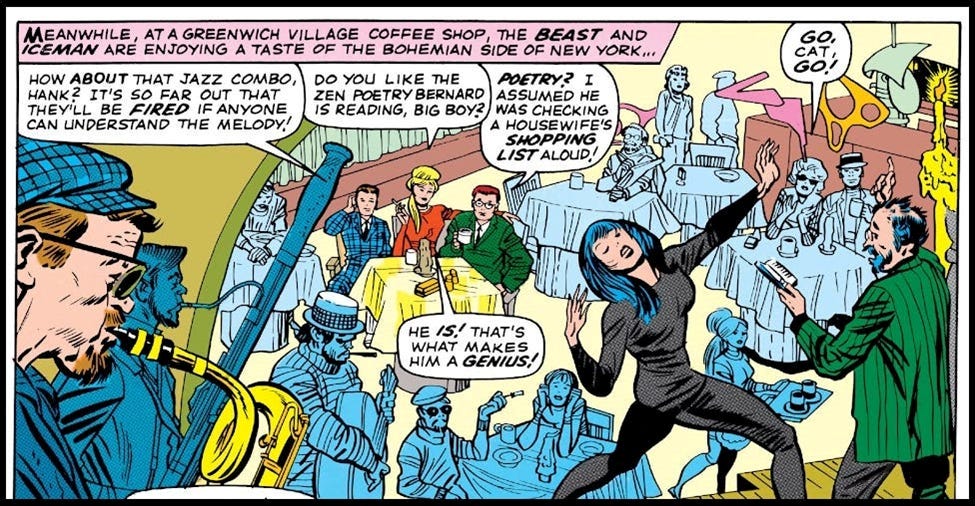
2003:
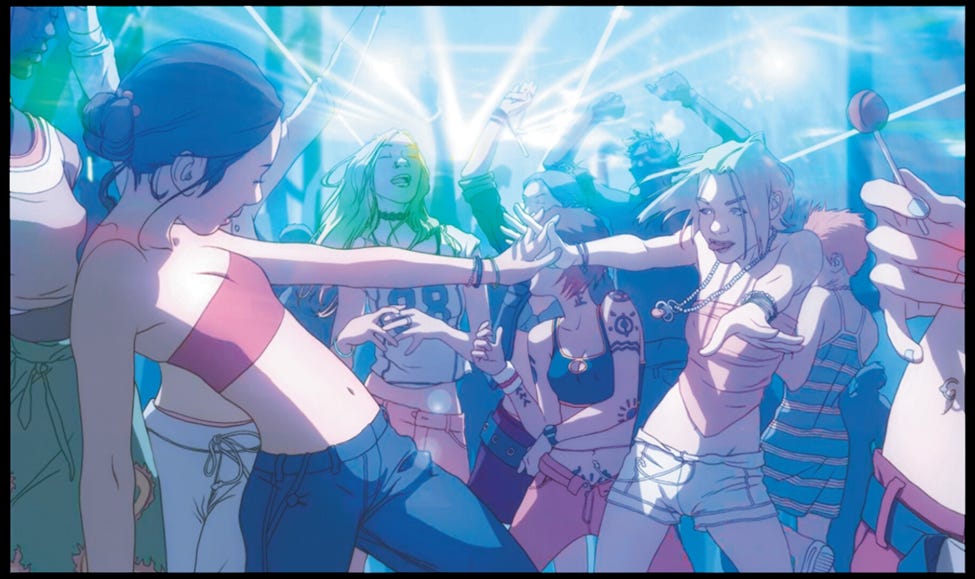
Let’s not sell Jack Kirby short here. What we’re looking at in the panel from NYX represents not only a technological improvement (digital coloring), but the evolution of a method which he helped to develop and carry forward.4 (Plus, he was penciling how many other books at the same time?) And, to be fair, Marvel Comics in the early 1960s absolutely could not be as frank as NYX in depicting the sexier & druggier elements of a subculture—nor was Stan Lee interested in depicting them. For that matter, a juvenile delinquent protagonist like Kiden would have been way out of bounds.
In any event: given how generally harried, maladjusted, and prone to making poor decisions she is, it’s understandable that sometimes Kiden wants everything to just stop. Good news for her, though: she discovers she’s a mutant with the power to halt the flow of time for everyone and everything except herself.
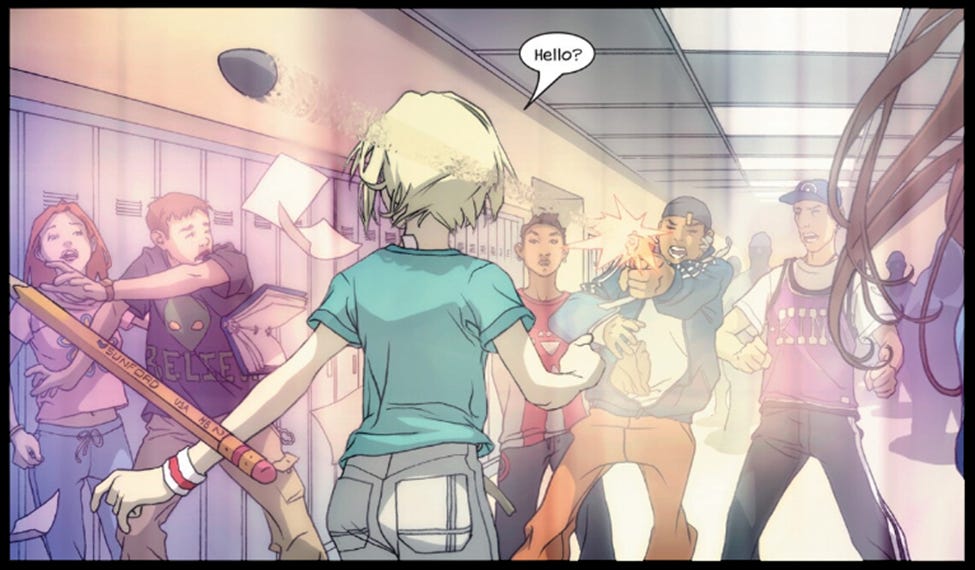
In NYX #2, she uses her power to hit pause when a thuggish classmate with a grudge against her smuggles a handgun past the school’s metal detector and fires off a shot. Though she gets out of the way, the bullet meant for her ends up in her teacher Ms. Palmer’s belly when she switches time back on.
Kiden disappears and lives on the street for several months, panhandling and dumpster diving with a group of other teenaged runaways. She feels freer and more in her element than she did as a relatively ordinary high-school student, but is called back from her voluntary exile to rescue the traumatized and unemployed Ms. Palmer, whom she discovers lying in her bathtub with a pair of slit wrists.
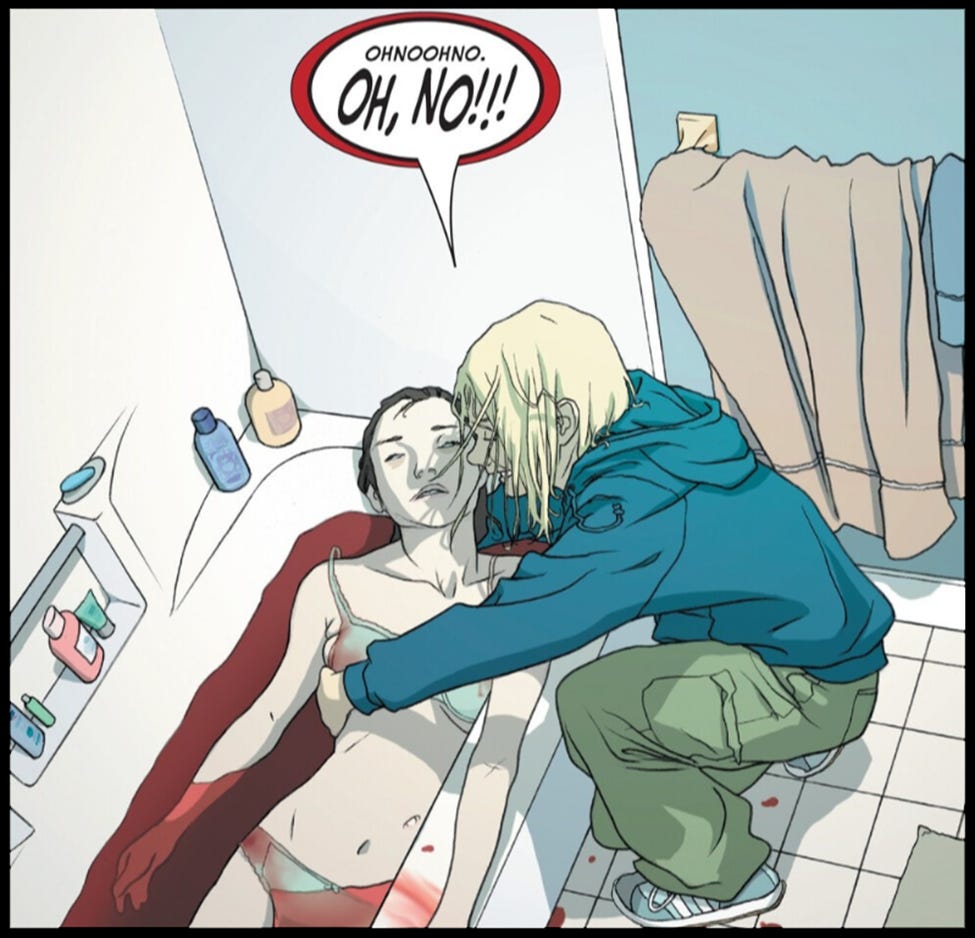
At this point I think we’ve passed beyond the threshold of a grim & gritty post-1980s X-Book into wholly new territory—something more like the dark magical realism of a Vertigo comic than a gory superhero affair.5 And if NYX had stayed on this track and remained a compact story about a bright but messed-up teenager with time-stopping powers, it might have been a decent little miniseries.
But that was never the plan. NYX was always meant to be an ongoing monthly about “an updated, ‘street’ version of the X-Men,” as Brian Wood put it, and Quesada clearly wrote it as an origin story: who this new group is and how they came together.
For the sake of brevity, we need only look at one of Kiden’s new friends: X-23, whom we meet in issue #3.
What Harley Quinn is to the Batman literature, X-23 is to the X-Books: a fan-favorite original character from a television adaptation imported back into the comics. In the X-Men Evolution cartoon, X-23 is a fearless, tough-as-nails living weapon produced from a modified strain of Wolverine’s DNA, whose fighting style is one-half ninja girl and one-half hurricane, and who’s really angry about having her life stolen from her.6
In NYX—her point of entry into the comics—X-23 is a sulky teen prostitute.
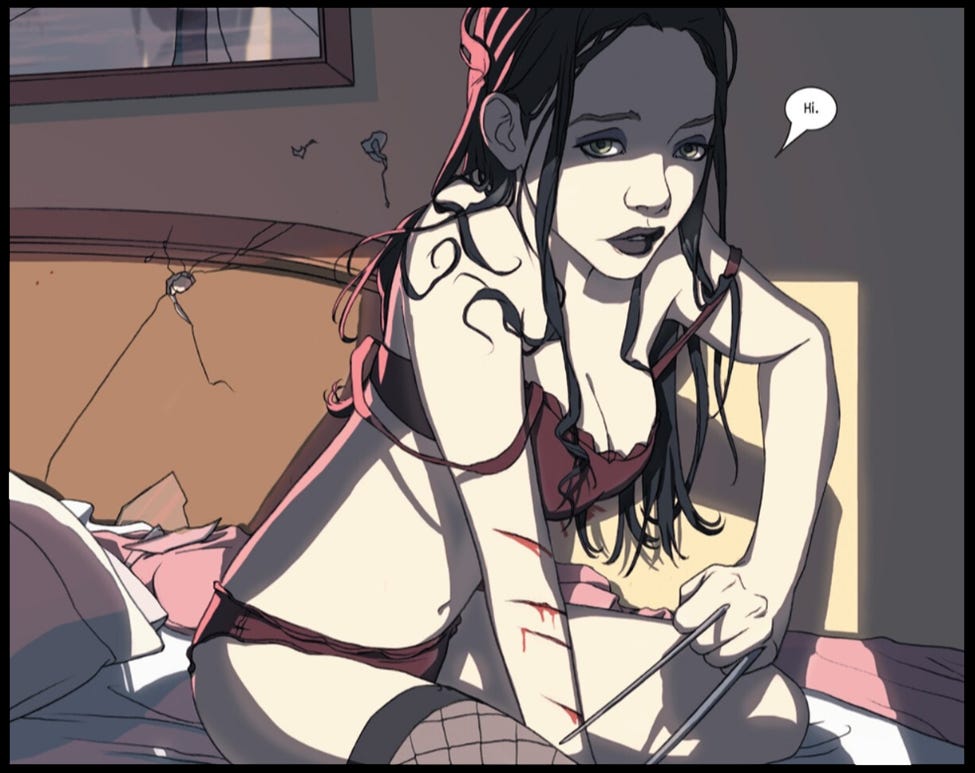
I fear we too are in danger of cutting ourselves—upon the edge of it all. Wherever the boundary separating gritty urban realism from squalid lumpenprolsploitation lies, NYX takes a running leap over it.
Hey: remember the Comics Code Authority? By the 1990s—four decades after the moral panic that spurred its creation—it was basically a joke. That issue of Green Lantern where the supervillain Major Force kills Kyle Rainer’s girlfriend and stuffs her various limbs and torsos into a refrigerator for the hero to find? The CCA called it kosher. That 1995 issue of Astonishing X-Men (not the Joss Whedon one) where a supervillain named “Holocaust” maims and leaves one of the heroes for dead, and the art shows blood dribbling from his flesh-stripped ribcage? Sure, said the CCA, sell it to ten-year-olds. All those issues of Batman and Detective Comics where the Joker wantonly murders people? Ratified by the CCA as good, clean family entertainment.
In 2001, however, the CCA deemed that Mike Allred’s depictions of people getting melted by acid and shredded by minigun fire in X-Force #116 (the first issue of the run that spun off into X-Statix) went a step too far. Marvel responded by creating its own rating system for its releases and abandoning the CCA.
While the 1990s are sometimes recalled as The Grim & Gritty Decade in American comic books, they have absolutely nothing on the aughts. Lacking the Nineties’ over-the-top designs and turgid artwork as a leavening element, the morbidness of aughts-era comics can be startlingly down-to-earth. NYX’s content isn’t altogether atypical of the period; the major difference is that its characters aren’t wearing masks and capes or adopting “-Man” and “Captain-” sobriquets.7
But we digress.
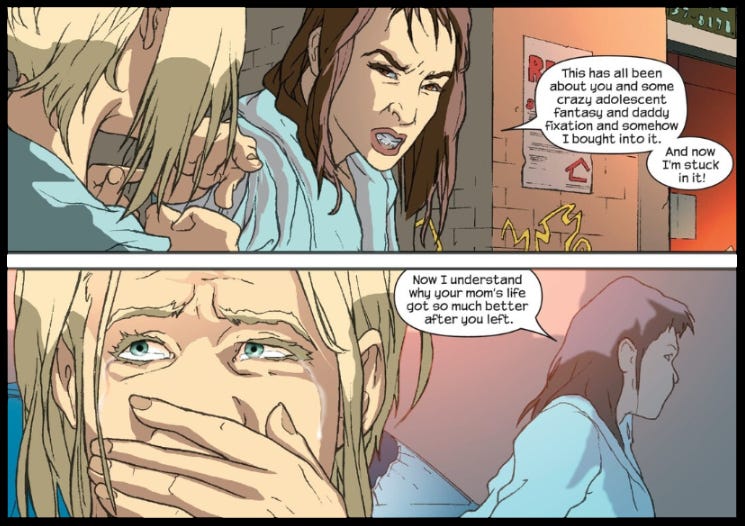
So—NYX had problems. Notwithstanding the popularity of Whedon’s Astonishing X-Men, there is no better way to lose the interest and earn the rancor of comic book fans than screwing up a release schedule.
As Marvel’s editor-in-chief, Joe Quesada definitely had a lot on his plate, and couldn’t dedicate as much time to NYX as he probably would have liked. There was a six-month delay between issues #3 and #4. During the five-month gap between issues #4 and #5, penciller Joshua Middleton left Marvel when his contract expired. Robert Teranishi picks things up, but it’s just not the same—and the artwork was one of the best things NYX had going for it. Issue #6 was then in the pipeline for nine months. At that point, it was probably only for form’s sake that Quesada and Teranishi bothered wrapping the story (sort of) in issue #7.
Even beyond its salacious content, what makes NYX such an awkward series is that it was patently written as the opening arc of a long-haul serial comic. Driving the plot are the ghostly visitations Kiden receives from her father, telling her to seek out and rescue people in trouble. She saves Ms. Palmer from bleeding to death, bails X-23 from a compromising situation with a dead john, and helps a teenaged metamorph named Tatiana escape a phobic lynch mob. It’s more than a little contrived, but it serves the purpose of assembling a coterie of outcasts for an ambitious new take on the well-worn concept of a “mutant team” comic. Readers picking up the first few issues might have reasonably supposed that explanations as to why Kiden sees her dead dad and why he wants her to bring all of these specific people together would be disclosed later on.
But that doesn’t happen. Instead, NYX becomes a story about our heroes living on the streets and hiding from X-23’s cokehead pimp Zebra Daddy, who sends a mutant tracker named Felon and a small army of heavily armed goons to hunt them down. If this was the inaugural seven-chapter pilot story for a monthly that went on to run for, say, thirty issues, all would be well. But taken as the self-contained limited series that it had to become, NYX’s storytelling economy is all kinds of screwed up.
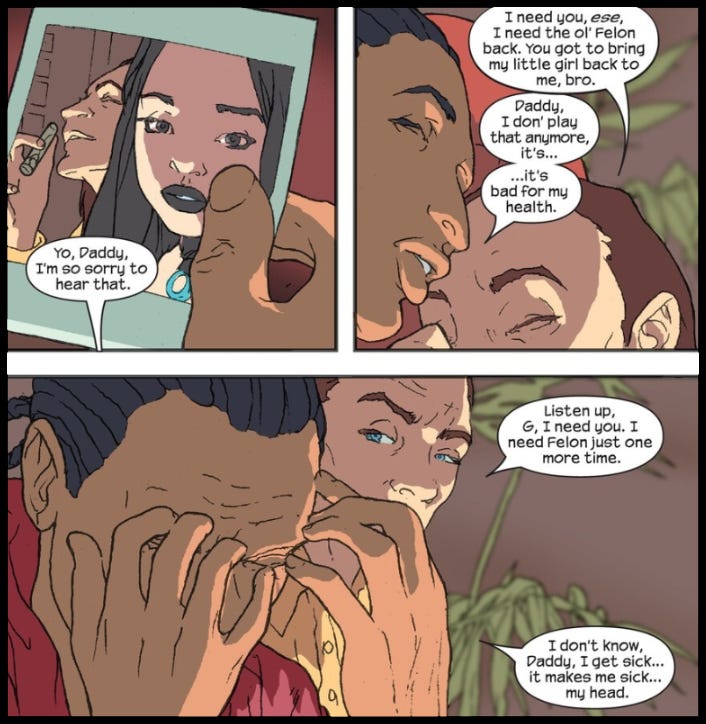
In the end, it turns out Zebra Daddy is the guy who shot and killed Kiden’s dad. And papa’s ghost is apparently a mental projection from Felon’s autistic kid brother. Or maybe he isn’t. What does it all mean? Who knows! Fin.8
NYX isn’t exactly a great comic, and I probably wouldn’t recommend it to anyone. But still, I’m glad that it happened. It goes for the gusto in trying to do something different, and that’s hard not to appreciate—especially after looking at Generation X, which Scott Lobdell (and/or Marvel’s marketing department) tried so hard to build up as something nobody had ever seen before, and came out as an “extremely conventional ‘teen superhero’ series,” as Brian Wood (accurately) puts it. As an X-Book, NYX is anything but conventional.
Interestingly, NYX shares some of its DNA with a wave of similar X-Books that eschewed the “mutant superheroes” angle and attempted a somewhat more grounded, realistic, and (yes) gritty exploration of what things would be like if the United States had a growing population of people with congenital superpowers.
The first of these, I believe, was a 2002 limited series called X-Factor, authored by one Jeff Jensen. It follows a group of operatives on the US government’s Mutant Civil Rights Task Force, and is even farther away than NYX from qualifying as a superhero comic. Does it have anything to do with the more familiar X-Factor series that was launched in 1986 and cancelled in 1998? Nope. So why give it the same title? Because preexisting name-recognition value amounts to free marketing.
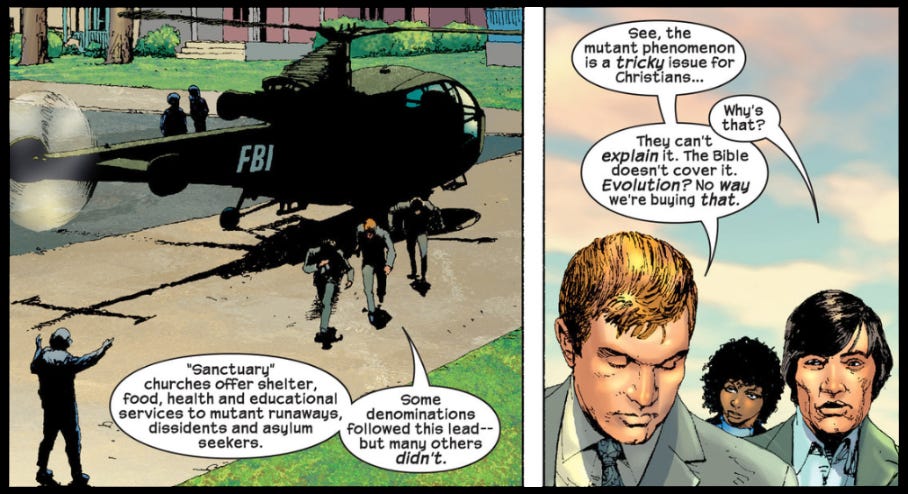
In 2003, the Marvel Knights imprint published the four-issue Chamber limited series by Brian K. Vaughan (Y: The Last Man) and Lee Ferguson. Generation X alum Jono matriculates to Empire State University, a progressive college with an affirmative action program for mutants. He’s secretly there to investigate a murder case, and gets entangled in the intrigues of campus radicals and social justice groups. This one tries its absolute damnedest to test the Mutant Metaphor’s elastic limit.
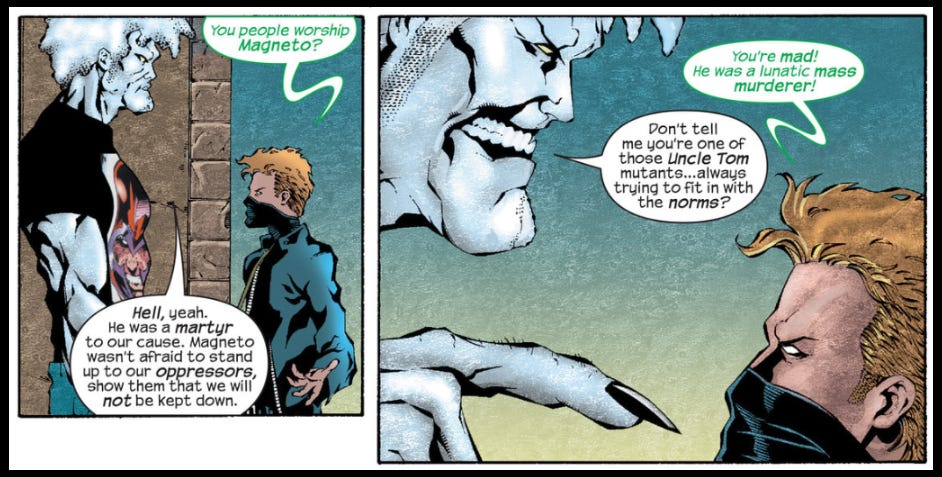
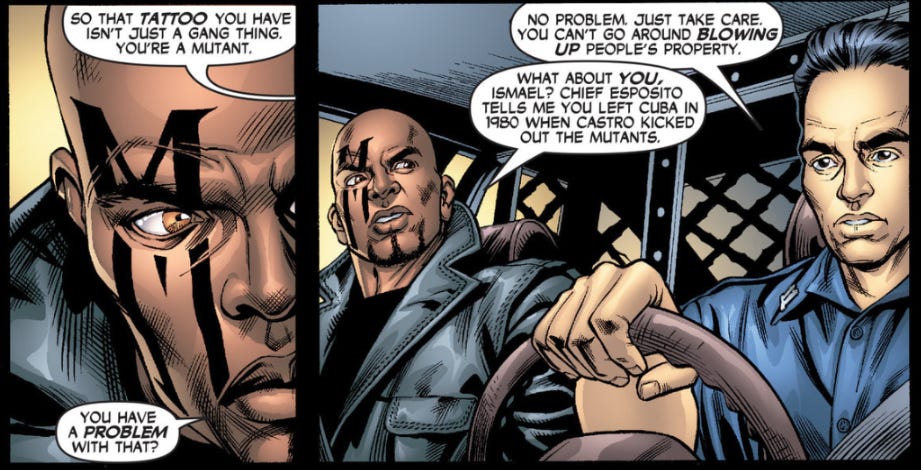
In 2004, author David Hine (Spider-Man Noir co-creator) and artist David Yarden launched the ongoing monthly District X, also on the Marvel Knights label. NYPD officer Ismael Ortega patrols the “Mutant Town” enclave on the lower east side. His new partner is none other than X-Man Bishop. The series ran nineteen issues, and was then retitled Mutopia X during the House of M EVENT. Afterwards it was retired.
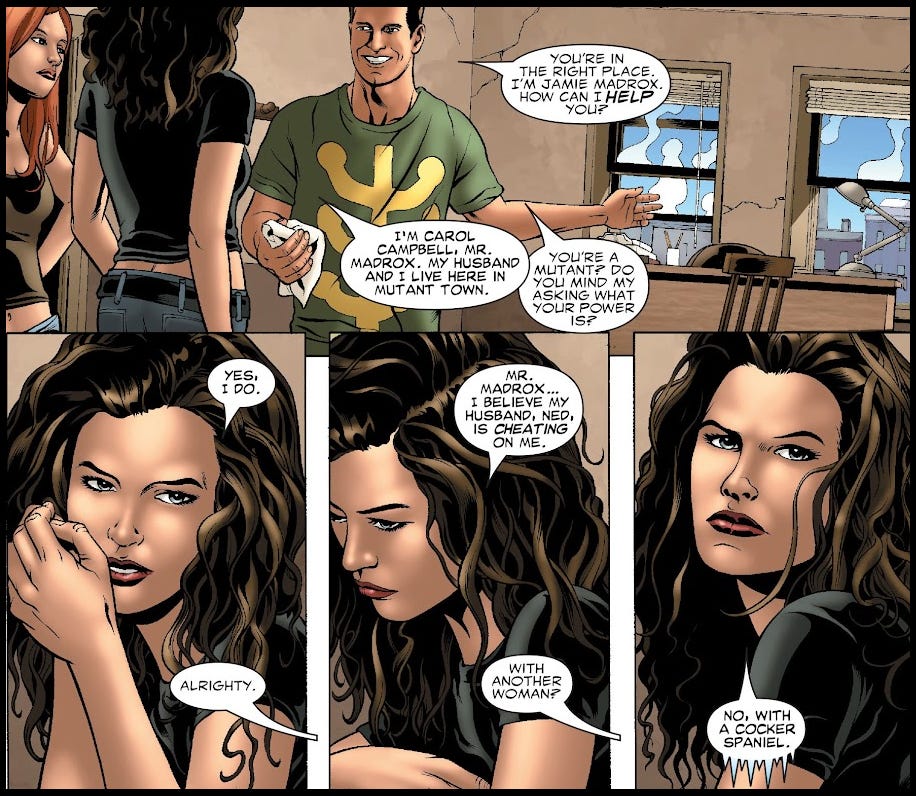
Also in 2004, also on the Marvel Knights imprint: the late Peter David’s limited series Madrox. As the title suggests, it features Jamie “Multiple Man” Madrox, a central character of David’s short but acclaimed X-Factor run in the early 1990s. Jamie moves to Mutant Town to start a private detective agency, and gets a little help from his old X-Factor pals Guido and Rahne. This was more or less the pilot test for David’s celebrated second sally on an X-Factor volume, which debuted in 2006 and ran until 2013—a not unimpressive lifespan for a tertiary Marvel series that kicked off in the aughts. (For the record, X-Factor’s cast will mostly consist of characters who previously featured in books we’ve covered here: New Mutants, Fallen Angels, X-Force, and Generation X.)
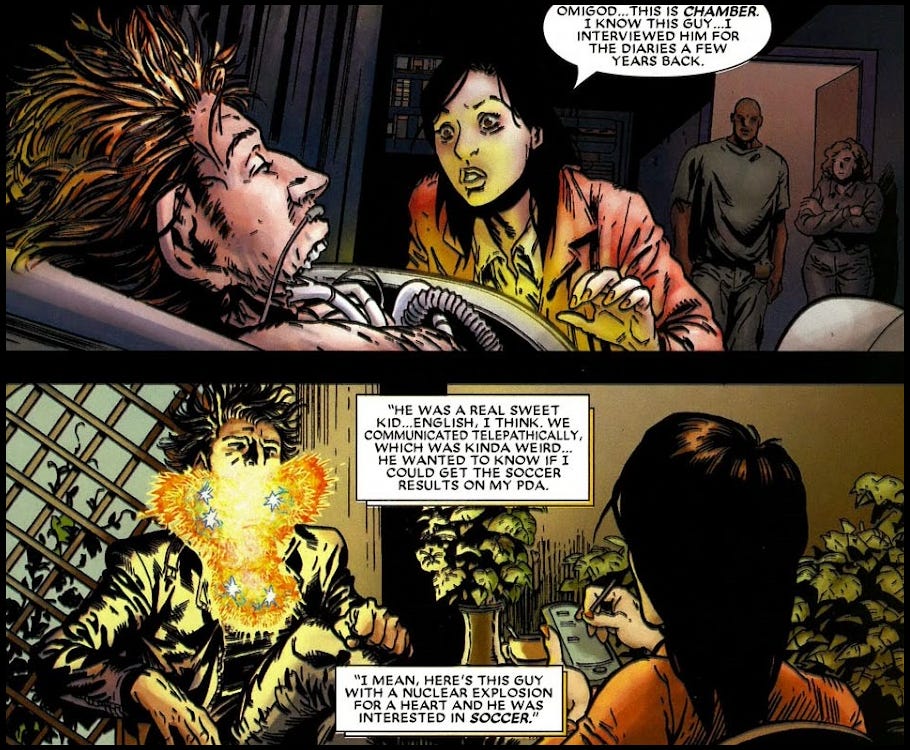
The last specimen of these books was the 2005–2006 limited series Generation M (authored by 1990s Marvel Knights alum Paul Jenkins), which explores the M-Day aftermath from the perspective of a journalist covering the mutant beat for an alternative NYC newspaper. (Remember those?) Incidentally, she meets a depowered Jono in the first issue.9
Here’s my guess (and it is just a guess) about how these came to be: by the early 2000s, the Xennials and older Millennials who hopped on the bandwagon during the X-Mania of the late 1980s and early-to-mid-1990s were in their late teens and early twenties. While many probably reserved a place in their hearts for comic books about people who dressed in bright spandex and quarreled with supervillains, more than a few had wandered off and became Preacher fans in the meantime, and now wanted something more in that vein: “grown-up” comics with mature themes and elements of speculative fiction and/or magical realism, but no capes, masks, or tights. These books were meant to appeal to that crowd.
It’s hard to know how well-received this stuff was—but the scarcity of later books like them suggests the decision-makers were unimpressed by the results. Apparently (and again, I’m only guessing) the lesson taken from NYX, District X, etc., was that there were definite limits on how far X-Men stories could depart from familiar conventions while remaining salable in the comic book shop. Updating them for a new century by stripping them of crystallized superhero tropes and trappings was evidently a no-go.
(2003–2008)
We’re looking at two different series here, but we’ll be treating them as a single unit—for the most part. New Mutants ran for thirteen issues, and then turned into New X-Men: Academy X with no interruption in its monthly publication schedule.
I. Nunzio DeFilippis & Christina Weir
(New Mutants #1–13, New X-Men: Academy X #1–19)
As we’ve seen, there was already a Marvel series called The New Mutants that ran for most of the 1980s. What we’re looking at now is a new and different series called New Mutants, and there were two good reasons to recycle the title. First: New Mutants alums Dani and Rahne are major characters, and Shan and Amara put in a few appearances, too. Second: again, preexisting name-recognition value amounts to free marketing.
For our purposes here, New Mutants will refer to this, to the 2003–2004 series by former Arliss writers Nunzio DeFilippis and Christina Weir. If we’re talking about the original New Mutants, we’ll specify it as such.
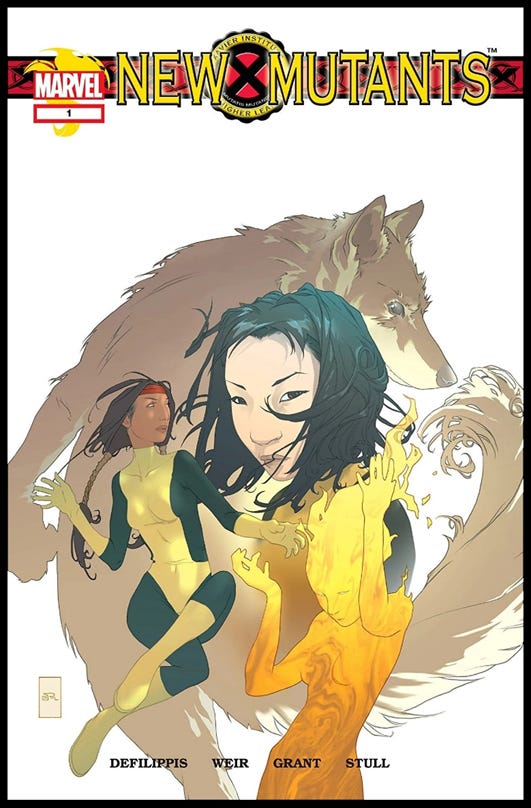
As you might have guessed, Nunzio DeFilippis’ and Christina Weir’s New Mutants introduces the third set of next-generation X-Teens after the New Mutants of the 1980s and the 1990s’ Generation X. As we’ve already seen, Generation X was something of a failed experiment—or, rather, it was less of an experiment than Scott Lobdell imagined. For all its hype, and for all its angsty teens with freaky bodies, it did nothing particularly special and is mostly remembered for the excitement that surrounded its early issues.10 New Mutants, on the other hand, truly was an unusual X-Book. It’s not really my cup of tea—but the point stands.
I’ll let you try to guess what makes it unusual. Let’s do a little plot summarizing for the first couple of issues. Be on the lookout for anything that seems odd.
Issue #1: our protagonist is a teenage mutant with wind-manipulation powers who lives in Venezuela. Her mother gets killed in a Caracas riot. Her aunt and uncle can’t afford to care for her, so she gets sent off to the United States to live with her wealthy supermarket mogul father. The man isn’t altogether thrilled to find out he has an illegitimate daughter, and that she’s a mutant to boot.
She doesn’t fare much better at school.
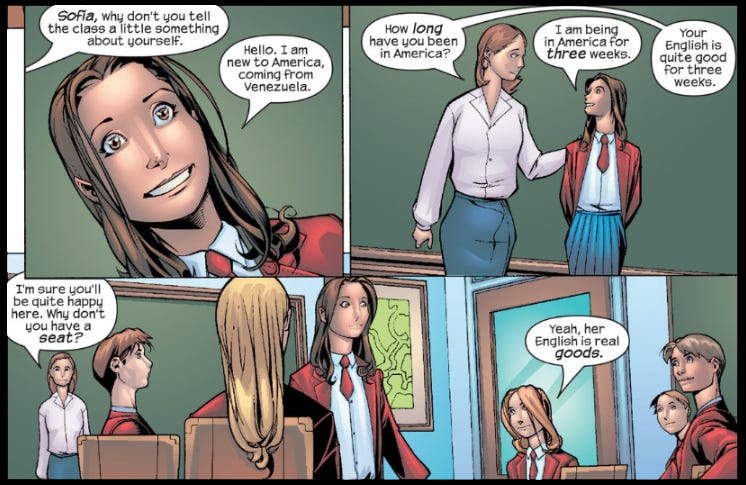
One day she gets fed up with being treated so shabbily by her father and classmates. She runs away from school, strolls into one of her father’s stores, and wrecks the place with her wind powers. After getting arrested and taken to jail, she receives a visitor.
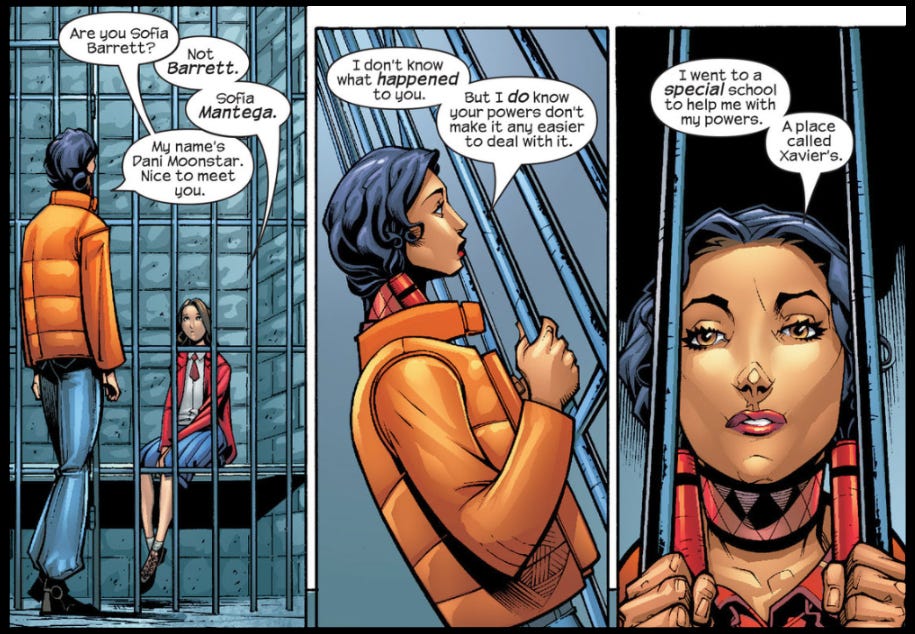
By the end of the issue, our protagonist has decided to matriculate to the Xavier Institute—which, thanks to Grant Morrison’s New X-Men, is now a large and fully-staffed boarding school for mutant children, operating in the light.
“What’s Xavier’s like?” Sofia asks Dani.
“Like no place else in the world,” Dani tells her. “You’ll see.”
And that’s issue #1.
Notice anything off? Notice anything missing?
Okay. Let’s look at issue #2.
Sofia arrives at the Institute, takes a tour of the campus, and gets settled in. She meets, in passing, a lonely girl who’s got a problem: her pheromone powers cause people around her to feel whatever she’s feeling, so she unintentionally messes with people’s heads, especially when she likes them. She self-isolates in order to prevent that from happening. Dani has the idea of making Sofia the girl’s roommate, since her wind powers can disperse any out-of-control pheromones. Now they’re friends! Problem solved! Professor Xavier offers Dani a teaching job, but she’s not sure if she’ll accept it. For the time being, she’ll remain a recruiter for the Institute. The end.
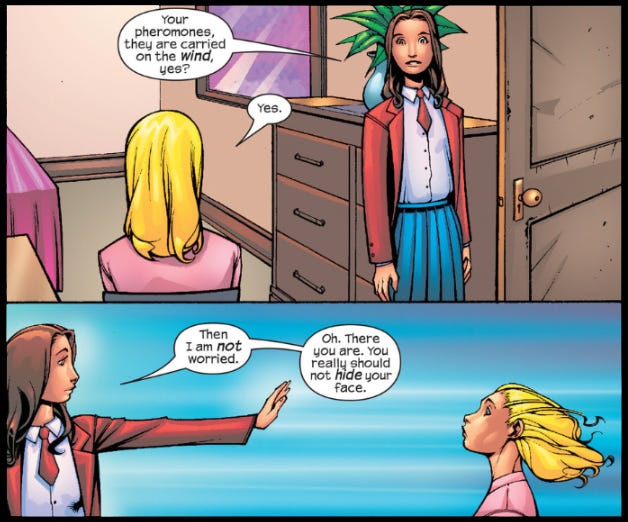
Most of New Mutants follows a similar track. Dani recruits new students. She’s joined by her old pals Shan and Rahne, who become Institute staffers. Dani eventually agrees to become a mentor/guidance counselor for the students she brought on. The older and younger cohorts’ stories intertwine as everyone adjusts to their new circumstances.
We need to underscore what an odd turn this is for the characters of an action-adventure superhero franchise. Dani, Shan, Rahne, and then Amara—four-ninths of Chris Claremont’s original New Mutants—take the next step in their careers, and it doesn’t involve putting on bright costumes with X’s on their belt buckles and galloping off to fight supervillains. They came into the first iteration of New Mutants as teenagers cultivating their talents at Charles Xavier’s School for Gifted Youngsters, and now they’re advising and mentoring students of their own at the Xavier Institute.
Let’s take a quick look at Dani’s kids:
Sofia Mantega (Wind Dancer). Venezuelan. Buoyant. Determined. Good with people. In addition to being able to generate localized gusts and fly on updrafts, she can hear voices on the breeze, giving her super-eavesdropping powers. Reminiscent of Kitty Pryde in that she’s introduced as the new kid at school and has a “heart of the team” thing going on. Drama value: doesn’t get along with her father, can’t decide if she reciprocates Julian’s crush on her.
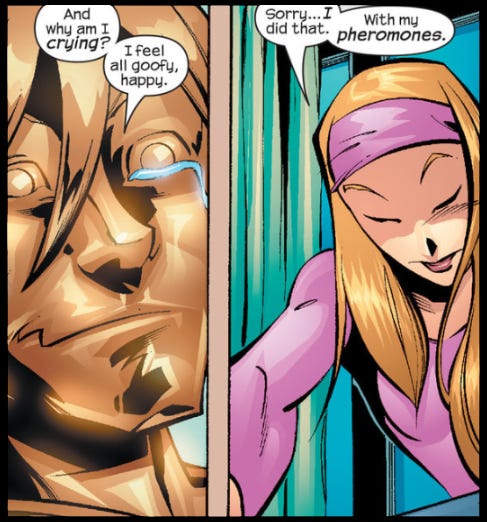
Laurie Collins (Wallflower). Westchester townie. Shy. Enjoys Mars Volta. Has super-pheromones that make anyone around her with functioning nostrils feel what she’s feeling, and have a high potential for abuse. Reminiscent of the original Hellions’ Empath in that she mucks with people’s emotions, and of Claremont Run characters in general because she always has to announce “I did it with my pheromones!” so new readers don’t get confused. Drama value: likes Josh, dates Josh, breaks up with Josh, and then compels David to kiss her at a school dance to make Josh jealous. (She does it with her pheromones.)
David Alleyne (Prodigy). Chicagoan. Harvard aspirant. Telepathically plucks knowhow from people’s heads, making him the world’s fastest learner—though a mental block prevents him from permanently retaining it. Reminiscent of Cypher from New Mutants in that he lacks a flashy superpower, and of Synch from Generation X in that he’s a well-adjusted kid from a midwestern city whose special ability involves borrowing things from other people. Drama value: is slow to warm up to Josh when the two are made roommates; has a will-they-won’t-they thing with Noriko.
Kevin Ford (Wither). From Atlanta. Artsy. Has an uncontrollable death touch: if he makes skin contact with anything organic, it instantly decomposes. Accidentally disintegrated his father when his powers activated, but he’s sort of weirdly not absolutely inconsolably wrecked about it. Reminiscent of Rogue from Uncanny X-Men in that he’s unable to touch anybody. Drama value: has a gigantic unreciprocated crush on Laurie.
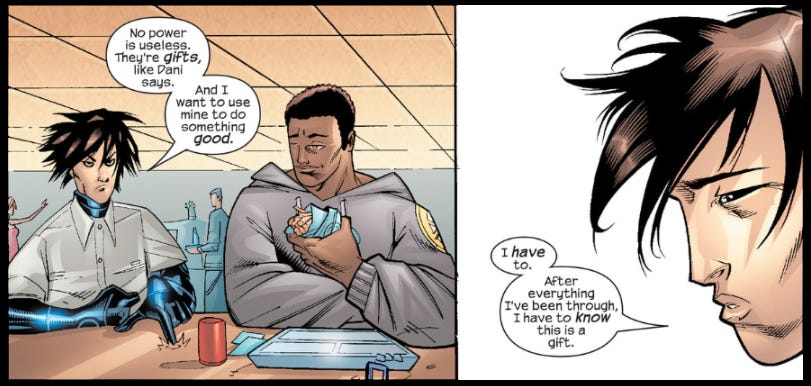
(Notice, by the way, how many different artists were on New Mutants. This was a problem throughout DeFilippis and Weir’s entire run. Comic book readers appreciate consistency, and it’s jarring when all the characters look one way for four months, look another way for two months, and then look a second kind of different the month after.)
Josh Foley (Elixir). Former Queens resident. Was an anti-mutant bigot until his X-gene activated, and then his friends beat him up and his parents disowned him. Has gold skin and a healing touch (which is actually a facet of omega-level biokinetic powers, but we don’t know that yet). Reminiscent of Sam from the original New Mutants in that his origin story involves very briefly working for Donald Pierce as a Reaver candidate. Drama value: repeatedly makes out with Rahne(!).11
Noriko Ashida (Surge). Originally from Japan. Throws out electric bolts and can run like the lightning. Testy. Lived on the street for a few years, stealing money and abusing drugs to manage her powers. Now she wears special gauntlets to regulate them. Her hair mysteriously turns blue between New Mutants and New X-Men: Academy X, but it probably isn’t a secondary mutation.12 Reminiscent of Dani in that she arrives at the Xavier Institute as the group member who pushes back against authority, and of Jono from Generation X in that she’s the group member with the most inspired visual design. Drama value: generally prickly; doesn’t get along with her roommate Sooraya.
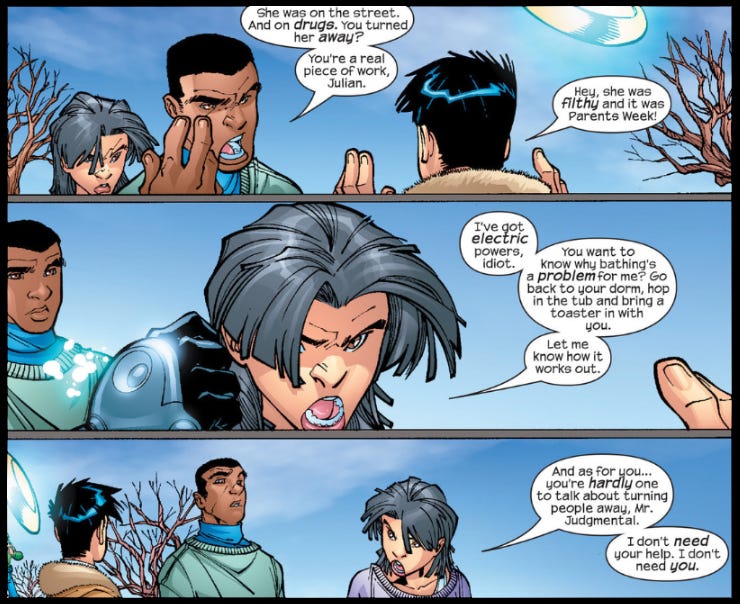
We’re taking some of this out of order. Several of the dramatic incidents mentioned here don’t boil over until New Mutants changes over into New X-Men: Academy X—but more importantly, the kids don’t get their superhero codenames until then. For now, Sofia, Laurie, David, et al. are just Sofia, Laurie, and David. We never see them wearing anything except for street clothes, either—as in, no Fighting Team uniforms.
So here’s what’s unusual about New Mutants. It runs for thirteen issues. The students have exactly one affray with a supervillain (the mutant-hating cyborg Donald Pierce), and the whole affair is over within fifteen pages. Within their first thirteen issues, the original New Mutants did battle with a hostile alien, a giant robot, terrorists, an axe-wielding mercenary, Roman gladiators, and an immortal sorceress.
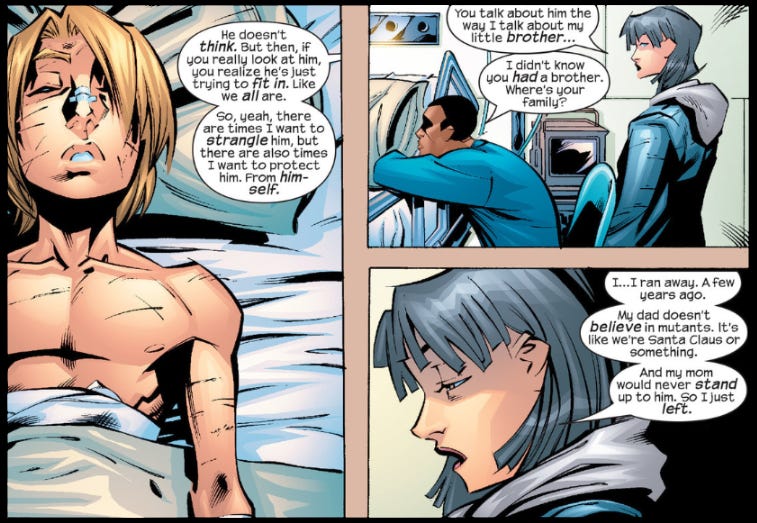
This iteration of New Mutants actually follows through on the “students, not superheroes” premise that Chris Claremont envisioned for the original series. It’s not an action-adventure book. It really and actually is a story about teenaged students doing teenaged student things, while also reckoning with being superpowered mutants hated and feared by much of mainstream society.13 Not that it’s altogether bankrupt of action or danger—but DeFilippis and Weir never feel obliged to send the cast on a dangerous journey into the Amazon, pit them against any extradimensional mutant vampires, or team them up with motorcycle stuntmen to foil a supervillain plot to satiate to an audience expecting a conventional teen superhero comic.
In other words, New Mutants is an X-Men comic primarily targeting girls and young women. Not exclusively, of course—but give a teenaged male (circa 2004) a choice between two comic books, and he’ll most likely pick the issue where Wolverine guts faceless goons and tanks through gunfire over the one where Prodigy accuses Elixir of being a social chameleon and then gets called out for his sanctimoniousness by Surge.
Incidentally, New Mutants was published on Marvel’s short-lived Tsunami imprint, which aimed to reel in new readers by emulating manga—which in 2003 was not quite yet an unchallengeable force in the American comic market. You can read about Tsunami here—and I also invite you to take a moment to think wistfully back to the time when sites like CBR actually did industry journalism instead of cranking out SEO’d blurbs and listicles. But the thrust of it was a perceived need to launch a subset of Marvel comic books more appealing and accessible to newbies than the long-running franchises, and featuring more diversity in terms of content.
I imagine the editors were dreaming of seventeen-year-old couples visiting their local comic shop together. The guy buys the latest issues of New X-Men and Ultimate Spider-Man; the girl leaves with a volume of Fruits Basket and the latest issue of New Mutants. While the pair doesn’t have much to talk about regarding Fruits Basket or Spider-Man, the X-Books give them common grounds for conversation.
“Oh, that’s Magma,” the guy says when the girl asks him if he knows who Amara is, and then fills her in on what he knows of the character’s backstory. And then she tells him the issue she’s reading is about Josh using his healing powers to bring Amara out of a coma and he says “oh cool, you don’t see a lot of white mages in X-Men comics, mind if I read that when you’re done?”
And then he passes her his copy of New X-Men so she can read more about Emma Frost, whom she recognizes from New Mutants—and now Marvel has a pair of customers who reinforce each other’s purchasing habits. Neat idea, right?
The Tsunami imprint lasted barely a year. It’s anyone’s guess as to why that was; some of its titles were fairly popular and got good press.14 But in 2004, New Mutants turned into New X-Men: Academy X, joined the mainline Marvel books, and got a makeover.
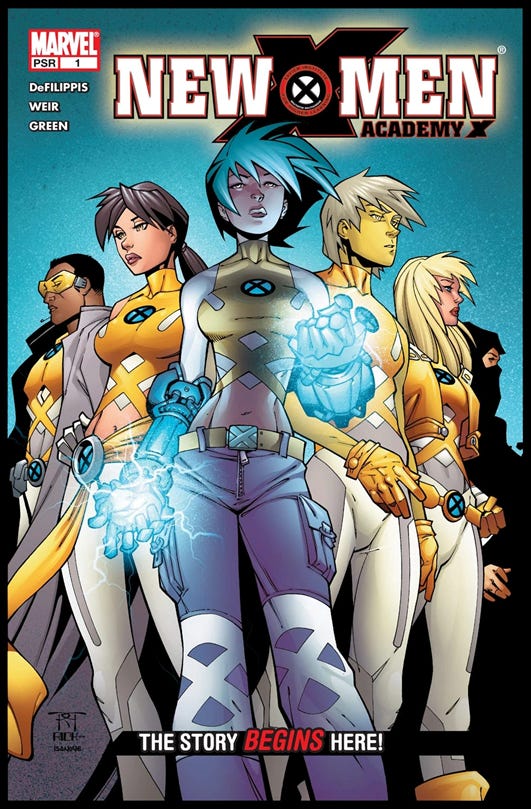
The title change was a truly sneaky move. Not long after Grant Morrison left Marvel, New X-Men reverted to what it had been before: Adjectiveless X-Men. That meant New X-Men was available as a title. That meant inattentive on-and-off readers wandering into a comic shop circa 2004 might pick up the new junior-team X-Book under the impression that they were buying an issue of the wild and crazy and smart Grant Morrison run they’d heard about.
We’re going to be seeing a lot of this going forward. For the third time: preexisting name-recognition value amounts to free marketing.
I’d be interested to know whether the changes that accompanied the switchover naturally occurred to DeFilippis and Weir as the obvious next steps for the story and characters, or if they had to be prodded by their editors. I don’t suppose there were any shouting matches over it, if that was the case. New X-Men merely brings New Mutants up to code by giving its cast superhero sobriquets, putting them in snazzy (if perhaps a little overdesigned) skintight combat training uniforms, fashionably exposing the girls’ navels, and making the boys absolutely jacked. The “students, not superheroes” premise doesn’t actually change.
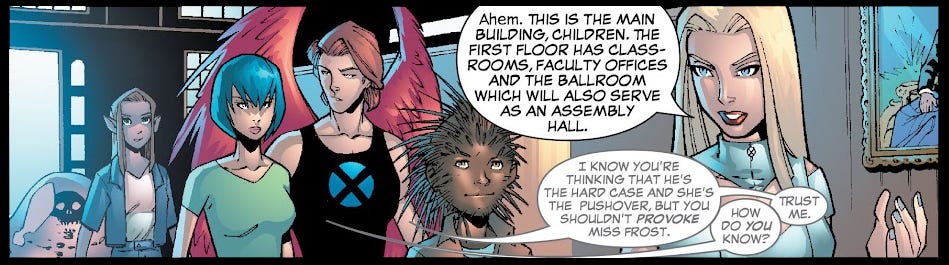
I suspect the most convincing argument for preserving the status quo had to do with the contemporary Harry Potter craze. Grant Morrison’s refashioning the Institute into a scaled-up junior academy for mutants laid the groundwork for the basic premise of DeFilippis and Weir’s New Mutants, and you don’t have to search very hard to locate the similarities between a boarding school for mutant kids and a boarding school for magic kids. Somebody—who knows who?—probably figured that the resemblance ought to be capitalized on.
(Monthly superhero comics, which have to constantly insist on their relevance in order to remain relevant, are practically required to chase trends. Ever heard of the short-lived 1996 comic Superboy and the Ravers? What about the cancelled-before-it-launched “woke” New Warriors series of 2020, which was to feature new teen heroes with names like “Snowflake” and “Safespace?”)15
In New X-Men‘s first storyline, the Institute’s student body is gets split up into houses squads à la Hogwarts. Sofia and friends are kept together and placed in the New Mutants squad under Dani’s supervision.
And things play out more or less as before, except now all the kids wear uniforms and are in competition with each other in a TWO POINTS FOR GRYFFINDOR NEW MUTANTS sort of way. The interpersonal drama continues, roiling in the context of inter-squad field day exercises, a mystery involving a ghost, the FBI investigating Kevin for the disappearance of his father, a school dance, an end-of-year awards ceremony, and so on. A plot thread running from New Mutants into New X-Men involves Laurie’s father Sean Garrison, who has the same pheromone powers as her but none of her inhibitions about abusing them. We’re just going to mention it and not bring him up again, because that’s more or less what ends up happening with his arc.16
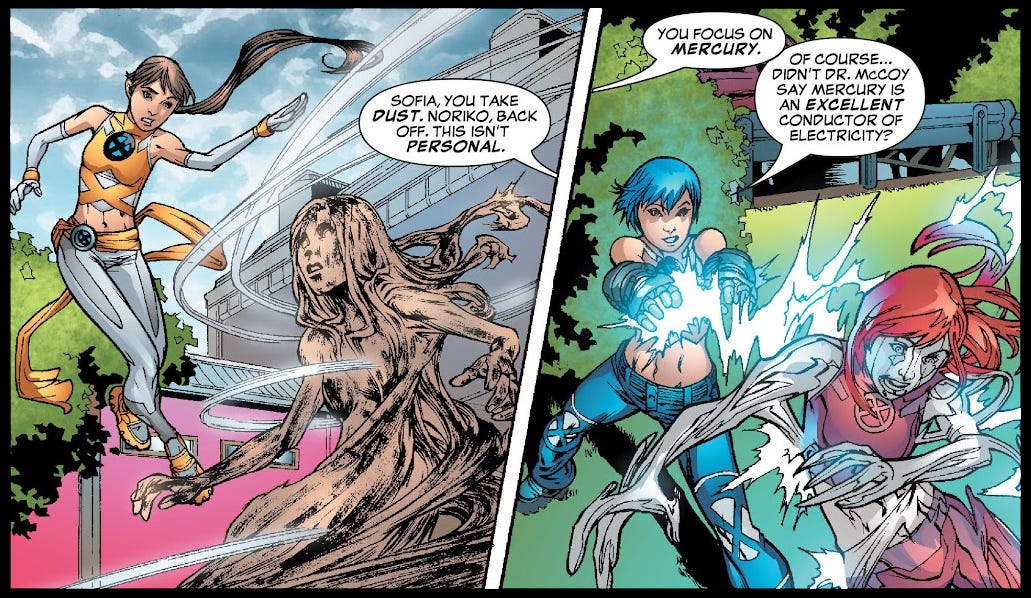
During this era, there were apparently eleven(!?!) different squads on the Institute campus, appearing in some form or other throughout the various X-Books between 2003 and 2005. DeFilippis and Weir introduce six, and near the end of their run, they publish a one-shot Academy X Yearbook that puts a bow on the story of the New Mutants squad up to that point and provides short character profiles on the members of the other squads, most of whom we never learn much else about.
The only one we need to glance at is New X-Men’s take on Slytherin: the Hellions, supervised by Emma Frost. The roster:
Julian Keller (Hellion). Comes from a rich family in California. Introduced early on in New Mutants as a cliquish, arrogant jerk who flirts with Sofia but has nothing but contempt for her friends. Emma’s favorite. Telekinetic powers. Drama value: mean boy.
Cessily Kincaid (Mercury). First appears in New Mutants as part of Julian’s clique. Her body is made of (nontoxic) liquid mercury, so she’s basically the T-1000 from Terminator 2 as a laid-back sixteen-year-old girl from Portland. Drama value: turns the Josh/Laurie/Rahne/Kevin love quadrangle into a pentacle. Cessily likes Kevin, but Kevin is too besotted with Laurie to care that Cessily might be the only girl he’ll ever meet who won’t die if he touches her.
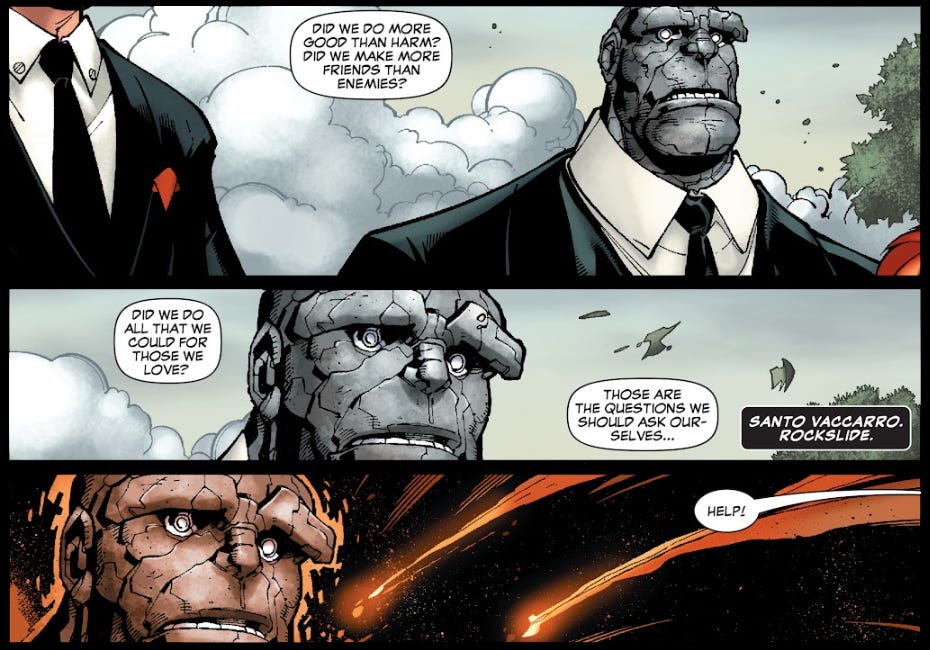
Santo Vaccarro (Rockslide). Big dude from Boston. Introduced as Julian’s burly lackey in New Mutants. Jockish. “Meathead” might be appropriate if he weren’t made of rocks. Can detach and launch his fists at people. Is actually a psychic entity that possesses and controls a stone body, but we don’t know that yet. Drama value: not much, but becomes an invaluable source of comic relief later on.
Sooraya Qadir (Dust). Afghani. Devout Sunni. Wears an abaya with a niqab veil. Was actually introduced in Grant Morrison’s New X-Men. Conservative, serious, and scrupulous, but rather sweet. Can turn herself into a cloud of silicate particles. Is actually incredibly dangerous. Drama value: pisses off Noriko; doesn’t reciprocate Jay’s crush on her.
Brian Cruz (Tag). Dreadlocks. After catching a bit of fan flak for giving their characters “obvious” powers, DeFilippis and Weir gave Brian the wholly novel ability to “tag” people and make them “it,” meaning that everyone nearby is irresistibly compelled to flee from them while saying must…get…away! Okee dokee, then. He makes up for it with his personality. Drama value: negligible.
Jay Guthrie (Icarus). Remember Sam from the original New Mutants? Remember Paige from Generation X? Jay is their younger brother. He first appeared way back in an issue of Claremont’s New Mutants, but had more recently been featured in a [dumb] story in Chuck Austen’s Uncanny X-Men run. Is actually named Josh, but goes by “Jay” because he’s at school far from home and trying on an aggressively chill new persona. Red wings, healing factor, hypnotic singing voice. Drama value: trades places with Kevin and joins the New Mutants squad because he thinks Julian is a dick.
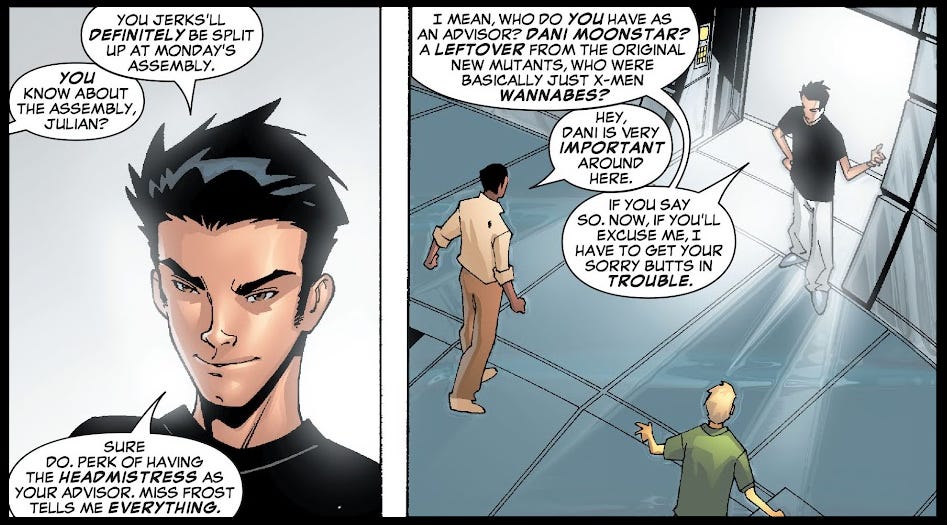
The rivalry between the two teams extends to their advisors: Dani does not like Emma. And why should she? Emma was a straight-up supervillain when they had their unpleasant first meeting in the original New Mutants, and Dani missed her reformation arc in Generation X. For her part, Emma thinks Dani sucks at her job. (Given that the Hellions operate like a well-oiled machine while the New Mutants are riven by interpersonal drama, she might be right.) Continuity can be fun, especially when the writers and editors bother to remember it.
Reportedly, DeFilippis and Weir wanted to give each of the non-New Mutants squads their own limited series, telling the stories and exploring the personalities of all the minor characters and faces in the background of New X-Men. They were only able to one out the door: New X-Men: Hellions.
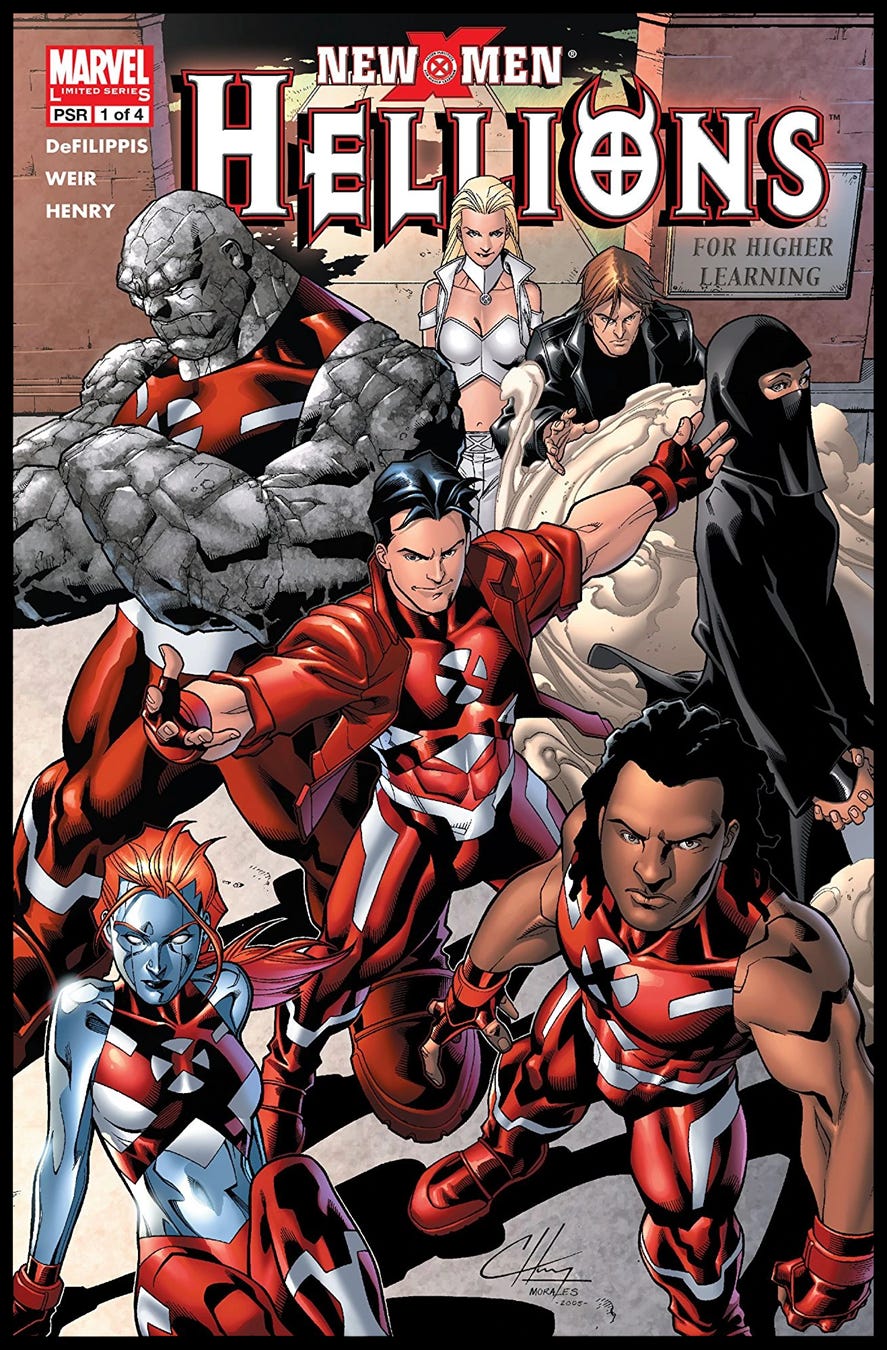
We don’t need to examine any of Hellions’ four issues. It will be enough to say that it possibly had the unintended consequence of making the characters at the center of New X-Men seem less interesting than their rivals.
But—there you have it. That’s Nunzio DeFilippis and Christina Weir’s Academy X: 10–20 percent action, 90–80 percent adolescent drama and character work. It’s not my favorite, but I certainly don’t dislike it, and it deserves a lot of credit for being less conceptually at odds with itself than the original New Mutants, and much more competently realized than Generation X.
But the editors had a vision for the Marvel Universe and the X-Men’s place in it—and New X-Men: Academy X stood outside the new parameters.
DeFilippis and Weir left the book after issue #19, the last chapter of a four-part story for the House of M EVENT. Their authorial duties were then assumed by . . .
II. Craig Kyle & Christopher Yost
(New X-Men #20–46)
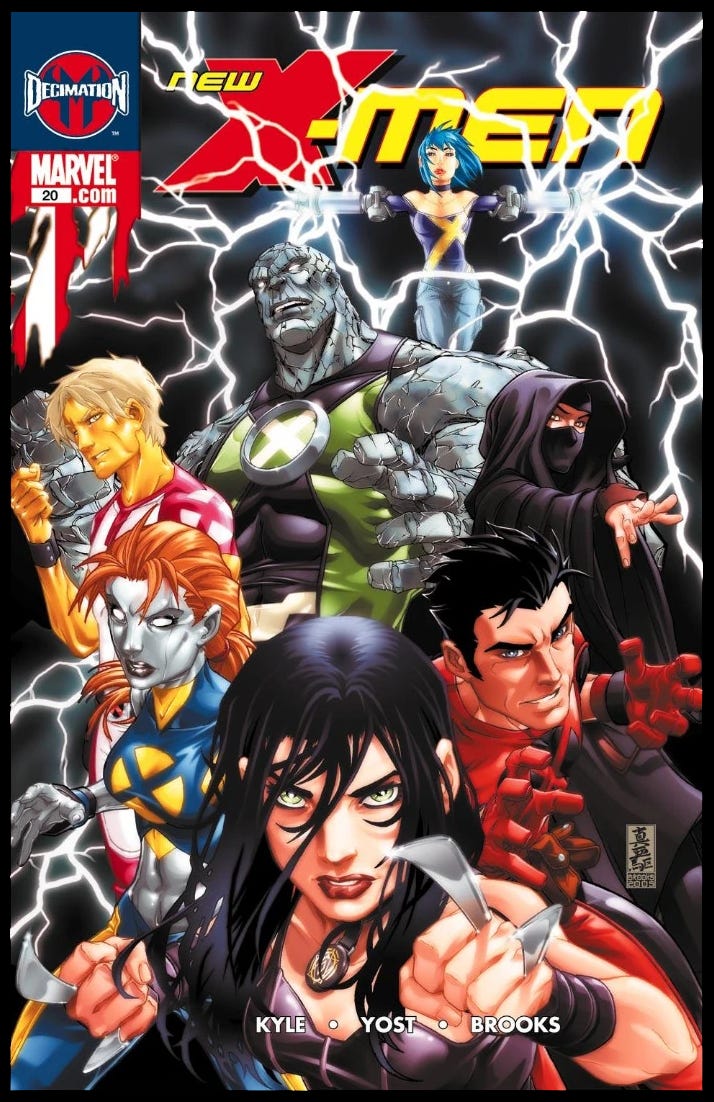
In 2005, Craig Kyle and Christopher Yost had very little experience writing comic books. The big item on their CVs was having worked together on the animated television series X-Men Evolution—the one that came out in the early 2000s and reimagined (most of) the X-Men as high-schoolers. You can see how that might be relevant here.
They take over New X-Men (notice: “Academy X” has been dropped from the title) on issue #20, and co-write the series until it ends on issue #46. Having been brought on for the specific purpose of winnowing down the cast and bringing New X-Men into compliance with the editorial department’s edict to push the X-Men’s backs harder against the wall than ever before, they get right to work.
Their first storyline, in brief: on the morning of M-Day, most of the Institute’s students wake up without their powers. Confusion ensues, and escalates to a general panic in short order.
Meanwhile, William Stryker, an anti-mutant fundamentalist Christian—introduced in Chris Claremont’s God Loves, Man Kills on the Marvel Graphic Novel imprint, and also the antagonist of Bryan Singer’s 2003 film X2—believes M-Day was literally a miracle from God. He prepares his band of heavily-armed religious fanatics, the Purifiers, to storm the Xavier Institute and cleanse the world of the mutant hellspawn cloistered within.17
Let’s get down to brass tacks. Which characters do Kyle and Yost write out and/or kill off?
Dani gets depowered; Emma forces her to leave the Institute. Sofia gets depowered; she packs her bags and quietly slips out. Kevin thinks he’s depowered, touches Laurie, withers her arm, and then runs away. Brian gets depowered; he and forty other depowered students leave the Institute on a bus, and are slain en masse by a Purifier assassin with a grenade launcher. Laurie gets shot in the head by a sniper. Jay has his wings amputated by Stryker and then gets shot in the head.
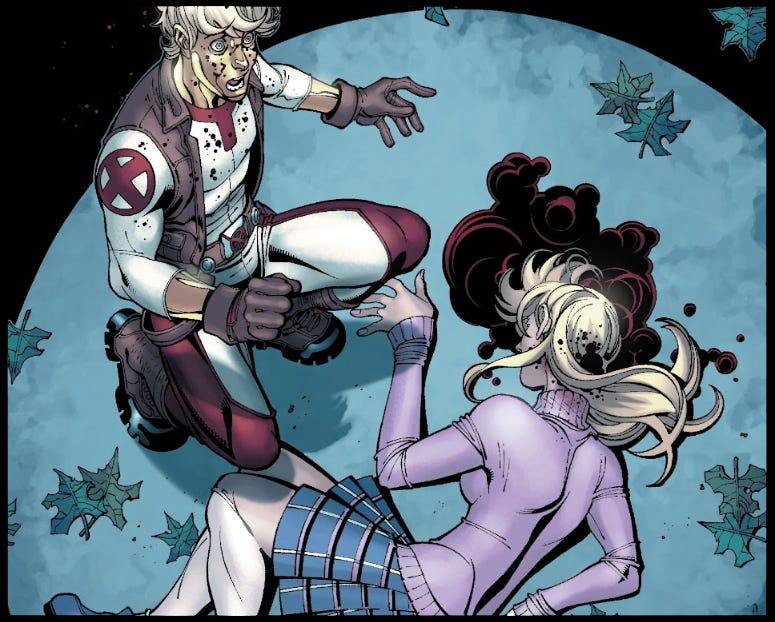
Headmistress Emma Frost, meanwhile, begins behaving erratically. She has the remaining students (fewer than thirty) participate in a battle royale to determine which ones will receive special combat training to become the new (and likely final) generation of X-Men. Initially, the lineup consists of the two members of the New Mutants squad who are still present, powered, and unmaimed (Josh and Noriko) and all the extant Hellions (Cessily, Julian, Santo, and Sooraya), plus X-23 from NYX.
Imagine if JK Rowling wrote out Harry and killed off Hermione at the beginning of Harry Potter and the Order of the Phoenix, and then made Ron, Ginny, Malfoy, and a few Slytherin characters the focus of the story from there on out. That’s more or less what happens here. For readers who had been following this series since it began as DeFilippis and Weir’s New Mutants, it was one heck of an adjustment.
The early addition of X-23 (now given an actual name: Laura Kinney) must have solidified longtime fans’ certainty that New X-Men was no longer the book they’d grown to love. Since her debut in NYX, Laura had been developed in subsequent appearances into a hypercompetent, instant-healing, teenaged murder machine who doesn’t know much about acting like an ordinary person.18 Readers who already weren’t happy about the book’s change in direction had one more thing to complain about as they watched Kyle and Yost inserting their original character from X-Men Evolution into the story, pushing her to the forefront, and making her Julian’s new love interest after writing out Sofia. Maybe a few of them were old enough to grouse that it was exactly like what Rob Liefeld did when he arrived on New Mutants in 1990: not only revising the whole idea of the series, but situating his OC Cable in the lead role.
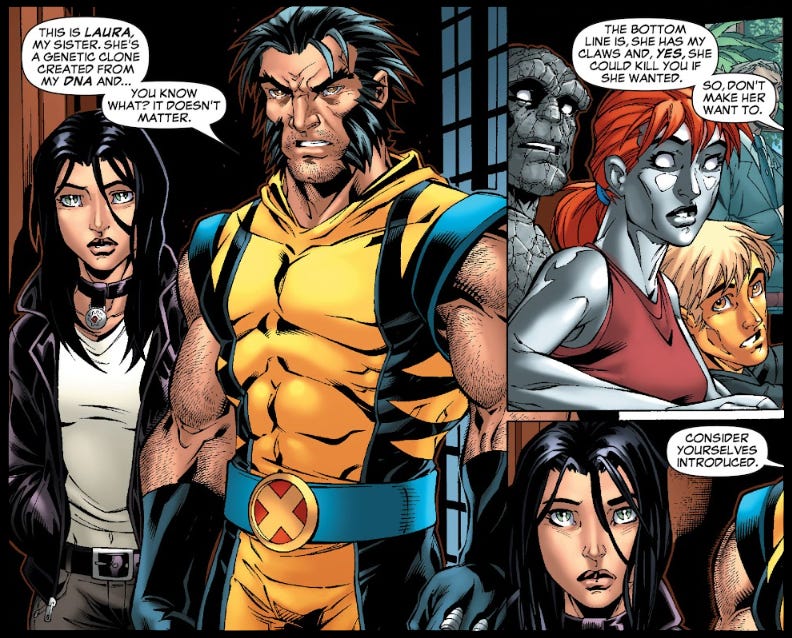
But this should look familiar by now. As the original New Mutants and Generation X approached their conclusions, you remember, people positioned to make creative calls decided that the current junior-team X-Book needed to be less “kiddy.” Rob Liefeld had the New Mutants falling in with Cable and becoming a squad of outlaw militarists after writing out most of the cast; Warren Ellis and Brian Wood sent Generation X off to fight ghastly dead-child cyborgs and then had them enact a life-or-death version of School Ties that climaxes with high explosives and fratricide. So now here come Kyle and Yost, torpedoing New X-Men’s foundational “students, not superheroes” conceit and turning the remainder of the series into another Violent & Dark action book where the kids have to fight villains and monsters.
To illustrate the point: here’s a short montage of people screaming in New X-Men:
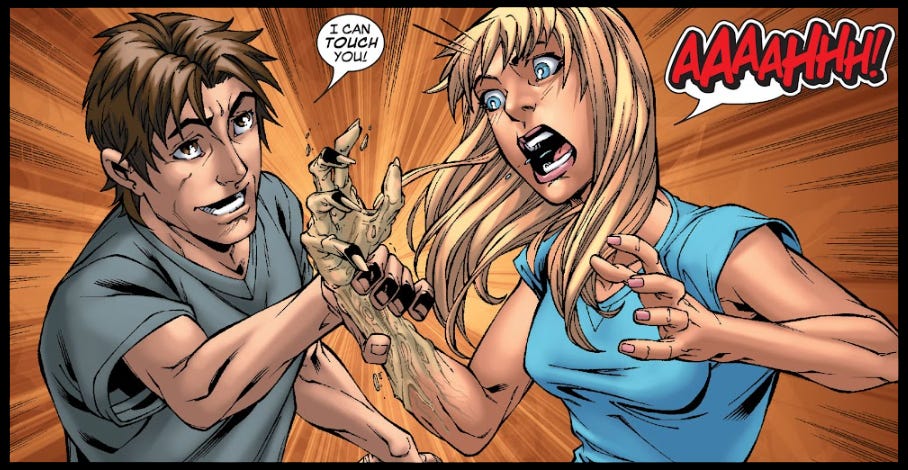
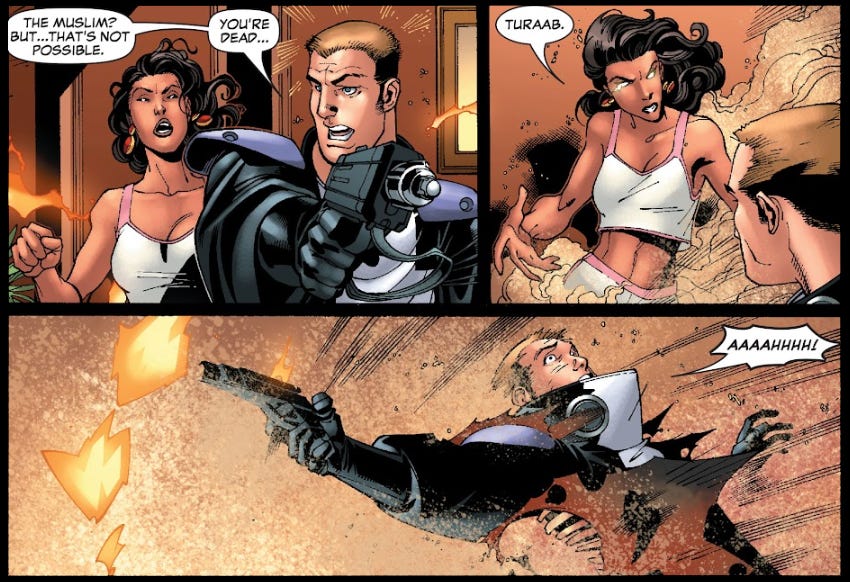
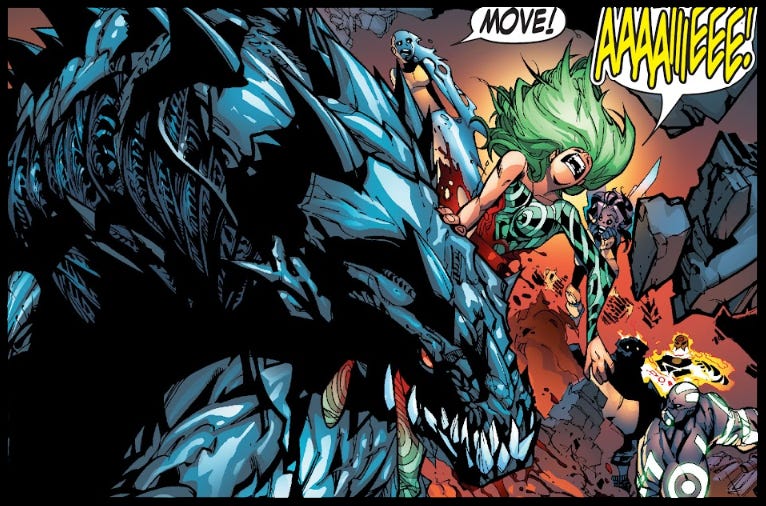
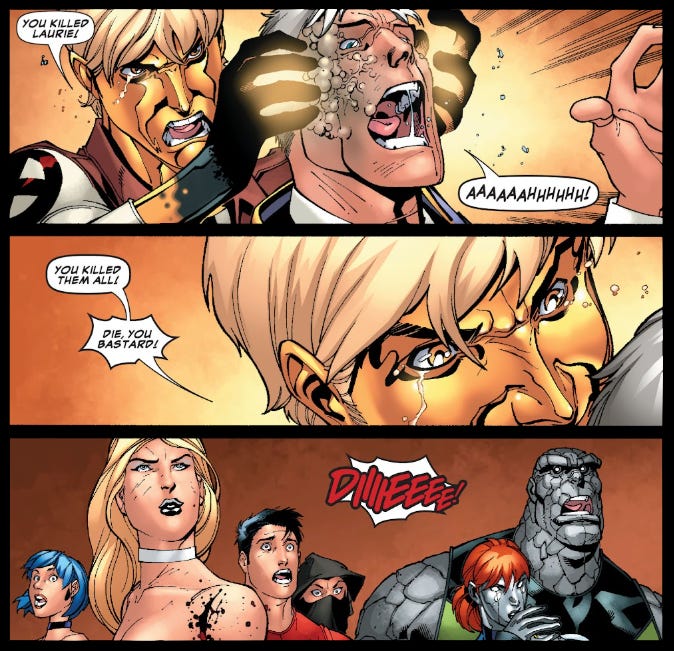
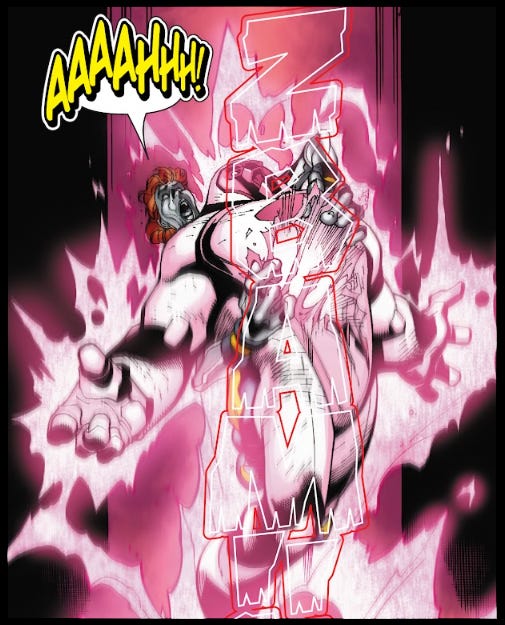
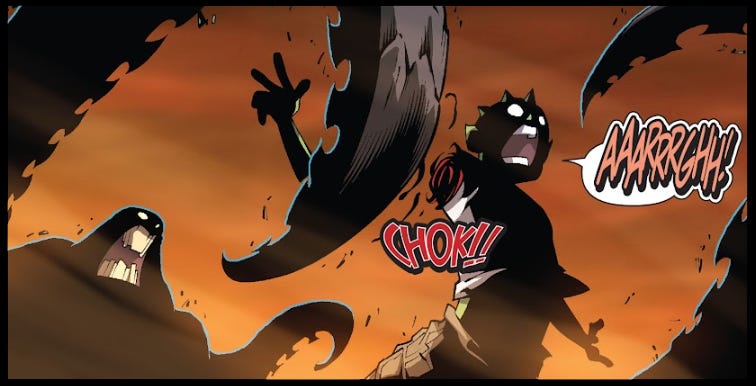
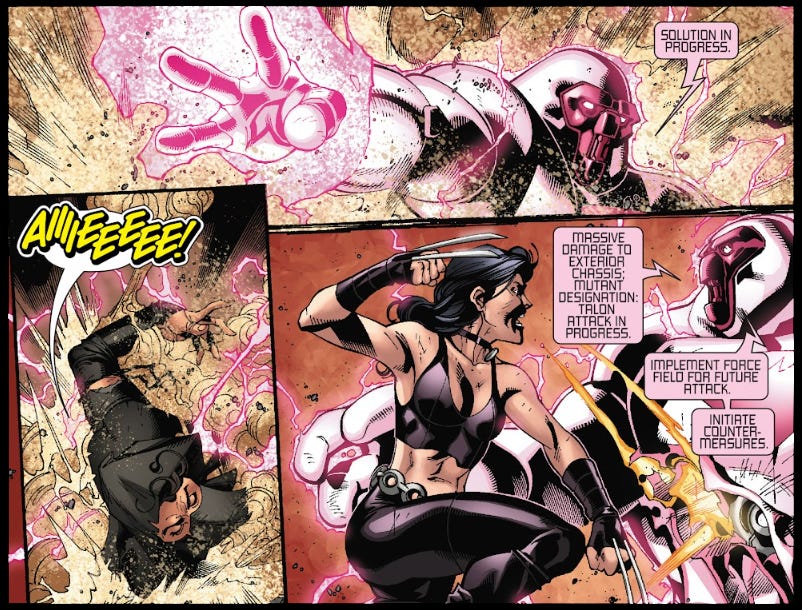
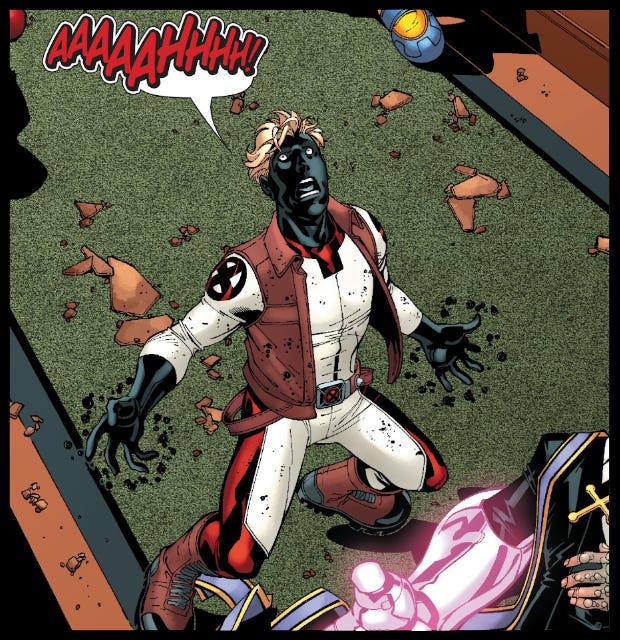
This is not remotely exhaustive.
But here’s the thing: Kyle and Yost’s New X-Men run stands leagues apart from what Liefeld did to New Mutants and from Ellis and Wood’s edgier, harder, six-months-laterer Generation X. They’re A-tier X-Book authors and know exactly what they’re doing. Having previously worked on an X-Men show for basic cable, they come into the comics with televisions writers’ appreciation for pacing, parsimony, and narrative structure, as well as a honed instinct for What Works. Moreover, they clearly took the time to familiarize themselves with the Academy X kids and learn what makes them all tick. The series’ emphasis on their interpersonal dynamics doesn’t go anywhere. If anything, Kyle and Yost amplify it.
With no disrespect to DeFilippis and Weir, I’m not sure I’d have ever felt compelled to revisit their run on New Mutants/New X-Men: Academy X if I couldn’t appreciate it as a long, patient lining up of the dominoes for Kyle and Yost. We’ve gotten to know who these characters are during (relatively) ordinary and happy times; now we see how they behave when the ground falls out from under them and they’re plunged into desperate extremes.
The character work here is impressive, especially where the former Hellions are concerned. Julian gets taken down several pegs, and finds himself in way over his head with Laura. Cessily comes into focus as one of the most and one of the least human students: a person-shaped blob of liquid metal who just wants to take care of her friends and be happy (and would prefer not be a blob of liquid metal if she had a choice in the matter). The ultra-earnest Sooraya complements her as the second chamber of the team’s heart, and manages to be remarkably expressive in spite of her covered face. (Pencillers Paco Medina and then Skottie Young do a great job with her.) Santo becomes a stellar “lovable dumb asshole” figure who, in some parallel universe where Deadpool never existed, is known as the funny X-Men character. Several also-there students who appeared in DeFilippis and Weir’s run—the ones who aren’t written out and/or killed off—stick around, and are consistently well-used in the capacity of minor characters.
The encompassing theme of what Kyle and Yost do with these characters, and with this book, can be summed up in two words: trauma bonding. Historically, the junior-team X-Books have been dipped deep in the genre sauce. These are superhero comics, after all—and in superhero comics, Batman’s plucky pubescent sidekick Robin doesn’t get psychologically scarred by being fired upon by bank robbers, held captive by murderous gangsters, or chained to an anchor and thrown into a shark tank by the Joker. There’s no time for any of that. We’re not supposed to read Generation X and find it odd that seeing a bunch of splattered corpses or surviving the third or fourth attempt on their lives at their own home hasn’t left Angelo, Everett, et al. terminally jumpy.
Kyle and Yost’s New X-Men is a little different.
This run is very much a product of its moment, of a period where superhero comics more conscientiously looked towards adults and older teenagers as their main audience. What happened during the 1990s, I think, was comic book creatives and fans taking the wrong lessons from Watchmen and the Dark Knight Returns, equating cool & smart & “mature” comic-book storytelling with grimness & grittiness & violence. The 2000s, to some extent, was a corrective catching-up. To my mind, the series that exemplified the new paradigm, and pushed it to its limit, was DC’s Identity Crisis. It’s dark, violent, and definitely not in the running for the decade’s best superhero comic—I don’t suppose you’ll find many people nowadays who won’t add an emphatic “but” to any praise they might have for it—but it was nevertheless a big & ballyhooed EVENT that didn’t focus on some supervillain’s world-domination gambit approaching its endgame. It’s about the collateral damage the super-person lifestyle inflicts on heroes’ loved ones, and the lengths to which the incognito “good guys” go to protect their normie family members. I don’t think anyone at DC would have even thought to attempt something like it a decade earlier. Across the board, there was an earnest attempt to imbue these stories about spandex-wearing vigilantes with a gravitas and emotional realism that had a less schlocky and melodramatic ring than the comics of the twentieth century.
To be sure: there was still a lot of melodrama and action-adventure schlock. This stuff doesn’t exactly attain the depth and sophistication of something like Anna Karenina—or even Watchmen, for that matter. Still, we do see writers and publishers trying their best to push the envelope of the genre and put out material that couldn’t be written off as puerile picture-books quite so easily as the excessive and decadent comics of the early-to-mid-1990s.
Kyle and Yost’s New X-Men augments the old “teen superhero series” formula with a kind of vulnerability that isn’t present—or at least not as concentrated—in New Mutants or Generation X. While Chris Claremont and Scott Lobdell underscored, each in his own way, the uncommon resilience and bravery of their books’ young casts, it feels somehow more meaningful that the New X-Men are able to pull it together. Kyle and Yost seem to be the sort of writers who express affection for the characters they like by putting them through hell.
I don’t want to give the impression that New X-Men gets into any genre deconstruction, but it does land differently that anything else we’ve looked at so far. Without putting too fine a point on it, New X-Men makes the reader feel the terrible enormity of the burden that has fallen upon its adolescent protagonists. If kids under twelve were reading this series—and they probably shouldn’t have been—I’m not sure they’d have been thinking about how awesome it would be to live at the Xavier Institute and have a cool superpower. In this book, that means getting targeted, brutalized, and traumatized.
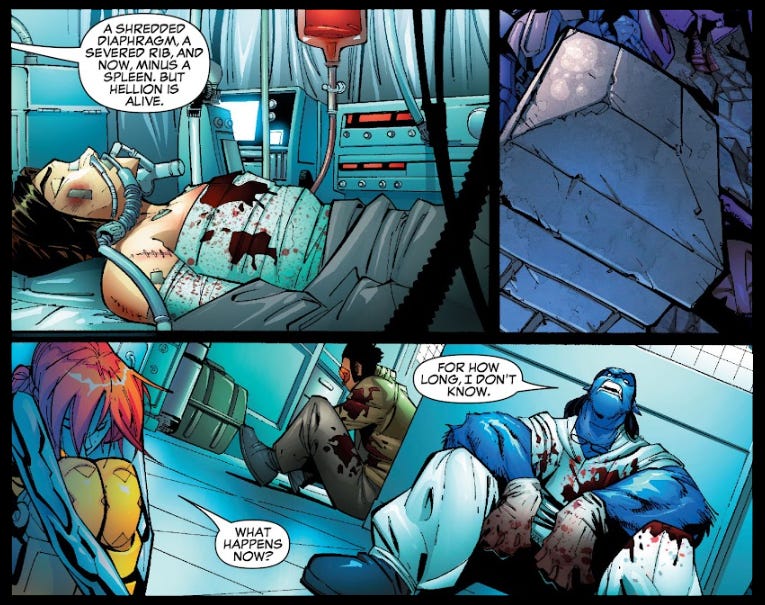
I might be willing to make the case that the half-decade between 2005–2010—bookended by the House of M and Second Coming EVENTS—were the X-Books’ most exciting years. Even if Decimation was contrived and annoying, it changed the tenor of the X-Books such that it felt like anything could happen, and what happened next mattered. The status quo was getting turned on its head almost annually, and the New X-Men and their book were casualties of the shakeup that occurred after the 2007–8 Messiah Complex crossover EVENT.
The demolished Xavier Institute shuts down and the X-Men briefly disband. Matt Fraction takes over Uncanny X-Men, and the book focuses on the group relocating to San Francisco. (John Francis Moore was ahead of the curve in setting up X-Force there in the late 1990s.) Mike Carey’s Adjectiveless X-Men has its title changed to X-Men Legacy; for a while it’s about Professor Xavier going his own way, and then it morphs into a Rogue book. New X-Men is cancelled, and Kyle and Yost elect to work on a new volume of X-Force that’s going to get made one way or the other. There was an attempt at a rebranded sequel/continuation, but—well, we’ll glance at that in a minute.19
When the team breaks up after Messiah Complex, it happens off-panel. There’s never anything like a one-shot where everyone shakes hands, says “nice knowing you,” and goes their separate ways. After their demotion from title characters, most of the New X-Men are consigned to the “Miscellaneous X-People” box by the mid-2010s. As a rule, the legacy characters—i.e., the ones who were visible between the late 1970s and the middle of the 1990s—are what move product, and the X-Men have a lot of legacy characters. The Academy X crew had the rotten luck of being just popular and recognizable enough not to quietly disappear forever (or get killed off for shock value), but too late on the scene as a secondary X-Team to ever be seated anywhere but at the kids’ table.
There exists a slew of vocal X-Men nerds who talk about New X-Men and its ensemble the way another subset of geekdom talks about the TV series Firefly. It’s easy to understand why: when you get to the end of Kyle and Yost’s run, twenty-seven issues just doesn’t feel like enough.
VALEDICTORIAN: Laura doesn’t count, since she was introduced in NYX, starred in a limited solo series, and had a stint in Claremont’s Uncanny X-Men ver. 3.0 before showing up in New X-Men. But if we were to ignore her being the comic-book equivalent of a pop industry plant, then sure, we’d have to go with Laura. She is, after all, probably the last X-Men character who will ever qualify for the “iconic” descriptor (or comes the closest, at least).20
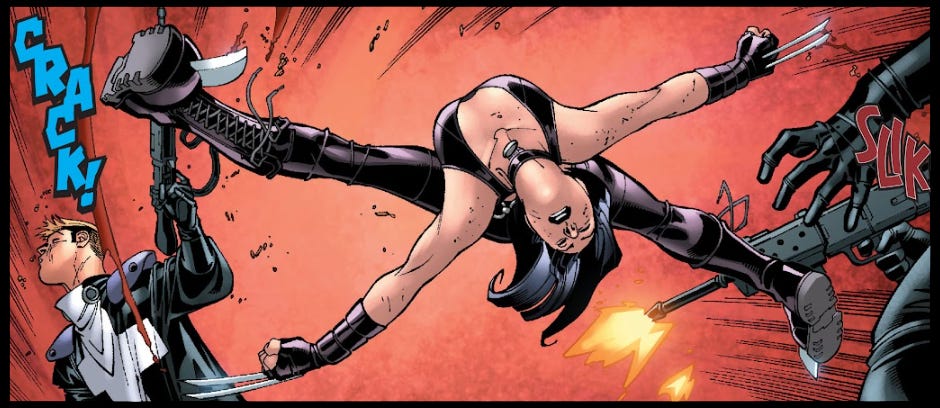
It occurs to me that my “Valedictorian” criteria have taken two different things into consideration: which character makes the best showing, and which character went on to be the most popular or high-profile after the series ended? Historically, the economics of comic books have usually ensured that the first entails the second. Where the Academy X kids are concerned, the arithmetic doesn’t work this way.
If we’re talking about the most consistently interesting and well-written character from the beginning of New Mutants to the end of New X-Men, it has to be Julian. DeFilippis and Weir introduce him as a high-school jerkwad, plain and simple. Fans sometimes compared him to Draco Malfoy. His ambition and arrogance seemed to put him at risk of going down the wrong path. In New X-Men: Academy X and the Hellions limited series, he’s fleshed out: we find that he’s genuinely in love with Sofia, savagely loyal to his friends, and has a strained relationship with his parents.
And then Kyle and Yost dismantle him. Sofia finally decides he’s an irredeemable jerk and leaves the Institute without saying goodbye to him. His mentor turns on him. He fails to protect his friends and classmates from the Purifiers. He’s repeatedly traumatized and humbled, and by the end of the series, he’s been completely broken down.
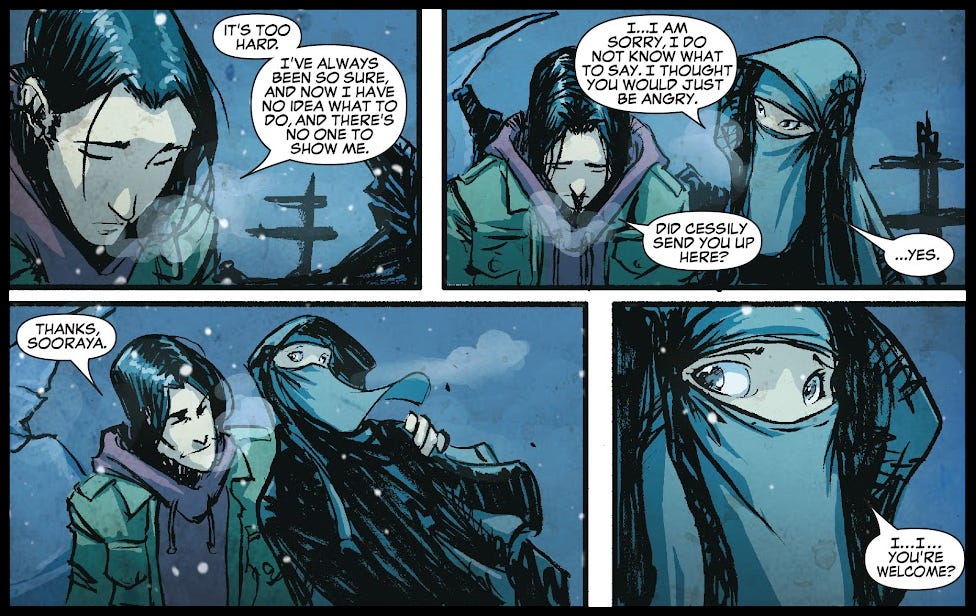
The implication is that now he’s ready to be built back up into something better than before—but, well, that’s not what ends up happening. (Hellion fans are a salty lot.)
If we’re going to talk about which of the characters went on to have the most prestigious post-New X-Men career, the answer has to be Megan Gywnn, aka Pixie. Wait—haven’t we mentioned Pixie yet?
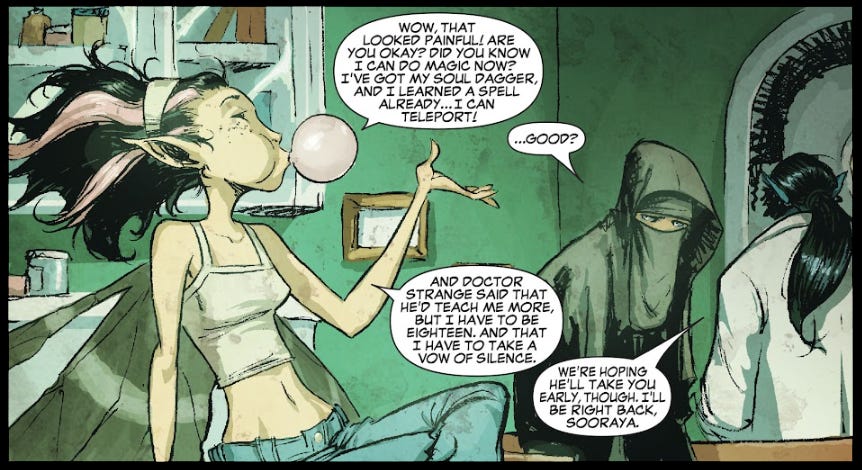
During DeFilippis’ and Weir’s run, she was a background character on the Paragons squad. She has fairy wings, scatters hallucinatory “pixie dust,” and wears a bicycle helmet because she’s afraid of crashing and injuring herself as she flutters around. When Kyle and Yost take over, they don’t start doing much with Pixie until the very last arc of New X-Men, and even then she’s still treated at least partially as a comic-relief character. (At least she loses the helmet, though.)
Shortly afterwards, Matt Fraction promoted Pixie to a full-on X-Man (er, X-Woman?) in his Uncanny X-Men run. She got her own limited series in 2010. She became a main character in Generation Hope. Si Spurrier made her a main character of his 2021 limited series Way of X, and its editorially contrived and hamstrung sequel Legion of X.21 Of all the Academy X characters who aren’t X-23, she’s had the most salient presence in the X-Books by a wide margin, even though she’s a second-stringer.
DROPOUT: Even though New Mutants began with Sofia, her importance quickly fades as other characters (Laurie, Josh, David, Noriko) and their relationships become the main sources of narrative propulsion. By the time Kyle and Yost take the reins, the only interesting thing about Sofia is the question of her romance with Julian. As abrupt and awkward as it was when Kyle and Yost wrote her out, I can’t say it was really a bad call.
Since departing from New X-Men, Sofia appeared in a bunch of series that few people cared about then or remember now, and is usually written tremendously out-of-character. But, hey, at least Kyle and Yost didn’t have her murdered.
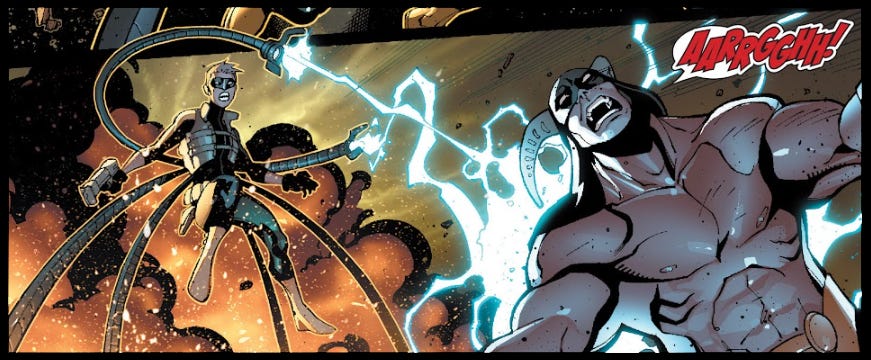
Hmm. On second thought, maybe exiting via gunshot wound like Laurie and Jay would have been the more dignified way to go.22
But the real answer is everyone who isn’t X-23. By the mid-2010s, none of these other characters will be seen very often. The era they belonged to passed. That does happen in comic books. But what’s interesting is that the New X-Men mark the beginning of a trend: most of the original characters we’ll be looking at from here on out will be similarly restricted to a moment in time. The farther out from 1991, the less staying power new characters have—especially ones of the next-generation variety.
I feel like this doesn’t bode well for the health of the franchise—but what do I know? I’ll save my speculations for next time.
MALEDICTORIAN: Hrm. Does Academy X introduce any new villains? There’s Laurie’s father, but we never even get past the foreshadowing on him. When Kyle and Yost take over, the baddies the kids thrown down against are established characters: William Stryker, Nimrod, Kimura, Belasco.
So—let’s give it to Illyana.
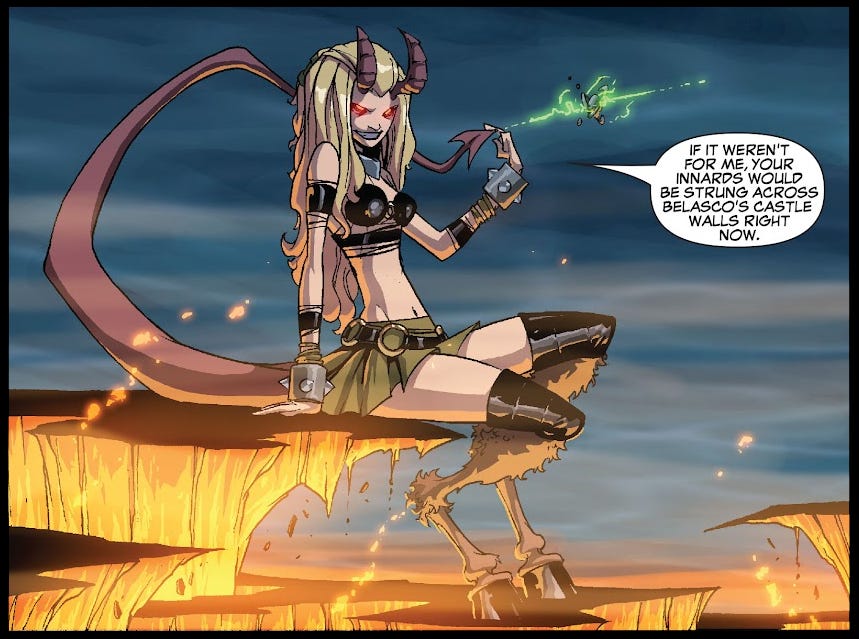
Yes, Illyana. As in, Magik/Darkchilde from the original New Mutants. Kyle and Yost’s New X-Men run is where she—or, rather, a soulless copy of her—returns to the continuity. This is the version of the character that eventually gets a soul, breaks good, and becomes a mainstay of the X-Books (with a modern-classic Chris Bachalo redesign) in the early 2010s. But until her rehabilitation, she’s a very nasty piece of work. (See below.)
BEST STORYLINE: I should probably nominate the four-issue “Nimrod” arc where the New X-Men take on—well, Nimrod. Lore-wise, the mutant-hunting pink robot from the future is one of the scariest opponents an X-Team can face down, and the New X-Men prove their mettle just by surviving the encounter. It’s intense.
But I’m actually going to give it to the two-part “Children of X-Men” story that more or less closes out the series. (There are another three issues afterwards, but they’re chapters in the Messiah Complex crossover EVENT.) In the tradition of Chris Claremont and his epigone Scott Lobdell, these are exemplary Quiet Issues arriving in the wake of a high-octane story arc. The students stay put at the Institute, and no fanatic militias, killer robots, demons, etc. show up gunning for them. Instead, the gang takes some R&R, receives medical attention, and processes the horrible shit that’s been happening to them.
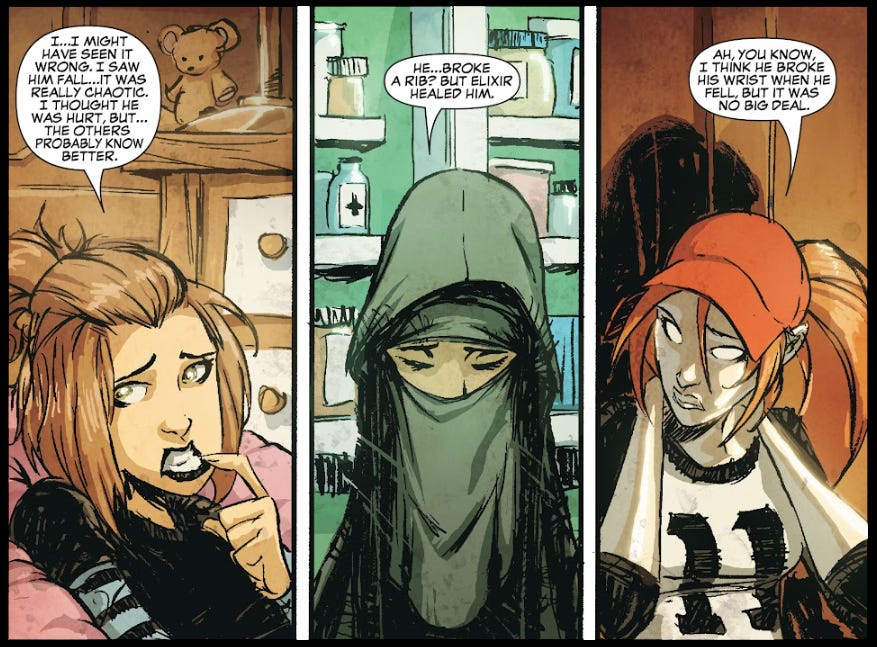
It rather feels like Kyle and Yost choose to end New X-Men by slowing down and doing a final story that evokes the series’ roots in Nunzio DeFilippis and Christina Weir’s New Mutants. These two issues amount to forty consecutive pages of character beats & moments, and run an impressively wide emotional gamut. After everything that’s happened since Kyle and Yost picked up the series, it feel appropriate to end with a reminder that these are still children who’ve got a lot of growing up to do—even though most of them are convinced they’re not going to live for much longer.
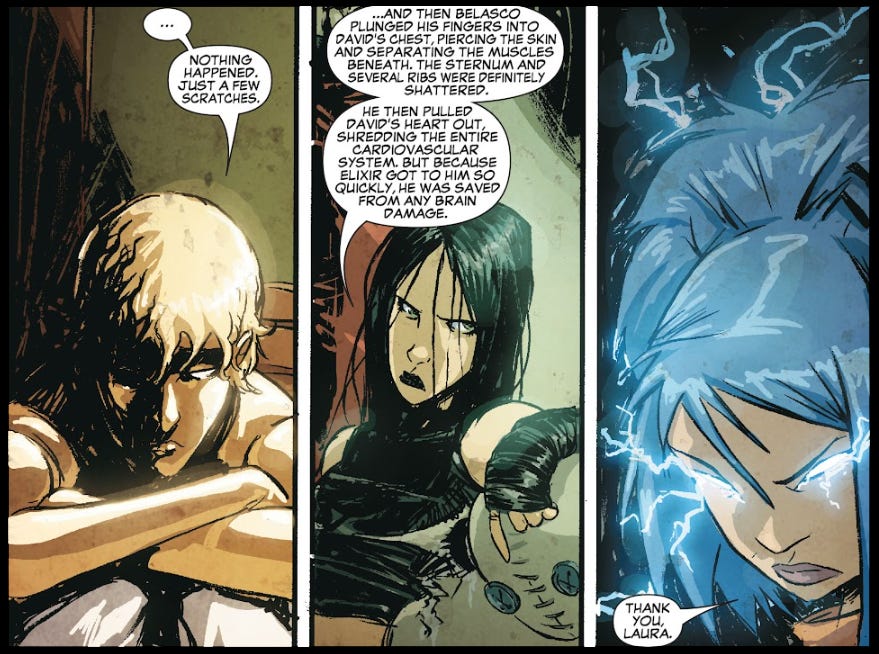
WORST STORYLINE: I’m going to default to the six-part “Choosing Sides” story that kicked off New X-Men: Academy X. It’s not bad, but it suffers from a problem that plagued DeFilippis and Weir’s entire run: inconsistent artwork. When you’re trying to get a new title off the ground, the third and fourth issues are an inopportune time to shoot illustrations like this into readers’ eyeballs:
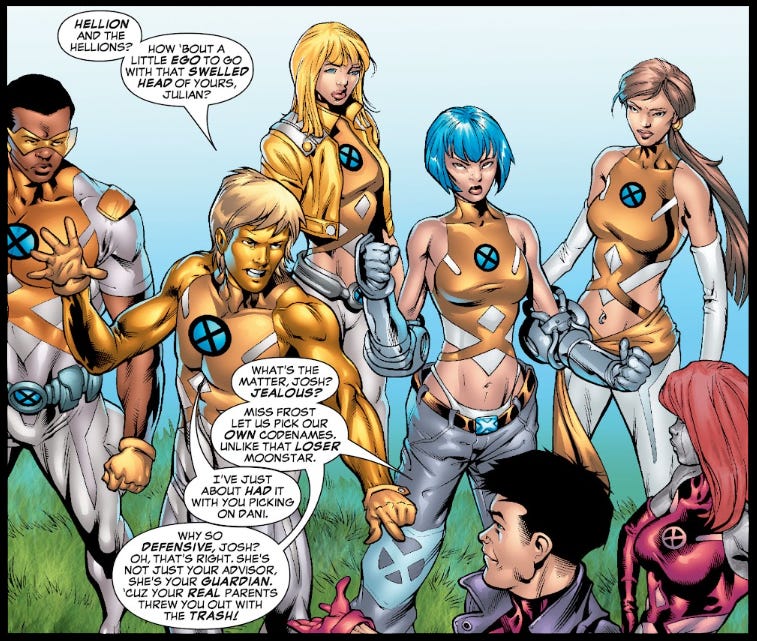
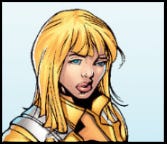
Cursed image: Laurie’s face in this panel.
(2008–2009)
Nope. I’m not doing this one.
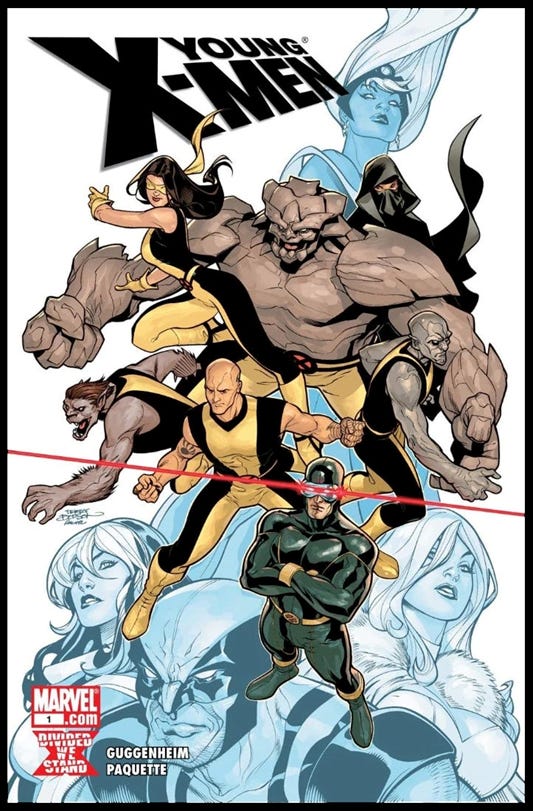
I’ve heard Marc Guggenheim is a very nice man—but he writes unbelievably dull comic books. Chuck Austen, Gerry Duggan, and Matthew Rosenberg have all penned X-Men material that’s so bad as to be offensive, and easy and fun to rag on, but Guggenheim isn’t even capable of that. The deadliest sin of a superhero comic is eliciting disinterested yawns, and based on this criterion, Young X-Men is in the running for worst X-Book of all time. It’s to X-Men comics what Matchbox 20 or Imagine Dragons are to rock music. It has characters, dialogue, a plot, story beats, fight scenes, interpersonal drama, and all the other ingredients of a superhero book—but it’s so boring.
It might be the pacing. It might be the characters’ voices, or their not really having voices. It might have something to do with the “decompressed storytelling” phenomenon. (We’ll talk about that next time, even though the aughts were when it took off.) It could be that rotating pencillers Yanick Paquette, Ben Oliver, and Rafa Sandoval were incapable of mustering up any enthusiasm for the scripts they were given. The characters Guggenheim invented for the series are charisma vacuums—that’s got to be a factor, too. Who knows. I don’t have the desire or the fortitude to conduct an analysis on what exactly makes Young X-Men such melatonin. But the series’ cancellation after just twelve issues was a mercy killing.
The funny thing is, Young X-Men wasn’t completely Guggenheim’s fault. From the get-go, its biggest problem was that the readers who would have made a point of picking up the first issue were almost certainly expecting a continuation of New X-Men—but most its characters are absent. Only Anole, Rockslide, and Dust stick around. They’re joined by Academy X background character Wolf Cub, Blindfold from Joss Whedon’s Astonishing X-Men, and anodyne new faces Graymalkin, Ink, and Cipher. This was an inexplicably bad call, and for a long time I assumed it was Guggenheim’s. But apparently—and I wish I could find the documentation again—he’s claimed that he wanted to stick with the Academy X group, and was told to formulate a new team with a few unfamiliar faces. Given Guggenheim’s inability to write even his original characters well, it was probably best that the number of fan-favorites imported from New X-Men to Young X-Men was kept to a minimum.
Either way, Young X-Men probably helped to cement the Academy X generation’s status in the eyes of the editors as has-beens and failures-to-launch who didn’t need a book of their own. There’s a not altogether infinitesimal possibility that Marvel went on to let Guggenheim write 36 issues of one of the X-Men’s flagship titles (X-Men Gold) in the late 2010s because it (or its parent company) was intent on sabotaging the X-Books. But that’s something we’ll save for next time.23
(2009–2012)
What? Again?
I should probably push this one ahead and treat it as a 2010s book, but let’s grandfather it in.
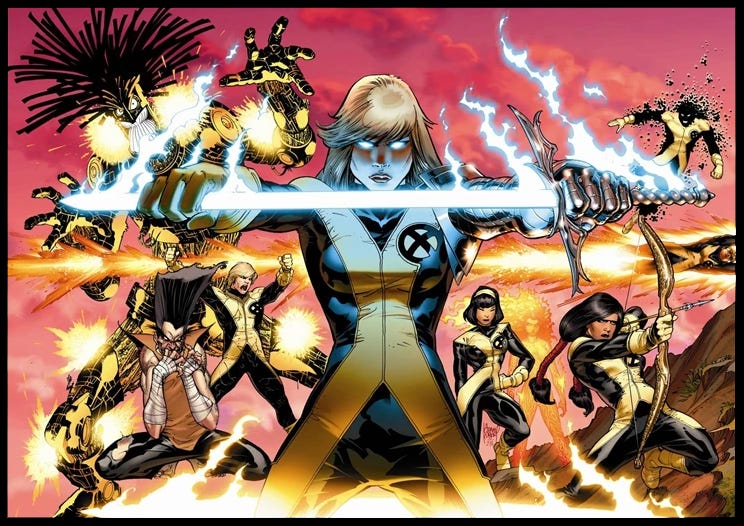
I. Zeb Wells
(Issues #1–21)
Although he’s lately known for alienating Amazing Spider-Man readers, Zeb Wells has a short but strong record on the X-Books. He’s an economical writer who excels at subtle character work and dark humor, and tunes his New Mutants run to the nostalgic key of the Claremont/Sienkiewicz days. Here there be demons.
As we’ve seen, John Francis Moore’s 1996–2000 X-Force run hearkened back to the series’ beginnings in the original New Mutants. Nunzio DeFilippis and Christina Weir wrote their 2003–04 version of New Mutants as a sequel, casting some of Xavier’s former students as mentors to a new generation. The third volume of New Mutants is a full-on revival series, garbing the Claremont-era crew in black-and-yellow combat uniforms and dispatching them to fight villains and monsters like it’s 1983. With the sole exception of Rahne (who’s off having a terrible time in Craig Kyle and Christopher Yost’s X-Force) the gang’s all here—even the ones who are supposed to be dead. Especially the ones who are supposed to be dead. (Why is the resurrected Doug in his early twenties after dying as a teenager? Shhh!)24
So why title it New Mutants if these characters haven’t been new in over twenty-five years? Because preexisting name-recognition value amounts to free marketing.
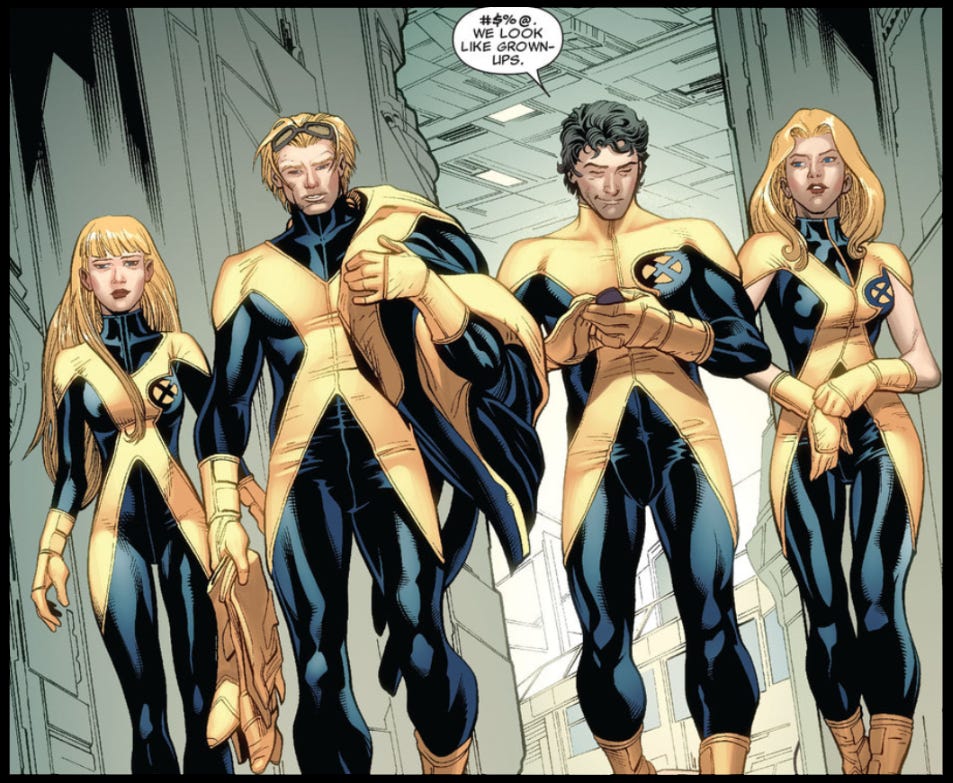
You’ll remember that X-Factor launched as a throwback to the X-Men’s 1960s iteration. While it reunited the old gang and partially restored them to the way they used to be (Marvel Girl lost her telepathy, Beast lost his blue fur, Cyclops lost his wife and kid, etc.), it also gave them new things to do—and new villains to fight. The third volume of New Mutants brings Doug, Illyana, and Warlock back into the fold, puts Dani and Shan back on a Fighting Team, and pits them all against a rogue’s gallery of familiar faces.
Story arc #1: David Haller (aka Legion) is back, and his Jack Wayne persona is causing trouble again. Who’s Jack Wayne? Well, jeez, weren’t you reading New Mutants in the early 1980s?
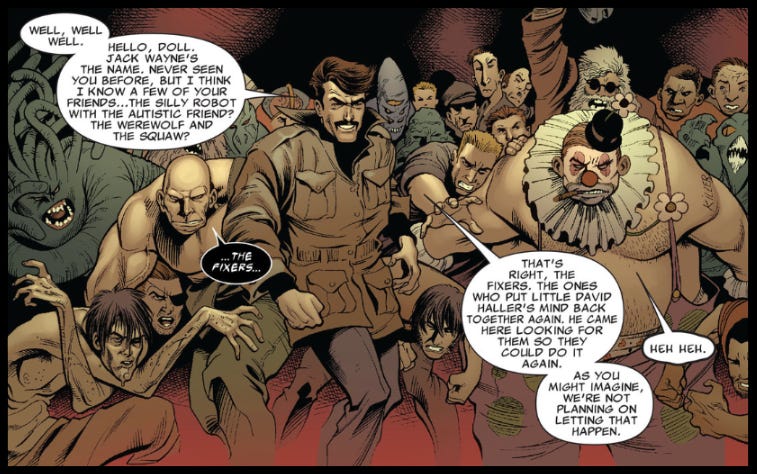
Story arc #2: It’s the original New Mutants versus the original Hellions—back from the dead as techno-organic revenants for the Necrosha EVENT. (Zombie Apocalypse stuff was a fad in the late aughts, you remember.) What’s the likelihood that someone who jumped into the comics circa 2005 read any of the issues of New Mutants (or Fabian Nicieza’s New Warriors) featuring Catseye, Jetstream, Roulette, et al.? Who knows!
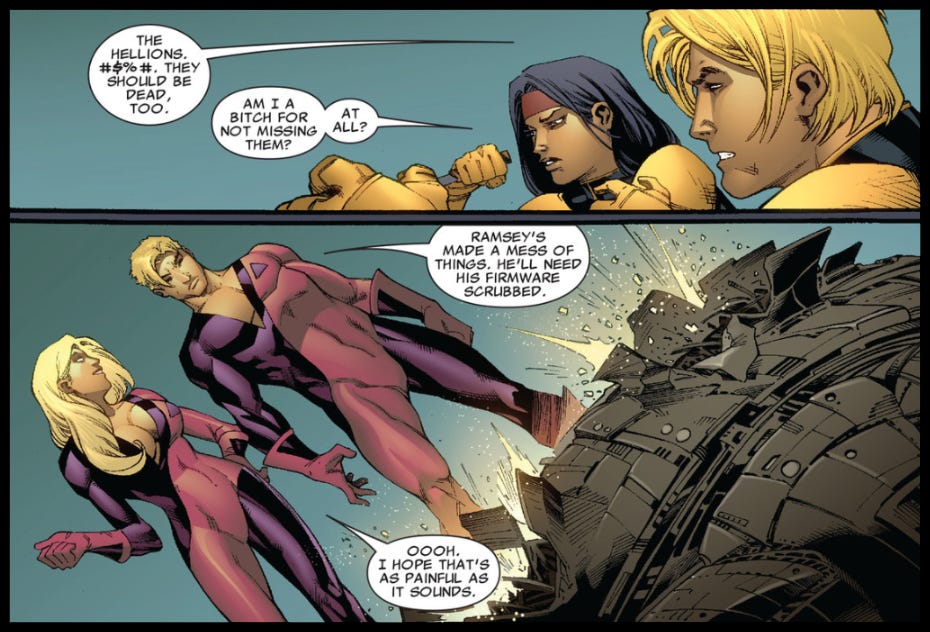
Story arc #3: This is where New Mutants enters into the Second Coming crossover EVENT, so for three issues it’s not telling its own story. But in the crossover’s first act, the gang faces off against their old foe Cameron Hodge, mounted on his familiar spider/scorpion/tank robo-body once again. Were you there when Hodge killed Warlock during the X-Tinction Agenda crossover EVENT back in 1990? If not, then perhaps you might not fully appreciate the cathartic impact of seeing the not-actually-dead Warlock going berserk and overpowering him. But perhaps you might! Who knows?!
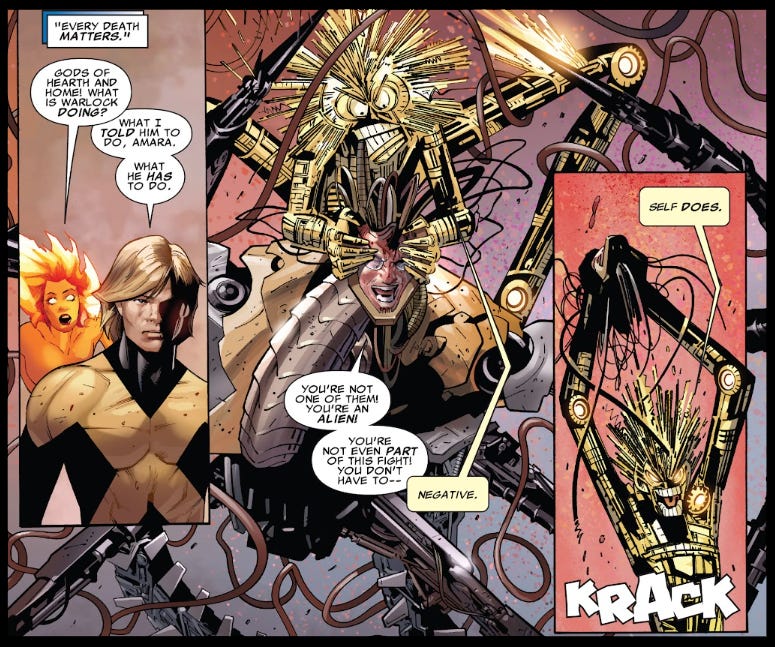
Story arc #4: It’s the grown-up New Mutants versus the grown-up Inferno Babies! Were you reading X-Men comics in 1989? Did you pick up the X-Terminators limited series? Did you go back and read the collected edition of the Inferno EVENT since then? Because if you did, boy will you be shocked to see what happened to the demon-abducted infants the X-Terminators rescued and turned over to the authorities! Otherwise, you’ll have no idea who these people are supposed to be, since nobody’s even mentioned them in like twenty years.
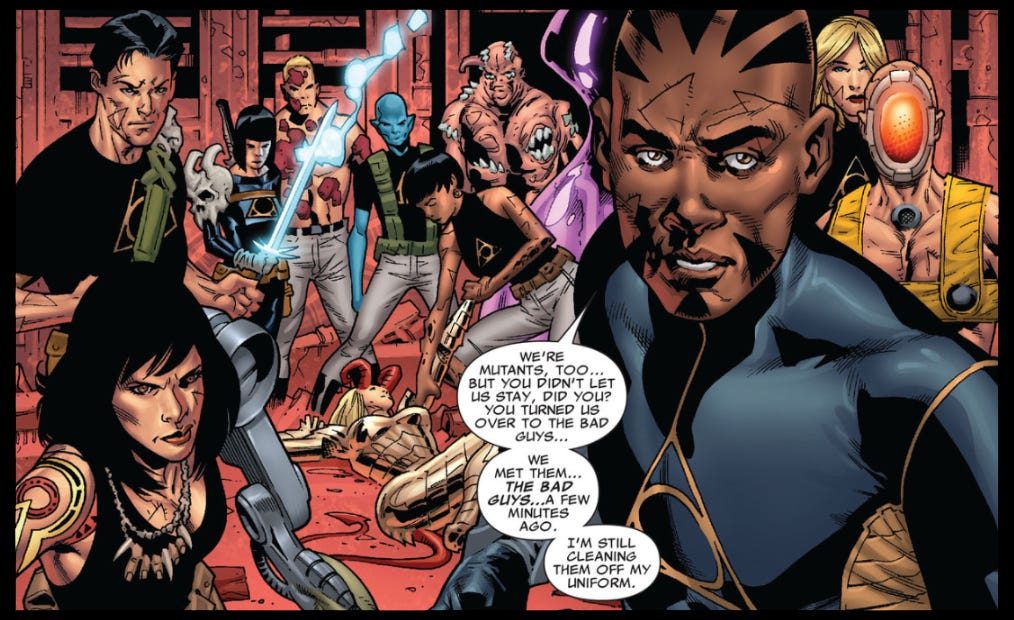
Ironically, the third volume of New Mutants, the original teen-team X-Book, was primarily aimed at older readers who knew their way around the lore. Was anyone under the age of thirty-five in 2009 going to have an emotional response to seeing the old Claremont-era crew getting back together?
But even though the series was made as catnip for longtime fans, there’s nothing stale about it. Wells transplants long-abeyant comic-book characters and stories from the 1980s into the late 2000s and early 2010s—two very different eras—and succeeds impressively. Since superhero comics were increasingly being made for Big Kids during this decade, there’s something delightfully appropriate about Chris Claremont’s X-Teens, all grown-up, reuniting for new escapades in a series that’s simultaneously true to their roots and fully in concert with the mood and aesthetics of late-aughts comic books.
I won’t guess how many brand-new fans it was able to win over, but I’d like to believe that it did capture the interest of a fair number of curious readers who subsequently went looking for collected editions of the 1980s series. Wells’ New Mutants is exciting stuff, and never gets so dark or heavy as to be joyless.
Sam, the natural choice for team leader (on the basis that he’s been an actual X-Man before), finds out the hard way that he’s not cut out for the role and gets a great big helping of PTSD as a consolation prize. Dani recapitulates the arc of the depowered Storm in Uncanny X-Men by becoming even more of a bad-ass without her mutant abilities. With Doug, Wells more or less settles Chris Claremont and Louise Simonson’s unfinished business with the character: bringing him back to the world of the living via his link to Warlock (Simonson’s original plan), and escalating his pattern-recognition powers to the point where they make him tremendously dangerous (probably what Claremont had in mind). Amara, Roberto, and Warlock are still Amara, Roberto, and Warlock, and they earn their places in the ensemble.
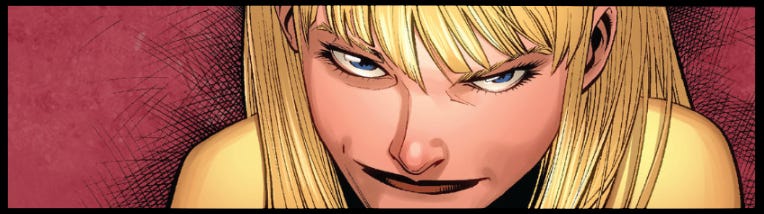
Once again, it’s Illyana who steals the show. While Claremont and Simonson liked to go on about the corrosive evil eating away at Illyana, neither writer’s depiction of the character as a young woman with a tainted (or in this case, absent) soul holds a candle to Wells’. He wrings a lot of pathos and dramatic irony out of her old friends’ being so happy to have her back that they’re unable or unwilling to see her for the manipulative sociopath she is until it’s much too late.
As for Shan—nope. Wells can’t think of much to do with her either. So he goes the obvious route and tortures her.25
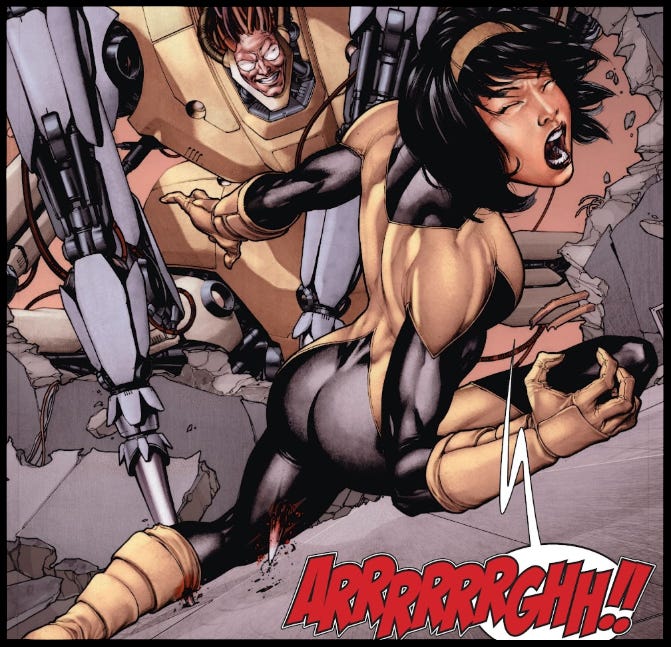
II. Dan Abnett & Andy Lanning
(Issues #25–50)
If you’ve been paying very close attention, you might have noticed that there are three unaccounted-for issues between Wells’ and Abnett & Lanning’s runs. These were chapters of the Age of X crossover EVENT, which ran through New Mutants and Uncanny X-Men and X-Men Legacy, and were written by Mike Carey.
Age of X—Age of Apocalypse throwback #2—sure was a thing that happened. By now we are into the 2010s, and “that happened” will increasingly sum up the contents and developments of the decade’s X-Books. A not-miniscule portion of the fandom likes to call this the Lost Decade. But more on that next time.
So now British writers Dan Abnett and Andy Lanning (best known for their work on DC Comics’ Legion of Super-Heroes) are the series’ authors. In summary: their run isn’t terrible. But the end of Wells’ run might be an okay stopping point if you ever choose to read this stuff.
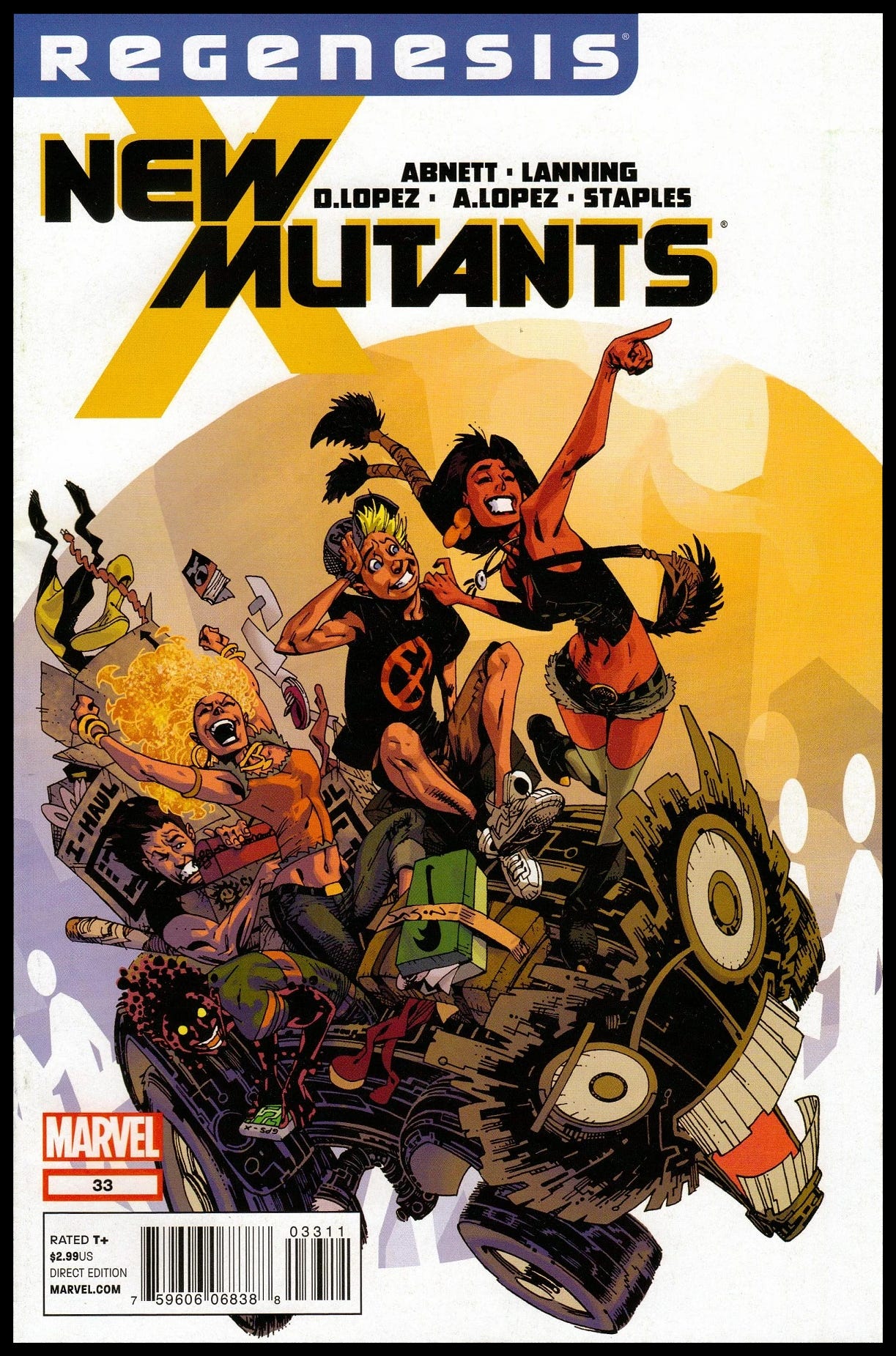
After sending the team off to fight Age of Apocalypse leftover villain Sugar Man (sure, why not?) and trying their gosh-darned best to imitate Peter David’s “the gang gets therapy” issues in his first and second X-Factor runs, Abnett & Lanning give the series its new premise. Dani and the gang (now minus Illyana, Sam, and Shan) leave the X-Men’s island fortress (don’t ask) to live in San Francisco, get normal jobs, and lead normal lives like normal people—while still being on call to go on any dangerous adventures Cyclops needs them to go on.
Sure! Why not?
So what happens during this run? Well—there’s an arc featuring Bird-Brain and the Ani-Mator from Louise Simonson’s run. Remember them? Yes, let’s bring back some of the most despised characters of the original New Mutants—because, sure, why not?
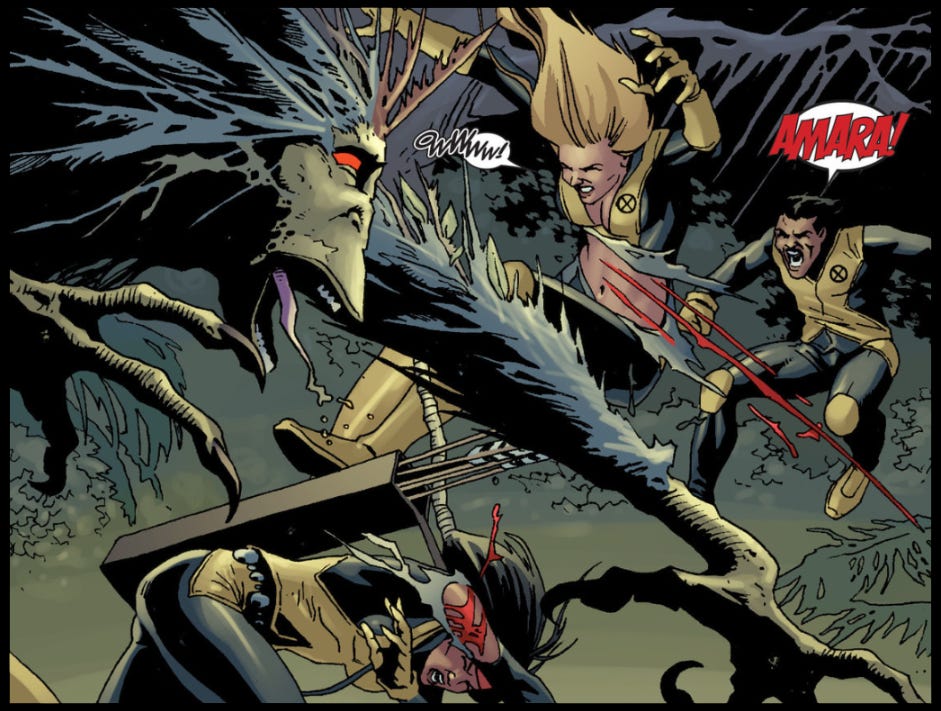
There’s also a romance between Amara and Mephisto. Like, you know, Mephisto—the Marvel Universe’s epitome of evil. Its capital-D devil. Gets off on screwing up people’s lives and spreading misery. Remember when Thanos snapped his fingers and killed half the universe? In the comics, Mephisto told him to do it. That’s the kind of guy he is.
In New Mutants, Mephisto is all dorky and flustered by Amara and sort of sweet— because sure, why not?
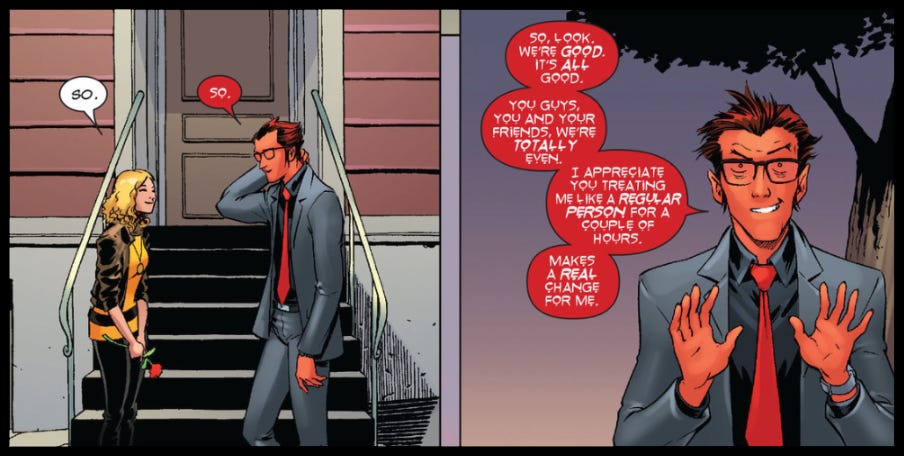
On second thought, let’s not talk about the story of Abnett & Lanning’s New Mutants. It will be enough to say that it’s a bit…tonally confused. In an odd change of pace, this is the only series we’ve looked at that started off dark and lightened up as it approached the finish line. While I’m reluctant to make any blanket statements about the vibe of 2010s Marvel, I reckon that “Magma dates a humanized Mephisto who wears hipster glasses” is a story idea that would have been shot down by the editors if it had crossed their desks any time prior to 2011.
Let’s wind this down by peering at the two new additions Abnett & Lanning put on the team. Neither is an original character.
First off, we’ve got Nate “X-Man” Grey.
Sure—why not.
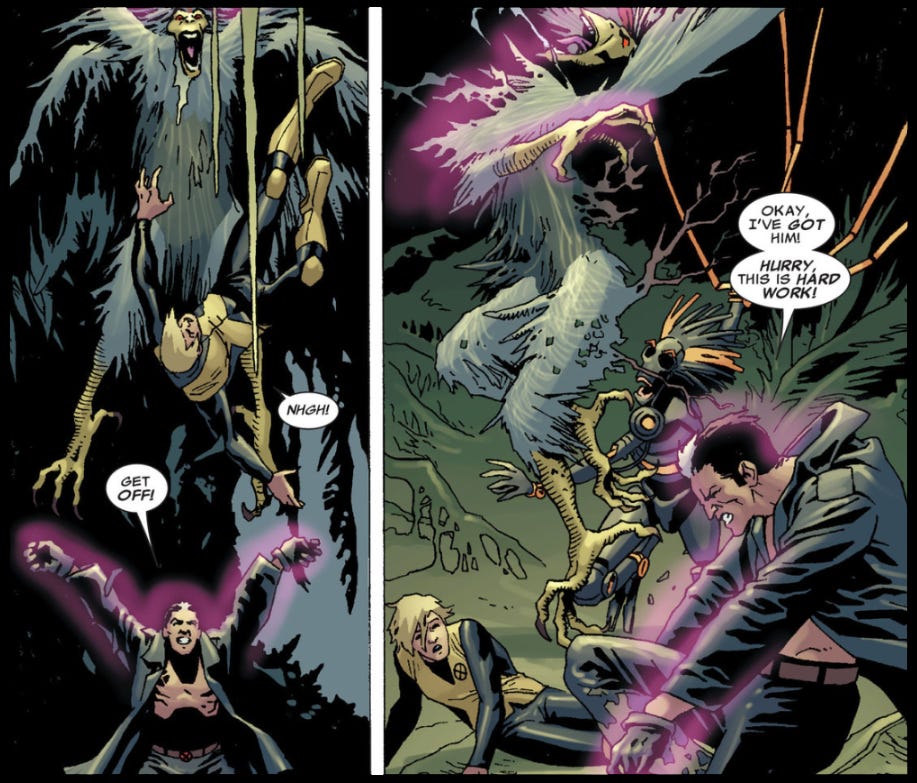
Since we last saw him, he’s grown a little older, has had most of his supermutant mojo drained from him, and is only capable of minor feats of telekinesis. Here he acts as the team’s resident stick-in-the-mud, and is—well, actually, a lot more interesting and likable as a peaked-at-eighteen grouch than a glowed-up brat of a demigod. He also enters into a romantic relationship with Dani. (Sure & why not.)
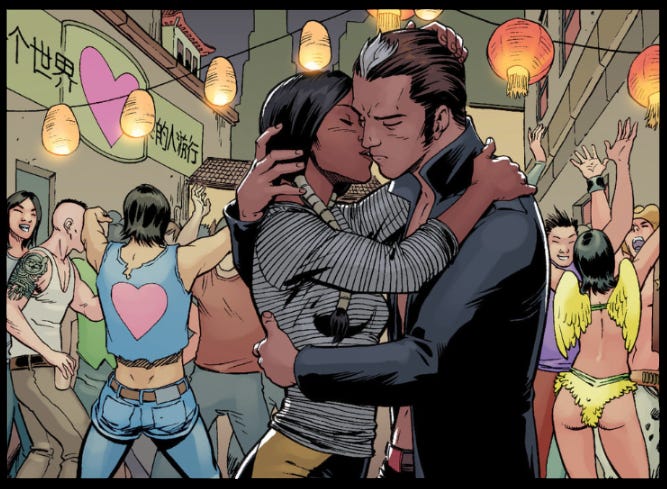
After this series ends, these two are never seen together again, their pairing is not spoken of (as far as I know), and Nate disappears for several years.
That’s going to be a theme of the 2010s X-Books. Stuff happens, and maybe it’s interesting, maybe it’s not, who knows. The new writers who get rotated in ignore the stuff that happened, and then make more and other stuff happen. It too gets forgotten about.26
Next, we’ve got Clarice Ferguson, aka Blink.
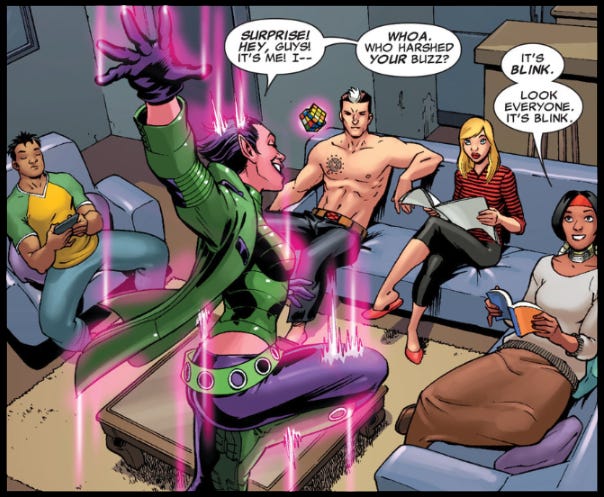
I think we need some background.
Clarice was the Generation X character who wasn’t. During the 1994 Phalanx Covenant crossover EVENT that introduced and brought together most of the team, Clarice sacrificed her life to save everyone from the big villain of the story. Here she was portrayed as a timid and mousy sort—kindhearted, but capable of causing a lot of havoc with her spatial distortion powers.
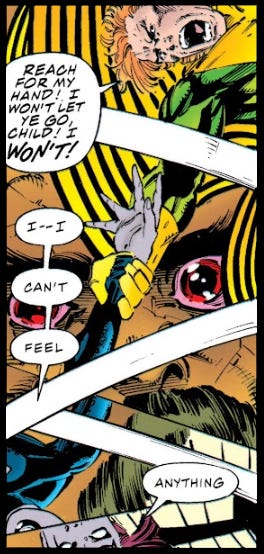
During the Age of Apocalypse EVENT, an alternate-timeline action-girl Clarice stole fans’ hearts. This version of the character didn’t shred things by turning them into triangles, but threw out energy darts that produced warp portals. Though she was thought to have disappeared from existence when the timeline reverted to normal, Judd Winick brought her back in 2001 to star in his dimension-hopping Exiles series. This is usually the character X-Men fans are talking about when they talk about Blink.27
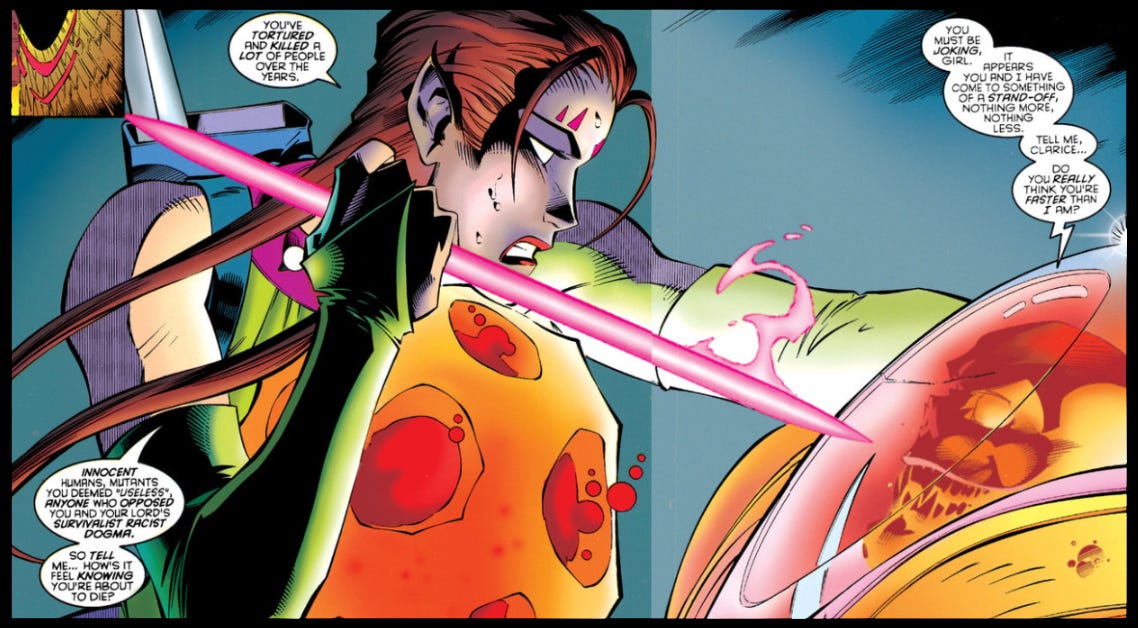
During the leadup to the 2009–10 Necrosha EVENT, the immortal mutant sorceress Selene goes around recruiting members for her inner circle. She visits the place where Clarice (the main-timeline Clarice whom everyone thought was dead) blinked herself out of existence, and reels her back into reality. After being lied to and love-bombed by her benefactor, quiet and sweet little Clarice turns into a cruel, violent fanatic.
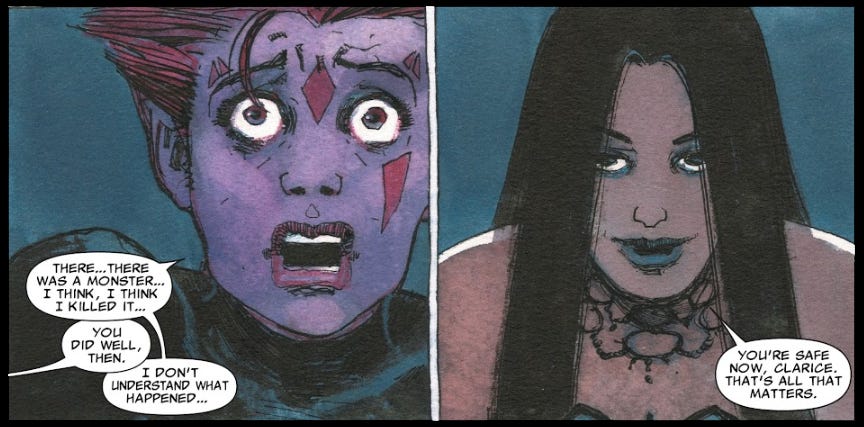
Sometime after Selene’s big zombie apocalypse scheme comes to naught, the X-Men track down Clarice and exorcize whatever evil voodoo she’d had injected into her. She eventually joins the 2010s’ iteration of the New Mutants as the peppy and fun-loving member of the gang.
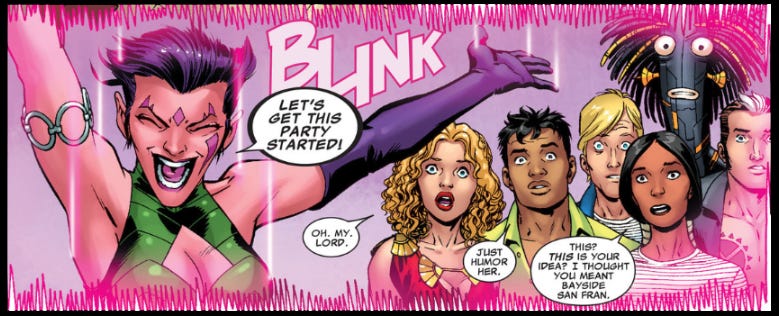
Hmmm.
So like—hm. Is it okay to draw Warlock like that?
No, wait. We’re talking about Blink here.
So as someone who was in elementary school when the Phalanx Covenant EVENT ran, and who owned and read and re-read the issues of Uncanny X-Men and Adjectiveless X-Men where Clarice was introduced and then killed off, I’ve got some quibbles about this depiction of her.
She acts like a stereotypical manic pixie—completely at variance with the quiet and sensitive Clarice whom Angelo, Monet, and Paige briefly knew (and with her tougher & bolder Age of Apocalypse doppelganger, too). Her powers aren’t supposed to work the way they do here; this version of Clarice is supposed to turn things into triangles, not perform teleporting light shows. And, like, okay, she was younger than the New Mutants when she was introduced—the New Mutants were generation two, Generation X was generation three—and then spent at least a few years in extradimensional stasis. So she should be significantly younger than Dani and the gang, right? There should be enough of an age gap that it would be awkward for them to hang out with her, right?? She shouldn’t even be old enough to drink—right???
Wait a second. “Niece?” Is Nate Grey talking about Rachel Summers, the alternate-timeline daughter of Scott Summers and Jean Grey? But since he’s Scott & Jean’s son from another timeline, wouldn’t Rachel be his sister from an alternate future that may or may not exist?
A fair answer to all of these questions might be: who the hell cares?
But still.
After fifty years of perpetually accruing content, the Marvel Universe and its continuity have by this point in our chronicle grown so huge that knowing everything about them practically qualifies one as a scholar (or an idiot savant). It’s become possible for the comics’ most committed longtime readers to know and value their lore more than the writers and editors in charge of perpetuating them. In the history of storytelling entertainment, this sort of thing might be unprecedented.
But let’s not intellectualize this. The unofficial rule is: you can blow off continuity, alter characters’ basic personalities, and change up the vibe if you’re good enough to get away with it. Ideally, you (the comic publisher/editor/writer) need to put out material that (1) impresses the grognards enough that they’re willing to say okay, whatever, it’s not correct/familiar/comfortable, but I like it anyway, or (2) catches the fancy and holds the attention of enough new customer-fans that you don’t need to worry about the oldheads finally following through on their threats to stop buying new releases because of your failure to honor the stories and the characters and the history and so on. Ideally, you’d try to do both—but if you’ve got to choose, your long-term interests are better served by (2), assuming you’re competent to pull it off.28
Most younger readers getting to know Blink in New Mutants wouldn’t have been bothered for an instant about the discrepancies between how she’s written here and in her first appearances in the mid-1990s. Wonderful; they shouldn’t have. For all I’m aware, a few hundred or thousand people out there will forever and ever love Abnett & Lanning’s New Mutants as their first favorite, their gateway into comic books. Who knows? But there also must have been at least a few X-Men geeks, some nineties-kid Blink fans for whom CARPE MARGARITAS! Clarice was the final nudge they needed to quit collecting superhero comic books and reallocate their time and disposable income to other pursuits.
A problem that hero comics and a few longstanding “geek” franchises are reckoning with at this moment has to do with a kind of commercial mathematics. Is your big legacy IP winning over and bringing into the fold enough new loyal customers (within a sufficiently large and consistent stream of curious visitors) to replace all the groaning oldheads and dissatisfied grognards complaining about how the new releases disregard the lore, are contrary to the spirit of the material, forget the franchise’s roots, generally suck, etc.?29
“Mainstream” comics have maneuvered themselves into an unusual and precarious position here.30 Decades ago, it was entirely possible to be a casual fan. While I may well be mistaken—and please tell me if I am—I don’t believe on-and-off readers constitute a significant revenue stream for publishers nowadays. Remember, nobody can grab the latest issue of Detective Comics or Captain America off the magazine rack at 7-Eleven or their local drugstore on a whim anymore. That’s just not a thing. Monthly comic books have become somewhat analogous to vinyl records: they’re something for connoisseurs, not a general audience.
We can examine this in more detail next time—but on a related note, let’s close this out by tallying up the number of EVENTS and initiatives this volume of New Mutants ties into.
Necrosha: three issues.
Second Coming: three issues.
Age of X: three issues.
Fear Itself: four issues.
Regenesis: four issues.
eXiled: two issues.
So: that’s nineteen out of fifty issues attached to some larger story that originated outside of its own pages. Almost 40 percent of this series either can’t be read and fully understood/appreciated without also reading something else, or occurred as a component of a linewide editorial directive. I’ll leave it at that.
NEXT: Manzikert
The Westchester mansion was actually renamed the Xavier Institute during Lobdell’s run, when the Massachusetts Academy Campus became the School for Gifted Youngsters during the Generation X years. (There’s the undiagnosed OCD again, possibly.) But this is where the change in nomenclature actually means something.
We didn’t touch on it last time, but the point of Onslaught was to write out characters with underperforming titles—Captain America, the Fantastic Four, Iron Man, et al.—so they could be hard-rebooted in a separate continuity and outsourced to Image Comics. It didn’t stick—but relaunches and reboots are lucrative short-term cash grabs, and the Heroes Reborn initiative was no exception.
Within five years of publication time, both Xavier and Magneto were re-powered. It had to happen.
NYX’s colors look pretty good, even though this particular panel might be a little overdone. The digital tools at colorists’ disposal were rapidly increasing in sophistication, and there are a lot of comics from the early aughts where it’s obvious that someone was really excited to play with a new toy. Some of it isn’t especially easy on the eye nowadays; look out for the cover of New X-Men #20 below.
Forgive me for being old-fashioned in genericizing “Vertigo comic.” In its time, the imprint went a long way in popularizing the kind of storytelling we see nowadays in stuff like The Nice House on the Lake, Something Is Killing the Children, Assorted Crisis Events, etc., etc.
It’s been a very long time since I’ve watched X-Men Evolution, so I glanced at some clips. Are you old enough to remember when broadcast TV cartoons had the animation budgets for stuff like this?
If you’re unfamiliar, go ahead and look up DC’s 2004 Identity Crisis EVENT. That’s the one where the Elongated Man’s wife is raped by a supervillain you might have seen on the Teen Titans cartoon. (Now that I look, there’s no Comics Code Authority seals on the covers of the Identity Crisis limited series.)
I guess it’s worth mentioning that Marjorie Liu and Kalman Andrasofsky do a 2008 sequel series called NYX: No Way Home, and I think it conjures a few whys and wherefores. I’ll admit that I’ve got no interest in revisting or doing a close read of it. From what I remember from a discontinuous skim, it’s better than the original, but even more self-consciously strives to be a “prestige” title.
He gets repowered—but here was one of the problems with M-Day. When it first happened, it was sold as irreversible. There’s no going back & we mean it. Over the next several years, there came more and more exceptions to this supposedly absolute rule. The individual circumstances where it happened were all unique and contrived. As I recall, Chamber took a trip to an alternate reality where he still had his powers, and then retained them when he came back.
But they were significantly less freaky than the Institute students Grant Morrison introduces in New X-Men. Basilisk, Beak, and Glob Herman make Chamber, Penance, and Skin look like Dawson’s Creek actors. Not to keep repeating myself, but the problem with Lobdell’s Generation X was that for all its bluster about being New & Different, it was really rather conservative and timid. (If I harp on this, it’s because I still remember how over-the-top the pre-release hype was.)
(1) An early issue of the original New Mutants puts Rahne’s age at fourteen. DeFilippis and Weir say that she’s three years older than Josh, which would make her nineteen. This means that in the slippery-sliding “don’t examine this closely or really at all” timeline of the X-Books, only five years have passed since the New Mutants were first brought together. I’ve a hard time buying it, but them’s comic books.
(2) Rahne fans hate how DeFilippis and Weir handle her here. Comic book nerds have long memories.
Ah, yes—the secondary mutations. Grant Morrison had wanted to use Colossus in New X-Men, but the character was dead and the editors vetoed his resurrection. So, instead, the telepathic Emma Frost got a second mutant power: a diamond form she can activate and deactivate like Piotr’s “organic steel” gimmick. When Chuck Austen started writing Uncanny X-Men, he took the idea and went wild with it. Warren has healing blood now! Secondary mutation! Bobby is really and actually made of organic ice now! Secondary mutation! Black Tom Cassidy is a tree now! Secondary mutation!
(Side note: I wouldn’t be at all surprised if the editors let Joss Whedon resurrect Colossus for Astonishing X-Men as a middle finger to Morrison.)
Mutant Metaphor moment: during a Parents’ Day open house, Professor Xavier mentions to Dani that he isn’t surprised by the low turnout. A lot of the students’ folks have cut ties with their children, and many of the ones who haven’t are still squeamish about visiting the campus.
Interestingly: I can’t find it now, but I’ve read an interview with DeFilippis and Weir where they claimed they had no idea New Mutants would be on Marvel’s “manga” label while they were in the process of developing it. Nobody told them.
I swear to god I am not making this up.
Knowing they would be gone before they could do anything more than foreshadow Garrison’s scheme to meddle in his daughter’s life, DeFilippis and Weir centered him as a villain in the four-chapter alternate-universe story they did for the House of M EVENT. Better than nothing, I guess. I think we’re supposed to assume he was depowered after M-Day.
X-Men as cultural barometer: the villainous televangelist William Stryker first appeared when Ronald Reagan was in the White House. He returned to the comics during the George W. Bush years. Coincidence?
Some of her post-NYX characterization was in Chris Claremont’s 2004–2006 Uncanny X-Men run. While it feels strange, almost blasphemous, to say that Claremont writes an X-Man out of character—well, there it is. (You can never go home again.) Most readers, I think, treat X-23’s appearances in Uncanny as though they don’t count.
Peter David, meanwhile, was allowed to keep doing whatever the hell he wanted with X-Factor. My harebrained theory is that it was his reward for playing nice and participating in Messiah Complex without making a stink about it.
Ms. Marvel doesn’t count.
“Hey, Si. Baby. How would you like to expand on the concepts you built up in Way of X? Spend some more time writing Legion and Nightcrawler? Hey, great, that’s great. But, listen, we’re on a schedule and we’ve got the next three EVENTS all lined up, so basically what you’re going to be doing is writing Legion of X to fit into them, pulling some levers, getting a few balls rolling. Actually, what you’re really going to be doing is introducing a villain belonging to a sinister quintet of baddies that’s going to play a big role in the blow-out EVENT that turns the page on this whole Krakoa thing. We need her to be introduced organically, you know, so she’s not just coming out of nowhere, and the whole point of Legion of X will be to get her in the continuity before the plot requires her to become really important. Everything else in the book will amount to filler, since we’ve already got plans and whatever you’re doing outside of those plans isn’t going to matter. Email us your pitch!”
Ah yes—this is from the short-lived and mostly forgotten late-2000s iteration of New Warriors. That’s the one where a bunch of depowered mutants—including Jono and Jubilee from Generation X—get back into the superhero business by disguising themselves under masks, taking new names, and wielding high-tech gizmos that have no correspondence whatsoever to their lost mutant abilities. As you can see, Sofia was outfitted with metal tentacles à la Doctor Octopus. It must have been demoralizing for Sofia’s fans to see her dropped into a series authored by someone who either hadn’t read the Academy X books or just couldn’t be arsed to let them inform how he wrote the character.
The one certainty of being emotionally invested in superhero serials is that the longer you read them, the more they’ll disappoint you.
(1) But don’t take my word about Guggenheim as an X-Men writer. For the record I found this after typing all of that up.
(2) Ink was easily the worst new character of Young X-Men. After the series was cancelled, he vanished because not one other writer wanted to touch him. A decade later, Guggenheim brought him back in X-Men Gold. Why? Why was he trying so goddamned hard to make Ink a thing?? (sorry. not a guggenheim fan.)
And how is Warlock alive, you ask? Didn’t you read Joe Quesada and Pasqual Ferry’s 1999–2000 Warlock limited series? Didn’t you read the 2007–2010 volume of Nova? I sure as hell haven’t.
Nowadays, the obvious route would be to stick her in a one-shot or mini for Asian American & Pacific Islander Heritage Month or Pride, and then keep her in the freezer for the rest of the year. Progress!
If you, like me, were reading this crap in the late 2010s: hey, do you remember Mothervine? Do you remember what happened in the story where Wolverine came back from the dead with “hot claws?” Do you remember when Sabretooth became a good guy? Do you remember how he became a bad guy again? Remember Bloodstorm crushing on the time-displaced teenage Cyclops? Do you even remember Bloodstorm?? Do you???
As hard as I was on Scott Lobdell for Generation X, let it not be said he was incapable of bangers & winners.
Memory lane: I was alienated by Super Mario 64. I didn’t want a 3-D Mario game. I played a little, couldn’t get into it, and took it back to Blockbuster Video. It was the last Mario game I ever played. One of my best childhood friends loved the SNES Final Fantasy games, but was left increasingly cold by the more “realistic” and serious PlayStation sequels. Nintendo and SquareSoft, however, were well-advised not to cater to us. (Not that kids our age could really be considered “oldheads,” but the point stands.)
It may also be worth asking: why are there people out there who are so damned invested in this stuff? Why do they care enough to get upset about it? The answer is simple: because millions upon millions of dollars have been spent and earned, hundreds of careers have been made, and a vast commercial infrastructure has been constructed to make them care about it.
This, too, may be unprecedented. But I think I’m getting close to the sort of critique I told myself I’m not here to do.
I keep having to put “mainstream” in quotes because at this point, what’s actually mainstream is manga. But superhero comics were synonymous with “comic books” for such a long time that Marvel and DC wear the “mainstream” label almost as an empty honorific nowadays.
Comments
Nothing yet. Say the first thing.
Sign in to join the conversation.