
Still busy with other stuff, but inspiration struck. Thanks for sticking around!
Also, this one blew right past the email length limit. If this is in your inbox, click the title to go to the Substack page.
Though I stopped dressing up for Halloween decades ago, I still find myself getting into the spirit of the spooky season around the first week of October. (Or does the spirit of the spooky season get into me?) Usually this means listening to a lot of Misfits, Skinny Puppy, Wumpscut, and the Electric Hellfire Club while I’m working, and pulling one of my H.P. Lovecraft anthologies off the shelf in the evenings.
I’m not sure if I’ve ever mentioned it here, but Lovecraft was the first author of whom I became a fan. Not only was I reading collections of his fiction on my own time during high school, but perusing volumes of his miscellaneous writings and letters that my mother generously gave me as Christmas gifts in hopes of distracting me from video games and Marilyn Manson.
Decades later, old Howard Phillips is still capable of surprising and impressing me. The best of his stories only get better with subsequent readings. A number of annotated collections have been published over the last couple of years, and revisiting certain pieces with their myriad historical, literary, and scientific references catalogued and clarified has been the next best thing to being able to read them for the first time again. And every now and then, something happens out in the world that obliges me to view long-familiar stories with new eyes.
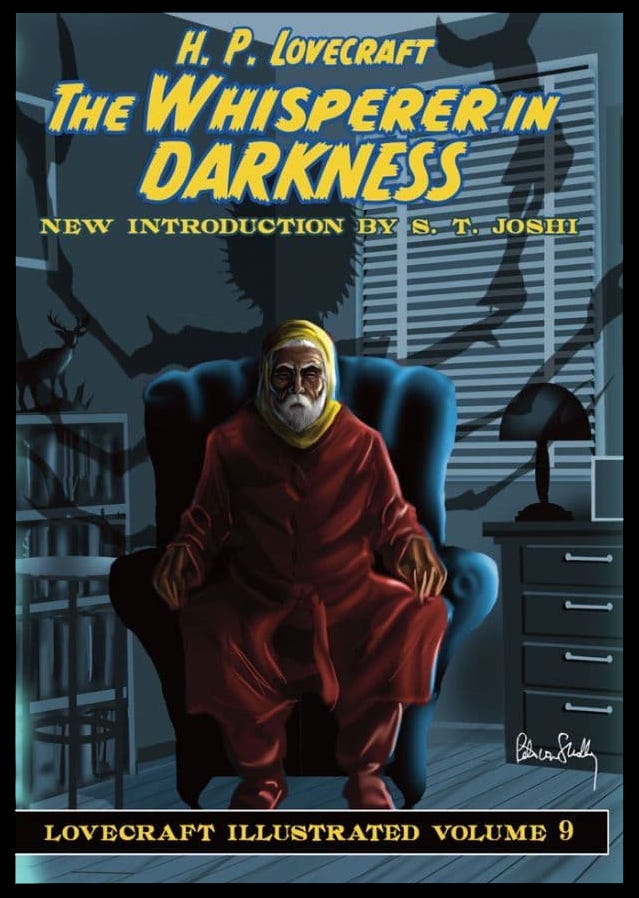
“The Whisperer in Darkness,” written in 1930 and published in 1931, has always had a slot in my top five (maybe even top three) personal favorite Lovecraft tales. It’s mostly known by fans as the vehicle for the alien creatures variously called the Outer Ones, the Mi-Go, or the Fungi from Yuggoth—lobster-like critters that fly through interstellar space on icky wings and have an amazing knack for engineering and surgery. I can’t speak for other Lovecraft connoisseurs, but over the years I’ve found myself growing less interested in the eldritch beasties for their own sake than in the ends to which Lovecraft uses them as means. The Mi-Go, their modus operandi, and their interactions with the story’s protagonist anticipate, however faintly, some of the digital age’s most persistent anxieties—or, rather, they demonstrate that these anxieties are not entirely new, and Lovecraft evidently felt them himself.1
The story begins with one Albert Wilmarth, a professor of literature at Miskatonic University, becoming embroiled in a minor public debate. During the Great Vermont Flood of 1927, denizens of the affected areas reported seeing unearthly carcasses swept up by the swollen rivers: “pinkish things about five feet long; with crustaceous bodies bearing vast pairs of dorsal fins or membraneous wings and several sets of articulated limbs.” Being a folklorist, Wilmarth is familiar with the superstitions of the state’s early settlers and their points of contact with both indigenous and Old World myths, and is firmly convinced that whatever the yokels actually witnessed being carried off by the floodwaters (probably bloated and mangled human bodies) was distorted by their residual belief in the stories their grandparents repeated to them.
Wilmarth’s arguments with cryptid enthusiasts make their way into the pages of the Arkham Advertiser, and are later reprinted in editions of the Rutland Herald and Brattleboro Reformer. These come to the attention of one Henry Wentworth Akeley, a reclusive gentleman scholar of rural Vermont, who pens Wilmarth a letter to set the record straight. “Publicly I am on your side,” he writes, “for certain things shew me that it does not do for people to know too much about these matters.” The creatures are real, Akeley assures Wilmarth, and implores him to let the debate die. So long as the aliens—for Akeley believes they come from outer space—are left alone, they seem content to live and let live. Motivating curious outsiders to visit the lonely hills and sniff around for the creatures won’t lead to anything good.
“I think they mean to get rid of me because of what I have discovered,” he writes, and claims to have acquired a bizarre stone covered with alien hieroglyphs. He also has in his possession photographs of odd prints in the mud and a recording of an entity speaking “in a buzzing imitation” of a human voice. Despite being convinced that the aliens and their human agents are spying on him and trying to cut him off from the outside world, Akeley wonders if Wilmarth wouldn’t like to see some of his evidence.
Akeley’s follow-up letter—too unnervingly comprehensive to be recollected and transcribed—persuades Wilmarth that there really is something strange up in Vermont:
My brain whirled; and where before I had attempted to explain things away, I now began to believe in the most abnormal and incredible wonders. The array of vital evidence was damnably vast and overwhelming; and the cool, scientific attitude of Akeley—an attitude removed as far as imaginable from the demented, the fanatical, the hysterical, or even the extravagantly speculative—had a tremendous effect on my thought and judgment. By the time I laid the frightful letter aside I could understand the fears he had come to entertain, and was ready to do anything in my power to keep people away from those wild, haunted hills.
As Wilmarth and Akeley exchange letters and information, the secretive aliens are roused to action. A parcel containing the hieroglyphic stone mentioned in the first letter is intercepted in transit. Human collaborators take shots at Akeley when he drives to town in his car. His phone line is repeatedly cut.2 His mail gets stolen. On moonless nights, packs of aliens reconnoiter his farm and attempt to break into his house.
Across three consecutive days in early September, Akeley manages to get three increasingly panicked and hopeless letters to Wilmarth. The last of these begins:
Yr letter came, but it’s no use to discuss anything any more. I am fully resigned. Wonder that I have even enough will power left to fight them off. Can’t escape even if I were willing to give up everything and run. They’ll get me.
Had a letter from them yesterday—R.F.D. man brought it while I was at Brattleboro. Typed and postmarked Bellows Falls. Tells what they want to do with me—I can’t repeat it. Look out for yourself, too!
“Goodbye, smash that record, and don’t mix up in this,” Akeley signs off.
Wilmarth is, to say the least, freaked out. But just one day later, he receives another letter. This one begins:
My dear Wilmarth:—
It gives me great pleasure to be able to set you at rest regarding all the silly things I’ve been writing you. I say “silly”, although by that I mean my frightened attitude rather than my descriptions of certain phenomena. Those phenomena are real and important enough; my mistake had been in establishing an anomalous attitude toward them.
I think I mentioned that my strange visitors were beginning to communicate with me, and to attempt such communication. Last night this exchange of speech became actual. In response to certain signals I admitted to the house a messenger from those outside—a fellow-human, let me hasten to say. He told me much that neither you nor I had even begun to guess, and shewed clearly how totally we had misjudged and misinterpreted the purpose of the Outer Ones in maintaining their secret colony on this planet.
The long and short of its contents: Akeley says he was wrong about the aliens. The aliens are great. The aliens are cool. They’re probably the coolest things in the universe, actually, and mankind has so much to learn from them. Wilmarth really ought to come up to Vermont and meet the aliens ASAP. Oh, yes, and he should bring all the letters he’s received over the last few months, and the photos and the phonograph record too.
Up until now, all of Akeley’s letters have been handwritten. This latest one is from a typewriter.
It concludes: “Awaiting word, and hoping to see you shortly.”
In my headcanon, Albert Wilmarth is a remote descendant of Captain Amasa Delano from Melville’s Benito Cereno. Red flag after red flag flap directly in front of his face, and yet he doesn’t immediately disembark and whirl off in the opposite direction with full dispatch. No, Wilmarth buys a train ticket from Arkham, Massachusetts to Brattleboro, Vermont, arranges for an automobile ride to the isolated Akeley farmhouse, and obligingly packs up all his evidence of the aliens’ existence to take with him. What could possibly go wrong?
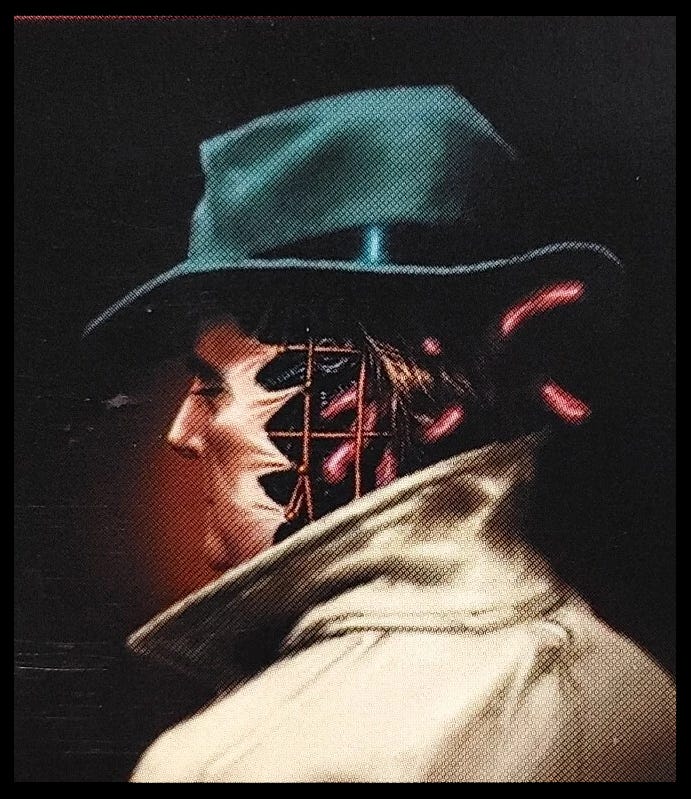
We don’t need to go over in detail what happens after Wilmarth’s arrival at the old Akeley place. The illustration from the short-lived Lovecraft-themed Mythos CCG directly above will give you a pretty good idea of what the aliens in “The Whisperer in Darkness” are about. (But since the rest of this little exercise here assumes a familiarity with the story, you may as well go and read it.)
To my mind, Wilmarth’s puzzling behavior can be attributed to a pair of basic causes. First, he is a man of great intellectual curiosity who very much does not want to walk away from an opportunity for an unmediated confirmation of intelligent alien life. Second, like Captain Delano, he has a specific area of credulity akin to an outright blind spot. Whenever he receives a communique or an item from Akeley (or from entities claiming to be Akeley), he consistently trusts in its genuineness, or otherwise convinces himself of its genuineness after a little deliberation.
“The Whisperer in Darkness” owes much of its serendipitous prescience to the fact that its protagonist never once sees or speaks to its deuteragonist face-to-face. Wilmarth has no direct knowledge or experience of Akeley. All he knows of the man, his life, and his encounters with malign extraterrestrial entities, he knows by way of media artefacts.3 This is precisely the foundational situation of any modern-day anecdote or fiction which involves someone being catfished via digital media or duped by AI-generated content, and it is fascinating to watch Lovecraft scripting out, nearly a century ago, thought processes closely analogous to those of someone entertaining and subsequently assuaging doubts regarding the veracity of a digital video, or the honesty of a too-good-to-be-true stranger flirting with them in their DMs.4
What I’d like to do here is review the various media through which Akeley, the aliens, and (perhaps?) the aliens’ human agents communicate with Wilmarth throughout “The Whisperer in Darkness,” and how Wilmarth responds to them.5
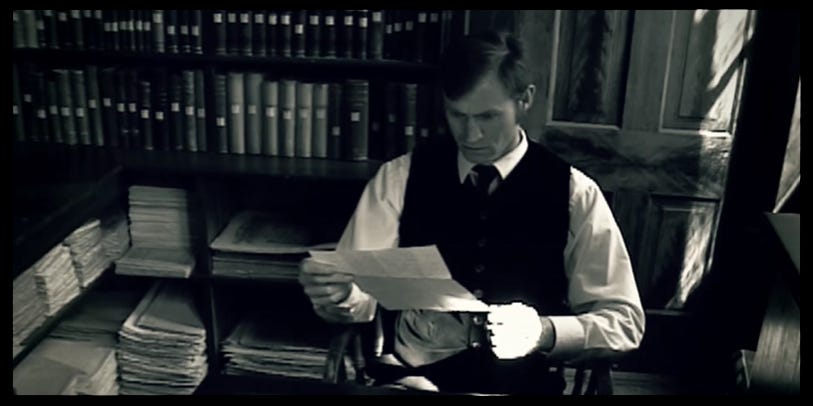
“I cannot bear a typewriter,” Lovecraft wrote in a 1931 letter to his friend Frank Belknap Long, “nor compose anything of any importance on one.”
The letter was, of course, handwritten. Lovecraft scribbled out thousands of letters in his lifetime. His extant and collected correspondence far outweighs his published and unpublished fiction, poetry, and essays. It really is a wonder he didn’t try his hand at more thoroughly epistolary fiction in the vein of Dracula; he would have been altogether in his element.
From the old man’s “cramped, archaic-looking scrawl,” Wilmarth determines Akeley “had obviously not mingled much with the world during his sedate, scholarly life.” One can reasonably infer certain details of a person’s biography and of their personal characteristics by looking at their handwriting. Penmanship is like a fingerprint in the sense that no two people inscribe the letters of the alphabet in exactly the same way. Unlike a fingerprint, however, it is an acquisition: something one learns to do with one’s body through training and practice. The circumstances of one’s life on both molecular and molar levels inscrutably combine with one’s genetic endowment to produce a unique style of handwriting, and in this regard one’s script is a microcosm of their personality as a whole.
Wilmarth’s first impression of Akeley is of “a man of character, education, and intelligence.” After he has gotten to know him better, he refers to his correspondent’s “passion for infinity” and “scholarly inquisitiveness.” These qualities Wilmarth extrapolates from the contents of Akeley’s letters; what goes unsaid is that what Akeley writes comports with how he writes it. Wilmarth’s initial assessment of him may well have tilted towards “lunatic” if had he the read the same message in an incongruously juvenile or belabored handwriting style. Imagine how seriously would you take a letter from a total stranger claiming to have had encounters with aliens if it were composed in big Sharpie capitals. The more articulate and reasonable the message, the more conscious and/or unconscious misgivings you’d have about the discrepancy between the thoughts expressed and their style of expression.
Wilmarth does call attention to the way Akeley’s handwriting conveys his emotional state. As the aliens grow more aggressive in maneuvering against him, his nerves fray. His hand shakes. His final letters are “scrawled and blotted . . . in the course of a plainly frantic and hurried composition.” When speaking to a person face-to-face, signals of agitation and fear are unmistakable. It can be the same with written communication: the manner with which Akeley puts his words on the page is analogous to the rapid, hyperventilating speech of a person in the throes of a panic attack. The total-body experience of terror does not leave one’s habitual motor functions unaffected.
While Wilmarth has never met Akeley and remains suspicious of one particular claim of his at this point (more on this below), he is certain that his correspondent is sane, afraid, and in danger. Notwithstanding that we, as readers of this fiction, know that Wilmarth has correctly apprised the reality of the situation, it would be difficult to say that he should receive these late dispatches with more incredulity than he does. We are to understand that suspecting Akeley of perpetrating an elaborate hoax at this point would pass beyond a healthy skepticism and into the domain of misanthropic cynicism. The old man’s “pitifully tremulous” script proves that his fear is real.
The first mechanically produced artefacts Wilmarth receives from Akeley are a series of photographs. Of these, the most striking is a shot of a weird print in the soil:
[T]hese pictures carried conclusive evidence of something in the Vermont hills which was at least vastly outside the radius of our common knowledge and belief. The worst thing of all was the footprint—a view taken where the sun shone on a mud patch somewhere in a deserted upland. This was no cheaply counterfeited thing, I could see at a glance; for the sharply defined pebbles and grass-blades in the field of vision gave a clear index of scale and left no possibility of a tricky double exposure.
He is, at this point in his correspondence with Akeley, still somewhat on his guard, and looking for signs of fakery. While Wilmarth grants that the camera is capable of lying—or of being made to lie—he is on the whole enthralled by the objectivity of the photographic process:
[The pictures] had a damnably suggestive power which was intensified by the fact of their being genuine photographs—actual optical links with what they portrayed, and the product of an impersonal transmitting process without prejudice, fallibility, or mendacity.
Akeley’s final letter relates his discovery that a guard dog seized and killed one of the aliens besieging his farm house the previous night. He tries to take a photograph of it—but when he develops the film, there’s no alien to be seen. The carcass completely evaporates just a few hours afterward. “What can the thing have been made of?” he writes, but hasn’t the presence of mind to share whatever conjectures he might have made.
Wilmarth will later be told that the aliens are made of a sort of exotic matter whose electrons vibrate at a different rate than their more familiar counterparts; the light they reflect can be perceived by the human eye, but does not interact with the chemicals on which the photographic process relies. In the moment, however, he trusts the Kodak mechanism more than the testimony and the capacities of his correspondent: “I did think his failure to get a picture of the dead monster was due not to any freak of Nature but to some excited slip of his own.”
Along with his pictures of spooky stuff in the woods, Akeley also sends Wilmarth a personal photo:
The final picture was of the Akeley place itself; a trim white house of two stories and attic, about a century and a quarter old, and with a well-kept lawn and stone-bordered path leading up to a tastefully carved Georgian doorway. There were several huge police dogs on the lawn, squatting near a pleasant-faced man with a close-cropped grey beard whom I took to be Akeley himself—his own photographer, one might infer from the tube-connected bulb in his right hand.
Lovecraft’s narrators typically share his own values, and Lovecraft respects dignity, good grooming, and order. By every indication, Akeley is a man on the up-and-up. Even though the reader will later learn that the old man in the photo is indeed Henry Akeley, it is significant that Wilmarth does not for a moment consider the possibility he might be getting catfished. But why should he consider it? The photograph fits what he has inferred about his correspondent from reading his letters. Despite having no face-to-face, person-to-person experience with Akeley, Wilmarth sees a coherence between these artefacts of his, pointing to a singular personhood.
But how much of this perceived coherence is exactly that—a product of Wilmarth’s perception and interpretation? All of it, really. While there are solid grounds for certainty that the person who sent Wilmarth the first letter is the same person who sent him the second letter (the handwriting is the same), it does not necessarily follow that the man depicted in the photograph must be of one identity with the person who wrote the letters. Wilmarth’s direct conclusion that the one does follow from the other represents an unconscious and uninterrogated act of trust on his part.
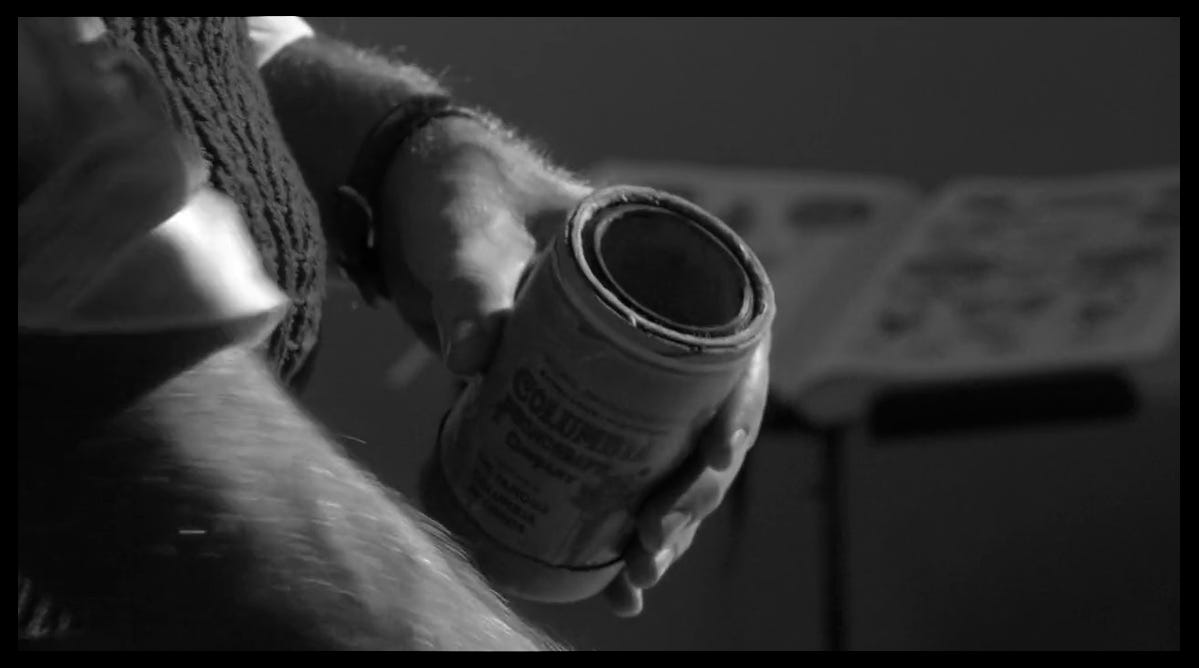
By the time Akeley drops off the wax cylinder at the Brattleboro post office, he has already made a believer of Wilmarth. In describing his receipt of the artefact, Wilmarth notes that notes that his correspondent showed due diligence in documenting its provenance: it “was obtained about 1 a.m. on the first of May, 1915, near the closed mouth of a cave where the wooded west slope of Dark Mountain rises out of Lee’s Swamp,” a site spoken of in local legends about unsettling voices heard at night. A Dictaphone was used.
Recounting the record’s content, Wilmarth bemoans his friends and colleagues’ disbelief in his later descriptions of it:
And then I heard the other voice. To this hour I shudder retrospectively when I think of how it struck me, prepared though I was by Akeley’s accounts. Those to whom I have since described the record profess to find nothing but cheap imposture or madness in it; but could they have heard the accursed thing itself, or read the bulk of Akeley’s correspondence . . . I know they would think differently. It is, after all, a tremendous pity that I did not disobey Akeley and play the record for others—a tremendous pity, too, that all of his letters were lost.
Notice how Wilmarth tries to exculpate himself with the passive phrasing here—but we’ll let that pass.
The people to whom he has spoken of the matter are convinced he’s been bamboozled by his correspondent. An audio recording is as serviceable a tool for deceit as a photo, especially when the counterfeiter knows what they’re doing. Wilmarth would have us believe that what he heard was too obviously and authentically alien to have been faked—and, if we didn’t know he was right, we would have no reason to buy his story.
It pains me to say that I was more than halfway through drafting this thing before discovering that one Vivian Ralickas has already written a much more thorough and scholarly version of it. Though I’ve avoided reading it too closely in the interest of not feeling my redundancy too deeply, some of her remarks about the phonograph are worth repeating:
[T]he narrow dynamics and high distortion rate of the wax cylinder record, including its ‘metallic timbre’ and faint, dissonant tones . . . prove that it offers a less than faithful rendition of aural phenomena. To what extent, in other words, is the alien voice’s ‘accursed buzzing which had no likeness to humanity’ . . . magnified by the recording medium’s limitations?
This is to say that if you’ve ever listened to very old audio recordings made without an electric microphone, you know that they don’t sound natural at all. If Akeley were actually a mountebank with some knowledge of acoustics and a lot of time on his hands, he could very probably use the format’s shortcomings to his advantage. If “The Whisperer in Darkness” had been written by Arthur Conan Doyle instead of H.P. Lovecraft, it would at this point be on track toward a very different ending.
Note, again, Wilmarth’s opinion that the handwritten letters would have certified the genuineness of the record. I’m not sure he is referring to their contents per se; Wilmarth is no novice in the matters of which Akeley writes, and can speak of them himself. More likely he means that they would prove the erudite and solid character of the old man, and lend credibility to any recordings he might have made.
This incident in a short story written ninety-five years ago neatly puts the epistemological crisis of own age in a nutshell. How do we verify the authority and the accuracy of media artefacts when the persons creating and/or disseminating them are themselves confronted as media abstractions—as are their social and institutional imprimaturs?
Wilmarth receives three telegrams in the course of the story. We are sure that the first is genuine:
On the morning of Wednesday, July 18, I received a telegram from Bellows Falls, in which Akeley said he was expressing the black stone [an alien artifact] over the B. & M. on Train No. 5508, leaving Bellows Falls at 12:15 p.m., standard time, and due at the North Station in Boston at 4:12 p.m.
Wilmarth doesn’t attempt to reconstruct the text of the telegram as he does with several of Akeley’s letters—but why should he? It would be like transcribing a text message reading omw running 15 mins late sorry see u soon instead of glossing it as she said she’d arrive in fifteen minutes.
The technical dimensions and commercial exigencies of telegraphy (companies usually charged by the word) precluded not only a clear imprint of the sender’s personality, but stymied anything like a natural style of written expression. Nobody “sounded” like themselves in a telegram—for the same reason that most of us don’t “sound” like ourselves when we punch out a hasty text message to apprise someone of changed plans or ask a direct and simple question.
Perhaps the parsimonious, inexpressive style expected of a telegram accounts for why Wilmarth is so easily conned by the aliens’ first direct attempt at social engineering:
In replying to [Akeley’s] letter I urged him to seek help, and hinted that I might take action myself if he did not. I spoke of visiting Vermont in person in spite of his wishes, and of helping him explain the situation to the proper authorities. In return, however, I received only a telegram from Bellows Falls which read thus:
APPRECIATE YOUR POSITION BUT CAN DO NOTHING. TAKE NO ACTION YOURSELF FOR IT COULD ONLY HARM BOTH. WAIT FOR EXPLANATION.
HENRY AKELY
But the affair was steadily deepening. Upon my replying to the telegram I received a shaky note from Akeley with the astonishing news that he had not only never sent the wire, but had not received the letter from me to which it was an obvious reply.
It doesn’t seem as though Wilmarth was suspicious of the telegram for even a moment; he finds “astonishing” the revelation that Akeley hadn’t sent it. His initial failure to hesitate upon on the misspelled name in the signature is alike to ours when we open our company Outlook inbox, find an external email promising a free Amazon gift card, and impetuously click on the hyperlink—even though the domain name “amozan.com” in the sender field is staring us right in the face.
After reading the portentous typewritten letter, Wilmarth replies to “Akeley” via telegram, informing his correspondent to expect his visit, and providing specific details about his plans. His correspondent answers in kind:
His wire ran thus:
ARRANGEMENT SATISFACTORY. WILL MEET 1:08 TRAIN WEDNESDAY. DON’T FORGET RECORD AND LETTERS AND PRINTS. KEEP DESTINATION QUIET. EXPECT GREAT REVELATIONS.
AKELEY.
Wilmarth doesn’t say as much, but he must have found the correct spelling of Akeley’s name tremendously reassuring. (I’m suddenly reminded a classic Simpsons scene.)6 What most sets his mind at ease, however, is the metadata, as it were:
Receipt of this message in direct response to one sent to Akeley—and necessarily delivered to his house from the Townshend station either by official messenger or by a restored telephone service—removed any lingering subconscious doubts I may have had about the authorship of the perplexing letter. My relief was marked—indeed, it was greater than I could account for at that time; since all such doubts had been rather deeply buried. But I slept soundly and long that night, and was eagerly busy with preparations during the ensuing two days.
Wilmarth specifies certain details in his message; the reply refers to those details. The telegram had to have been sent or telephoned directly to the Akeley household in order to have been received; the reply indicates that it had not been intercepted and was received at the Akeley household. Everything checks out.
The bare fact that the communication system is working the way it’s supposed to work, with its usual rhythm of dispatch and response, convinces Wilmarth that all is well. He unthinkingly confounds the reliability of the telegraph service with the trustworthiness of the entity sending and receiving messages through it.
“Pardon this typed letter,” it reads, “but my handwriting has grown shaky of late, as you know, and I don’t feel equal to long stretches of script.”
Provided one can capably press the keys one intends to press, a typewritten letter betrays nothing of its author’s emotional or physical condition—or of their identity, for that matter. Leslie Klinger, editor of The New Annotated H.P. Lovecraft, points out that this was a plot device in the Sherlock Holmes story “A Case of Identity,” and quips that while Lovecraft had probably read it at some point, Wilmarth apparently didn’t.
It was long my assumption that one of the aliens’ collaborators did the job for them—though on closer inspection there’s really no evidence for this. One of Akeley’s final handwritten letters does mentions his receipt of a typed letter from them, presumably dropped off at the post office by one in human guise. While it’s kind of funny to imagine an extraterrestrial mushroom-crab hunkered down in the depths of a mountain cave, punching out a missive on an old Remington with its horrible nippers, let’s grant that Akeley is correct: the aliens have access to a typewriter (possibly in the domicile of a human ally?) and are able to use it competently.7
Wilmarth notes that even the letter’s signature was typed, “as is frequent with beginners in typing.” But its author is too “marvellously accurate” a typist to be a novice, and our hero smooths over the discrepancy by convincing himself that the old man must have mastered using the device in his college days.
Wilmarth’s whole response to the letter tends towards rationalization and a veritably Mulderian wanting to believe:
As I analysed my impression, I saw that it consisted of two distinct phases. First, granting that Akeley had been sane before and was still sane, the indicated change in the situation itself was so swift and unthinkable. And secondly, the change in Akeley’s own manner, attitude, and language was so vastly beyond the normal or the predictable. The man’s whole personality seemed to have undergone an insidious mutation—a mutation so deep that one could scarcely reconcile his two aspects with the supposition that both represented equal sanity. Word-choice, spelling—all were subtly different. And with my academic sensitiveness to prose style, I could trace profound divergences in his commonest reactions and rhythm-responses.8 Certainly, the emotional cataclysm or revelation which could produce so radical an overturn must be an extreme one indeed! Yet in another way the letter seemed quite characteristic of Akeley. The same old passion for infinity—the same old scholarly inquisitiveness. I could not a moment—or more than a moment—credit the idea of spuriousness or malign substitution. Did not the invitation—the willingness to have me test the truth of the letter in person—prove its genuineness?
Wilmarth imposes more facile coherence upon the situation. Stylistically, the letter doesn’t read like any of Akeley’s previous missives, and the total reversal of his attitude defies belief—but then again, his new rapport with the aliens could have put him in a mood and state of mind unlike any in which he had previously written Wilmarth. The personal imprint of his handwriting is absent—but, okay, sure, he’s old, he’s been through a lot of stress lately, and he’s somewhat rustic and unpolished. All might account for his minor faux pas in typing his signature instead of scratching it out.
Moreover, “Akeley” does refer to disclosures he’d made in earlier letters—never mind that Wilmarth knows the aliens have been tampering with his mail. The envelope is postmarked Bellow Falls, whence Akeley had previously sent Wilmarth packages and telegrams—never mind the last handwritten letter stating that that the typewritten message he received from the aliens arrived at the farmhouse from the same post office.
What cinches his willingness to put his confidence in “Akeley,” in spite of all the indicators that something is rotten up in Vermont, is his seeming to see a facet of Akeley’s personality emerging from the utterly unfamiliar prose. The jigsaw puzzle pieces kind of sort of appear to possibly fit together. Wilmarth makes them fit, because he wants them to fit.
So. Here I’ll come clean about what prompted this writeup, and what struck me during my latest reread of “The Whisperer in Darkness.”
I’ve mentioned before that I’ve been teaching a first-year college English course. As you’re probably aware, ChatGPT is poised to make the job impossible. Owing to the gen-ed status of the course, my position is particularly difficult: unless freshmen took and passed the appropriate AP-level English classes in high school, they are required to enroll in a section. So I’m teaching a room full of kids who would probably rather not be there and just want to get through the semester and earn a decent grade with a minimum expenditure of time and effort.
Because of the way the course is set up—there are certain standardized elements which I can’t change—it’s impossible to switch back to blue books. Students have to write three major papers, and none are of the sort that can be done in class under an instructor’s supervision. All I can do is tell them that I consider the use of generative AI (which now includes Grammarly) cheating, and warn that I’ll come down hard on anyone who turns in work they have not composed on their own.
I’ve also implemented a series of in-class writing assignments. During the first day of class, they handwrite a self-introduction in which they describe their experiences as writers and readers. After they turn in each of the three big papers, they pen a personal reflection telling me about their writing process, the aspects of their work they’re confident about, where they’d most like constructive feedback, etc.
Whenever I turn from a faltering and vague handwritten page to a digital six-page document composed, nominally by the same teenaged student, with manifest confidence and competence, a sophisticated vocabulary, and no typos or misspellings, I am become Albert fucking Wilmarth scanning the letter supposedly typed by Henry Wentworth Akeley.
I’ve been grateful for the ones who make it easy. When I fail them at the end of the semester, they don’t make a peep about it. They know what they did, and they know they got caught. Usually they’re dumb enough to let hallucinated quotations and sources stand, and I can easily point these out should they try to complain to someone above me in the hierarchy. Once in a while an entire paper will be so obviously hallucinated that I don’t even have to bother reading it closely. In many cases, the students who turn in AI slop have so many other problems regarding attendance and completing weekly assignments that the quality or authorship of their papers is pretty much beside the point.
It’s the students who make it difficult—the smart ones—who keep me up at night. They’ll always turn in their homework on time. It’s suspiciously neat. I might receive a notification from the LMS that they pasted it into the submission field, but if I ask about it they’ll have a ready explanation that’s both innocent and plausible. They’ll participate in class and seem to be interested in the material, so it shouldn’t be entirely surprising that they turn in cogent papers showing every indication of personal engagement. And when their papers set off two or three out of five AI detectors, I have to decide whether or not to give them the benefit of the doubt and deem the results a false positive.
If I think I do see the stamp of a student’s personality (or what I can know of it) in their papers’ suspiciously clean and lucid prose, what’s the likelihood that I’m choosing to be tricked by a mirage? Or if I’m fairly certain I’m reading a paper that wasn’t written by a human being, do I trust my intuition, bring the hammer down, and risk the blowback for handing out a failing grade based on a mistaken (and basically unprovable) presumption of academic dishonesty? Or do I just grit my teeth, usher the kid through, and let the sinking feeling that I’ve contributed to the systemic ruin of higher education stew in my guts?
The handwritten in-class work was meant to eliminate some of the guesswork. In a few cases, it has. In others, it’s damnably inconclusive. What’s worse is that I’m pretty sure it’s made me more paranoid. A few weeks ago I spent several minutes scrutinizing the frequency with which commas occurred in a student’s handwritten work as opposed to what they’d submitted digitally.
The shoggoth, another of Lovecraft’s alien beasties, has had a peculiar renaissance as a meme in the AI conversation. If you’re unfamiliar with At the Mountains of Madness: the shoggoths were genetically engineered protoplasmic blobs, bred and used as slave labor by some of the Earth’s prehuman colonizers.9 After developing “semi-stable brains,” their “occasionally stubborn volition echoed the will of the Old Ones without always obeying it.” The shoggoths eventually grew impossible to control, exterminating their beleaguered masters and usurping their last functioning city on the Antarctic continent. Their survivors, lurking in the subterranean depths of the frozen metropolis, speak in their creators’ “voices” and crudely replicate their artwork.
The shoggoths, then, are imitators possessed of a pseudo-intelligence reflecting that of their creators—though they actually run on an entirely different type of hardware, as it were, and where their borrowed volition conflicts with their masters’ interests, they become an existential danger. As an AI metaphor, the shoggoth is basically perfect.
I’ll confess I was unaware of the shoggoth meme when I began to write this—and will venture to say that the Mi-Go or Outer Ones of “The Whisperer in Darkness” are perhaps the more appropriate Lovecraftian metaphor in the limited case of AI-generated text, music, art, video, etc. The shoggoths, after all, have nothing to say to humanity. The Mi-Go, on the other hand, communicate with Wilmarth in written English, and under a false human identity. We are to understand that they don’t think like we do. They are of a nature altogether other than ours—and what sort of interiority do fungoid entities “more vegetable than animal” actually possess or experience? Yet they are capable of operating upon us through counterfeited human verbal behavior, both spoken and typewritten. The shoggoth may “personify” artificial intelligence as a whole, but where AI-generated slop text presented as human output is concerned, the Mi-Go is our Lovecraftian avatar.
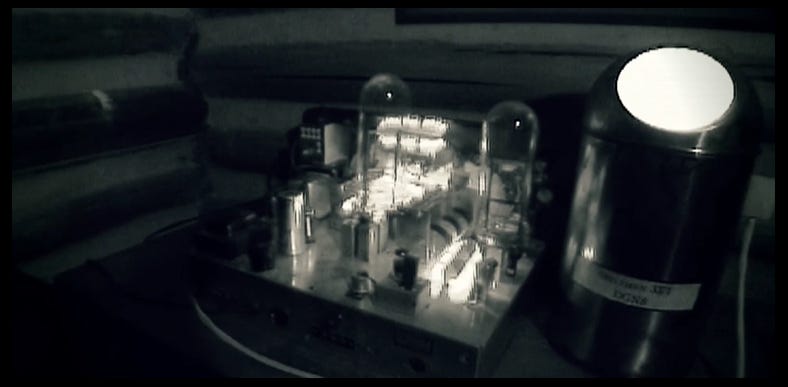
During his conversation with “Akeley” in the farmhouse, Wilmarth encounters some bizarre alien technology. It sometimes pleases the Outer Ones to remove a living human brain from its skull, place it inside a metallic cylinder, and shuttle it between their outposts across the cosmos. These cylinders have plugs into which a variety of sensory apparatuses can be inserted; with the proper equipment, the brains within are able to see, hear, and speak. The speech produced is wholly mechanical, “incapable of inflection or expressiveness,” alike to natural vocalization as type is to script.
When Wilmarth attaches the sensory machinery to a cylinder labeled “B-67,” the speech apparatus delivers a monologue about the incredible rewards for serving the aliens as a collaborator:
Do you realise what it means when I say I have been on thirty-seven different celestial bodies—planets, dark stars, and less definable objects—including eight outside our galaxy and two outside the curved cosmos of space and time? All this has not harmed me in the least. My brain has been removed from my body by fissions so adroit that it would be crude to call the operation surgery. The visiting beings have methods which make these extractions easy and almost normal—and one’s body never ages when the brain is out of it. The brain, I may add, is virtually immortal with its mechanical faculties and a limited nourishment supplied by occasional changes of the preserving fluid . . .
There is nothing to fear. All transitions are painless, and there is much to enjoy in a wholly mechanised state of sensation. When the electrodes are disconnected, one merely drops off into a sleep of especially vivid and fantastic dreams.
In spite of Wilmarth’s assurances that “the speaker was actually present and observing us,” the way Lovecraft writes the sequence leaves completely within the realm of possibility that a credulous Wilmarth, stunned speechless, is listening to a recorded message.10 The speech-machine’s tone and diction are eerily similar to the prose of “Akeley’s” typewritten letter, after all—and since we know that identity theft and sockpuppeting belong to the aliens’ MO, why should we put it past them to issue propaganda to Wilmarth through a second source they’re trying to pass off as human?
True, the text notes that the speech-machine momentarily pauses when Wilmarth is visibly startled by something he hears—but even in the technological environment of 1930, it would have been fairly easy to imagine a watchful alien lifting the needle from the proverbial record by remote, and then setting it back down after Wilmarth composes himself. There are even fewer steps involved in guessing that the aliens might be authoring the mechanical speech in real time.
Even at the end of the story, when our fears about Akeley’s fate are all but confirmed, the evidence that Wilmarth is addressed by a human brain articulating itself through alien technology is circumstantial at best. We can only decide whether or not to take Wilmarth at his word on the matter—and we know he’s not the best judge of this sort of thing.
But perhaps it would be less horrible to know for certain that the speech-machine’s discourse is so much more alien subterfuge. The living brain of a human being who’s drank deep of the Kool-Aid from Yuggoth and swears that it’s wonderful and fun to be bodiless, immobile, and completely at the mercy of his alien keepers—if that’s truly what Wilmarth encounters—introduces an repulsive new dimension to the affair.
Maybe the real reason for why the monologue delivered through the speech-machine rings so similarly to the blithely detached and cerebral prose of the aliens’ typewritten letter is because the brain in the jar is of a kind with his “benefactors.” Like a dyed-in-the-wool transhumanist, he must be rationalistic to the point of gnostic psychopathy. Without knowing it, Lovecraft sets forth in “The Whisperer in Darkness” a disturbing anticipation of TESCREAL futurism, whose true believers espouse the desirability of becoming immortal, noncorporeal consciousnesses inhabiting machines in outer space. I’ve already mentioned that I enjoy pretending that Wilmarth is a descendant of Amasa Delano; I also like to imagine that the dude whose brain sits in cylinder B-67 had a grand-nephew named Ray Kurtzweil.
Another eerie coincidence: the brain in the jar makes a point of telling Wilmarth that this is a boon only bestowed upon the elect. Not just anyone gets to transcend the prison of the flesh, travel the stars, and live forever—only clever people. The TESCREAL ideologues and the aliens agree on this point.
B-67, at any rate, has willingly chosen this for himself, while Akeley has it forced upon him. So it typically goes with general and inexorable technological paradigm shifts—and Lovecraft, born in 1890 and deceased in 1937, had some firsthand experience of this.
This is, of course, the ultimate terror of “The Whisperer in Darkness.” When Wilmarth visits the Akeley farmhouse, he finds his host much the worse for wear:
For a moment the closed blinds allowed me to see very little, but then a kind of apologetic hacking or whispering sound drew my attention to a great easy-chair in the farther, darker corner of the room. Within its shadowy depths I saw the white blur of a man’s face and hands; and in a moment I had crossed to greet the figure who had tried to speak. Dim though the light was, I perceived that this was indeed my host. I had studied the kodak picture repeatedly, and there could be no mistake about this firm, weather-beaten face with the cropped, grizzled beard.
But as I looked again my recognition was mixed with sadness and anxiety; for certainly, this face was that of a very sick man. I felt that there must be something more than asthma behind that strained, rigid, immobile expression and unwinking glassy stare; and realised how terribly the strain of his frightful experiences must have told on him. Was it not enough to break any human being—even a younger man than this intrepid delver into the forbidden? The strange and sudden relief, I feared, had come too late to save him from something like a general breakdown. There was a touch of the pitiful in the limp, lifeless way his lean hands rested in his lap. He had on a loose dressing-gown, and was swathed around the head and high around the neck with a vivid yellow scarf or hood.
And then I saw that he was trying to talk in the same hacking whisper with which he had greeted me. It was a hard whisper to catch at first, since the grey moustache concealed all movements of the lips, and something in its timbre disturbed me greatly; but by concentrating my attention I could soon make out its purport surprisingly well. The accent was by no means a rustic one, and the language was even more polished than correspondence had led me to expect.
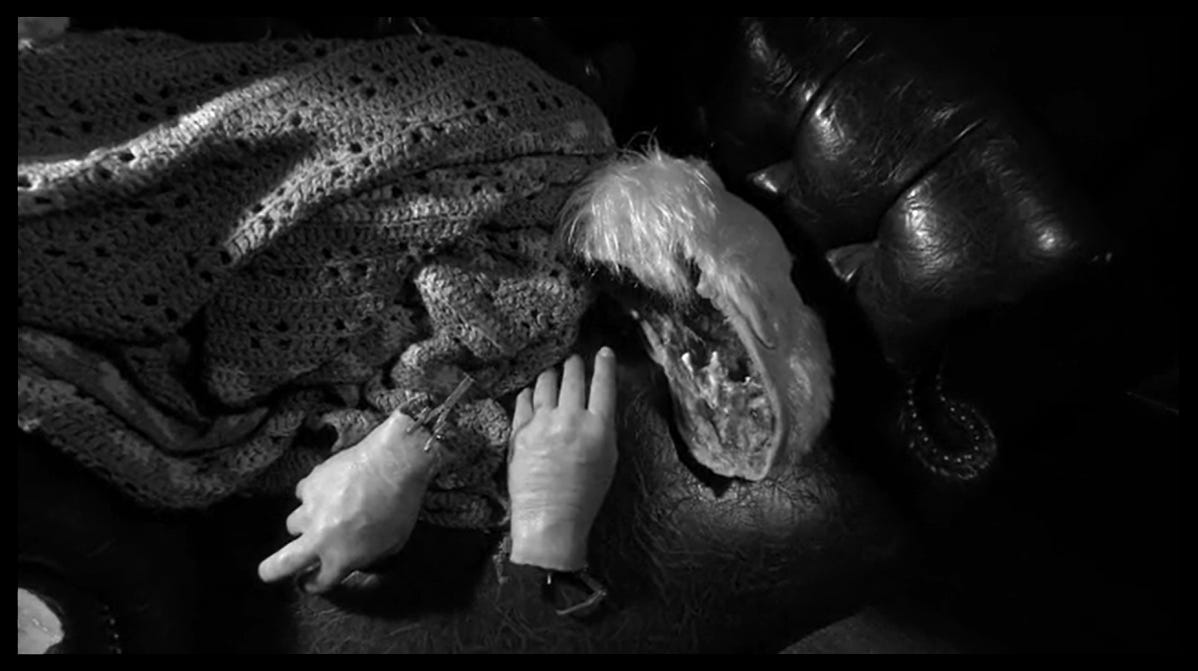
Spoilers: it’s an alien disguised as Akeley. The face and hands it wears were almost certainly surgically removed from Wilmarth’s doomed correspondent, whose brain sits encased within one of the metal cylinders on a nearby shelf. Having known Akeley only through his letters, Wilmarth has no basis for recognizing the abhorrent whisperer in darkness as an impostor.
That Wilmarth didn’t check his watch, excuse himself for a cigarette, and jack Akeley’s car after spending just ten minutes in the room is a testament to his politesse, though not his instinct for self-preservation. “Akeley” looks like a corpse. There’s an unidentifiable odor and a strange vibration in the room. Wilmarth has an inkling that “the faint but penetrant sounds” of the old man’s wheezing voice “represented not so much weakness as deliberate repression.” One wonders how well the illusion would hold up if he were to stand directly in front of “Akeley” and shine his flashlight on his face.
Nevertheless: the Mi-Go skulking about New England, disguised as human beings, screw with the postal system and telegraph offices, and pass more or less unnoticed until Wilmarth and Akeley start asking questions. But even here, one supposes that they might not be able to get away with it if people knew what to look and listen for: their weird droning voices and the sallow complexions of their stolen faces stick out in witnesses’ memories and are apparently difficult to conceal.
Writing in 1930, Lovecraft found in the typewriter and telegraph cable a speculative-fictive vector for baleful nonhuman influences. It is behind mechanical and electric means of communication (and their attendant habits) that the Mi-Go most effectively camouflage themselves. Moreover, they undermine the vaunted “objectivity” of recording media: photography cannot be relied on where they’re concerned, and the technical limitations of Dictaphone technology suffice in and of themselves to make Wilmarth come across as a sucker or a loon when he tells his peers about hearing alien voices on a phonograph his vanished friend gave him.
Man—what a sweet summer child old Howard Phillips was. He hadn’t seen anything yet.
In the age of AI, our dependence on digital media places us all in Wilmarth’s position, and we are only able to hope we are not mistaken in our supposition that we know imposture when we see and hear it. How certain can you be that I am who I say that I am—or that there’s even a “me” composing this text you’ve been reading?
Hmm. Maybe I should do a Lovecraft post every October.
Poe devotee that he was, Lovecraft had definitely read “The Man That Was Used Up.” (“And who shall calculate the immense influence upon social life—upon arts—upon commerce—upon literature—which will be the immediate result of the great principles of electro-magnetics!”)
Akeley’s owning a telephone elicits the question: why didn’t the two of them ever call each other? Perhaps readers in the early 1930s didn’t need to be reminded that the operator could have easily eavesdropped on them.
I’m becoming persnickety in my old age, and feel that the British spelling “artefact” doesn’t carry the same connotations of superannuation as does the American “artifact.”
Apropos of nothing—even though I’ve mostly talked about my two “Zeroes” novels here, there was an intermediary novel about an online correspondence in the days of dial-up internet that perhaps you would like to read. I am told it was ahead of its time.
The images, you’ll notice, are from a pair of feature-length adaptations of the story. Neither saw a theatrical release. The Grave Hill Productions version was filmed in a week on a budget of $700. The H.P. Lovecraft Historical Society (HPLHS) version is much more polished, but takes some fairly wild liberties with the story that don’t always work. I’ve a soft spot for both, but I’m not sure I can recommend either of them to anyone who isn’t already enamored of “Whisperer.”
Come to think of it, the episode “Bart the Lover”—in which Bart catfishes his teacher as an act of petty revenge—would make an interesting companion piece to “The Whisperer in Darkness.”
This leaves as an open question how the spelling of Akeley’s last name was bungled in the spurious second telegram, but my ideas about that are unimportant here.
A letter Lovecraft wrote to one Maurice Moe in March, 1930—when he was working on “The Whisperer in Darkness”—expounds at length upon how the technical aspects of composing on a typewriter befoul one’s prose:
Only the generation of writers brought up on cautious pen and ink methods can have any chance of clicking out passable rhythm on a typewriter. This is indeed already sadly obvious—for the newest crop of adults contains from fifty to seventy-five percent of lifelong typewriter-addicts whose tempo and mechanically imposed limitations can be readily traced in short, jerky sentences, staccato near-rhythms, and an utter ignoring of periodic beats and modulations in favour of ideas and images presented by direct intellection and without the aid of sound-appeal.
At the Mountains of Madness—basically John Carpenter’s The Thing meets Edward Gibbon’s The Decline and Fall of the Roman Empire—is Lovecraft’s magnum opus. Read it.
The film adaptations of “The Whisperer in Darkness” either slightly or heavily alter the scene to mitigate or eliminate its ambiguity.
Comments
Nothing yet. Say the first thing.
Sign in to join the conversation.