
Last fall, Justice Brett Kavanaugh wrote a concurrence in a Supreme Court case about ICE’s practice of arresting people based solely on the facts that they appear to be Hispanic, and were caught speaking Spanish in a public place. In his opinion in Vasquez Perdomo v. Noem, Kavanaugh argued that this unabashed racial profiling does not actually harm anyone, since those with legal status can “promptly go free” after a “typically brief” period of questioning.
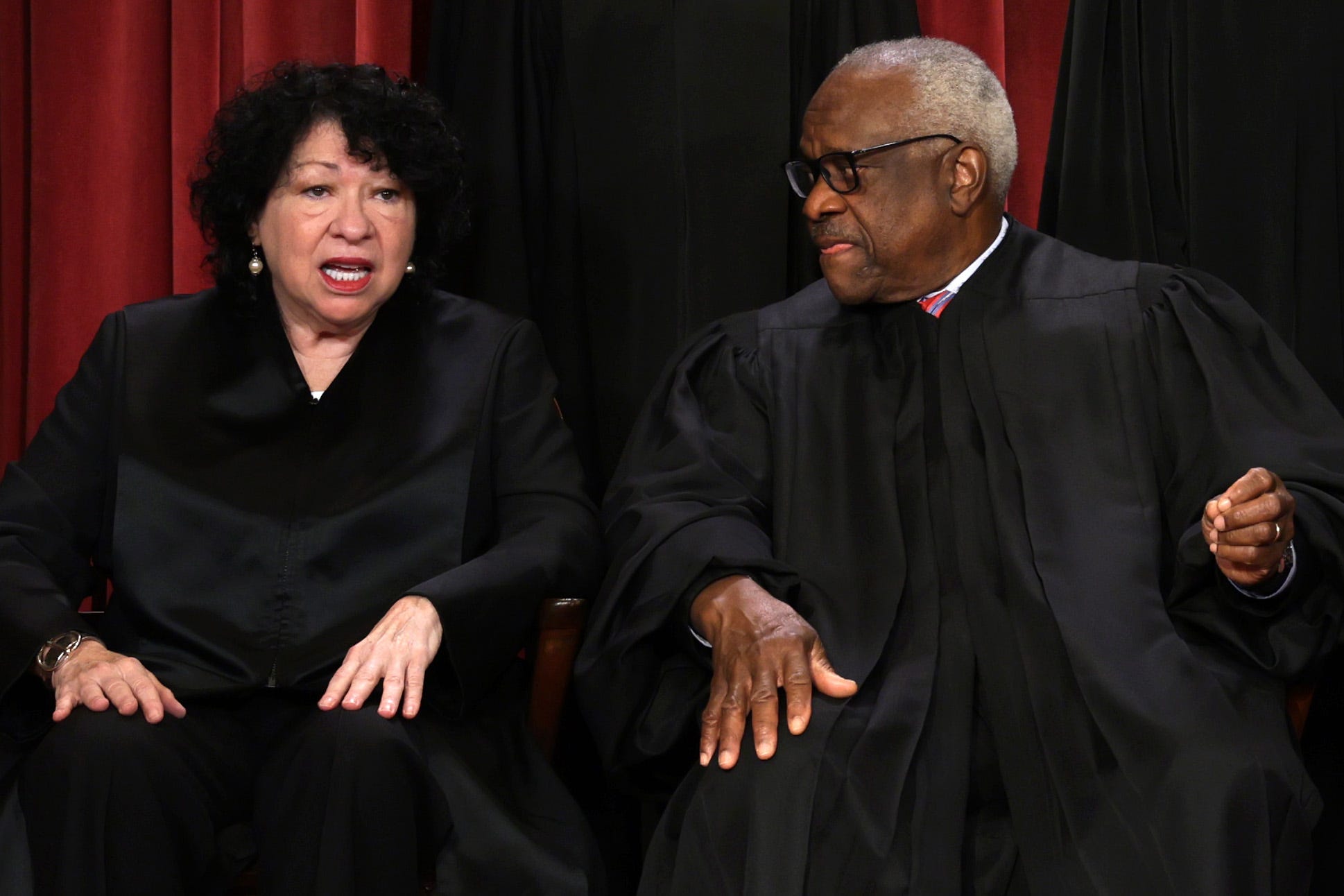
Speaking at the University of Kansas earlier this month, Justice Sonia Sotomayor detailed some of the real-world implications that Kavanaugh, a well-to-do federal judge, appears not to have considered during the drafting process. “This is from a man whose parents were professionals, and probably doesn’t really know any person who works by the hour,” Sotomayor said. “Those hours that they took you away—nobody’s paying that person, and that makes a difference between a meal for him and his kids that night, and maybe just cold supper.”
As far as public responses to bad Supreme Court decisions go, this qualifies as pretty tame: a substantive, factually grounded criticism of a particular aspect of a particular opinion. Yet on Wednesday, Sotomayor nevertheless apologized to Kavanaugh, releasing a brief statement in which she expressed “regret” for her “inappropriate” and “hurtful” comments.
Just a few hours later, at an appearance at the University of Texas, Justice Clarence Thomas took the stage in front of several hundred law students and delivered the functional equivalent of a CPAC keynote address. In it, he bemoaned the emergence of a national sense of “cynicism, rejection, hostility, and animus toward our country and its ideals,” and criticized political leaders for their insufficient “devotion” to “traditional morality,” “free enterprise,” and “religious piety.” He blasted progressivism as an effort to “undo” the Declaration of Independence’s “commitment to equality, natural law, and natural rights,” and to “replace…our form of government.”
To leave no doubt about how he really feels, Thomas also asserted that progressivism “requires of the people a subservience and weakness” that is “incompatible” with the Constitution, and linked it to the rises of Joseph Stalin, Benito Mussolini, Mao Zedong, and Adolf Hitler.
Parts of Thomas’s speech covered the history of the early 20th-century Progressive Era, but as he wrapped up, he also made clear that he views progressive ideals to be just as dangerous today: To repel progressivism’s evils, Thomas urged the assembled students to strive to emulate the “courage” of the Framers. His examples of the forms this courage might take in their lives—“standing up for your religion when it is mocked and disparaged by a professor,” or “running for your school board when you see that they are teaching your children to hate your values and our country”—are the exact sort of the martyrdom fantasies that today’s right-wing culture warriors dream of someday getting the chance to live out.
At one point, Thomas also excoriated people who “gain positions of authority,” and then become “enticed by access to things that were previously unavailable to them.” In a related story, I have been unable to confirm whether Thomas flew to Austin for Wednesday’s event, or traveled there in the quarter-million-dollar luxury RV that one of his billionaire benefactors purchased for him.
Purely as a practical matter, I can understand why Sotomayor might have concluded that apologizing to Kavanaugh was the prudent course of action. As Chris Geidner points out at Law Dork, a Supreme Court justice’s most important task is to win cases—or, when the Court is under the control of a six-justice conservative supermajority, to at least lose cases less badly. As it stands, Kavanaugh’s vote is one that Sotomayor might need if she is to have any hope of, say, protecting trans kids’ right to play high school sports, or keeping the Voting Rights Act alive a little longer. Perhaps, after seeing her remarks yield several days’ worth of strong headlines about the impact of Kavanaugh’s pro-racial profiling opinion on people of color with working-class jobs, Sotomayor decided that she’d made her point.
All that said, Thomas’s and Sotomayor’s remarks on Wednesday lay bare the maddening double standard to which liberal and conservative judges are held in this country—by the journalists who cover them, the politicians who govern alongside them, and the legal profession as a whole. I promise you that if Sotomayor had gone to the University of Kansas the other week and scorned originalism as, for example, “a bunch of pseudoacademic horseshit reverse-engineered to justify reactionary policy preferences,” every editorial board of note would be scolding her for her breach of decorum, and a half-dozen House Republicans would be racing to see who could introduce articles of impeachment against her first.
Instead, for the offense of stepping outside the pages of the United States Reports to offer a thoughtful, mild critique of a colleague’s argument, Sotomayor felt compelled to issue a public apology that conservative pundits thirstily accepted on Kavanaugh’s behalf. That same afternoon, Clarence Thomas had zero reservations about somberly declaring, as C-SPAN cameras rolled, that every American to the left of Mitt Romney is a godless, freedom-hating coward. Conservative judges are never accountable for the deranged things they say, or the devastating consequences of the decisions they make. It is only liberals who have to say they’re sorry for ever having the temerity to mention such things in public.
As always, you can find everything we publish at ballsandstrikes.org, or follow us on Bluesky at @ballsandstrikes.org. You can get in touch by emailing us at contact@ballsandstrikes.org. Thanks for reading.
Neomi Rao Understands What It Means to Be a Trump Judge, Madiba Dennie
For conservative judges with Supreme Court aspirations, nothing is more important than reminding the president what you are willing to do for him
Trump Is Making the Most of the Appeals Court Picks He Has Left, JP Collins
Trump continues to appoint hardline conservatives to life-tenured federal judgeships. But with a tight Senate calendar and the midterms looming, time is running out for him to fill many more vacancies.
When Trump Judges Complain About “Woke Ideology,” Everyone Knows What They Mean, Jay Willis
Eighth Circuit nominee Justin Smith says he will decide cases “fairly and impartially.” On his LinkedIn page, he still describes himself as “an attorney and strategist who fights for conservative values.”
The Trump White House Is Very Upset About States That Won’t Do Its Dirty Work, Madiba Dennie
Citing a long line of Supreme Court precedent, federal judges have been reluctant to force state law enforcement officials to help enforce immigration law.
The Supreme Court Keeps Embracing Convenient Lies to Excuse Rank Bigotry, Ava Ayers
Trans kids are only the latest victims of the justices’ long history of buying dubious arguments offered in support of a reactionary policy agenda.
How Originalism Broke the First Amendment, Luke Smith Morgan
The Supreme Court’s myopic focus on history and tradition yields free speech jurisprudence that is both incoherent and dangerous.
Trump Judge Gives Qualified Immunity to Cops Who Brought Murder Charges Against a Woman Who Had an Abortion, Susan Rinkunas
“When you have basically admitted constitutional violations and unchecked power—flagrant abuse of that power—and a court or a doctrine that shields people from any accountability, that’s a real problem.”
Judges Overseeing Louisiana’s Landmark Oil Cases Have Financial Stakes In Defendants, Garrett Hazelwood, Floodlight
“Since 2013, nine of these judges have collected nearly one million dollars in income from their investments in the defendants, according to an analysis of their financial disclosures.
The Supreme Court Has a Chance to Revolutionize Its Approach to the Law, David H. Gans, Slate
“Shamefully, the court has never cited any Black figure from Reconstruction—not even Frederick Douglass—in a majority opinion.”
No posts
Comments
Nothing yet. Say the first thing.
Sign in to join the conversation.