
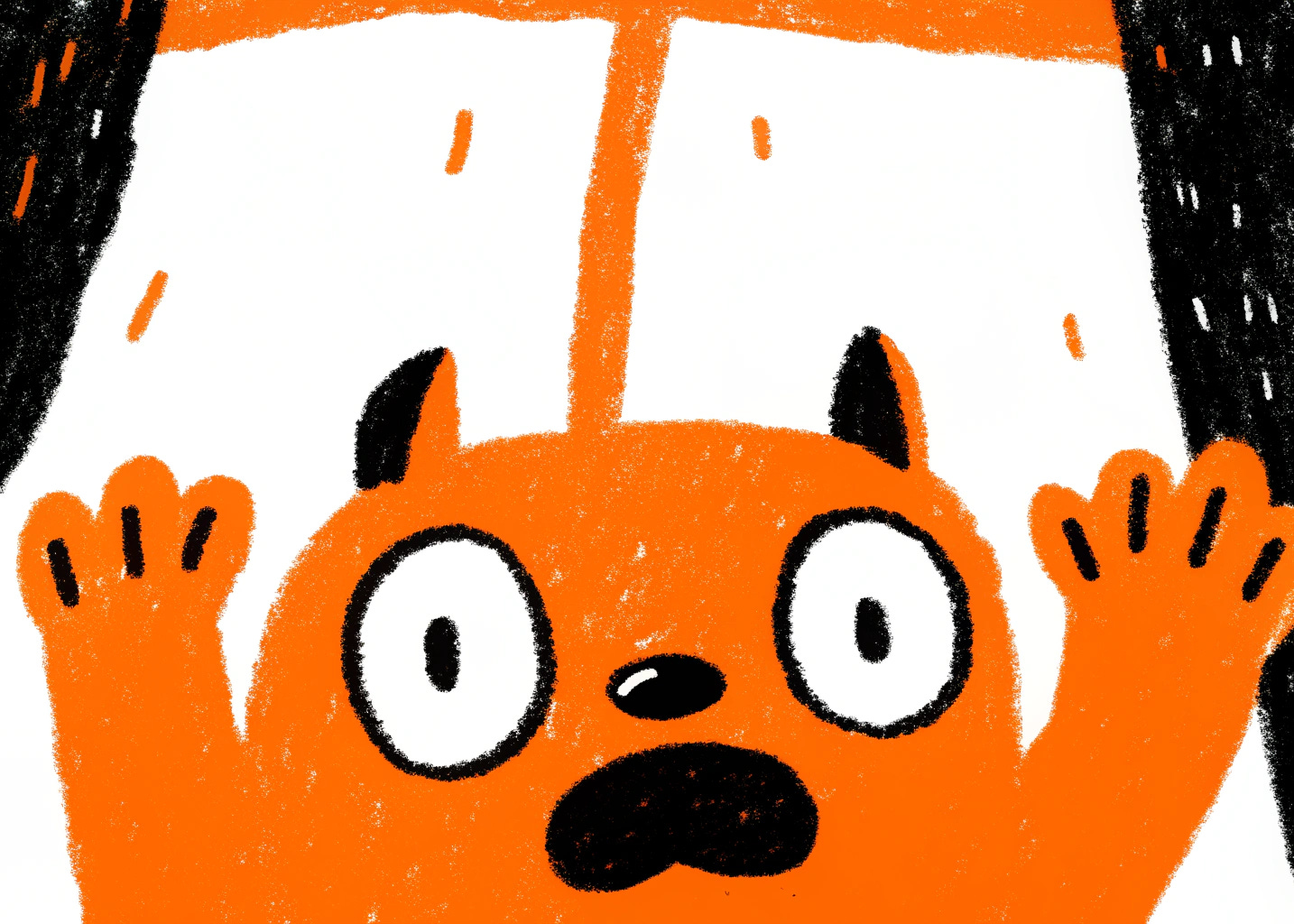
A designer messaged me a few weeks ago asking whether she should get out of the design field entirely. Two years in, decent work, no layoff, no bad review. She’d just spent a weekend reading posts about how design was finished and her changed mind about career based on 4 confident opinions and zero pieces of evidence.
And honestly, I’ve done the same thing. I’ve closed LinkedIn or Twitter at 11pm feeling behind on something nobody could name.
So this issue is about why fear reads as truth, what the actual numbers look like, and why so many people are getting paid in attention to keep you scared.
There’s a study in Nature Human Behaviour that I think about constantly. Researchers looked at around 105,000 headline variations from the same news stories, about 370 million impressions worth. Same story, different wording, randomized.
Each extra negative word in a headline pushed click-through up by roughly 2.3%. Each extra positive word pulled it down by about 1%.
A separate study looked at 95,000 news articles and hundreds of millions of Facebook and Twitter posts. Links to negative articles got shared about 1.9 times more often.
Then there’s the detail that actually bothers me. When researchers had people pass negative news along, they didn’t just repeat it. They made it worse. More negative words, new ones the original never used. The fear grows a little with every retelling.
So when you see “designers are cooked” next to “design hiring is slowly stabilizing,” those two posts aren’t competing on accuracy. They’re competing for a click, and one of them starts three lengths ahead.
Nobody has to be lying for this to happen. The system just quietly promotes one and buries the other.
The best data I’ve found on AI and jobs comes out of Denmark, from economists at Chicago Booth and the University of Copenhagen. They tracked 25,000 workers across 7,000 workplaces and focused on the 11 jobs everyone said were most exposed. Software developers, marketers, journalists, legal, HR, customer support.
Two years after ChatGPT launched, they found no meaningful effect on pay or hours in any of those jobs. Their confidence intervals rule out anything bigger than 2%. The average time saved by people using the tools was 2.8% of their work hours.
Not zero. Also not the end of white-collar work.
On design specifically, the US Bureau of Labor Statistics projects employment for digital designers growing about 7% between 2024 and 2034, faster than the average job. Nielsen Norman Group’s read on 2026 is that UX team sizes have stopped shrinking and might start growing again.
Here’s what makes me trust that read more than the doom posts: NN/g points out that AI hype was useful to leaders who were already cutting budgets because interest rates went up. If your CFO wants a smaller team, “AI can do it now” is a much nicer sentence than “we over-hired in 2021.”
The story arrived after the decision. It usually does.
Junior roles are genuinely rough. The same NN/g report that says team sizes are stabilizing also says the recovery is uneven: senior and generalist roles are bouncing back faster, while entry-level positions stay scarce and get fought over.
That gap is real and I don’t want to wave it away with a stat about ten-year projections. If you’re trying to land your first design job right now, the market is harder than it was, and it’s not because you’re bad.
But notice what that says. The problem is a hiring funnel where hundreds of people apply to the same role with roughly the same portfolio template, and companies got cautious about training anyone.
Those are different problems. Only one of them gets solved by panicking about Figma.
Here’s the psychology bit, since that’s what you signed up for.
We judge our own value by the parts of our work we can see. The file. The screens. The prototype that clicks. That’s what you show in a review, what goes in a portfolio, what you point to when someone asks what you did this quarter.
So when a tool starts producing that visible layer in ten seconds, it feels like it’s taking the job. It isn’t. It’s taking the receipt.
The invisible parts never made it into your portfolio anyway. Deciding which problem was worth solving. Sitting through the meeting where a stakeholder wanted a feature nobody asked for and finding a way to say no that kept the relationship. Knowing which of the eight things users complained about was the one actually costing money.
None of that shows up in a Dribbble shot. All of it is what people pay for.
When average output becomes free, the thing that gets expensive is having an opinion worth listening to. I don’t think that’s an inspirational line. I think it’s just what happens to the price of anything abundant.
I use these tools every day. They’ve made parts of my work faster and made me lazier in ways I’m still catching. Some days I look at what they produce and feel a small drop in my stomach. Other days I’m just wasting time using them, when I could just do it myself, better and faster. That’s honest.
But I’ve stopped taking advice from people whose income depends on me feeling behind. When someone posts that a role or a tool is dead, I now check one thing: are they selling a cohort, a course, a tool or a newsletter about the thing that’s supposedly killing it?
That single question filters out most of my feed.
What I told the designer who messaged me: don’t quit on evidence you can’t cite. Go find three people doing the job you want and ask what their week actually looks like. Real information is boring and slow and it doesn’t trend.
And if you want a decent test for anything you read this year, ask whether the person could have written the same post in 2019 by swapping one word. “Outsourcing.” “Templates.” “Squarespace.” “Canva.”
Design has been ending for about fifteen years now.
It’s still here. It just keeps moving further away from the pixels.
Where the numbers came from
Robertson et al., “Negativity drives online news consumption”, Nature Human Behaviour, 2023. The 2.3% and 1% figures.
Kearney et al., “Negative online news articles are shared more to social media”, Scientific Reports, 2024. The 1.91x sharing figure.
“Negative news headlines are more attractive”, Current Psychology, 2024. The bit about people adding negativity when they pass a story on.
Humlum and Vestergaard, “Large Language Models, Small Labor Market Effects”, NBER, 2025. The Denmark study.
US Bureau of Labor Statistics, Occupational Outlook Handbook, special effects artists and animators / digital designers. The 7% projection.
Nielsen Norman Group, “State of UX 2026”. Team sizes, the uneven recovery, and the point about AI hype being convenient during budget cuts.
If someone forwarded you this, you can subscribe here.
P.S. I’m building Brisk, a tool for freelancers who’d rather not chase invoices. If that’s you, take a look at staybrisk.com.
Thanks for reading :) If something in this issue resonated, please reply and tell me.
Even one line. These replies are my favorite part of writing this newsletter.
See you next Thursday 🙌
— Balint
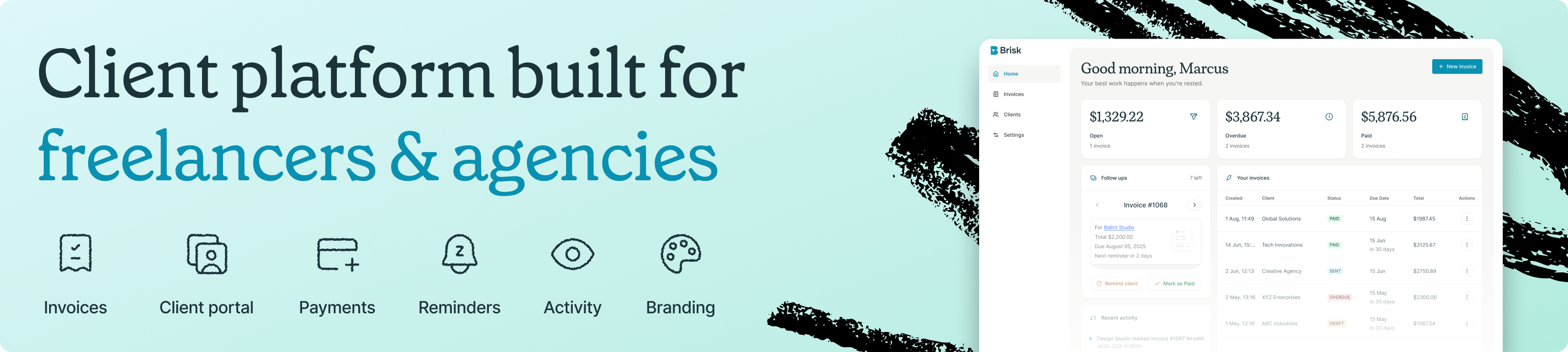
P.S. Here’s what I’m building
A calmer way to run your freelance business.
Brisk helps you give clients a professional experience: from the first agreement to the final payment.
No posts
Comments
Nothing yet. Say the first thing.
Sign in to join the conversation.