
The first industrial robot, Unimate, was on a General Motors assembly line in 1961, lifting hot die-cast parts and setting them into place. It was strong, precise, tireless, and completely following manmade programming; it did not have its own intelligence. Sixty-five years later, industrial robots have advanced but function in the same paradigm. They are able to position to within fractions of a millimeter, lift loads no human could, and run continuously for years. They fail if the external environment does not match what is written in their programs. Artificial intelligence (AI) demonstrates the change that is happening now in two logically successive waves. The recent explosion of software moving from rigid, rule-based programming to flexible, general intelligence is being followed by a parallel shift in robotics from rigid automation to physical AI.
Over the last decade, the robotics industry has attempted to tackle its most pressing hurdle to date: getting a robot to think on its own. Pre-programmed robotics capabilities such as walking, lifting, or balancing something have been wildly successful, yet these machines struggle to handle situations that they are not hardwired for or that take place outside of their simulated environment. This gap between technical capabilities and autonomous judgment is why robots have failed to become products suitable for commercial adoption and deployment, and it is one of the defining constraints that has defined nearly every failed robotics company over the last thirty years. However, the industry has reached a turning point. Robotic intelligence is developing, and it is developing fast, demanding both market and investor attention. For the first time, companies have developed intelligence layers that seem to actually work.
Robotic intelligence is best understood through two capabilities: perception and control. Perception is a robot’s ability to analyze its surroundings and understand where it is and what it is looking at. This capability has been largely developed and reliable since the early 2010s, riding the same deep learning breakthroughs that transformed image recognition broadly. While these advancements allow robots to identify, map, and track position with an accuracy unimaginable two decades ago, this is old news and attracts very little investor attention. Control, on the other hand, is the capability the robotics industry is currently racing to develop, and the winner might just produce one of the most successful companies of all time. Robotic control would mean that perception data could be used to decide on an action and physically execute it through the correct hardware. It is simply the difference between a robot being able to recognize a cup on a table and actually being able to pick that cup up. Much of today’s investment in robotic intelligence today is betting on someone finally cracking this problem at scale.
Control poses more technical challenges than perception for a few specific reasons. First, the range of possible inputs is extremely large. The extent of possible outputs is extremely large. After perceiving a cup on a table, a robot would need to activate and coordinate a multitude of different joints and motors simultaneously to pick the cup up, with no clear “correct” answer. Additionally, physical errors can compound in much more extreme ways than perception errors do. Misread labels can often be caught and corrected downstream, but a robot arm that misjudges position by a few seconds or centimeters might not get a second chance to execute its task. Most importantly, control requires different learning paradigms beyond supervised perception alone. Control can be learned through demonstrations, simulation, reinforcement learning, and real-world interaction, sometimes requiring thousands or millions of times before mastering a simple action. Control is refined through trial and error rather than pattern-matching against data that already exists, making it a much slower and more costly capability to develop.
The race underway is not a race to build better mechanics, but to solve control. Companies have approached this challenge through differing strategies that have separated them into the three layers of taxonomy this report uses to make sense of the industry.
By mapping the industry into three layers, we naturally develop an immediate question: where is the value? This physical AI industry has yet to produce a clear answer to this debate, but companies are beginning to place their bets on which part of the stack will answer this question. In recent history, software investors have developed a common assumption that intelligence stores the value, and hardware commoditizes it. Companies entirely focusing on Mind development, such as PI, Skild AI, Generalist AI, and Microsoft, are all still banking on this theory holding strong. The logic follows that if they are able to build the dominant foundation model for autonomous robots, they will become the premier licenser for hardware developers.
The counter to this argument is that robotics is not software. Because the Mind layer needs a heavy amount of real-world deployment and testing to properly develop its model, and this requires access to the physical robots, the Body is not only a commodity, but the physical capital that determines whether a company’s AI ever gets good enough to be defensible. Therefore, companies like Figure AI, Tesla, and Boston Dynamics, which are focusing on developing integrated companies targeted at developing both the Mind and Body. In the grand scheme of things, this bet seems to be more durable, but it also runs a significantly higher cost.
Figure AI stands as a cautionary tale, making the case for integrated companies more concrete. The company was originally a pure-Body player and partnered with OpenAI to develop the intelligence for their products. The partnership quickly soured once Figure realized their core intelligence was being controlled by a third party, creating a significant loss of autonomy of their products and independent functionality. Figure AI quickly pivoted and created its own Helix model in a single year.
Which archetype wins is still unknown, but the answer will determine the majority of value creation and the investment concentration over the next decade.
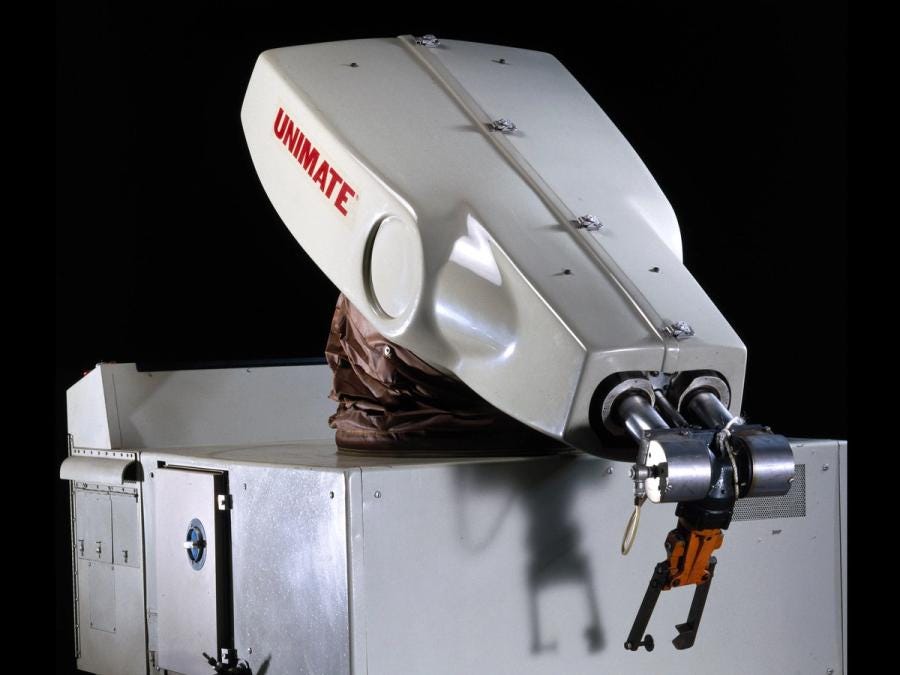
Unimate was the first commercial robot to come out of the GM assembly line in 1961. It was used to weld and lift objects but only was capable of executing preprogrammed actions. Around the same time, SRI was developing Shakey the Robot, which produced groundbreaking developments in terms of machine reasoning. While it would take Shakey hours to cross a room, it successfully demonstrated the first example of the perceive-plan-act loop that remains the fundamental base of modern-day robotics. However, there still remained a large amount of progress to be made before robots could be considered sustainable or successful in environments other than their simulations.
The 1980s and 1990s produced very few commercial breakthroughs for the robotics industry. This was due to a number of factors like the ongoing AI winter, limited computing power, immature sensors, but also the fact that one of the primary funders of advanced robotics research, DARPA, was dealing with significant budget cuts. It wasn’t until the early 2000s and specifically the launch of DARPA’s Grand Challenge in 2004 that significant advancements resumed. The Grand Challenge was a competition to build a vehicle that could autonomously navigate a desert. While the competition fell apart with no vehicle ever meeting the challenge, DARPA remained persistent and launched the Urban Challenge focusing on the development of autonomous vehicles in 2007, successfully kickstarting the autonomous driving industry. Once again, DARPA created the Robotics Challenge in 2012 which tasked companies with developing humanoid robots with real-world utility, specifically for disaster-response scenarios in the wake of Fukushima. This exposed the immaturity of humanoid robotics and turned the industry into a meme as videos of robots falling over slowly and repeatedly went viral. The challenge cemented an industry-wide belief that for the foreseeable future general-purpose humanoid robots were too hard to develop mechanically and cognitively.
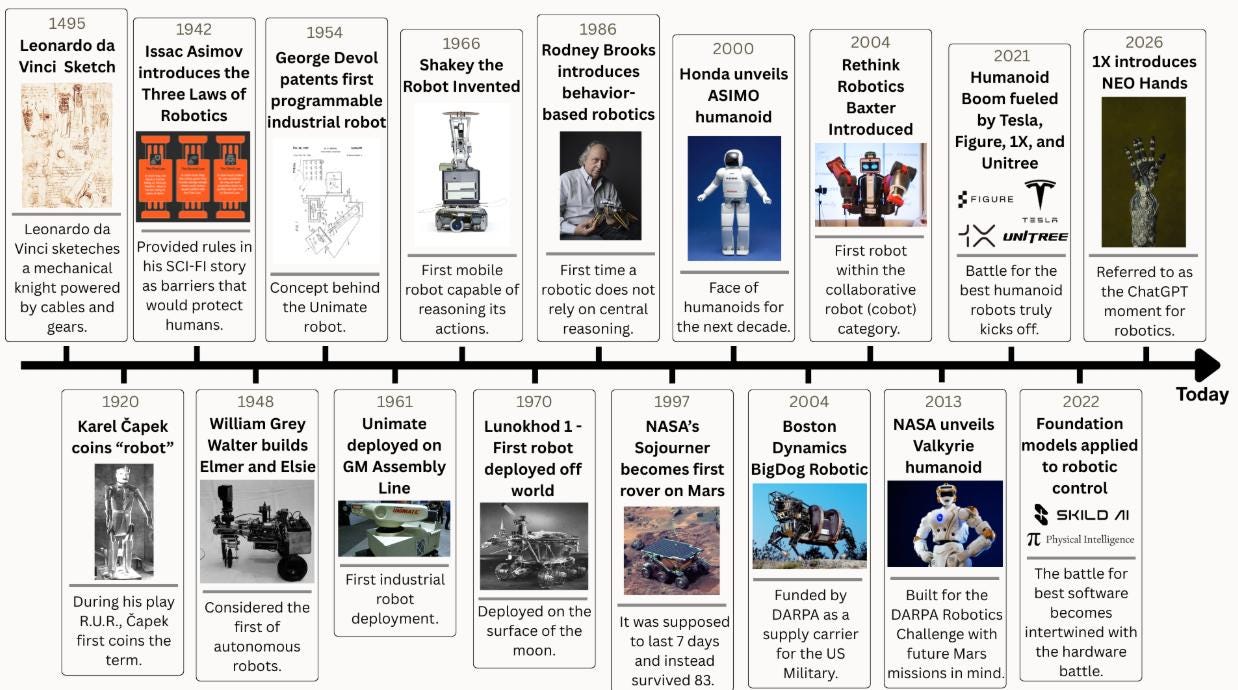
In turn, VC money became concentrated on narrow-task, non-humanoid robots such as warehouse automation, agriculture robots, and specialized industrial arms. In the 2010’s two failures reinforced this lesson very publicly. Rethink Robotics developed Baxter and Sawyer, general-purpose robot arms that were meant to address a variety of functions and settings. However, the company went under in 2018 despite being backed by significant capital. In the end, the robots were too expensive and failed to be as adaptable as promised. The other cautionary tale was Jibo, a social home robot that raised over $70 million before failing in large part because of the product being commercially incoherent.
Through all of this, there have been several key turning points for the robotics intelligence industry. In 2012, AlexNet was launched and proved that deep learning could solve perception at scale, revolutionizing perception. But that was only half the problem. While still being a huge breakthrough, perceptions alone does not produce a successful robot, a robot then must be able to use perception data to determine its best course of action in order to be commercialized, and this capability has proven much more difficult to develop. The next big breakthrough was in 2016 when OpenAI and DeepMind began using reinforcement learning models that were practical and worked, allowing robots to learn dexterous behaviors through trial and error in simulated environments rather than being hand-coded. This breakthrough was a huge development for the industry, but there was still a gap between the mechanics and physics of simulated environments and the real world. Arguably the biggest breakthrough for the industry came around 2020 when it was discovered that transformers could be generalized across modalities. This meant that robotic actions could be treated as a sequence for the model to predict, and this development is what made Vision-Language-Action models technically possible.
Foundation Future Industries San Francisco, CA
General Overview:
Founded in 2024, Foundation Bot is a heavy-duty humanoid aimed at military and industrial work rather than homes. They have proprietary rolling-contact gearbox actuators claimed at 90-95% energy efficiency versus 50-60% for harmonic-drive competitors. The company acquired Boardwalk Robotics in Dec 2024. Their explicit defense positioning sets it apart from the rest of the humanoid field.
Product(s) & Technology:
MK-2 – The second generation of a durable humanoid bot, waterproof, durable, use cases in heavy-duty labor and defense roles
Funding:
Last Series Seed → $100M at a $1B valuation, led by Tribe Capital with participation from Defined and Veteran Fund
Raising a new Series at a $3B Valuation
Leadership & Team:
Sankaet Pathak (Co-Founder & CEO) – Former Founder & CEO of Synapse, University of Memphis CS & Physics Undergraduate, MS in Electrical Engineering
Mike LeBlanc (Co-Founder) – Former US Marine Corps Officer, Founder and COO of Cobalt Robotics, Harvard Business School Alumni
Eric Trump (Chief Strategy Advisor) – VP of the Trump Foundation, Georgetown Alumni
Team: ~80 employees, with the most recruited university being Stanford University
Physical Intelligence San Francisco, CA
General Overview:
Founded in early 2024, Physical Intelligence (PI) is an AI startup building a generalist brain for robots. It has software that lets diverse robotic platforms understand language commands and execute real-world tasks they weren't explicitly trained on, by learning universal physical principles like gravity and friction rather than being hardcoded for a single environment.
Product(s) & Technology:
π 0 – Base model. Takes pre-trained vision-language models and adapts them to produce motor commands, enabling robots to perform precise physical tasks.
π 0.7 – Upgraded version that makes micro-adjustments during operation using diffusion-based action decoding.Funding:
Currently raising a $1B Series C at an $11B valuation
Series B → $600M at a $5.6B valuation led by Alphabet’s growth fund, CapitalG, alongside Index Ventures and T. Rowe Price (November 2025)
Leadership & Team:
Karol Hausman (Co-Founder & CEO) – Former Google Brain Staff Research Scientist and Robot Manipulation Lead, USC alumnus & Stanford professor
Chelsea Finn (Co-Founder) – Former Google Software Engineer, UC Berkeley PhD, & Stanford professor
Brian Ichter (Co-Founder) – Former Boeing Propulsion Engineer, Google Research Scientist, & Stanford Aerospace Master’s Degree & PhD
Team: ~80-200 employees, with the most recruited university being UC Berkeley
Figure AI San Francisco, CA
General Overview:
Founded in 2022, Figure builds humanoid robots that perform human-level physical tasks, operating in warehouses, factories, and domestic settings. Figure is the full-stack humanoid leader, pairing proprietary hardware with Helix, an in-house vision-language-action model built after splitting from OpenAI in early 2025. Its BotQ factory targets 100,000 robots over four years. In June 2026, deployed robots outnumbered human employees at the company, an industry first.
Product(s) & Technology:
Figure 03 – In production at BotQ, with output described as doubling monthly. ~740 robots deployed as of June 2026.
Helix – In-house vision-language-action model built after Figure's split from OpenAI in early 2025.
Funding:
Currently raising a $1B Series C at a $39B valuation (Sept 2025), led by Parkway Venture Capital, backed by Nvidia, Intel, and Salesforce.
Capital Raised to date: $1.9B.Leadership & Team:
Brett Adcock (Founder & CEO) – Serial entrepreneur, previously founded Vettery and Archer Aviation.
Jerry Pratt (Founding CTO) – Formerly of the Institute for Human and Machine Cognition (IHMC), a longtime leader in humanoid robotics research.Team Size: 660
Generalist AI San Mateo, CA
General Overview:
Founded in 2024, Generalist AI is an artificial intelligence startup that aims to build generalized software foundations that enable robots to perform a broad range of physical tasks across diverse environments. Rather than simply bolting robot actions onto existing Vision-Language Models (VLAs), they built their models from scratch as native foundation models for physical interaction.
Product(s) & Technology:
Gen-1 – Flagship model capable of human-like micro-adjustments, it is 3x faster than competitors in tasks such as folding boxes and packaging, among others. Boasted a 99% success rate on specific physical tasks. (Released in 2026)
Funding:
Series B → $400M at a $2B valuation, led by Radical Ventures with participation from NVentures, 8VC, Union Square Ventures, Hanabi Capital, Norwest, Bezos Expeditions, and individual investors like Fei-Fei Li, Naval Ravikant, Eric Yuan, and Lin Bin (June 2026)
Leadership & Team:
Pete Florence (Co-Founder & CEO) – Former Staff Research Scientist at Google DeepMind, Cambridge Alumnus, & MIT PhD
Andy Zeng (Co-Founder & Chief Scientist) – Former Staff Research Scientist & Tech Lead at Google DeepMind, UC Berkeley Alumnus, & Princeton PhD
Andrew Barry (Co-Founder & CTO) – Former Senior Roboticist at Boston Dynamics, Machine Learning Scientist at Broad Institute - MIT & Harvard, & MIT PhD
Team: ~80 employees, with the most recruited university being MIT
Mind Robotics Palo Alto, CA
General Overview:
Founded in 2025, Mind Robotics (Rivian spin-out) is focused on building intelligent robots fit for industrial production that current assembly robots cannot function within. They believe the path to successfully building their full-stack platform product results from high-stress testing. The company is financially backed by Rivian and uses the current Rivian Factory as a data flywheel.
Product(s) & Technology:
Currently, no products → ‘Expected’ rollout is 2027
Focus on building the full stackFunding:
Series B → $400M at a $3.4B valuation, led by Kleiner Perkins with participation from Meritech Capital, Redpoint Ventures, SV Angel, Accel, Andreessen Horowitz, and othersLeadership & Team:
Robert Scaringe (Chairman & Founder) – CEO of Rivian, established Mind Robotics
Ruijie (RJ) He (Core Builder & Robotics Leader) – Former VP of engineering at OptimusRide, MIT undergraduate & PhD
Daniel Burrows (Head of Data Platform) – Former Founder of Trucklabs & Stanford AlumnusTeam: ~32 employees with the most Illinois Science & Mathematics Academy & Stanford
Apptronik Austin, TX
General Overview:
Founded in 2016, Appronik produces AI-powered humanoid robots that aim to assist humans in physical capacities. A spinout from the Human Centered Robotics Lab at UT Austin, they believe that collaboration with man + machine is the next step in our evolution. The company is well-known for its previous collaborations with NASA and DARPA. Recently, they announced that they will be unveiling a new robot.
Product(s) & Technology:
Apollo – A humanoid robot standing 5’8”, 160 pounds, with a runtime of 4 hours per battery, and a maximum payload of 60 pounds. Apollo is the first commercial humanoid robot that was designed for friendly interaction, mass manufacturability, high payloads, and safety. It was developed from their experiences with ten previous robots, including the NASA Valkyrie. The robot is also able to change between full bipedal walking, a stationary pedestal, or be attached to an autonomous wheeled base for faster factory navigation. The Apollo also boasts a swappable battery system.
Funding:
Series A → $935M at a $5.3B valuation led by B Capital, Google, & Mercedes-Benz with participation from AT&T Ventures, John Deere, and the Qatar Investment Authority
Leadership & Team:
Jeff Cardenas (Co-Founder & CEO) – Former Deloitte consultant, CTO of ThinkVoting, & UT Austin undergraduate and MS
Dr. Nick Payne (Co-Founder & CTO) – Former Centaur Technology Senior Technician & UT Austin undergraduate, MS, & PhD
Steve O’dea (COO) – Former iRobot Senior Director of Engineering, Amazon GM, Red 6 CTO, & WPI undergraduate & Boston University MBA
Team: ~350-400 employees, with the most recruited university being UT Austin
Neura Robotics Metzingen, Germany
General Overview: NEURA Robotics is the only company worldwide that designs and manufactures cognitive robots entirely in-house, with their humanoid 4NE1 built for series production across industrial, trade, and eventually household environments. They currently boast a contract with Amazon Web Services (AWS).
Product(s) & Technology:
4NE1 – 4NE1 is NEURA's humanoid robot designed for series production, built to perform physically demanding and autonomous tasks across industrial and household environments, powered by NVIDIA's Isaac GR00T foundation model and Thor T5000 processor, with artificial skin that senses proximity before contact for safe human collaboration.
Neuraverse – The Neuraverse is the world's first scalable robotics app store that allows robots to continuously gain new skills as easily as a smartphone receives software updates.Funding:
Series C → $1.4B led by Tether Holdings, backed by C4 Ventures, HV Capital, InterAlpen Partners, NVIDIA, Qualcomm, Amazon, & others
Leadership & Team:
David Reger: Founder & CEO – Former GM of MABI robotics
Jens Knut Fabrowsky: COO – Former BoschTeam: ~1,400 employees, with the most recruited university being the University of Stuttgart
Other Companies:
Skild AI – Focusing on building the ‘Skild-Brain,’ which can control any robot regardless of shape or size. The goal is to replace specific skill software with a single intelligence software that can interpret the physics of the real world. Currently valued at over $14B.
Machina Labs – Created the RoboCraftsman robot, which combines AI and robotics in an effort to redefine output in sheet metal forming. This machine eliminates the need for custom-built molds and improves time efficiency. The company is valued at $375M.
Fluid Wire Robotics – Italian-based robot manufacturer focused on making robotic arms and movements that are built for extreme environments. They use sensitive motors and electronics in an actuation box and combine them with their patented fluid wires for force transferring. This allows the robotic movements to be both lightweight and resilient. The company received a $1.39M seed round and a $2.9M grant.
Salem Robotics – Salem Robotics is an Austin-based robotics company developing autonomy software for inspections in hazardous industrial environments. Founded in 2026 by former Los Alamos and UT Austin nuclear roboticists Caleb Horan and Janak Panthi, the company’s hardware-agnostic platform enables existing robots to navigate facilities, manipulate instruments and equipment, collect radiological measurements, and generate auditable compliance records. Salem is initially focused on nuclear facilities, with potential applications across oil and gas, chemical, CBRN, and space infrastructure. The company is part of Y Combinator’s Summer 2026 cohort and is backed by non sibi ventures; its total funding has not been publicly disclosed.
Field AI – Field AI is building an autonomous software stack through Field Foundation Models (FFMs) that act as a brain and can be plugged into many model types, such as quadrupeds to humanoids. This plugability allows autonomous navigation and functionality in real-world environments. The company sits at a $2B valuation.
Dyna Robotics – Dyna Robotics is an AI-powered robotics manufacturer. Their core product, the Dyna-1, is a robotic arm that boasts 99.4% sucess at 60% of human speed and performs tasks such as laundry, cleaning, and manufacturing. The company is valued at over $600M.
Google DeepMind – Google DeepMind is the culmination of the London-based DeepMind start-up and the Google Brain based in California. The company researches and builds AI systems such as the Gemini series, the open language Gemma model, and other breakthrough systems such as AlphaFold, which predicts the 3D structures of proteins. Analysts estimate the worth of this venture alone is around $700-$800B.
Tesla – Tesla has begun producing the Optimus robot, a humanoid designed for repetitive, boring, or dangerous tasks. The robot uses the same software stacks used in the Tesla automobile lines and custom Tesla-designed chips. Optimus robots are already being used in Tesla factories and are planned to set up a potential colony on Mars before humans arrive.
Boston Dynamics – Boston Dynamics is an MIT spin-off that focuses on building both hardware and software for robotics. Some well-known products include the Orbit fleet management system and robotic hardware such as the Spot (quadrepadal), Atlas (humanoid), & Stretch (robotic arm for automation). They have also been popularized from their longstanding history of working with DARPA. The majority ownership (80%) has been held by Hyundai Motor Group since 2021.
Genesis AI – Building a full software stack for robotics. The company is developing advanced software, such as the GENE line, and hardware, such as high-dexterity robotic hands that mimic those of a person in both feeling and task applications. The company recently completed a $105M seed round.
Agility Robotics – Spun out of Oregon State, Agility Robotics develops the full stack for humanoid, bipedal robotics. Their main line includes the digit humanoid robot and the RoboFab software that powers it. The company recently completed a Series C that brought its valuation to $2.12B.
Microsoft Rho-alpha – Focusing on pioneering Vision-Language-Action (VLA+) models, Rho Alpha focuses purely on the software to bring adaptivity and intelligence to physical robots. Models are trained using synthetic data generated via reinforcement learning in the NVIDIA Isaac Sim framework.
Wayve – The London-based company focuses on providing software and AI models for autonomous vehicles. Instead of using the complex rules, detailed 3D maps, and specialized sensors favored by traditional companies, Wayve built an end-to-end deep learning model that learns to drive from raw data, giving its models an edge in diverse cities. The company recently completed a Series D, which brought its total valuation to $8.6B.
Saronic – Saronic is an American autonomous surface vessel (ASV) manufacturer. The Austin-based company was founded in 2022 and boasts two core products: the Corsair (24-foot model) and the Marauder (180-foot model). The company has multiple contracts with the Department of War, with current products deployed. They recently completed a $1.75B Series D that valued the company at $9.25B.
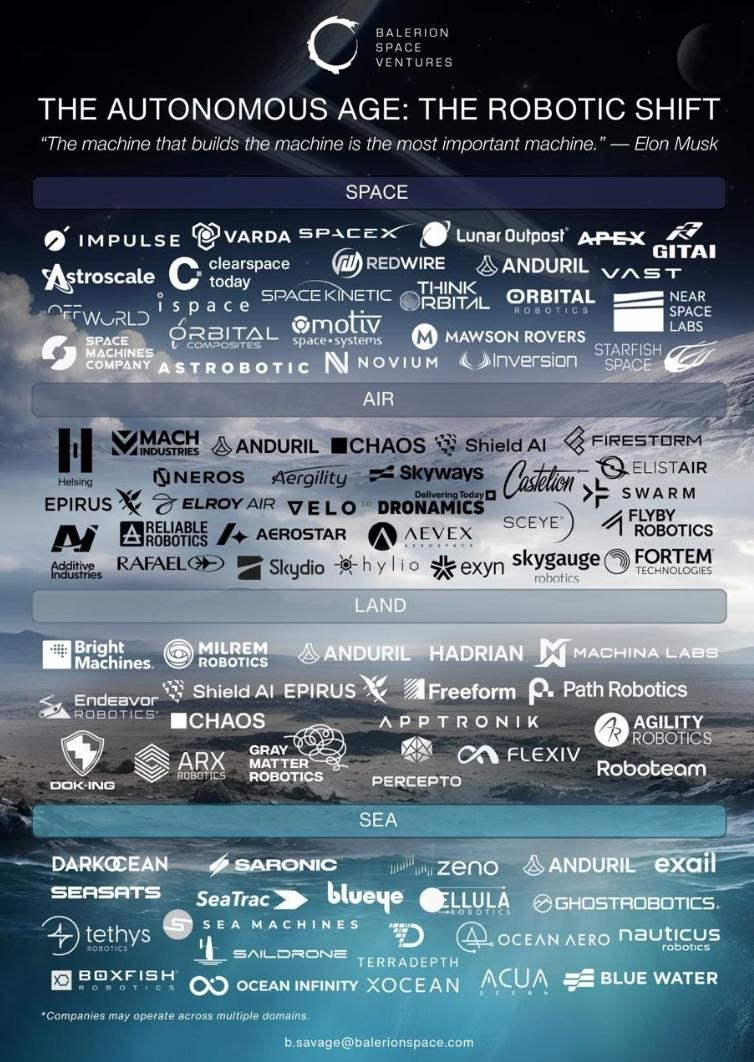
Anduril Industries – Anduril is an American defense and technology company building autonomous systems for the modern warfighter. Founded in 2017 by former Oculus founder Palmer Luckey and co-founded by former Palantir executive and current Anduril CEO Brian Schimpf. They operate radically different than legacy defense primes by doing R&D on their own dime and aiming to have an arsenal of products ready for purchase immediately. They boast many robotic systems such as the Dive-XL Submarine, Fury (Autonomous Jet), the Ghost autonomous helicopter, Bolt quadcopter, and the Lattice software system. They recently raised a $5B Series H that valued the company at over $61B.
Persona AI – Persona AI is a Houston-based robotics company that builds humanoid robots for heavy industry applications. Founded in 2024 by former NASA Valkyrie leader Nic Radford and MIT Graduate and former Figure CTO Jerry Pratt, the company's core ‘persona’ bot is meant to act like a teammate that is adaptable to harsh fields experiencing labor shortages. The company has raised $27M in pre-seed funding.
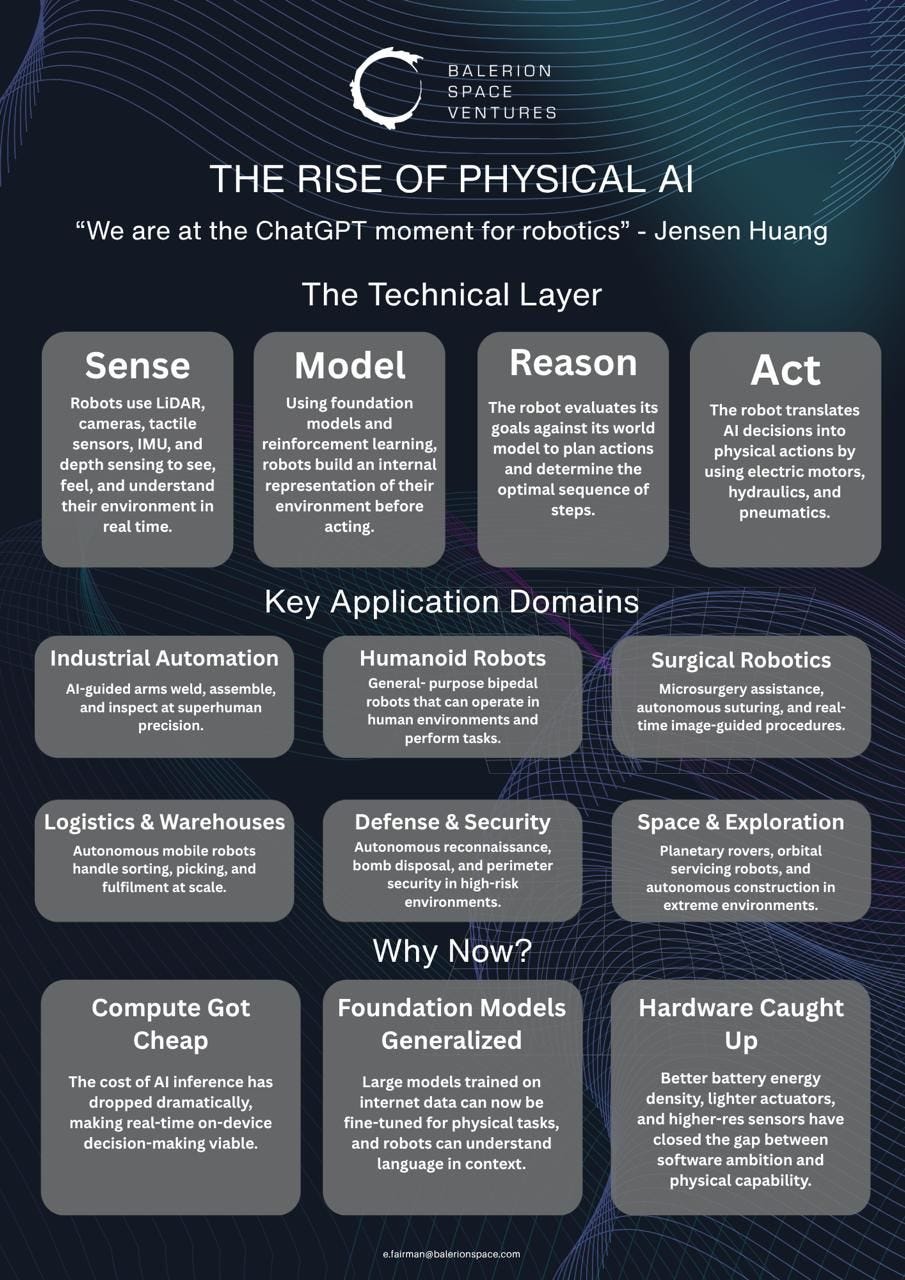
The robotic intelligence industry is currently at an inflection point. Companies must now transition from demonstration to reliable deployment, a very difficult feat. The industry has proven that narrow-task robots can work at commercial scale. The challenge of locomotion is largely solved. Unitree currently has a commercialized bipedal robot retailing for under $20,000. Additionally, perception has been reliable for nearly a decade and VLA models, such as those used for Google’s RT-2 and Physical Intelligence's products, can execute generalized tasks in controlled environments and handle situations the robots were never explicitly trained on. On the other hand, there is much the industry has yet to solve. Dexterous manipulation, simulation-to-real-life transfer, and defensible reliability are shaping up to be the determining factors for who will win this next stretch of the robotic intelligence race. However, there has never been such a prevalent time for the commercialization of this industry. A structural shift in capital is underway, with manufacturing and logistics facing compounding labor shortages and aging demographics around the world, including in the US, Germany, and Japan. While physical labor demand is rising and the available workforce is depleting, physical intelligence stands to be the solution. The sector itself has attracted over $55 billion in capital and is valued at approximately $76 billion with projections showing the industry exceeding $200 billion by 2030. What follows is a breakdown of the current key players racing to be the first to successfully deploy and commercialize physical AI.
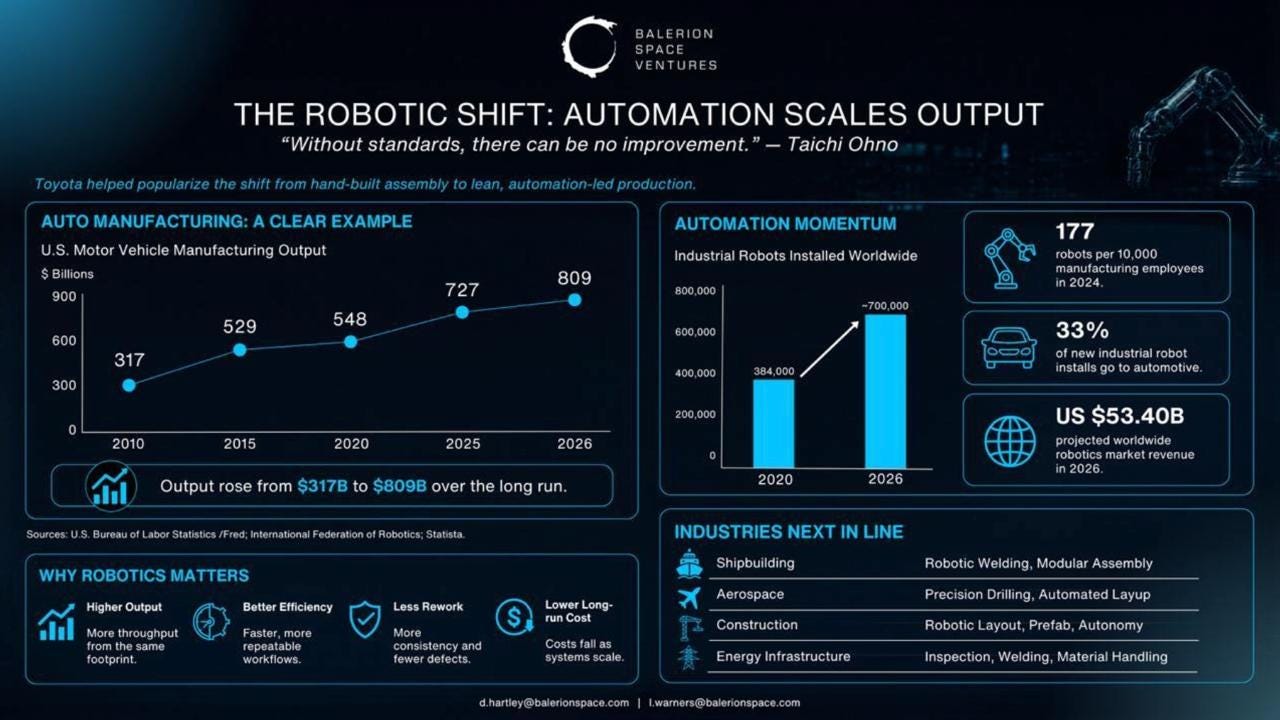
The robotics sector is undergoing one of the fastest expansions in modern technology history, growing from a $12B market in 2020 to a projected $165B by 2030, a nearly 14x increase driven primarily by the convergence of AI and physical hardware. The defining shift has been the emergence of foundation models for robotics, which allow a single AI system to control diverse hardware across tasks, replacing the era of purpose-built single-function machines. Humanoid robots represent the highest conviction bet in the space, with Goldman Sachs projecting a $38B market within a decade from near zero today. On the defense side, the Pentagon's autonomous warfare budget is set to surge from $226M to $54B under the 2027 spending proposal, cementing robotics as a national security priority. Across logistics, industrial, and service verticals, the common thread is the same: labor costs are rising, AI is maturing, and the hardware is finally catching up.
An issue arises for companies focusing on one side of the equation, whether it be software or hardware. For software producers, you need data and training in harsh and challenging environments that are essentially impossible to replicate without a hardware component. For hardware manufacturers, it is nearly impossible to have the premier adaptable software within your product if the software being used was not trained to the exact specifications and extraordinary outcomes associated with the hardware device.
The value, therefore, accrues to the full-stack operators. These companies gain the strategic advantage of complex and tested data sets while mastering hardware components, making total vertical integration a strong indicator of overall performance.
No posts
Comments
Nothing yet. Say the first thing.
Sign in to join the conversation.